Paul the killjoy – epileptic or schizophrenic?
One of the reasons I wanted to go to Ephesus was because it’s where, according to Christian writings, the apostle Paul – Saint Paul to Christians – was unceremoniously chucked out after lambasting the locals for worshipping the goddess Diana. Or Artemis, if you favour the Greek.
Of course, what VERY little we think know of Paul means that we can’t even be sure that he existed at all. Though believed to have been born more than half a century after the birth of Christianity’s foundation figure, Jesus of Nazareth, there is no mention of a Paul or Saul in any early Christian or non-Christian sources, even by the best-known historians of the time. And when his name does pop up, it’s as the writer of letters to various Christian communities (the term itself only just coming into use; it’s origin still a matter of scholastic debate). In fact according to the New Testament, Paul wrote to just about everyone: Romans, Colossians, Corinthians, Thessalonians, Hebrews, the Jewish community at Ephesus and his best buddy Timothy.
The authorship of all the writings attributed to Paul are themselves subject to ongoing scholastic debate. As a journalist, trained in the days when truth in journalism mattered, I would be sceptical of a bunch of old letters, attributed to one man only, being any kind of truth. Given what I know about how the Chinese-whispers effect of the spoken word is distorted through time (see Monty Python’s Life of Bryan, Sermon on the Mount), given how the written word is filtered and retranslated and too often edited or rewritten to serve a cause or individual interest, given what I know about the established codices of the early Christian church and indeed about Ephesus itself (more of this below) – I remain deeply sceptical about Saul of Tarsus.and his all-too-convenient conversion along the road to Damascus. As do many eminent historians today.
I also bear in mind that writing paper as we know it was not around until centuries after Paul’s time and it seems unlikely to impossible that he could have written so many “letters” to any people a distance away on parchment scrolls. Leading to the conclusion that these useful missives were written by churchmen long afterwards, when the New Testament as we know it was being put together from scraps of early tales and ecclesiastical construction.*
After all, somebody somehow managed to collate all these scrolls, scattered as they were through so many countries and communities. Who did that? Who thought, “Blimey, here’s another of Paul’s long, long scrolls. Should we keep it for posterity? Where do we keep anything this damned big?” It’s not as if Paul was an important, famous figure whose works, like those of Plato, might have been deemed worthy of keeping in the city library. Itself prone to earthquake, war damage, rising damp and the abandonment that comes to all our buildings over the centuries.
It’s rather like the man’s death and subsequent martyrdom, which Christians claim to be about 62-64 CE. You can’t find anything about it in the New Testament. And, if as has been claimed, the Emperor Nero in one of his hissy fits chopped off the apostle’s head, it certainly wasn’t recorded by any Roman historian or writer of epistles. Like everything else, it was a legend propounded by later Christians and passed down as fact. My little copy of the King James bible version printed in 1944 has a handy note to this effect at the end of Timothy 2. He’s called a “saint” because he claimed to have performed miracles but was never formally canonised.
But for the sake of argument let’s assume that the Christian historians, most of them clergymen and women, have a point, and that there really was such a man, Certainly, according to them, he was the real founder of Christianity which, until he took it up as a cause was just a lot of disparate small groups of Jesusites. Really, the religion should be called Paulianity!
Though he doesn’t strike me as a very nice person on whom to found a religion; being, judging from”his” letters, dictatorial, opinionated, self-righteous, pushy, uncompromising and over-zealous – a term of which he himself would probably have approved. He suffered “visions” that realists would call hallucinations and this might have been caused by epilepsy, schizophrenia, wine, drugs or were just plain made up to bolster his connection with the divine – Mohammed claimed these sorts of otherworldly visions too.
Saul of Tarsus, according to Christian scholars, was a Jew and a Roman citizen and a Pharisee dedicated to Judaisman (like Christianity, a term not used back then), the Torah and the One God of Israel. In most respects that’s what he remained – the difference being that he viewed this Jesus of whom his persecuted followers spoke as the long-awaited Messiah. “Christians” to him, were just the Jews who had got it right, and the larger number of non-Jews who liked the idea of a God-made-man who stood up for the poor and downtrodden.
Saul-then-Paul was not silly or vain enough to claim messiahship for himself. He knew nobody would believe him, being so obviously of flesh and blood and apparently unattractive to boot. Rather like today’s tele-evangelists who evoke a superior Being to command our attention – and our money because their own earthly flaws are all-too-evident.
Archaeology – at a price (and don’t go in summer!)
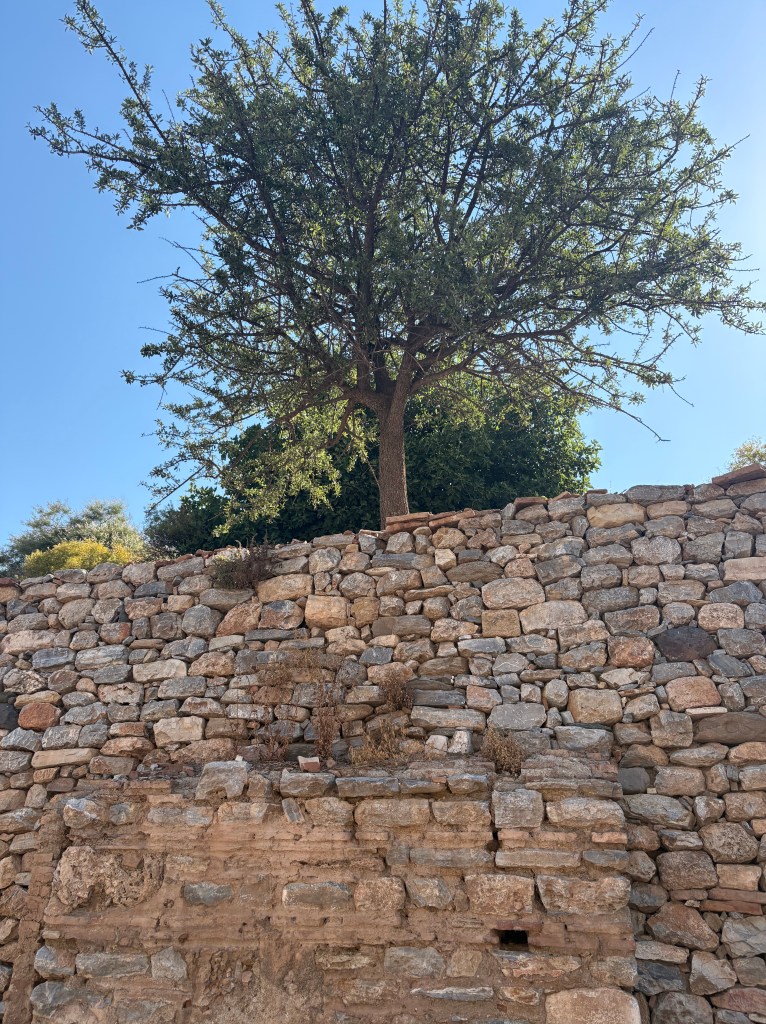
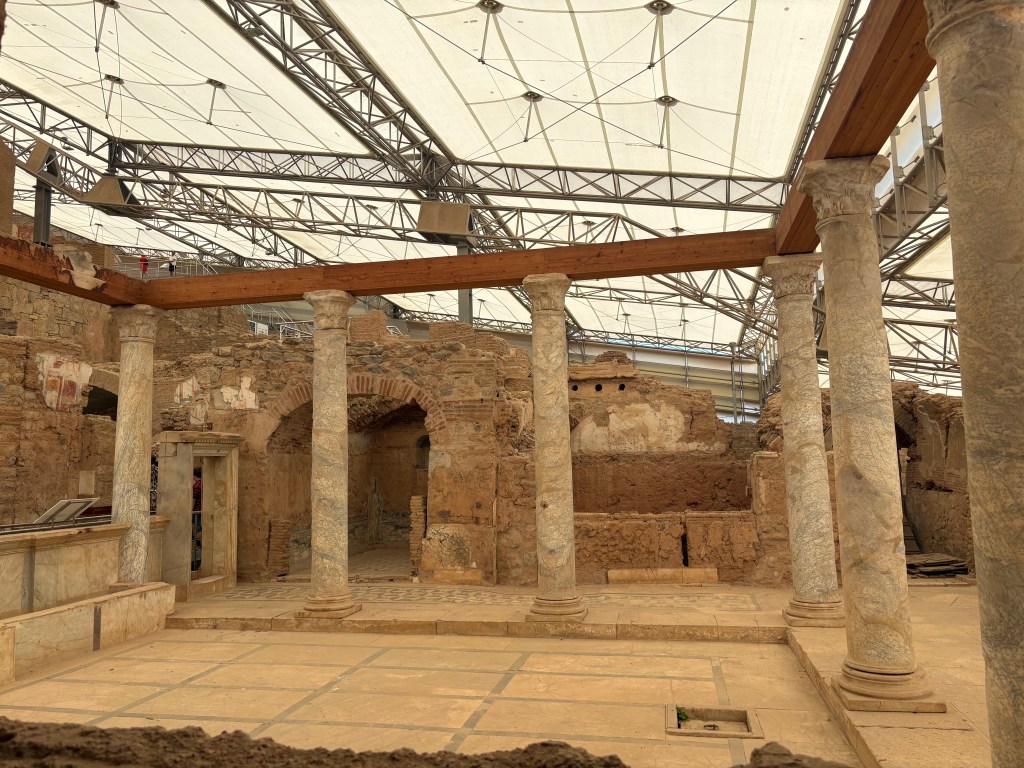
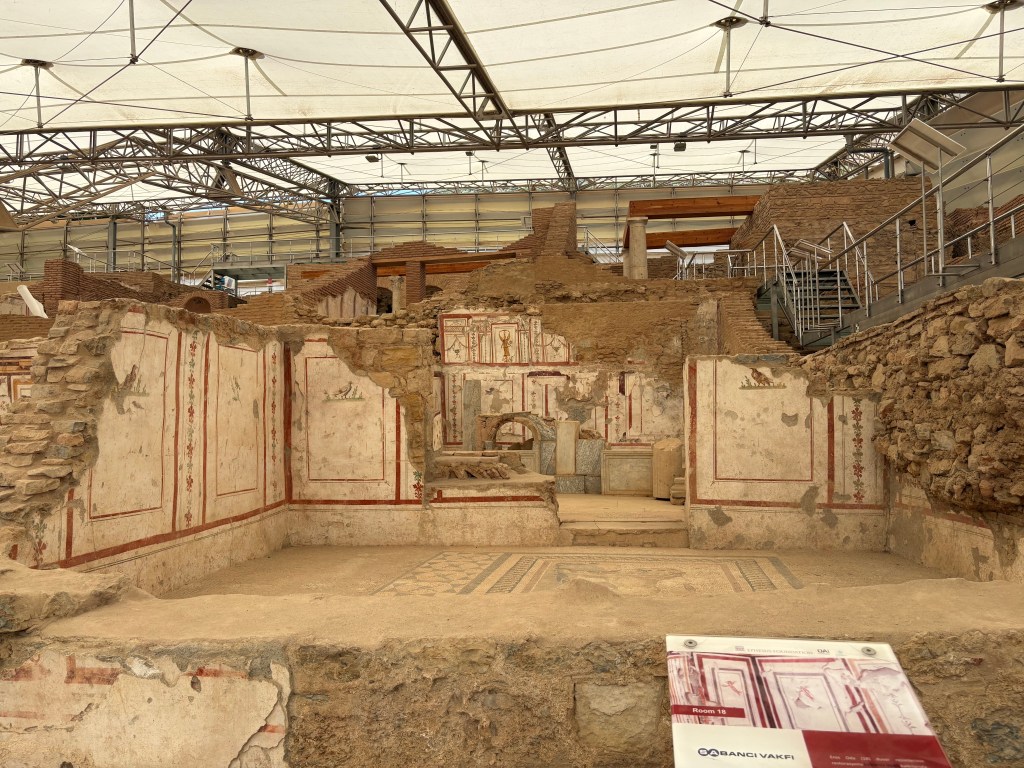
An old olive tree atop an ancient wall dating back to at least Roman times. Olives can live to 3,000 years in this part of the world. Also, two shots of the Roman villas which have been painstakingly excavated so that we can get a good idea of how they lived. At least if they were rich!
Anyway, back to Ephesus, which I visited this year, in his (so it is writ) footsteps. He went there a time or two and lived there for a few months; preaching to mostly unconvinced Jews (who had already established a synagogue there) and Greeks. On one occasion his two companions were threatened by the crowd, instigated by artisans who made their living crafting artifacts that honoured the Goddess Diana whose temple there was one of the Seven Wonders of the World. Paul himself was advised by his fellow proto-Christians not to hang about and risk the wrath of the crowd.
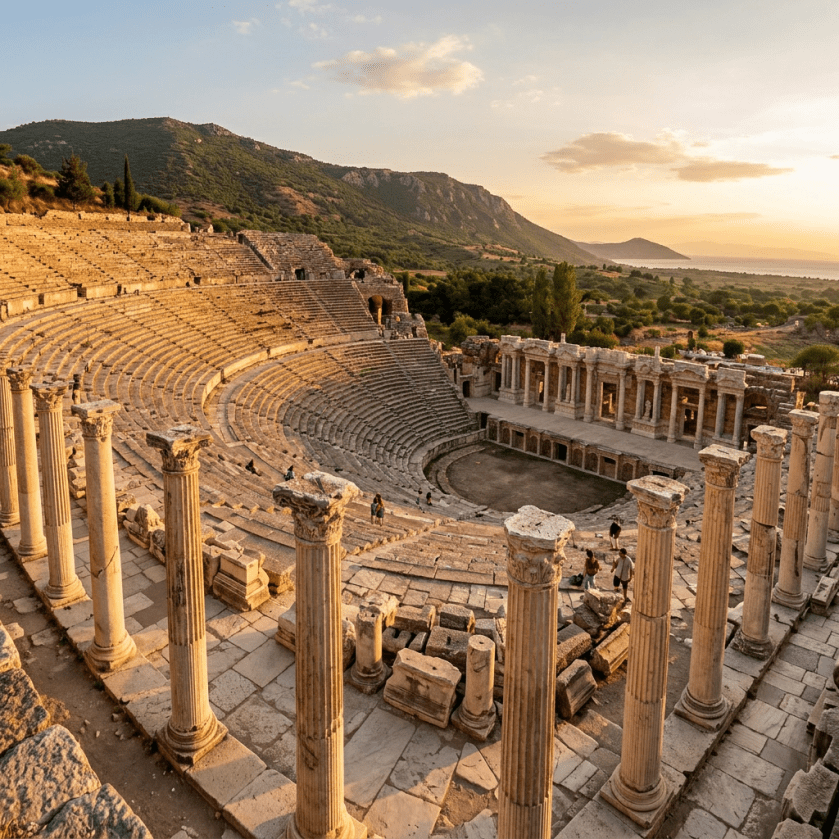
Today, you can see the amphitheatre where much of this story supposedly took place. It has all been dug up and bared to our eyes in one of the most spectacular and important architectural endeavours on the planet. Ephesus dates back at least 10,000 BCE and this city, once pivotal to the histories of first Greece and then Rome, now offers tantalising remnants of both. There are the remains of Artemis/Diana’s temple, there the great library in surprisingly good nick, there the remains of Roman villas with their mosaics and frescoes and excellent plumbing. And much more. You walk the ancient marble stairway, slippery as ice from the many feet that have trodden it (and still do), touch the walls of hewn rock and man-made stone, marvel at both the sheer oldness of it and the modern skills and dedication that have uncovered all this evidence of history for our contemporary eyes.
Rather a lot of eyes, unfortunately. Millions flock to Ephesus each year, most of them with very little true appreciation of what it reveals about our past. Groups of earnest Asians behind their be-flagged guides, admiring but lacking my advantage of cultural relevance (rather like the way I once went around Angkor Wat). Groups of bored schoolchildren. Women off cruise ships flaunting too much overweight flesh in skimpy tops and shorts and sandaled feet that bring them to grief in the rubble. Fat, elderly, red-faced men in Hawaiian shirts panting in the heat and thinking only of cold beer.
Because, for much of the year, Ephesus is HOT. South-western Turkey has brutal summers and the city today is in a bowl of low, dry, mountains and a long way back from the sea, thanks to the silting up of the once-busy harbour. Today’s harbour is at Kusadasi, nearly an hour’s drive away. If you visit there – and I recommend it if you love history and archaeology – go in the early northern hemisphere spring or late autumn. Possibly winter.
Of course, Ephesus attracts serious scholars both amateur and professional, including Christians. In New Testament terms the city is associated more with the apostle John than with Paul and nearby is a house which, it is claimed, was where Mary the mother of Jesus spent her last years. A claim so breathtakingly ridiculous that it’s a true wonder of the modern world that anyone would believe it or bother to visit the place. And yet they do, the faithful and the curious.
And that’s the thing about Ephesus as it appears in the bible, and about “saint” Paul himself. What we think of him today comes down to a matter of faith – if you are a Christian then you will disregard all evidence to the contrary and accept that he was what the early (and, I think, not-so-early) Christian writers want and believe him to be, and that all the letters were written by him. If you are not, then you will either dismiss them outright or subject these to the forensic examination of historical expertise.
Ephesus was very important to the formation of Christianity; indeed it is at least as important, if not more so, than Jerusalem or Antioch or Alexandria or Constantinople – even Rome. So many councils were held here that it’s not unreasonable to claim that it was this city, not just Nicaea, which effectively created Christianity and made it into a religious belief system powerful enough to take on the world. There were many stakeholders in such a power; not just churchmen (themselves hungry for a power that they abrogated to themselves through claiming Divine backing) but also rulers and the courtiers, politicians and military men who supported them. And thus, feeding upon itself down the ages and growing fat in the minds of the ignorant and cowed masses Christianity, like Islam that later sprung from it, Christian doctrine and practice dominated life and thought pretty well everywhere west of India.
These early councils were not by any means peaceful. Bishops, the newly-minted church leaders, fought bitterly over the tiniest nuances of doctrine. Schisms arose, some of which endure. Blood was shed – at least one bishop was murdered. The seeds of Christianity were indeed nurtured by the blood of its martyrs – most of it shed by fellow Christians who thought that Christ was god made man, and not the other way round. Or that a certain number of angels could dance on the head of a pin. It was like an early form of football rivalry and even more violent.
But there is so much, much more than early Christianity to be found at the archaeological treasure that is Ephesus. Diana/Artemis was a bigger deal here than Jesus ever was, and other deities as well. It was an important centre of government and trade for thousands of years. Rulers came and went, emperors visited, arts and crafts flourished. Until the Visigoths came and wrecked it and an earthquake finished the job and the sea became impossibly far away. It’s harsh country; goats thrive here and olives are grown and, where water can be accessed, stone fruits and figs.
In the nearby town is a delightful small museum which nicely completes your visit and there is no Christian reference here. There are restaurants nearby and a tourist vibe. The closest large town is Kusadasi where the cruise ships dock and ruthless men will sell you carpets of silk and wool, made (we are told) by village maidens subsidised by the government to keep the art of carpet-making alive. Seaside apartments here are owned by wealthy Turks and also by foreigners, lured by concessions that make property-owning easier than in other European seaside places. The beaches are quite good.
Paul would not recognise the place, nor would he approve. There are women flaunting flesh in skimpy clothing, with loose hair. Much has been made of his misogynism but that is unfair because we see it through the eyes of twenty-first century society. Back in the beginning of the common era, women were expected to be quiet, modest in dress and behaviour, sticking to hearth and home and doing what their menfolk told them. Even empresses, though they might exercise power behind the scenes, could never reign and ruled (when they did) through the means of their male advisers.
At the same time, modern Christian reformists and in particular Christian feminists have tried to cherry pick the New Testament and interpret it to suit their notions – with a sad lack of historical understanding. Yes, women played a role in the early church, albeit a small and supportive one. No women bishops and to this day no woman pope or metropolitan. Certainly they were forbidden from preaching – which makes you wonder what Paul would have made of today’s Church of England female vicars! The sayings attributed to Paul are unambiguous – women were to remain submissive and keep their heads down – and covered. Don’t take my word for it, it’s there in the scriptures!
To whit:
“But I do not allow a woman to teach or exercise authority over a man, but to remain quiet! For it was Adam who first created, and then Eve. And it was not Adam who was deceived, but the woman being deceived, fell into transgression. But women will be preserved through the bearing of children if they continue in faith and love and sanctity with self-restraint.”
Take that, sisters!
Some of Paul’s modern apologists have claimed he must have been misunderstood and mistranslated down the years, with later writers putting words into his mouth to suit their own ends. That strikes me as a dangerous road for any scriptural reformist to travel because it just confirms what people like myself believe – that nothing in the testaments old and new can be taken as truth. It’s just religious fiction, as reliable as today’s journalism and AI-generated fake news, serving the beliefs of the writers who know that some, if not most, will take their reportage as – well – gospel!
Anyway, whatever you choose to believe, Ephesus possesses its unique archaeological truth and I’m glad I went there to see it for myself, despite the midsummer heat, appalling crowds and lack of decent lavatories.
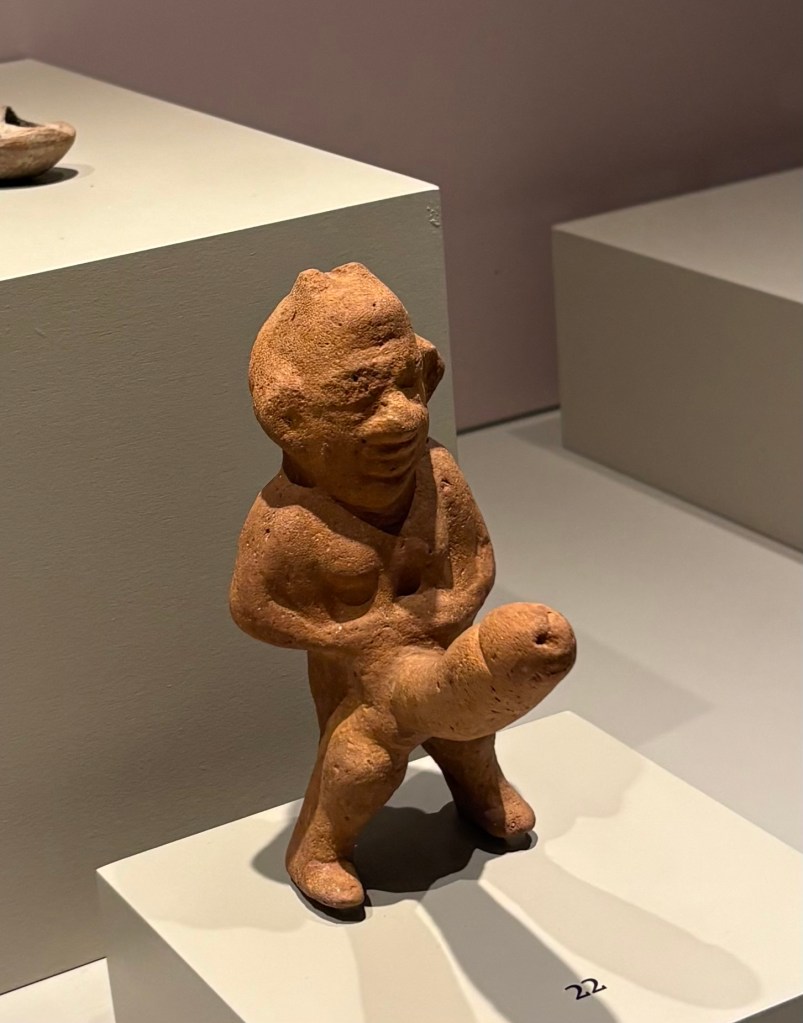
I bet the prudish Saul/Paul wouldn’t have approved of this pagan chap, dating from long before the Roman republic.
*The golden age for letter writing during the first millennium CE is reckoned by scholars of the era to be between 200 – 600 and this is quite a long time after Saul-become-Paul is supposed to have written his long missives. Another reason for doubting their authenticity and believing that they were probably made up by later Christians to suit the narrative.