The night of the siafu – an African horror story!

The siafu came, like all true horrors, at midnight.

They came stealthily as they always do, determined of purpose.  The leaders made their choice and the long columns followed, obedient as automatons, the scouts ahead and to the side, the stalwart marshals vigilant along the side of each column, keeping the foot soldiers in line.  There would have been several columns.  I didn’t see this for myself but knew it to be so because I had witnessed these sudden, forced marches before and, though well aware of their deadliness, had teased and provoked and dropped obstacles in their path, gleefully and fearfully watching the seething mass that soon sorted itself into order and marched on, over the bodies of comrades. . Overcoming everything.  Leaving me awed at such sacrificial resolve.

I was the giant, so immensely huge by comparison that they would barely have been aware of my existence.  I could destroy them, like a god, but while I had the size, they had the numbers and should I for any reason fall they would swiftly discover me to be no deity but mere flesh, and devour me.

On that night the siafu came I was asleep in my bed, in our solid-walled house of cream palnted coral block and terra cotta tiled roof in Kizingo Road, on the seaward side of Mombasa.  Across from us was a grassy vlei and beyond that a collection of small cottages separated by narrow laneways.  These were known collectively as the bandas and they housed  lower-ranking white employees of the City Council, many of them of South African origin.  These bungalows were tiny, two-bedroomed and hot, with kitchens out the back to be fire-safe, joined to the main house by narrow covered walkways.  There were no ceilings below the thatched roofs and geckos hunted along the beams while snakes and rodents made homes in the straw.  Those today who think all the colonial white bwanas and memsaabs lived in luxury should be taken back in time to live for a few nights in one of the bandas.

I had playmates living there and so spent some after school hours chalking out hopscotch squares on the melting black tarmac and throwing balls against the mud-and-wattle walls. One of my favourite activities was to visit a couple known as Aunty Bertha and Oupa and in the strange way that some children attach themselves to adult oddities, so I became enamoured of this couple, so very different from my parents and their friends.  Aunty Bertha was a large, fat, jolly woman and Oupa was her father, an immensely old (to me) man who rarely seemed to stir from his armchair.  They spoke mostly Afrikaans, at least to each other, and his English was poor or else, as was the way then of elderly Afrikaners, spoken grudgingly. 

Aunty Bertha loved children and always had sweeties for us.  They kept no servant – unheard of! – and she did her own baking so that we could be sure of gingerbread and sugary biscuits.  She kept bottles of Vimto for us in the old, noisy frig and had a forlorn monkey on a chain in the tiny baked-earth yard whose main amusement was to leap out at passing children, teeth bared.  We could not play with him but could instead fondle and throw balls for the sweet-natured golden cocker spaniel who was Bertha’s darling.  She had never been married and this dog, Meisie, was the object of all her maternal affection. She had a heart as big as her body, did Aunty Bertha and all the time in the world for the neighbourhood children whose own, more affluent parents were usually either at work or at the club. 

The old man would watch us play and listen to us prattle without saying much but we always assumed his presence was benign and, as he did not engage with us, we ignored him.  He, too, was very fond of the dog and would take it on his lap and feed it little treats – and as a result the dog was, like its mistress, very fat. 

It was to this modest household, on one dark night in, I think, 1957, that the siafu, in the inscrutable way of marching ants, directed their attack. 

It was all too well known in the Kenya of those days that once the safari ants went on the march, and your house was in their way, then all you could do was get out.  Africans, in their village huts, had long known this but a traditional hut only takes minutes to clean out and you can flee to a safe distance and wait while they trail relentlessly through and go on their way.  For the white folk and Indians, however, there was rarely enough time to remove everything except all foodstuff not in tins and as much clothing as possible.

Because the ants would consume everything except metal, stone and hard timber.  Soft fabric on furniture, clothing, bed linen, paper, carpeting, shoe leather and every kind of foodstuff could be chewed to pieces or totally gobbled up by those savage mandibles. 

Siafu invasions of urban areas were rare.  We did not live in daily fear of them.  But we knew they could happen, had seen them happen to others and had heard the stories – no doubt wildly exaggerated and the stuff of myth but – as I was to learn that night – sometimes true.

These ants of the Dorylus genus were indomitable.  They marched in their millions and nothing except wide water or fire would stop them.  Usually when they were spotted nearing houses or shops there would be a concerted community effort to deflect them – chemicals would be sprayed on them, water would be blasted at them through hoses and though millions would die, millions more marched over them towards their mysteriously-determined goal.  Mysterious to humans, that is. 

In the bush, one often came upon these columns which seemed to go on forever, consuming anything in their path such as vegetation, baby birds and young creatures too weak to run.  All things that could run, from bush mice to elephants, got out of their way.   But in this environment the siafu played their part in the natural way of things and no doubt it was a useful one.  It was only in the urban environment that they became a menace.

Houses like my own were better able to stand up to ant attacks but the Bandas, only a step up from African huts, were very vulnerable.  Full of nooks and crannies and entryways and the walls that ended just short of the thatched roof so that the air could move through and keep the place cool.

When the ants marched during the day they would usually be spotted well in advance and evasive action taken.  Or a line of fire lit to deter them, though it had to be continuous and wide or else the siafu would just march through across the bodies of their frizzled comrades.  But when they came at night the chances of detection were minimal.

As was the case that night, of which I write after nearly seventy years, when the siafu came to the Bandas and, of all the little houses there, chose to invade the home of Aunty Bertha and her father.

We heard the shrieks and shouts.  Even from our house, on the other side of the vlei , we heard them and woke.  Closer neighbours crowded the little laneways and some rushed in to help the stricken couple while others checked the lines of ants to see if their own houses were in danger.  The fire brigade was called.  And in this white residential area, the live-in servants emerged from their quarters and gathered in small groups, speculating and sending runners to find out what was going on.  Soon the dread word siafu was whispered around and my father, deciding this was not his affair, ordered us all back to bed. 

But I didn’t go.  I was twelve and curious.  So was one of my friends who lived across the road.  Together we sneaked out of our homes and across the grassy open space to where the action was.  There were so many people milling around that we could not get very close, but close enough that we could see Aunty Bertha and Oupa, wrapped in sheets, being ushed into a car, and that big, kindly woman dishevelled and in tears, arguing with those assisting her.  She was, I learned the next day, desperately trying to tell them something, and to get back into the house.  And they were just as desperately trying to urge her away. 

I could see a wide pathway that had been left between the roadway and the house and along it flowed a relentless river of ants which was, in the next minute, sprayed by the fire hose.  Other hoses were being sprayed on the house.  Here and there firemen and a mixed crowd of Africans and Europeans were beating – rather uselessly – at other ant columns, using brooms and sticks and even hippo-hide whips.  The lights of the fire engine whirled and made everything glow eerily.  Torches bobbed.  I heard men discussing the possibility of lighting a fire line and deciding it was too dangerous in that close environment of thatched homes.  It was the kind of chaotic drama that kids love. 

By this time we knew the bones of it.  The siafu had come and invaded the little house of Aunty Bertha and her father.  They had woken only when the ants were upon them, biting them, covering everything.  A horror too terrible to think about.  Overweight, aged and slow, it had taken them a while to yell for neighbours and get out of the house – but they had done so and, though shocked and badly bitten, would survive. 

“The ants were all in her hair,” I heard a woman say, and I shuddered.  “All over and…you know…up in every part of her”.  I envisaged this and shuddered again – fascinated as well as appalled. 

Nobody knew quite what to do in such a situation and it was decided that the stricken couple, beating at their bodies and in great distress and pain, should be taken to hospital.  But, good neighbours that they were, nobody wanted to use their own car for fear of filling it with ants, for the bite of one siafu is very painful, as I had long since learned to my cost, along with other overly-curious children.  The bit of many is true agony.

Later, my mother told me, a solution of a kind was found and the poor old couple was liberally sprayed with DDT, using the little barrelled flit guns that were found in every home, our only defence against the mosquitoes and other annoying insects which bedevilled the African night.  The chief of the fire brigade sent a departmental vehicle to take Bertha and Oupa to the hospital – but still she protested and struggled back towards the house.

And then I could hear…we could all hear…what she had been hearing.  The long, dreadful howl of a dog. A dog in agony. A dog in terror.  A dog abandoned. Poor Meisie was in the house.  People do strange things in time of panic.  Aunty Bertha, from sheer force of habit, had locked the door when she left the house! And in all the beating and the fumbling of clothing and the frenzied attempts to rid herself of the biting ants, she could not find the key! 

When this was conveyed to those standing by, there was talk of breaking down the door, or smashing a window.  But the ants were everywhere around the house as well as inside it, thick on the ground and up the walls, wreaking havoc on the thatch, a seething and malignant dark mass.  Nobody would be foolish enough to try and rescue a dog. 

The firemen were urged to spray the door and try to break it down so that Meisie might be able to rush out but they would not do it – their remit was to kill ants but not damage property, even if the owner was begging for it.  And really, what good could it do? Already the dreadful shrieking – so appallingly different from any dog howl that we had ever heard – was muting to faint whimpers.  And then silence. 

My friend and I sneaked back home and I lay in bed, deeply distressed and sleepless. I longed to tell my parents, next morning, what I’d seen and heard but didn’t dare.  However they soon learned about Meisie and it was a great relief that I could now share my misery with them.  We hugged our own dogs closer and wondered aloud what we would do if such an awful fate had befallen them.

 My mother and other members of the East African Women’s League visited the hospital with food and other comforts.

“Bertha is very brave,” she told me.  “But she blames herself terribly for leaving her dog behind.” The two women had never spoken before and my mother was gratified – and very surprised – to learn that in one household, at least, I was considered a “lovely little girl.”  Dear Bertha and her kind heart, no other adult had ever described me thus!

It was a week before Aunty Bertha and Oupa were released from hospital.  In that time their house had been thoroughly cleaned and replacements found for soft furnishings that had eaten by the ants.  They had not owned much and most of what they had was consumed or damaged so badly it had to be thrown away.  Pots and pans and china remained, as did the frig and the stove and the water filter.  The old man’s pipe was intact along with the tobacco tin.  Somebody had taken away the little skeleton which was all that had been left of pretty Meisie, with her soft floppy ears and lively eyes. 

The ants had disappeared as silently and mysteriously as they had arrived.

Charlie, the Vervet monkey, had survived.  His shrieks were one of the first things to attract attention to the unfolding threat and a neighbour had rushed into the yard and freed him.  For which act of mercy he was rewarded by a severe bite, requiring several painful rabies injections!

Somebody gave Aunty Bertha another dog; another golden cocker spaniel. I don’t know how she really felt about that, but she accepted it.

I, along with the other neighbourhood kids, grew up and moved away.  But for years I had nightmares about swarming ants and, as you can see, the sound of that little dog’s dying haunts me to this day. 

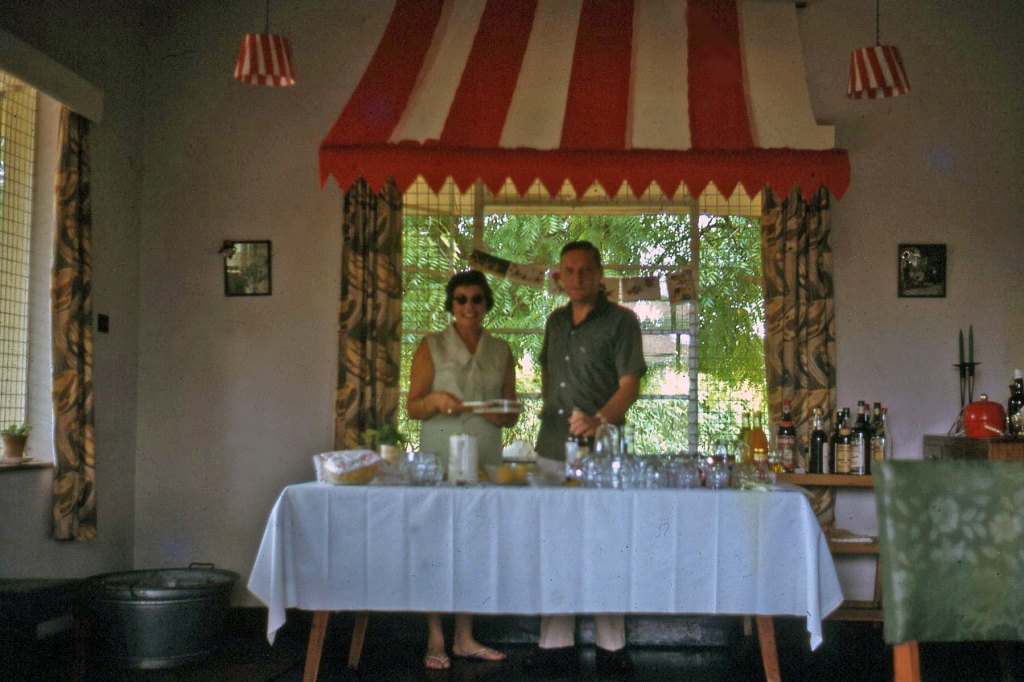
My parents in our house in Kizingo Road, getting ready for their usual Christmas morning Pimms party. This was taken not long after the night of the siafu invasion, which took place only a short distance away. And no, that’s not the family bath in the left hand corner, it’s the ice tub!

That old time rock and roll at the Mombasa Railway Club

Teenagers, as those of my generation know, were invented sometime around the mid –to-late 1950s.  There weren’t any before then – just children who became adolescents who then made the sudden leap into official adulthood at twenty-one.  No matter if you had been out to work since the age of fourteen and had a driver’s licence– you weren’t taken seriously as a fully-fledged member of human society until you were given the key of the parental door.  Unless, of course, you were silly enough to have got married – as many of us did for the very reason that it gave us adult status.

Teenagers were invented in America, like just about anything else back then, and the idea soon crossed the Atlantic to hybridise into sub-cults like Teddy Boys and, a bit later, Mods and Rockers.  Young men slicked back their hair into duck tails and grew sideburns.  They dressed in drainpipe trousers and draped jackets.  Girls bound their hair into pony tails or combed it up into “beehives.  THEY went forth either in a frou-frou of full skirt and starched petticoat, or else pencil-tight skirts or pedal-pushers, feet shod in bobby socks and flats or stiletto heels.  Rock and roll ruled the airwaves,  prime time TV programs were dedicated to “pop” music, records went vinyl and society suddenly discovered that the youth market was a goldmine because – hey! – for the first time in history kids had money to spend!

All this reached Kenya rather late.  When Elvis was warning people to keep off his blue suede shoes most white Kenyans between the ages of, say, 13 and 18, were still schoolchildren following the same pursuits that their parents had followed before them.  Even if we’d left school our leisure time was still influenced by the activities of the previous generation and we  inhabited that uncomfortable no-man’s land between childhood and adulthood, where little account was taken of our adolescent desires.

 Not so bad if you lived in the country because there you had horses and could shoot things or go camping or tear around the bush tracks, unlicensed, in a Landrover.  For townies, however, the school holidays and weekends could be dreadfully dull.  You couldn’t be forever playing tennis or Monopoly.  Those lucky enough to live at the coast had, at least, the beach for amusement.  But  even that offered little amusement when evening fell and you were too old to go to bed early but too young to go dancing at the Sports Club, or to the cinema without a chaperone.

However, by the time Elvis had changed his tune and was out of the army singing It’s Now or Never things in Kenya had changed too and the cult of teenagehood was well and truly established. Suddenly those of us born during or at the end of World War 11 found ourselves with a collective identity and parents with the time, money (comparatively speaking) and social awareness to indulge us.  In Mombasa this new recognition manifested itself mainly in the introduction of special “teenage dances” every Wednesday evening during the school holidays. 

These were run by the East African Women’s League which was very brave of that ultra-respectable organisation because supervising a bunch of youngsters with their hormones running wild and hell-bent on making whoopee is not for the faint-hearted.  As we all know, the EAWL was formed of doughty gels up to anything from scaring off a rampaging lion to executing the most exquisite of embroidery stitches so those who volunteered to supervise the teenage dances were obviously made of stern stuff.  They had to be youthful enough, or at least youthfully aware enough, to let us have plenty of fun while at the same time able to command sufficient respect to prevent excessive behaviour such as drinking, fighting or having sex behind the cricket screen.  As far as the first two were concerned, they were generally successful. 

The dances were held in the Railway Club.  This was centrally located at Mbaraki and its membership was tolerant enough to allow we rock and rolling youngsters to take over the joint for one night a week, eight weeks a year.  Such a thing would have been inconceivable at the Mombasa Club and even the popular Sports Club was obviously not prepared to yield up its wonderful sprung dance floor to the juvenile brigade. From memory we paid a small fee though this could hardly have covered the cost of the excellent and youthful live band that could play everything from early jive to the latest pop tunes to foxtrots and sambas.  In truth we were a lucky lot – we Mombasa kids of the late fifties and sixties, to have had all this laid on for our delight.

Yet to this day I still shudder at the memory of my first teenage dance.  I was only thirteen at the time and still something of a tomboy.  My only experience of dancing, apart from ballet, was the obligatory ballroom lessons given weekly at our Nairobi school and some clumsy attempts to practice my steps at the Saturday night hops held in our boarding house.  There, of course, girls danced with girls and we younger oiks were barely tolerated on the common-room dance floor by our seniors. 

Timid is hardly the word to describe my feelings at my first public dance.  Terrified would be more like it.  I’d only gone there at the command of my mother, who was one of the regular chaperones at the teenage dances and, indeed, one of the most enthusiastic proponents of the whole idea.  She was also among the most popular with the kids, being herself quite young, pretty, fashionably-dressed and easy-going of temperament.  This latter quality meant that she was inclined to spend more time sipping cocktails and gossiping with the other chaperones, or any stray member of The Railway Club foolish enough to risk the bar on teenage dance nights, than keeping an eye on her charges.

 In general, my mother was not a natural habituee of the Railway Club and was usually to be found at the Mombasa Club or, in younger days, at The Sports Club.  But she was an affable soul who could chat as easily with engine drivers’ wives as she could with the old codgers at the “Chini” Club across town.  “Oh good, your Mum’s on duty”, the other kids used to say to me, knowing that our activities would not be overlooked too scrupulously and the smoochy “lights-out” period that ended every dance could be extended.

 Not all the EAWL women were so sympathetic.  On one occasion a certain prominent committee member with a spurious double-barrelled name and an even more spurious posh accent (cruelly mimicked by my mamma to amuse friends and family!) opened the night’s events by pleading with us to “why not enjoy yourselves gels and boys with some naice quicksteps and waltzes instead of all that horrible rock and roll” and instructing the band to play her kind of music.  Some of the older boys – men, really – objected strenuously and threatened to go home.  The whole future of the teenage dances hung in the balance and Mrs Double-Barrel reluctantly yielded – but spent the whole night patrolling the dance floor like a sergeant-major and forcibly separating any couples who got too close during “lights out”.  “Silly bitch”, said my mother to my father, in my hearing, voicing a sentiment which no teenager of my day would have dared say aloud.  And so, thanks to my mother and the other younger and more “with-it” supervisors, the dances continued – a highlight of every school holiday.

Still, at that first dance, I was far from considering it a highlight and was furious with my mother for making me go.  In truth, I was still too young.  Only one or two of my friends were there, under similar duress, and similarly dressed in childish clothes.  I wore, I remember with embarrassment, a white broderie-anglaise blouse buttoned to the throat and a flared yellow skirt with white ricrac round the hem.  No starched petticoat to fill it out; it just hung in dull, chaste folds from the waistband without even a belt to make it look a bit more grown-up.  Worse still, I wore white socks!  True, this was the age of the bobby soxer,  but that particular dress code had never really caught on in Kenya and all the older girls wore stiletto heels.  I don’t remember the shoes I wore and only hope they weren’t those Bata sandals with little bits cut out of the toes! Or were they Clarkes?

When you walked into the Railway Club there were the lavatories on the right and then the bar area and the main club room on the left, which was where we danced.   Outside was a patio overlooking the sports field.  Around the room, wooden chairs were arranged.  Here, on these wooden chairs, sat the novice boys and girls.  The shy, the plain, the fat, the skinny, the spotty, the non-dancers.  The in-crowd; those Godlike beings who were older and better dressed and more popular than the rest sat in groups at the clubhouse chairs and tables.  When each dance started I, and the other little girls of my acquaintance (and there were painfully few of us) sat stiffly on our chairs, eyes cast mainly upon our shoes but straying occasionally upwards to watch, with envy, those older teenagers flinging themselves so confidently around the dance floor. 

We took an occasional peep, too, at the boys of our own age or slightly older who sat with equal stiffness across the rooms.  They, too, had been parentally coerced into attending the dances, usually with the well-meaning idea that this would improve all our social skills.  Which, eventually, it did.  Though perhaps not always in the way that was intended!  The European community of Mombasa being small, and the community of the young smaller still, we knew most of those boys.  Like us, they were finding their feet for the first time in the often brutal world of boarding school, or else the difficult transition from boarding prep school to high school, and were gawky and awkward with neatly parted brylcreamed hair and less adept than we were at hiding their spots.  And, despite the fact that they had been playmates just a short time before, racing around with us on bikes and exploring the caves on the seafront and daring each other to dive off the higher boards at The Florida pool, in this newly slicked-out guise and in this strange venue they had become strangers to us.

Yet it was only from this disappointing pool that we younger girls could draw our dancing partners.  None of the desirable older boys would be caught dead jitterbugging with an adolescent wearing white socks!  Occasionally one of the EAWL chaperones would go up to one of the young, chairbound boys and cajole them into inviting one of the young, chairbound girls to dance.  Across the floor he would come, shuffle-footed, tied of tongue, eyes darting everywhere but at the target.  And we girls would sit there, smiling and chatting frantically to each other to show we were having a good time, pretending the boys didn’t exist and at the same time whispering inside ourselves “Pick me! Pick me!”  I remember, still with some pain, seeing some spotty youth whom I remembered from Mombasa Primary heading my way and feeling both disgusted and grateful at the same time, and nervously readying myself to accept even though I couldn’t really dance and knew I would make dreadful fools of us both – and then he asked the girl next to me!  Oh, the mortification!  This was my first dance and nobody asked me at all and when I got home my mother – who had not been on duty that night, wanted to know if I’d had a good time! 

This painful experience was repeated a few times though I was, when at home with my girlfriends and the record player, and back at the Saturday night boarding school hops, gradually learning to dance.  And, too, boys sometimes asked me on to the floor, though only when prompted by the well-meaning chaperones. Mostly, though, myself and other plain little girls, and all the plain little boys who would so much rather have been at home reading Beano and Dan Dare, sat there admiring the older dancers – and learned with our eyes.  Oh I can see them now as clearly as ever, those beautiful girls and boys of sixteen and seventeen.  Mombasa had, I now realise, a surprising number of good-looking girls in my day who would have held their own in any beauty contest anywhere and during the fifties and sixties many of them strutted their stuff at the teenage dances.  Most beautiful of them all were the Italian girls and their faces are before me as I write – vivacious Gloria who danced so splendidly, elegant Marilva,  and Marialena  who was as  lushly gorgeous as any movie star.  How I envied their flowing hair, their stylish clothes, their earrings.  And the boys who partnered them were all magnificent dancers and handsome in the dark Italian way.  They were the stars of the teenage dances and seemed impossibly up there beyond the reach of we ordinary mortals.  

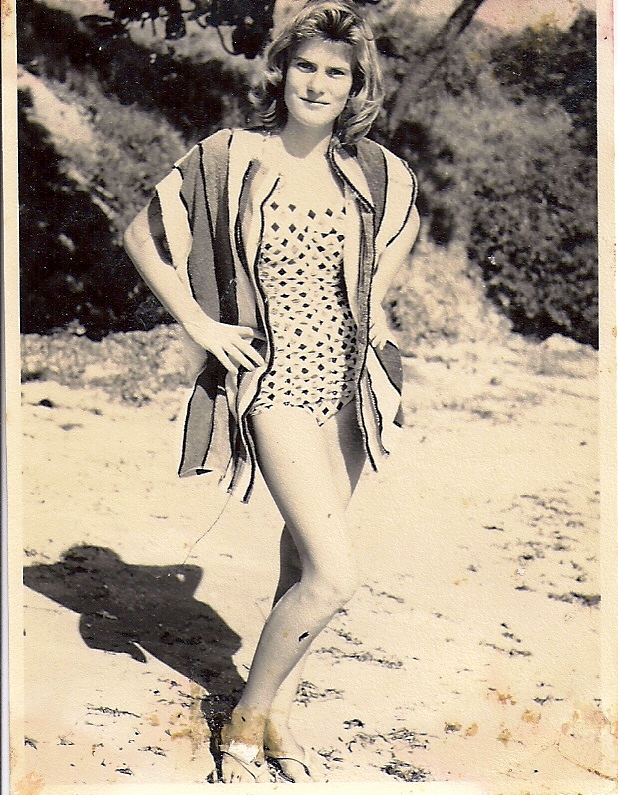
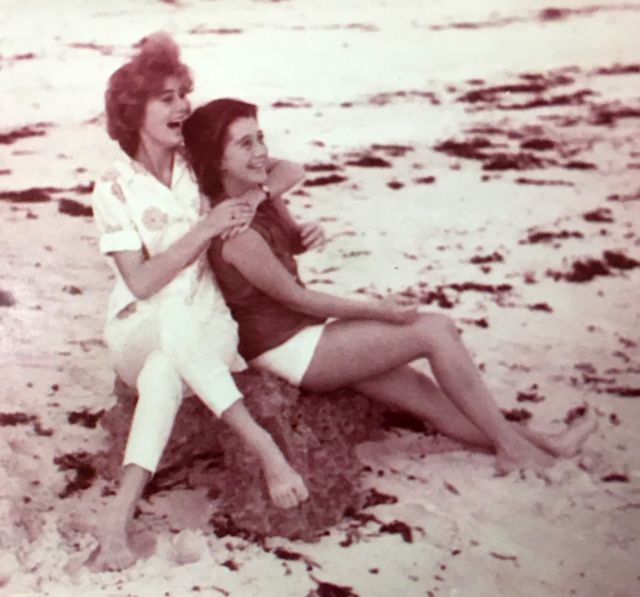
Top: Winning a rock and roll fancy dress prize, age 14, with my friends Marilyn and Lesley. (Not at the Railway Club). Bottom left: An afternoon on the beach was often the precursor to a night of rock and roll at the Railway Club; at left, myself aged 15 on the Mombasa Swimming Club beach and, bottom right, on Nyali Beach, at 16, with my best friend Valerie, another enthusiastic participant in the Wednesday night holiday teenage dances. Valerie and I still live just an hour apart.

And then, suddenly, the longed-for transformation took place and within a year or so – so swiftly do things change for teenagers and yet how long does that time of transition seem to last – I was one of the “in-crowd”.  A cinderella, magicked from the ashes of pubity who no longer slunk into the dance hall wretched with shyness but instead flew in blithely with the rest of the flock, greeting friends, giggling and squealing, tossing hair, eyeing the boys with a sharp look out for the boy, rushing to the Ladies to put on forbidden make-up and earrings nicked from my mother’s jewellery box.  I used to “borrow” her high heeled shoes, too. 

And dance!  All of a sudden I was the dancing queen – out on that floor with partners competing for my hand and winning competitions.  Even some of those desirable older boys were no longer too proud to give me a whirl now and again, even if they returned to their steady partners when the lights were turned down for the last dance.  This last dance was a ritual – when the band stopped playing rock and roll and turned to the slow, romantic ballads of our parents’ era and darkness descended on the dance floor then couples would move in to a clinch.  For steady daters this was a chance to indulge in some officially sanctified necking.  For unattached boys bold or lucky enough to have grabbed the girl of their dreams before the lights went out it was a chance to declare their interest with a bit of cheek-to-cheek and perhaps a daring kiss and, if not discouraged, a bit of frottage.  For girls lucky enough to have been chosen by the boy it was the very acme of teenage romance – a kiss and a hug to boast about to your friends the next day.  Many romances did, indeed, begin on that dance floor.  Some were consummated down behind the cricket screen or in the car on the way home. Others led, in time, to marriage.  For all of us back then it was an important right of passage; the only opportunity we had to make acquaintance with the opposite sex and embark on that best of all games, the Mating Game.

It never occurred to us that we were extraordinarily fortunate to be doing what young people all over the world were doing – but in a far, far more special place than most.  Mombasa, when you think of it, was so perfectly made for romance.  The palm trees, the white beaches and turquoise sea, the constant warmth that meant we could dress lightly and prettily all year round, our bodies bared to the gilding sun.  We were all of us the children of privilege, free of responsibility, cossetted by servants, well-nourished on post-war abundance.  Not as privileged, perhaps, as those Bright Young Things who emerged from the previous war and were glamourised by novelists.  But privileged, nonetheless, compared to those living in a Europe still throwing off the last shadows of war or a United States where youth rebellion was beginning to take on a darker cast and rising crime was ever ready to prey on teenage vulnerability Whereas there in our small and lovely town on a small and lovely island in a country also poised for drastic social and political change we kids rocked innocently on, as far around the clock as we could get.

When the lights went on again my friends and I would open our blissfully-closed eyes, withdraw reluctantly from our partners and make another mad dash for the Ladies where we would strip off our make-up and flashy Woolworths jewellery before our fathers (or mothers) arrived to pick us up.  Until I was sixteen and had a steady boyfriend with a car (and was allowed to wear make-up, though not to pierce my ears) I was always collected by my father.  Or the parent of an approved friend.  In vain I pleaded that this would blight my social life forever; my father was adamant.  I considered this a form of child abuse – it never occurred to me that my father, tired from a day at the office and perhaps a difficult meeting or two, and a post-work game of tennis or golf, was making a considerable sacrifice in taking out the car and going to pick up his sullen, ungrateful daughter at 11 o’clock at night.  That his strictness was, in fact, an act of love.  The Railway Club carpark would be full of such parents, smoking and gossiping until their offspring emerged, hot and sweating and dazed with frustrated lust, or else still full of high spirits.  It occurs to me now how very tactful most of them were, not to intrude on our teenage world by arriving early and hanging around watching us from the edge of the dance floor.  Perhaps they were afraid of what they might see!

Today’s young – my grandchildren for example – would consider those long ago dances and adolescent grope-fests tame affairs indeed.  They would laugh at our long drawn-out mating rituals where dancing was such an integral a part.  And at our notions of “going steady” as a natural precursor to marriage, which at least, for some of us, made sex permissible.  After an awful lot of heavy breathing and groping in the back seat of cars or on beach blankets.  Yet I remember them with great affection and I’m sure others do also.  They were, too, remarkably free of trouble considering the amount of testosterone on display.  In fact in my time I remember only one unpleasant incident and when I recall it now it tells me a lot about our social attitudes back then. 

The teenage dances at the Railway Club in my day were organised on behalf of those young people still at school and though teenagers who had already left school were not excluded they tended to regard the dances as rather too juvenile.  They, after all, were free to join the adults on the dance floor at Nyali Beach Hotel or other such places and, being in the workforce, had money to spend.

  In any case, the EAWL, with the support of the Railway Club, did vet the dances carefully to ensure that “undesirables” were excluded.  I have written elsewhere in this collection about the subtleties of social discrimination in Kenya society; suffice it to say here that “undesirables” meant, for the most part, those boys and young men who did not go to one of the definitively “good” and “white” schools: The Prince of Wales, Duke of York and St Mary’s.  Or perhaps an English public/grammar school and home to Kenya for the hols. 

There were, in the Mombasa of that time, young men who did not quite fit this profile.  They tended to wear leather jackets, ride motorbikes or hotted-up cars and be of mixed race or else identifiably working-class.  One such lot had even formed themselves into a gang – the nearest thing we had in Kenya to bikies.  They had a certain lure for we girls – some of us at least – who tended to identify them with Marlon Brando or James Dean.  OUR boyfriends were cricketers or rugger buggers; decent, predictable and a bit unexciting.  We knew we’d probably end up marrying one of them but still our adolescent dreams yearned secretly for The Leader of the Pack – deliciously dangerous, possibly doomed and definitely forbidden!  It was this type of youth that the good ladies of the EAWL, acting in loco parentis, scrupulously attempted to ban from the innocently middle-class teenage dances.  Of course, the ban didn’t always work.  The young men sneaked in – or sometimes boldly strode – through the back way and dared each other to take to the dance floor, with one of “us” as partners.  They were invariably very good dancers. 

A friend of mine was being pursued by one of the “undesirables”, known to us as Mike.  He was shortish, wiry, dark-hair  slicked back into a DA and yes – despite the cloying heat of the coast would wear a leather jacket when riding his motor scooter.  He had been to no school that we recognised, his parentage was obscure (i.e. not known to OUR parents) as was his nationality – some said he was Maltese, others Slavic but I now realise his surname was Armenian in origin.  Mike had a cocky manner that would have irritated any protective father but went down well with young girls.  And one night he walked nonchalantly into the Railway Club and asked my friend to dance.  Worse, he kept hold of her hand when the dance was over and then led her outside where they sat with his arm possessively round her shoulders.

 Going outside with a boy was generally a declaration of sorts – an indication of romantic interest and, often, a prelude to sneaking off behind the cricket screen!  Mike danced – rather flamboyantly for he was lithe and very good and could throw a similarly skilful partner over his shoulder – with others of us that night, though mainly with my friend, and very closely, too.  I don’t know exactly what happened – whether he was asked by one of the chaperones to leave or whether one of “our” boys took objection to him – but a fight broke out.  I remember thinking it was rather thrilling – like West Side Story!   A rumble! Mike wasn’t alone, he had a couple of mates with him and though they had not danced but hung around the edge of the dance floor looking ill-at-ease they weren’t the sort of boys to back off from a friend in trouble. 

The EAWL ladies clucked like hens and, as far as I remember, somebody in authority from the Railway Club waded in and separated the fighters and threatened to call the police.  Mike and his mates left. I got a stern lecture afterwards from my father about not encouraging the attentions of such youths and what he would do to me if I was ever seen in their company!  Mike’s brief fling with my friend ended when she left school  shortly afterwards and went to study in UK.  I met him again, some years later, in Zambia.  We were both married by then, with children, and he had some sort of dull, respectable job.  The DA and the leather jacket had gone, along with the Vespa, but the cockiness was still there.  I asked him what exactly had happened at that long ago dance and it was obvious the memory still irked.  “Those dances were kids’ stuff,” he said, with something of the old, carefully cultivated sneer.  “I only went there for a dare and because I knew it would upset those snobby old biddies”.

Kids’ stuff perhaps, but how quickly kids grow up.  Soon enough – though we are only talking a matter of three or so years here – the lovely Italian girls and their beaux had danced themselves into maturity, even matrimony,  and their places were taken by myself and the friends of my age, and our boyfriends.  Now we were the much-envied older crowd, confident in our dancing and sexual allure, and another lot of scared young girls and boys were inhabiting the chairs around the dance floor, being cajoled into getting up to dance or fearfully hoping – and dreading – to be asked. 

The last time I went to one of the Railway Club Teenage Dances I went there not to rock and roll but to show off my engagement ring, and my fiancée.  Absurdly young, I had nonetheless achieved a social triumph in the eyes of my peers (if not my parents!) by managing to snare a man six years older than my still-teenaged self, who had a respectable job and a car.  No more teenage dances for me!  Nor for anyone, because not long after that, when Independence came, the dances were discontinued.  The young white bwanas and memsaabs – most of them – left for new lives in new places and graduated to nightclub dance floors around the world; to Twisting the night away and, in time, Disco.

I am an old woman now and as I write this my mind goes back to those hot, sticky nights on that tropical island with the starched skirts whirling and the high heels deftly tapping and the pretty girls and the slim young men and all that energy that would have rocked us around the clock if we’d been allowed – and I hope, oh I hope, that the young folk of Mombasa are still dancing today. 

Ghostbusters of Mombasa

It was midnight and clouds were scudding across the moon.  By its fitful light we crept nervously up the ruined staircase to the turret, avoiding the jagged-edged holes where boards had rotted or been ripped away.  Everything was deathly quiet; the only sounds we could hear were our own breathing and a skitter of small, clawed feet somewhere in the darkness beyond.  Silently we sat on the littered floor, backs against the walls, hands touching for reassurance.  “Oh God,” I heard someone whisper, “What are we doing here? “ and I knew I was not alone in my fear.  Down through the window it was just possible to make out the shapes of trees and bushes in the weed-wild garden which suddenly seemed full of threat, barring all possibility of escape.  The moon came out from behind a cloud and lit full upon the black mouth of the old well…

From memory there were about eight of us.  I know” Kuku” Henn was there, and Ruth Brereton (as she was then) and Bryan Beardmore, and Mary Molloy.  Today, more than sixty years later, I can no longer remember who else – probably Bill Hurst and possibly Chris Selby-Lownes.  We were all rather into ghosts back then, and always trying to find something to do on a Saturday night besides going to the flicks and then on to Nyali Beach Hotel to dance, or crashing somebody’s party. So when it was suggested that we sneak into the empty Phantom Inn and look for the ghost, it seemed like a fun thing to do.

The Phantom Inn had previously been called The Golden Key (for some reason nicknamed by many The Golden Bollock) and in my memory of the 1950s and early 60s in Mombasa, it had never been much of a place before falling into disuse and dereliction.  My mother, however, told me that before World War II and possibly during, the small hotel on the northern side of Nyali Bridge had been quite a popular spot for drinking and dancing; a sort of night club.  It stood alone on the cliff just as you came off the bridge on to the mainland, overlooking Tudor Creek.  And by 1963, when this story takes place, the only interesting thing about it was The Legend – of a young Arab woman who had been thrown down the well by her husband as a punishment for some unspecified offense.  She was said to rise from the well at midnight when the moon was full, and wander around the hotel.  Certainly Africans avoided the place after dark and many white Mombasa-ites, too, claimed to believe the story.

Picture of the old Nyali Bridge that connected the island with the north shore, back in the time of this story. The Golden Key aka Phantom Inn aka The Golden Bollock is the two storey building at far left of the bridge. (Photo courtesy of Rajni Kant Shah).

So, late one night when the moon was suitably full, our gang of ghostbusters parked our cars on the island side of the bridge and crept across, eager to be in place by midnight.  Giggling and shushing each other we clambered through a window, pulling back the rotting shutter, and picked our way gingerly through the debris on the ground floor.  A dilapidated staircase led up to the next storey, where there was a sort of turret room.  Here we ensconced ourselves, sitting on the floor with our backs to the wall, where most of the inner lining had rotted away.  The whole place stank of rodents and bats and, I think, human piss.  It was quite horrible and I remembered wishing I’d stayed home!  When our watches showed midnight we all became breathless and silent.  I don’t think any of us REALLY expected to see a ghost, especially the older men who were less credulous than my 18 year old self (I was the youngest in the group by about four years).

But then…oh the horror!… all of a sudden we saw a wavering light creeping towards us.  We couldn’t see exactly where it was coming from, it just seemed to wander all about without purpose or direction.  At least for a while.   A pale, mysterious light with no sound to humanise it. “It’s the ghost…there really IS a ghost!” whispered Ruth, sounding slightly hysterical.  Mary Molloy, I remember, crossed herself and asked for some heavenly protection – I’d never known her be particularly religious before.  The men – Kuku, Bryan and the others – had been scoffingly sceptical about the whole adventure until then, just going along for the hell of it, but now they, too, had gone ominously quiet and that worried me most of all.

We sat there, group hysteria taking over, terrified and not quite sure what to do.  I can’t say we were frozen with fright because this was, after all, Mombasa on a hot Saturday night.  But we were certainly immobilised by it. What else, after all, could this mysterious light that seemed to hover a few feet off the ground be BUT an apparition of some kind?  The light came closer, we could see it diffused and indistinct but certainly THERE through the cracks in the floorboards.  And then – it began to ascend the stairs!  It now seemed to be accompanied by a sort of shushing noise which to me sounded JUST like the noise an ambulatory ghost might make, especially if she was wearing her buibui

“Omigawd!”, muttered Ruth.  “What will we DO?”  One of the men – can’t remember who it was, now, probably Bill, told us to stay calm and very quiet.  No screaming.  And so the light came nearer…and nearer…and the moonlight, quite ghostly in itself, shone through the window and cast shadows that made the whole thing seem more sinister.  And then a voice…a trembling voice that wavered fearfully behind the wavering light…said: “Nani huko?”

 It was the night watchman! 

We hadn’t thought of that!  Hadn’t realised there would be anyone watching over this derelict building but of course local watu might have found a use for the old timber and stuff.  So a night watchman had been employed, and a wizened, ancient and very frightened and indignant mzee he was too, carrying a kerosene lantern and wearing huge unwieldy thongs made of recycled tyre rubber, hence the “shushing” sound.  He was not at all amused by this bunch of young wazungu with nothing better to do with their time than disturb his peace of mind.  And, of course, we WERE trespassing.  So to soothe him down and shut him up (calling the policewas mentioned) we paid him a few shillingi and made our merry way back across the bridge.

This ultimately dispiriting experience didn’t in the least dim our enthusiasm for things supernatural and paranormal – far from it.  Our next ghostbusting adventure after that was spending a night in the Mombasa Cemetery – but that’s another story!

The game drive – death on the African plain

THE beginning of the 1960s was a bad time for Kenya farmers.  First, in 1960, came a severe drought which hit the Ukambani around Machakos  harder than most other areas.  As so often happens in Africa, the drought which forced farmers to sell off cattle cheaply or else move them to other and often remote grazing areas was followed by some of the worst flooding known since European settlement.

And then came the army worm (Spodoptera exempta), a voracious little caterpillar that can gobble up entire pastures in a few hours.  This time the army worm plague was so thick on the ground that the Mombasa-Nairobi train couldn’t run on its tracks, greased to impassability by the crushed bodies.

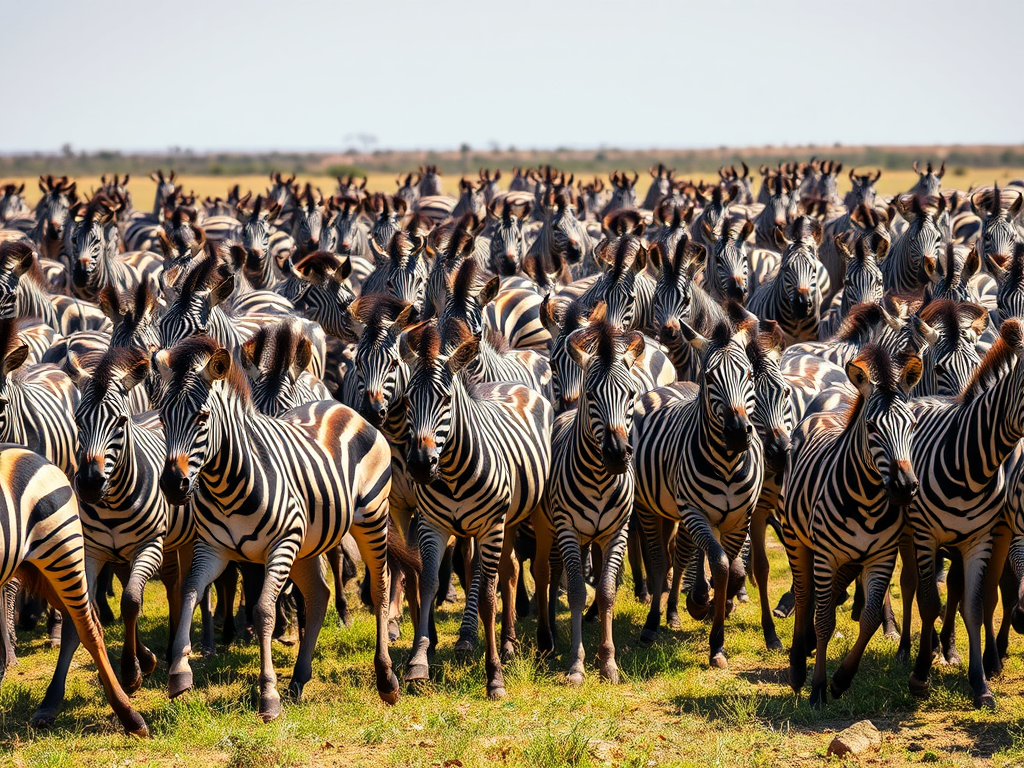
After the army worm the precious new grazing that came up after the rain was suddenly invaded by herds of zebra and wildebeest.  The first time in years such a thing had happened and the timing seemed almost deliberate, as if the game was getting its revenge for the invasion of the wilderness with our pampered domestic stock.

And so the farmers gathered in the Ukambani to save their grazing by driving the herds of zebra and wildebeest, impala and kongoni back into the Masaai Reserve.  Half a dozen families including children over the age of twelve, assorted friends and relatives from “town” who enjoyed a bit of shooting, and plenty of watu to do most of the “driving” because it was not only white settlers who were affected by the infestation of game but also the squatters who lived on their land and those who worked the village shambas.

Imagine if you can today, in the age of endlessly clicking cameras and little zebra-striped safari buses and game lodges with infinity pools what is was like to rise in the chill of dawn on the day of the game drive.  To eat a hearty breakfast of porridge or cornflakes, eggs and bacon, kedgeree and sliced venison, toast and marmalade.  To hear the click of bolts as guns were checked and feel the excitement sizzle through your veins like a lighted fuse. It sounds terrible to tell such a tale today,  but this is how it was, back then and one shouldn’t judge the past by the mores of the present.

All had been planned days before.  A shallow valley selected along which the herds could be driven; the strategic placing of the best shots along that route, the starting point for the mass of yelling beaters waving sticks and bright pieces of cloth and clubs to finish off the wounded animals.  Also in the rearguard were those Europeans who would follow the herds in vehicles, some armed, some just along for the fun of it, all making a great deal of noise as they bush-bashed their suffering vehicles over the rough and mostly trackless terrain.  Here and there lookouts were stationed on rock outcrops and small kopjes along the slopes above the valley. These were mostly younger people and the less-experienced shots, positioned where their sharp eyes could be of benefit to the hunters but where they were in no danger from the stampeding mass of hooves and horns.  We (for I was once one of them) were given light rifles and two pieces of cloth, one red and one white.  We waved the white “flag” when we first saw the game coming towards us down the valley.  The red cloth was used mostly to drive back any animals desperate enough to stray up the slope. It could also be used to signal danger to the other watchers, for where there are zebra and wildebeest in a panic there are also lion and hyena.  Other creatures used to get caught up in game drives, too, made dangerous when their natural fear of humans was overcome by confusion.  Rhino for example.  Or stray buffalo.

Standing on one of the kopjes with hands shading eyes, we looked to where we’d been told the game would come.  It was a long wait, in the hot early sun that drove the chill from the air and hyrax back to their holes after a night’s foraging.  This was Africa so in that early hour there was always something to see; a Bataleur eagle soaring overhead, a cloud of vultures rising on distant thermals, a family of wart hogs trotting busily by, tails in air, a cobra slithering hood down in the grass.  We were always warned to be wary of cobras which were plentiful thereabout and used to lie and sun themselves on the rocks, ever ready to take offence.  Meandering across the long, shallow valley was a creek, dry in that season and a likely hazard to the vehicles that would soon cross it in pursuit of the driven herd.  Its belt of shrubs and long grass was a daytime shelter for the small solitary antelope such as Dik Dik and Duiker and they, too, would be caught up in the general stampede and perish there, unless they could stay calm and low among the boulders. 

It takes a long, long time to get grazing herds of wildebeest and zebra on the move.  They start easily when disturbed by humans but don’t run for long.  They must be steadily, mercilessly harassed until the spark of panic ignites into a headlong rush that will not easily be stopped until the stronger beasts tire.  For once they are in range of the guns and begin to fall they must run on and on, or die.  On the particular day that lives in my memory, it was early afternoon before those of us acting as lookouts far down in the valley saw the first puff of dust on the horizon.  The puff soon became a cloud, thick and brown, rising higher and higher, sinister as smoke.  Then we heard the dull, insistent thud of many thousands of hooves and, as they came closer, the wild cries of the beaters and the blare of vehicle horns.  We enthusiastically waved our white flags to signal the distant marksmen and soon enough the vanguard was a hundred yards from us, heads down, back legs driving through under the hard bellies or else kicking up in occasional bursts of terror or perhaps rage.
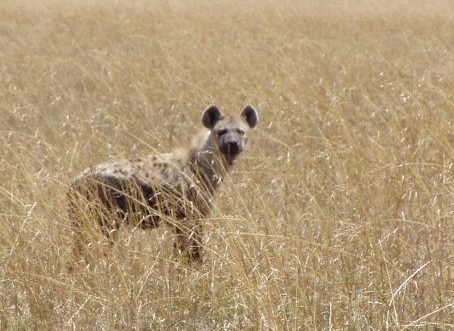
On and on they came, the heavy grey bodies of the wildebeest, the flashing stripes of the zebra, an occasional flash of dun or chestnut. Small self-contained herds of impala stayed wisely on the edge of the stampede, leaping high and long, graceful even in panic.  You could smell them from a long distance;  the bovine gaminess of fleeing ungulates; the reek of squirted dung turned liquid by fear.  And over it all, and through it all, the coppery smell of African dust that is made up of so many elements both ancient and new.   Amazingly, despite the general pandemonium, a few creatures here and there would stand off to the side, grazing for a few minutes as if they hadn’t a care in the world, before suddenly rejoining the stampede.  Some of these strayed innocently up the slope to where the lookouts were waiting to shoo them back into the mainstream and though here and there some developed a sudden sense of self-preservation and broke through to safety up the slope and beyond, most obeyed the herd instinct and continued to run with the rest.

The din was beyond description yet soon another and louder sound reached our ears as the guns began their merciless slaughter.  And slaughter it was, because the point of the exercise was not fine shooting but simply to send the herds far enough away from the European-owned farms and tribal shambas so that they could not easily come back.  So the hunters – and perhaps hunting is not quite the right word here for it denotes skill and there was no skill involved in this – just fired into the solid mass of animal flesh as it galloped by, not worrying whether they killed outright or merely wounded.  In any case, no wounded animal would survive long in the rush for if it stumbled or fell the hooves of its fellows would make sure it never got up again.  And so it went on, hour after hour, and we all felt the blood-madness that takes over at such time until the last few exhausted stragglers staggered by. 

This blood madness is a fearful thing and when it passes people look at one another uneasily or cough and turn aside or light up a cigarette or shuffle themselves about a bit, embarrassed by such a loss of the self that is usually governed by everyday decencies.  Some find it harder to shed than others.  I remember an incident involving two young soldiers from the Cameronian regiment, invited out for the day by a kindly farmer who feeling sorry for them as being far from home and friendless in a strange land,  thought they should be given a chance to know Africa better before being sent elsewhere.  This pair were not officers but ordinary squaddies from the slums of Glasgow whom nobody else would have thought to invite into their homes. 

They were conspicuously ill-at-ease among the settlers, shy and mumbling and sounding so much like the comic-book hero Oor Wullie that nobody could understand a word they said. Yet at the end of the day, with the blood madness still on them, they suddenly became volubly over-excited.  As we drove home in the red dusk, with several of us standing close-packed in the big farm truck, they were swearing and yelling every time the wheels hit a pothole, boasting of all they had shot that day.  Game drives got to some people like that; they just couldn’t come down or let go.  A jackal ran in front of the truck, its eyes glinting in the dusk, presenting an easy target.  One of the soldiers picked up his rifle and shot it, but the shot only caused a gut wound and the jackal spun round and round, shrieking and snapping at its side.  The soldiers laughed at the spinning jackal; almost screaming with mirth that sounded every bit as frenzied and horrible as the shrieks of the wounded animal.  The whole convoy of vehicles stopped and somebody – I can’t remember who – finished off the jackal with a merciful bullet.  The soldiers stopped laughing and there was a dark silence.  Having killed all day and seen others kill, they couldn’t understand that what they had done was an appalling breach of etiquette.  That enough was enough, even for hunters.  That we were sated with slaughter and could suddenly bear no more of it.  Especially when it was gratuitous and unnecessary.  I think one of the soldiers had been planning to jump out and seize the dead animal’s brush, as a trophy, but if so he thought better of it and they were both silent for the rest of the journey.  Nor did we see them later at the post-hunt barbecue on one of the farms, for they had been packed off back to their regiment.

Behind us on the plane we had left more than a thousand corpses scattered in heaps of grey and brown and black-and-white.  The watu from the farms would take some of the meat and so would the tribespeople from the reserve but most would be left to the scavengers, for Africa has a vast appetite and can soon swallow up any excess, any outrage.  Blood and bone and flesh would soon enough be reduced to fragments in the dust and where in the fresh morning the herds had grazed and kicked their heels, now the carrion eaters would come through the evening murk for their turn at the table. 

Rumours of blood travel far and fast in Africa.

Life among the lions of Athi Tiva

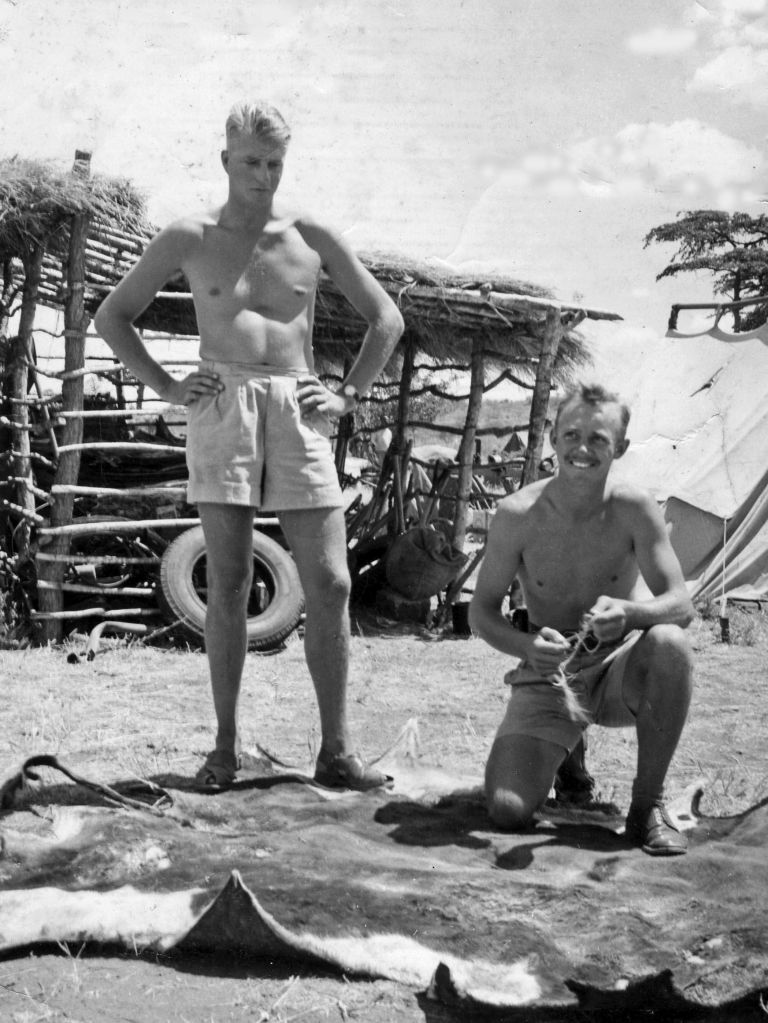
This is the story of two young men, a mob of cattle and a year spent under canvas battling lion, rhino, drought, deluge and the many diseases of the African bush. All they had were a few basic supplies, a nervous labour force and their guns.  It’s an adventure that Ernest Hemingway, that great lover of African adventure, could never even have dreamed of.  And it recalls a time and a way of life that is long gone.

Kenya, like much of Africa, is a climate of extremes and it’s always, as Bob Lake used to say, one or bloody other!  Bob is one of the two young men in this story, and the one who endured this adventure the longest.  It is from his memoirs that the account is drawn.

In the three years up to 1961 the annual rainfall in Kenya fell from just over 304.8 millimetres (12 inches) a year to 76 millimetres (3 inches). .  This severe drought caused problems for the cattle farmers in the Machakos district, south of Nairobi, and stock condition began to deteriorate.  Then, as grazing turned to dust, huge herds of game – mainly zebra, wildebeest, gazelle and antelope, hartebeest and eland – moved out of the neighbouring Maasai reserve and on to the farms. 

This led to a concerted effort to drive the wild game back into the Maasai country. Farmers and friends from the city gathered to shoot the vast herds and drive them back towards the railway line that ran between Nairobi and Mombasa. Bob Lake and his friend and neighbour Mark Millbank, the heroes of this tale, between them shot several hundred head in less than a month and drove many more than this on to other farms, where the shooting continued. Thousands of carcases were left for the vultures. It was brutal, bloody work and, in current terms, unacceptable but for them at that time, it was survival.

And, as Bob recalled, seventy years later: “It was all in vain. When I was out shooting with Major Joyce’s William Evans shotgun, on his property on the evening of April 11,  1961, I was surrounded by huge clouds of moths –  as heavy as a snow storm. On top of the drought, the dreaded army worm moth had arrived. Within days our land was covered by millions of caterpillars, eating the last bits of vegetation down to the roots of grass.”

The caterpillars devastated acres of crops and pastureland as well as the greenery that kept the herbivores  alive in the wild areas.  They made the roads treacherous and stopped the trains from running.  It was a plague of biblical proportions, consuming what little pasture had survived the drought.  Something drastic had to be done.

Another local cattle farmer, Dennis Wilson, located 250,000 acres of ungrazed land at Athi Tiva, known then as the B2 Yatta Controlled Hunting Block and mostly uninhabited.  It wasn’t good land, which is why nobody lived there; it was a dry, thorny part of the nyika that lies between the high plains country of the Athi, just south of Nairobi and the green hills that run behind the coastal strip.  The nyika is not desert and it has rivers but it’s inhospitable country and home only to lion, rhino, elephant, cheetah, hyena, various tough-mouthed antelope and a lot of ground squirrels.  Today it’s all been subdivided into small holdings and shanty villages and you have to wonder how they make a living there.  Back then, nobody wanted it, except to shoot things for sport.

To save the herds around the Konza and Ulu areas, Bob and Mark set out to move 5,200 head of cattle belonging to nine farmers to the Yatta plateau, on to land given by the Kenya government as temporary grazing until the drought broke.

Each farmer provided herdsmen for his/her own  livestock and contributed to the expenses of the venture on a per head of cattle basis. Bob was appointed manager and Mark as his assistant. Their only transport was Bob’s old, stripped down Land Rover.  

For the two men, both 21,  it was a great adventure – and a big responsibility. Athi-Tiva was home to the dreaded tetse-fly as well as ticks carrying cattle diseases such as anaplasmosis, east coast fever and redwater.  The area had no roads, only rough tracks through the hunting block; nor were there any buildings or development of any kind.

The journey involved moving, at very quick notice, the 5,200 head of cattle south by rail for 150 km, then unloading them and walking them another 80 km north-east along the bush tracks and game trails.  The herdsmen had to be constantly vigilant because the local Big Cat population soon got word that there was beef takeaway to be got for very little effort – it’s a lot easier to bring down a cow than a wildebeest or buffalo!   Bomas – rough enclosures of thorny brush – had to be erected at night and the Wakamba youth taking it turns to be on guard were armed only with spears, clubs and pangas (machetes).  Bob and Mark had rifles, shotguns and sidearms and the former were in constant use, to scare away predators or shoot for the pot. 

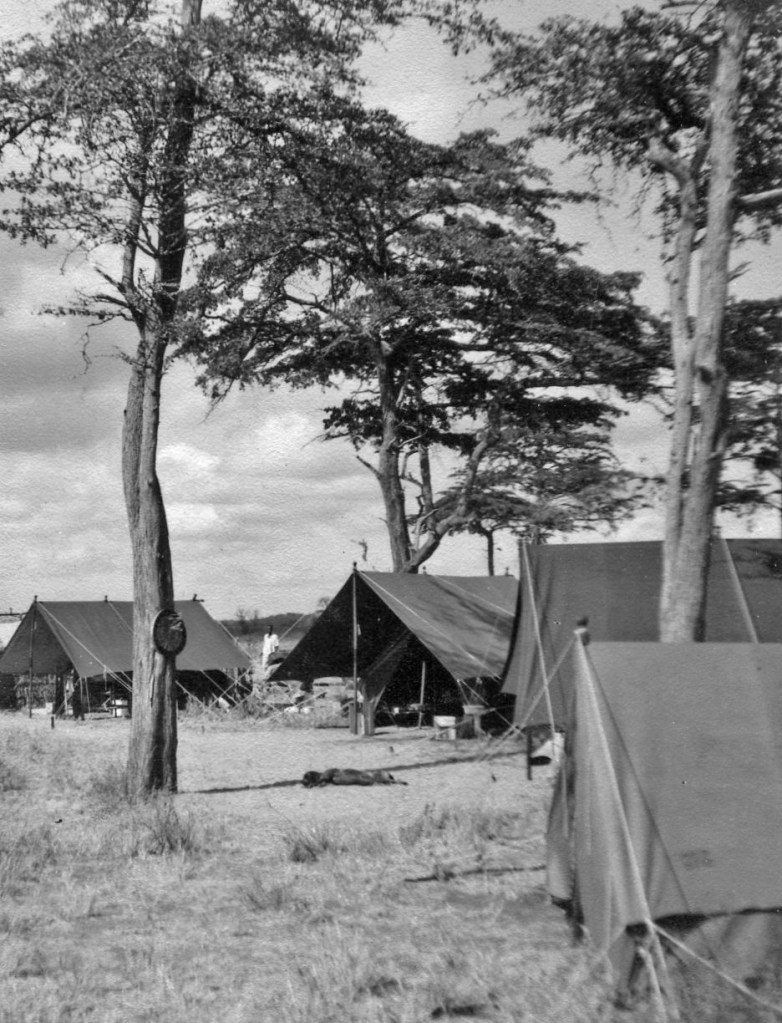
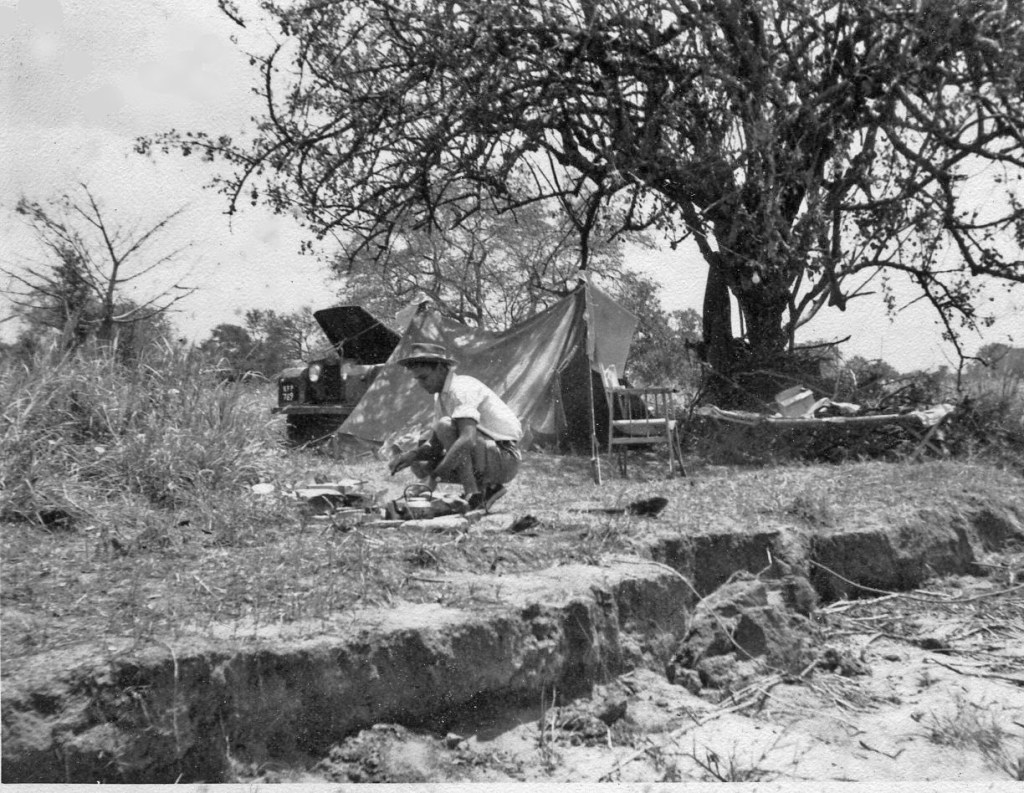
When Bob, Mark and the labour force reached their destination a camp was set up near the Athi River – which was only a series of shallow pools in that dry season – and eventually Bob had the labour build him a long-drop loo up on a hillside where he could look out over the countryside – king of the world!  Because he loved it there!  Loved the whole, wild, hard life of it.  A solitary man by nature, he was content to spend his days supervising the men and tending to the cattle, hunting and yarning with Mark, eating simple meals cooked over a campfire, going to sleep with the sounds of the bush in his ears.  Lion prowled around the camp at night, attracted by the beef carcasses hung in one of the tents, covered only in a mesh to keep away flies.  These steers, as well as various buck and antelope, had been killed to keep the camp in meat. A vigil had to be kept to prevent rhino from barging through the camp and knocking it down, there were a couple of near misses with elephant herds wandering past.  Hyenas came to scavenge for any scraps or rubbish left lying around, their weird, wittering calls making it difficult to sleep.

They were not completely isolated. A few weeks after the camp had been established, a small village appeared further down the river. A few huts roughly put together from mud-daubed branches and corrugated iron, a dozen families, some goats and chickens. In the Kenya of those days, such habitations could appear almost overnight. Bob questioned the menfolk who blandly replied that they had squatters rights as the land was uninhabited. Bob pointed out that it was government land, set aside for hunting and not habitable anyway. Before long, a cow disappeared and then another. Bob’s men reported finding horns and hooves half-buried in the sand along the riverbank. Then food and small items were stolen from the camp. The Kamba herders went and searched the new “village” and found incriminating evidence. They threatened to drive the newcomers away and burn down their shanties. Things looked ugly and the two young white men had to try and calm things down; concerned also by the fact that the squatters were obviously starving in that savage country.

They shot some Grants gazelles as an emergency food supply, much to the disgust of the herders who clearly regarded these non-Kamba invaders from further south and east, lacking in all the bush skills needed to survive, as opportunistic parasites attracted by what they obviously saw as some sort of new farm settlement. More would come, they warned darkly, and Bob knew this was probably true. So he contacted the authorities in Kitui who eventually sent down an African police officer and his askari to deal with the problem. By now the number of squatters was steadily increasing, though they had neither food nor water nor protection from wild animals. A child had died, and it was reported that an old man, too, had died and been put outside the loose boundary of the squatter village, among the trees, where he was consumed by hyenas. Bob was skeptical about this story but the Kamba labour force firmly believed it and shook their heads at the young bwana’s tender British innocence.

In any case, the brief and lacklustre appearance of uniformed authority seemed to work and the squatters disappeared as quietly as they had come – one morning they were there and by nightfall the bush had swallowed them, leaving scarcely a trace.

Visitors, too, came from time to time to relieve the loneliness – friends, family, the other cattle owners, government inspectors and a vet bashed their way through the thorny terrain to reach the camp. All had to bring their own camping gear and at times the little canvas boma became quite festive – there would be rough shooting by day and singalongs by night; the Wakamba labour force would put on a bit of a dance.  Better than that, the visitors would bring whisky, gin, beer, tinned delicacies, newspapers, books and magazines. But nobody stayed for long.  Which was just the way Bob liked it.  He was happy with Mark’s company and with learning more about the ways of the Wakamba and the wildlife all around.  In the evenings they would read by the light of torches and spirit lamps.  They turned in early because the work began at dawn, the days were long and in any case sleep was often interrupted by troublesome wildlife including, once, an invasion of Safari Ants which consumed everything in their path that wasn’t wood or stone or iron and could only be halted – though not completely stopped – by splashing around kerosene and petrol and setting it on fire, then battling to prevent the fire from spreading to the surrounding bush.

“Of all the dangerous things that happened in that year,” said Bob later, “That was by far the worst and it was lucky one of the watu gave the alarm before the ants got into the sleeping tents.”  Trapped animals – and humans – have been devoured alive  by the dreaded siafu – the remorseless, relentless Dorylus ants of Africa. 

As it was, any food that wasn’t in a tin was consumed and a perilous trip in bad weather had to be made to Kitui the next day to re-supply; not just food but petrol and kerosene. “We kept a good supply after that,” Bob remembered. 

Another constant threat was the scarcity of water and seeking it involved risk as the cattle were moved to the nearby river, and waterholes, and back.  Water storage tanks were trucked in, small dams were built, pumps were put in place with great difficulty in and over the hard ground. 

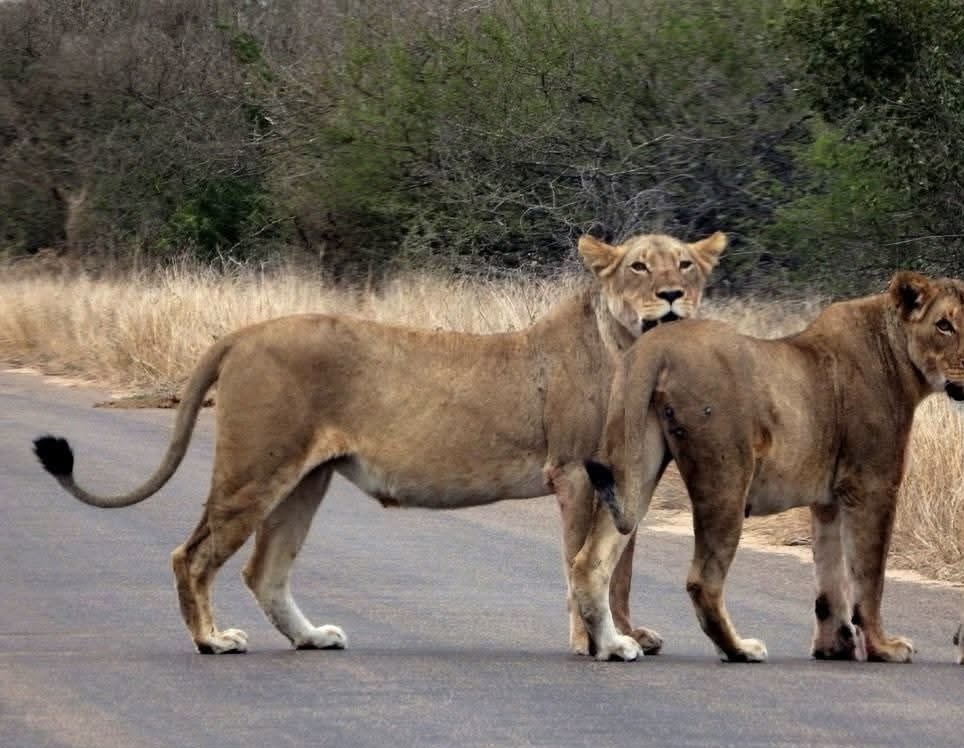
Bob and Mark were both keen hunters and good shots but had some narrow escapes – especially when an enraged rhino chased them, and Bob’s gun bearer, up a small and very prickly thorn tree.  On another occasion, Bob and one of the senior herders were walking back to camp in the dusk when they got a strange feeling.  They turned round to see two lionesses walking a few metres behind them.  The men stopped. The lionesses stopped. Then, seemingly uninterested, moved into the bush.  The men started walking again, turning their heads to see, after a few minutes, the lionesses back on the track behind them.  Athi Tiva is not so far from Tsavo, where the famous pair of man-eaters once roamed and the area had always had a bad reputation for producing lion with a taste for human flesh. So the men were worried.  After this continued for a few more minutes, and the camp still some distance away, Bob turned and shouted at the animals, who hesitated, lashing their tails, then, as Bob told it later, looking at each other as if to say “What’s that puny human think he’s doing?”

“I think, Bwana,” said the senior herdsman, a little agitated,, “That you should shoot them, not shout at them.  These simba do not like to be shouted at.” 

The lionesses were now only a few bounds away.  Lion are curious creatures and Bob felt that if they meant serious trouble they would have just attacked without warning; perhaps they just wanted to know what these two strange two-legged creatures were, wandering through the bush. 

“It was for all the world like they were two girls just out for a stroll and not particularly interested in us at all,” he always said in later years, when recalling the incident.  “They knew where they were going and they obviously had no intention of getting off the track just because we were there.  I got the feeling that if we’d just stopped and stepped back to one side they’d have passed us by with hardly a glance.  But of course I couldn’t take the risk.” 

So he raised his gun and fired over their heads.  Even in those days, you couldn’t just kill a lion without a permit, except to save your life, though of course nobody would have known, in so remote a place. Nor blamed you, for there was no shortage of lions.  Bob knew he might have to shoot them both and hoped they’d have the sense to bound away – which they did.  Snarling.

“They stopped once and looked back at us,” he recorded in his game diary, “And I’d swear they were looking annoyed and reproachful.  And then they melted into the bush and we didn’t see them again.”

Lions weren’t the only danger.  When the rains came, which they did with shocking force, the almost-dry riverbed suddenly became a torrent, washing away bridges and tracks.  This meant that the cattle could not be moved and Bob had to stay for longer than planned.  Mark had gone by then, called to other duties, and two other young men came down, at separate times, to lend a hand.  Two other young adventurers.  But it all proved overly rough for them; too dangerous and lonely, and, like the occasional visitors, they didn’t stay long.

One of them, though, stayed long enough to give himself some grief.  When the rain eased off the Athi ran more gently and pools formed among the rocks.  Almost overnight, hippo appeared, just a few of them, lounging in the water with their watchful eyes above the surface by day, coming on to the riverbank at night to feed on the fresh new grass.  Grass which was needed for the cattle. 

The men tried scaring the hippo away and Bob’s new offsider, James, even went to Kitui – a long journey in the Land Rover – and brought back some cheap firecrackers which they set off gleefully – but after an initial panic and a lot of bellowing and splashing the hippos ignored them.  Bob then shot one, and made biltong from the flesh and whips from the hide but while the hippos moved further down the river they didn’t go away.

James, who was in Kenya for a year after finishing Agricultural College, to gain experience before finding a job in South Africa, was a hot-headed 19 year old who came to look upon the small mob of hippo as a personal challenge.  Though he had never done any shooting before, he took to it with enthusiasm and spent hours driving Bob and the African camp servants mad by practicing on a variety of targets – mostly old Heinz soup cans.  Bob taught him rough shooting with a shotgun, for birds, and they bagged francolin and guinea fowl which made a pleasant change from the main diet of beef with maize meal and tinned vegetables. 

But James’s mind was set on something bigger and as this was still a hunting block he was able to obtain a license to go for it.  And the shooting of almost anything could be justified as necessary to conserve cattle feed.  Bob had a good relationship with the Game Department, which trusted him to do the right thing, so he warned James several times to be prudent with his new-found skill. 

Rain had made everyone’s work harder.  No visitors could get through to relieve the tedium, this included the vet so Bob had to do a lot of the veterinary work himself; inoculating and dipping the cattle in the rough timber yards which had been hurriedly erected upon arrival, helping cows give birth, castrating young bulls.  These were tough beasts with a strong dose of Sariwal in their bloodlines but they were still subject to the pests and diseases that makes raising cattle in Kenya such a challenge.  Some of them were mauled in attacks  by lion and leopard, which also took calves,  others were bitten by snakes or harassed by hyena. Bob was out for long hours each day, fixing problems and encouraging the labour, many of whom had got fed up with the whole venture and wanted to leave, or had already gone. 

James, young and heedless, went down to the river one evening and shot a hippo.  He thought he’d missed because it disappeared under the water; when its head popped up he shot again.  And again it disappeared, only to reappear a minute later.  James decided to take a closer position and moved from behind his rocky vantage point closer to the water.  And then he noticed three hippo carcasses floating along in the current, towards the camp.  He’d shot three different animals!  Half thrilled, half scared, he raced down the bank to have a closer look.  Whereupon a couple of huge males came out of the water, straight at him.  Instead of standing his ground and trying for another shot, James turned and ran towards the camp, screaming.  Bob and some of the labour came from their tents to see what was up, in time to see the boy stumble and roll down the bank, on to some rocks.  As Bob told it, the two hippos stomped about a bit but the sight of so many humans proved discouraging and they waddled back into the water to join the herd.

James had broken his right arm.  It was put in a sling and he was given some aspirin, the only painkiller they had in camp, apart from whiskey.  He had to endure the agony for several days before Bob was able to get him to Kitui in the Land Rover – an excruciating journey for someone with a bad fracture and a

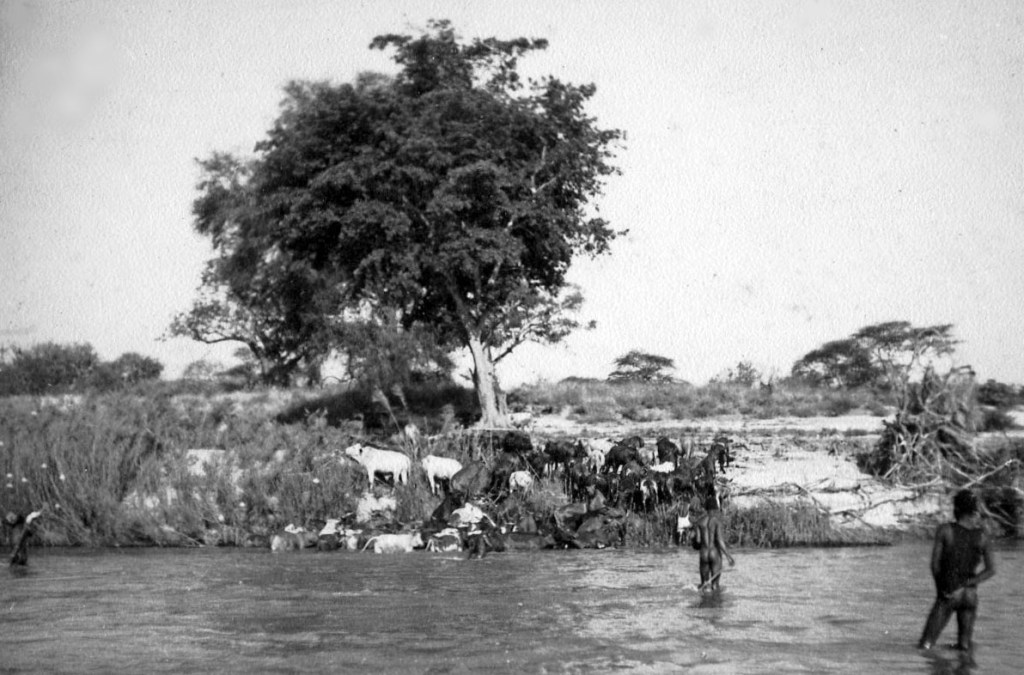
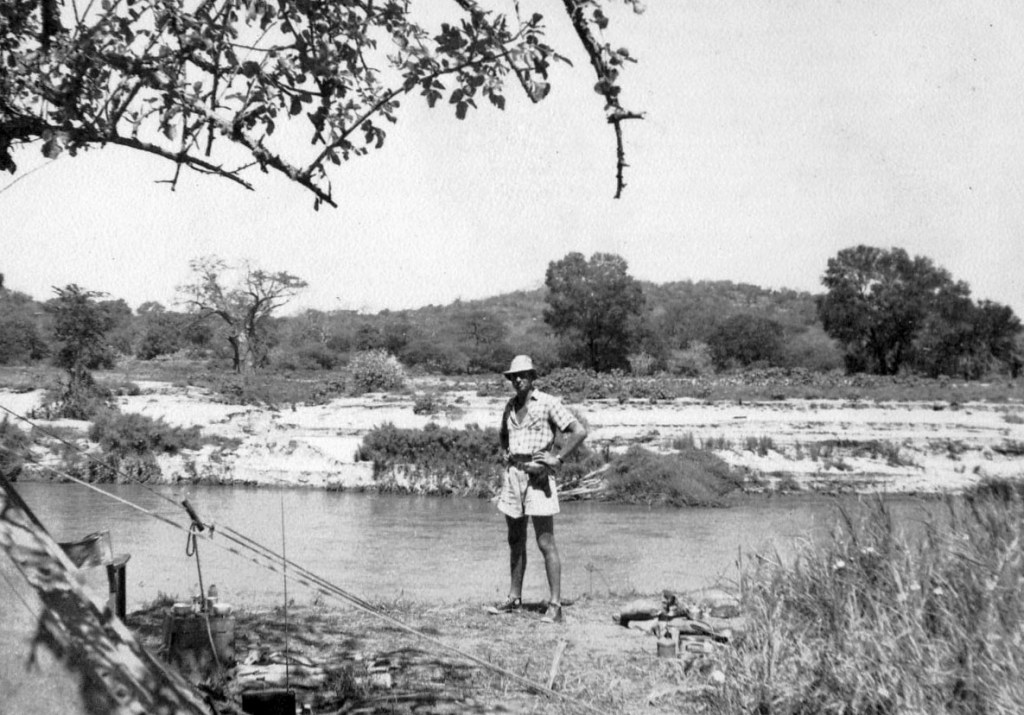
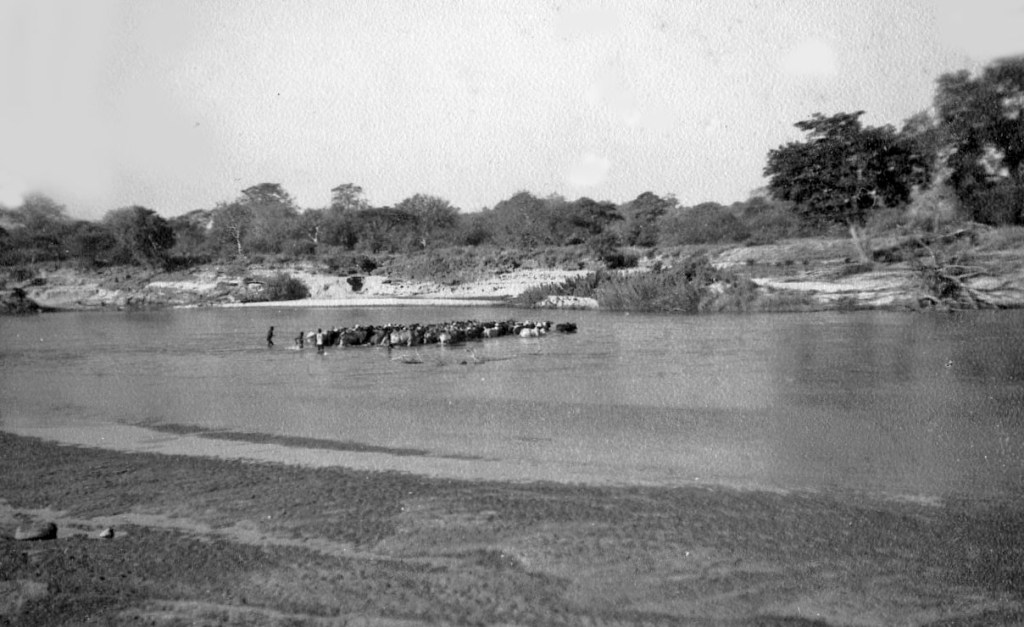
Down on the Athi River in 1961 From top left, Bob by the river near where his offsider James shot three hippo and then had to run for it; taking cattle across was always a risky business; James in the camp, just before his hippo hunting trip. Botom from left: When the drought broke and the rains came the river flooded and carried away the bridge; watering the cattle; an askari and his officer from Kitui questioning one of the squatters who mysteriously came to take up residence near the Athi Tiva camp.

Bob stayed for a year, living under canvas, happy in his comparative solitude and well-aware that he was undergoing a rare Boy’s Own adventure.  Eventually, after the rains had come and gone and the grass grew quickly again on the plains, under the hot African sun, he and others took the cattle back to their home farms, with remarkably few losses considering the long period of privation and danger.  Another long and difficult trek, another rail journey.  And the acclaim of those whose livelihoods had been saved. 

Bob Lake, my husband, lived to be 85.  He had many adventures, both in Africa and in Australia where we eventually migrated and where we lived in some of the country’s toughest cattle country.  Yet he always considered the Athi Tiva expedition the greatest adventure of his life and it’s a good job he wrote it all down because otherwise I wouldn’t be able to share it with you now.

The great romance of travelling by train through the African bush

The world boasts many great train journeys.  The Orient Express, the Trans-Siberian, the Rocky Mountaineer, South Africa’s Blue Train, Australia’s Ghan or Indian Pacific.  I contend, however, that there have been few train journeys to rival the overnight trip between Mombasa and Nairobi in the years before 1963.

I’m going to try now and recreate that journey in my memory and because I was a Mombasa girl, and because the beginning of a journey is usually more exciting than the way home, it is always the “up” journey I remember, from the coast to Nairobi.  Up-country types will, of course, remember it the other way around. 

Travelling by train back then was more than just a journey, it was an Occasion.  People dressed for it, casual but smart.  No jeans or shorts for women and men planning to eat in the dining car had to wear long trousers and a tie.  There was only one passenger train a day and it left at 6pm.  It’s possible some travellers arrived at the last minute and flung themselves into their carriage just in time, enjoying none of the gracious ceremony of departure.  But these would have been few and far between because most of us liked to arrive at the small but immaculate station in good time and, having checked out our compartment and found a porter to load our luggage, repair to the bar-cafeteria for a tea, a beer or a cocktail.  You could buy a very good small plate of potato chips for next-to-nothing, I remember, or  sandwiches and other snacks.
 Leaving on the train was a social affair and the more people who came to see you off the more fun it was.  Sitting there on the raised dais of the cafeteria you could survey your fellow passengers.  There would be bashful honeymoon couples shedding confetti, businessmen in formal garb with briefcases, sun-reddened holidaymakers heading back home to Nairobi or Nakuru or even Kampala, smart young women on shopping trips to the superior retail outlets of the capital, men in safari suits, Indians in turbans or dhotis or vivid saris, perhaps a priest or two in dog collar and cassock, or a family of soberly-dressed missionaries.  It was all very noisy and chaotic as people yelled greetings to acquaintances or farewells to those who came to see them off, and porters dodged in and out trying to get all the luggage safely stowed before departure, and  station staff made occasional announcements over the tannoy  which could barely be heard above the general din. 

And, behind it all, the slow, steady, deep chuffing of a great engine getting up a head of steam.  You were hardly aware of it at first, until it began to build to its crescendo of imminent departure and your pulse began to throb with it, excitement building along with the steam.  You began to withdraw, a little, from those who had come to see you off and make common cause instead with your fellow passengers who, like you, were now moving purposefully towards the train that huffed and puffed like a great animal anxious to be on its way.  You felt a sense of importance – The One Who Was Travelling, who was going places – and a sense of pity for those poor domestic creatures being left behind.  A flurry of kisses, a hug or two, many more handshakes (for most of us were, after all, British!) and the usual banal injunctions “not to miss the train”.  As if you would!  Though inevitably there were one or two folk 1`frantically running and gesticulating and grabbing at door handles when the rest of the passengers were already safely aboard and taking up their positions at the windows, waving and grinning.  Unless, of course, they had nobody to see them off, in which case they quietly took possession of their seats and took out their books, immune to the emotions of parting.

Then – the guard would blow his whistle and the last door would slam and there would be some flag waving from the boiler plate up front and the guard’s puny toot would be obliterated in memory by the thrilling shriek of the engine’s great steam whistle and all the romance of train journeys everywhere – from Dodge City to Bhowani Junction to the Coronation Scot – came together in one glorious moment as the pistons began their steadily-increasing rhythm and the  mighty engine left the station, its many dull red carriages with their eager travellers following obediently behind.  Oh, those mighty steam engines of my childhood!  No wonder people still love them today; enough to collect them or buy books about them or gaze at them in museums.  To us, they were neither quaint nor remarkable; merely the way we travelled.  Yet we were not immune to their charm and power – even as a young woman I enjoyed going to look at the engine before departure and others did, too, with awe.  When I was about ten, and not travelling myself but seeing somebody off, my dearest wish was realised when the engine driver invited me (and a couple of other kids) into his cab and showed us the controls and let us pretend we were driving the train.  Everything in that cabin gleamed and shone with brass and rich wood.  If only my father had been an engine driver and not a government official who went, dressed in tropical whites, to his dull old office every day.  I would have much preferred him with dirty hands and a smut on his nose and a huge, powerful steam engine under his command!

In my memories those engines were either green and black or entirely black.  I’ve been told there were also red ones but I never saw them.  They always gleamed, their paintwork and brasswork immaculate, the letters “EAR & H” born proudly.  Sometimes it took two of them – one at the back as well – to get the carriages up the two main scarps between the coastal strip and the plains of the Athi; I don’t know why this was; perhaps it was when the number of carriages exceeded the norm.  Mostly, though, when there was still light in the sky,  you could lean out the window and see, on a curving line, the fine sight of the engine up ahead, smoke pouring from its funnel (and putting smuts into your eyes if you weren’t careful!), pulling its line of carriages with apparent ease. 

In those days (and maybe today also) there were three classes of train travel.  First class compartments had two berths and a spare, modern blue-grey décor with pull-down tables.  Second class compartments had changed little in design since Victoria’s day and had four berths with green leather seating and lots of dark timber panelling.  Whichever class you travelled, you did so in a propinquity quite alien to English people of the time, who under other circumstances would rarely speak to a stranger unless properly introduced, let alone dress and undress in a confined space and share the intimacies of sleep.  In fact my husband once travelled in a second class compartment with three other men and none of them spoke a word until, next morning, one broke the ice by introducing himself.

 My generation was much less formal and we would soon be chatting happily with whoever our co-travellers might be – some lasting friendships were formed on the overnight journey between Mombasa and Nairobi.   In my day, only the distinctly better-off whites travelled first class.  Most people – those of European origin and the wealthier middle-class Indians – travelled second.  Only  black Africans and the poorer sorts of Indians travelled third class and this was a very different affair.  No compartments but open carriages with wooden seats where passengers stowed their baggage, goats, chickens and children and took along their own food.  Third class was noisy and lively and probably great fun but few Europeans ever risked it.  One who did was my grandmother, always a bit eccentric and very curious.  Just why she did so I never knew, being very young at the time.  But she often talked about it.  She got on the train at Ulu station at about seven at night and sat there with all the tribespeople and livestock, sleepless on the hard and upright seats, until the train arrived in Mombasa at six the next morning.  Apparently she was made very welcome; women shared their mealies and cold posho with her; she shared her sandwiches and fruit and biscuits with them.  She’d thought to take several packets of polo mints with her and these, no doubt, proved very popular.  She never drank coffee and didn’t care all that much for tea so I don’t know what she drank – probably water infused with Andrew’s Liver Salts, which she took daily. Most of those in her carriage were Wakamba and as this was the tribe among which she lived, and was most fond, I expect they all got on very well together.  Those who travelled third class tended, as much as possible, to congregate in tribal groups though all seemed to get on well together, whatever their tribe, and the close carriages would be filled with the sound of Swahili as well as a dozen tribal languages.  Men sat with men and women with other women, and children.  This applied to both Africans and Indians, and the latter, in any case, sat usually in their own carriages – there was no official segregation but unofficially the two races did not mix.  I can just imagine the smells – Africans rarely bathed in those days, as we would understand bathing, and had no deodorants.  And there were, in any case, no bathing facilities on the train.  The lavatories were pretty foul, too.  Goodness knows how my ultra-fastidious grandmother managed – but she always spoke of the whole journey as a great adventure (though her doing so odd a thing infuriated my staid parents!).

Back in first and second class, life was both more ordered and less lively.  At first, you could look out the window as the train climbed the steep grade from the coastal plain,  as it was described in my book A Garden in Africa: “through hills of red earth planted with coconut palms and banana trees, African children waving, chickens running among the mud-walled houses, women of the coastal tribes in their bright cotton kangas or short skirts of fibre strips, naked from the waist up”. By the time the first station was reached, at Mazeras, it was already dusk – that brief equatorial blink between blazing daylight and the cool of night.  I cannot be sure after all these years but the first sitting for dinner was called about this time.  Those travelling with children would answer this call, and others wishing to get fed and to bed as early as possible.  Some took along their own meal of sandwiches and fruit and cake.

Most, however, opted for the later sitting at about 8.30 and I remember regarding this as a significant right of passage the first time I travelled on the train as an adult.  When the second dinner gong was sounded by African train staff immaculate in their starched EAR & H uniforms we would hurry down the swaying, rocking corridors from carriage to carriage until we reached the dining car.  People dressed for the second sitting – men in ties and light jackets, women in frocks with high heels and well-coiffed hair. And making your way down those narrow passageways in three inch heels involved quite a balancing act, let me tell you!  The dining car harked back to earlier and even more gracious times – all white linen and gleaming silver and each four-seater table with its cosy little red lamp.  Attentive staff brought the beautifully-presented menus and though the food was plain and very English it was well-cooked and with all the advantages of a country generous in fish and seafood and fresh tropical fruits. How the chefs managed to produce such meals in the tiny galley was a matter of wonder. Outside, the night was speeding by and wild things were seeking their own sustenance.  But there, inside that softly-lit carriage, with its cheerful chatter and chinking glasses, you could have been in any civilised restaurant in any civilised city in the world.

That, to me, is one of the enduring fascinations of train travel.  Ships take us over the ocean, an element of which we can never truly be a part.  Planes take us up so high that we no longer feel connected with the earth.  A train, however, remains earthbound and the everyday world of earth and trees and houses is still visible and only inches away as we move through that stationary landscape in our own time and space, untouchable and unreachable by what’s outside and snug within our own frame of reference.   No wonder Einstein used a train to illustrate his Theory of Relativity.  And that is what it was like, in my memory, back on the Mombasa-Nairobi train in the nineteen-fifties and sixties.  After dinner we tended to turn in early for by this time the train staff had been round to make up the bunks and there was nothing to do except chat to your fellow passengers or do a crossword puzzle.    Some people passed the time with cards and I know one regular train traveller from those days who always carried a couple of packs with him and says he made some good friends over those late night card games.  The fact remains, though, that in a second class compartment with four people of, usually, different ages and habits and inclinations, it was better to climb into your bunk and read yourself quietly to sleep.    Some people find  it hard to sleep on a train that judders and rattles but I always find it soothing.  Today, it’s true, I’d find it impossible to sleep in a confined space with four other people, probably strangers if you were travelling alone, with all the snoring and snuffling and coughing and clambering up and down the ladder from the top bunk to get to the loo at the end of the corridor.  Back then, though, a veteran of the school trains, I found all that rocking, rolling and riding very conducive to deep slumber.  And as you snuggled down in your narrow bunk, in your crisp white EAR & H linen, outside was all the vast red thorny wilderness of the nyika that lies between the coastal scarp and the high plains country around Nairobi – a wilderness in those days little inhabited by humans but rich in species such as elephant, rhino, lion and cheetah. 

Oh, to go to sleep with all of Africa around you.  And then to wake to chill air and the vast plains of the Athi, alive with herds of zebra, wildebeest, kongoni, and antelope of all kinds.  Ostriches would seem to race the train, their great legs mimicking the pistons.  Tommies would skitter away, tails wagging. Warthog families would trot busily over the dusty ground, sometimes with several little piglets in a well-behaved line.  How many of the world’s great train journeys could offer a Movietone panorama such as that?  In the small compartments we would modestly try to dress ourselves without inconveniencing our fellow-travellers- or baring too much flesh.  Early-risers would lay claim to the loos while others queued up outside.  Overnight baggage and handbags would be gathered, goodbyes would be said, people would start to hang out of the windows as the train steamed through the dull outlying area around Embakasi before making its final huffing run into Nairobi station.  Greatest of all the beasts in Africa, the mighty locomotive of the EAR & H had brought its consignment of passengers and mail safely through almost 330  (530 km)or so miles of night and trackless bush, scaling almost 6000 feet (1700m).

The railway was pivotal in the development of colonial Kenya, linking the coast with the inland and carrying early settlers from Europe to take up their farmsteads (though the doughtier Boers came up from South Africa by wagon!). In the centre, the opening of the Mombasa railway station, at left, the carriage from which Inspector Ryall was dragged to his death by a man-eating lion and right, tribal society gets a first taste of technological change to come.

To school and back

Travelling on the school train offered a slightly different experience.  We high school girls would arrive at the station in full uniform (grey flannel skirt, white blouse, red and black tie, grey felt hat – blazer over the arm) despite the Mombasa heat with our hockey sticks and tennis rackets and big tin trunks, rushing about excitedly to greet friends while our parents retreated thankfully to the bar.  I have some faint memory of boys and girls travelling back to boarding school on the same train, at some earlier time, but by my time at boarding school (1958 – 1961) we travelled on different days.  Not hard to guess why!  It’s interesting to reflect on how self-focussed are the young because for the life of me I can’t remember anyone else travelling on those trains except our lot.  Presumably there were other passengers on those school trains but I have no recollection of them, nor of girls travelling to any of the other up-country boarding schools – Limuru, for example, or Loreto Msongari.  All I can see in my mind’s eye are the grey-clad KGHS lot milling about in a crowd large enough to eclipse all over travellers – shrill little thirteen year-olds going up for the first time; dignified sixth formers in their distinctive blue ties; a couple of harassed-looking teachers trying to herd us all together.

The journeys “up” were tinged with sorrow and trepidation – at least for those of us who didn’t like boarding school.  Another term looming: of compulsory games and sarcastic prefects; of stodgy food and conduct marks; of Sunday church and a life ruled by electric bells. Coming home on the “down” train, though, was a different matter.  How happy we would be as the train puffed its way out of Nairobi station, past the carriage where the man-eating lion had snatched the unfortunate police inspector Ryall years before, and southward across the Athi plains as night began to fall.  Schoolchildren travelled second class and didn’t eat in the dining car – instead we were supplied with sandwiches and fruit by the school, and a large bottle of cordial each to drink.  Of course, we’d already had a cooked lunch and were, I think, quite happy to sit in our compartments munching our sandwiches and knowing that our next meal would be in Mombasa…at home! 

Those long nights on the school train were filled with happy chatter as we gossiped about our friends and enemies, shared secrets about boys we admired, or whom we fervently hoped admired us, made plans for the holidays that seemed to stretch endlessly ahead even though we only got four weeks at Christmas, two at Easter and two in August (or was it July?).  To us coast girls the holidays were all about the beach – those long, white, empty, palm-lined beaches divided only by the dark lines of  native fish traps and the occasional headland, beyond them and the aqua sea with its protective line of offshore reef.  How we longed to be back on our dear little island with its baobabs and scarlet poincianas and glorious architectural fusion of the Arabic and the Portuguese.  Sailing at the Yacht Club, dancing at the Sports Club or Railway Club, lounging happily over a Coke at the Nyali lido, waterskiing on Tudor Creek, eating samosa and playing the jukebox at the Cosy Café, listening to the latest hit singles at Shankardass where the patient owner put up with us crowding into his listening booth even though we rarely had the money to buy anything. 

And, once we were old enough, there would be boyfriends waiting to meet us in town, or at the pictures, or cycling with us over the bridge to Nyali, or across the ferry to the south coast beaches.  It was a wonderful time, and a wonderful place, to be a teenager on holiday.  Though of course, nothing is quite THAT wonderful and I have to think hard, now, and honestly, to remind myself that being young had its share of anguish.  Spots that erupted overnight.  Parents who wouldn’t let you stay out late. The boys whom you desperately wanted to date and who wouldn’t look at you.  Boys with whom you wouldn’t be seen dead who kept asking you out.  Quarrels with your best friend. Jealousy of girls prettier than you.  Frustration that your mother wouldn’t let you have a new dress for the teenage dance, or let you wear lipstick, or pierce your ears.  Worry about what your father would say when he saw the latest term’s school report.  No, being a teenager wasn’t always perfect bliss but on the school train, going home, with all those glorious days of comparative freedom ahead, it certainly seemed that way.

At that age we pretty much took for granted the great wonder of Africa that lay beyond the train windows.  Elvis or Cliff or Buddy were of much greater interest to us than wild animals and those of us with transistor radios were very popular in the small four-berth compartments, where we might be lucky enough to pick up Forces Overseas Broadcasting, which played the best pop music.  Sometimes, though, Africa forced itself upon us.  There was the time, for example, when the line was so slippery with the bodies of millions of army worms that the train had to halt while workers cleaned the tracks.  Elephant sometimes crossed the line, necessitating another slowdown. And once we hit a rhino, somewhere around Tsavo, in the middle of the night.  There was a thud that travelled down the length of the carriages and the great engine juddered to a halt.  You can imagine the pandemonium with a great mob of teenage girls in their nightdresses and pyjamas, having been suddenly awoken, hanging out of the windows to see what was going on and, despite the furious exhortations of the two teachers, actually getting down on to the ground by the side of the track.  Hysteria prevailed – we’d hit another train, the tracks had buckled, a Maasai herdsman had been crossing the line with his cattle (at that hour!).  Then word was passed back that it was a rhino.  Of course we all longed to see, and crowded to the front of the train, but could see nothing in the darkness beyond the steaming bulk of the engine.  We waited for what seemed like hours though it was probably only an hour before a truck arrived, with men and ropes, and after a lot of that typical African argy-barging and fitina the poor beast – quite dead – was dragged off to one side.  The engine (one supposes) was inspected and found fit to travel and we got up steam again and continued the journey, we girls hanging out of the window to stare at the remains of the poor, foolish rhinoceros.  Some said it had probably charged the engine, rhinos being notoriously cantankerous and always ready to take on creatures bigger than themselves.  Though this was obviously nonsense, we liked to believe it.

In my memory we rarely slept on the school train, though of course we must have done.  Mostly, I remember lying awake and chatting in the darkness, then getting up and peering out every time we stopped at one of those little lonely stations along the line where mysterious goods were noisily loaded and unloaded and young tribal boys would run alongside trying to sell ostrich eggs and bananas to the newly-awakened passengers.  One night I remember in particular for I was sitting curled up on my lower bunk, by the window, and noticed a falling star, and then another, and another.  A meteorite shower of some extent, because it went on intermittently through the night.  It was 1960 and a time of turmoil – some religious group had forecast the end of the world,  there had been a great earthquake in Chile and not long after that the newly-independent Belgian Congo had erupted into civil bloodshed that sent thousands of white refugees across the border.  Which was, in fact, the reasons we Boma girls were on that train because the school had been opened to house the refugees and we were all being sent home early – and in a heightened state of excitement.  So, being fifteen and credulous at the time, I saw those scattering “stars” as a sinister omen and was both frightened and awed.  Perhaps the end of the world really WAS at hand!  I have seen meteorite showers since, and Halley’s Comet, but nothing so spectacular as what I saw out of my train window that long ago night, in the clear skies over Africa. 

When we awoke in the morning –IF we slept – it was to the languorous warmth of the coast and a series of fiercely competed-for “firsts” – the first palm tree, the first glimpse of the sea.  Down we went through the green and terraced hillsides of Mazeras and Mariakani, waving enthusiastically at the Watoto carrying bananas and the women cutting maize.  Down, down, down to the flatness of the coastal strip and the water everywhere.  Across the causeway, where in the distance the dockside cranes of Kilindini Harbour stood like giant giraffes.  It was our custom to throw our emptied drink bottles from the window and over the causeway into the creek below.  That muddy creek bed must be lined with glass fragments to this day, to mystify future archaeologists.  This practice was forbidden but we did it anyway!  Term after term, year after year.  It was part of the ritual of coming home.

Once we had crossed the causeway the train slowed right down and seemed to take an interminable…an unreasonable…an unbearable time to meander through the sheds and godowns around Changamwe.  Until…at last…oh longed-for at last!…we would round the bend among all the shunting yards and myriad tracks and huff our way into the station.  There, waiting for us, would be parents, smiling and waving.  Even my bothersome little bro was a welcome sight.  EVERYTHING was a welcome sight…the palm trees, the distinctive clothing of the coastal tribes, the splendid tusks on Kilindini Road under which we passed, the servants welcoming us home with a bountiful breakfast, the beloved baobab tree in the garden, the gleaming blue ocean, the feeling of holiday and above all the heartfelt happiness that is HOME!

That’s where I’d like to end my story but it does have a slight, sad sequel.  Some years after I’d left Kenya I returned there with my husband and, for old time’s sake and ignoring the warning of friends still living there, we decided to travel down to the coast by train.  We so looked forward to this experience and were as excited about it as children when we left Nairobi Station.  Alas, even in a short time, things had changed for the worse.  Our First Class compartment was not very clean and nor was the bedding – the crisp, white sheets and coarse but sweet-smelling EAR & H blankets of yesteryear were no more.  The dining car looked much the same, albeit shabbier and the silverware tarnished, but of course the clientele had changed.  Instead of smiling at each other intimately across a red lamp-shaded table as the African night rushed past we found ourselves facing two very large, very fat, very cheerful Luo police inspectors with rather awful table manners.  They couldn’t have been more friendly and we chatted away quite happily – about our new home, about our recent travels, about the changes that had come to Kenya – but it wasn’t what we’d imagined our journey would be.  And the food  – some grey and indeterminate stew – was even worse than boarding school grub. 

It was a lesson that has stayed with me ever since – for it can be a mistake to go back.  Kenya, more than most places, exerts a magic so powerful that our nostalgia haunts us even half a century or more after we’ve left.  Ex-Kenyans gather wherever they can, even when very old, to remind each other of how it was, back then.  What we are inclined to forget is that our longing is for another time, as well as another place.  It’s possible to go back to the place, and even try to put a positive spin on changes that, in our hearts (and eyes) offend us.  But we can never recapture that special time not only of youth – everyone has that – but of rare privilege.  The privilege of being such as we were, in such a place, at such a time – and all the rarer because it can never be quite that way again.

And so, in my memory and that of many others now approaching the twilight of their lives, the dear old train puffs forever on through the African night.

Mrs R and the tiger

Though Kenya is famous for its wild game the island of Mombasa has always been rather poorly equipped with wildlife, if you exclude marine creatures.  Mongooses were plentiful, and birds and reptiles but no antelope or elephant or zebra and certainly no large feline predators.

Until, that is, the Day of the Leopard.  Or, to be more correct, a couple of weeks of The Leopard because once, a long time ago, a rumour went racing round the island that a leopard had crossed from the mainland and was on the prowl.  I can’t exactly remember the year but it was possibly 1959 or 1960, and I missed all the excitement because I was at boarding school in Nairobi.

*

Africans on their way home at night reported a large, spotted cat – a chui for sure, glimpsed slinking through gardens or following them at a discreet but still nerve-wracking distance.  An Indian shopkeeper thought he saw the same creature skulking about when he was emptying some food bins one night.  Soon sightings were coming from all parts of the island and these gained credence among the scoffers – such as my father – when pug marks were found in the grounds of the Church of England cathedral.  The protestants of Mombasa considered this a definite triumph over the Papists down the other end of Fort Jesus Road and some wag suggested that the Provost of the Cathedral (not sure if it was still Rex Jupp at that time) buy himself a rifle!  The pug marks were identified, by those who knew how, as being definitely those of a leopard.

After that the search was on, but the leopard proved elusive which, consider how crowded was our little island, without a lot of natural bush left upon it, is a tribute to the ability of big cats to conceal themselves from human view. We were not, in fact, particularly frightened of this particular big cat because leopards were not known to attack humans unless seriously provoked.  However, a leopard is still a formidably strong and well-armed animal and who knew what it might do if it became hungry enough.  Children were warned not to wander too far and dogs were kept indoors at night.  As it was, any dogs that disappeared at that time were considered to have become leopard food and a couple of gung ho types actually sat up at night with native pi-dogs bought especially for the purpose and tied up as bait nearby, until the RSPCA put a stop to it.  Men – European men at least – seemed to consider the whole thing a good joke but women and Africans – who were of course less-securely housed and more likely to be out on foot at night – were frightened.  Indians were frightened too or at least the man behind the counter of our grocer, Beliram Parimal was, because, as he told us, “leopard is terrible man-eater”.  In India, said my father, that’s quite true, for there leopard are larger than ours and also seem to be fiercer. He was a great fan of the books of the Indian hunter Jim Corbett, whose brother lived at Bamburi, and had not long since read The Man-eating Leopard of Rudraprayag. Unfortunately others in Mombasa had read this book too, borrowed from the British Council Library at Tudor, which probably helped fuel the general hysteria.

Leopard were, of course, quite common on the mainland wherever there was heavy forest.  I myself saw them a few times – one on the roof of a cottage at Jadini Hotel, one crossing the road not far south of Malindi.  When calves were taken at Kilifi Plantations a leopard was the suspected culprit and when I lived at Port Reitz my servants were afraid to walk home after dark because leopard were often seen in the vicinity. But a leopard on Mombasa Island would have to have either crossed the causeway, or Nyali Bridge, or swum  across Tudor Creek or possibly the lower mangrove reaches of Kilindini Harbour.  Suggestions that it might have crossed on the ferry from Likoni were generally disregarded!  It all seemed so unlikely and even the reported pug prints in the church ground were regarded with suspicion by some – Mombasa was never short in those days of young practical jokers and some still remember the night a few of us drove all over Nyali pulling out name posts (remember those?) and swapping them around to confuse home owners and visitors.  And then, suddenly, the leopard did something quite unexpected.

We lived in Kizingo Road and not far from us was a collection of small, cheap, thatched houses known collectively as “the bandas” and inhabited by the lower-ranking  white local government employees.  Among them was a woman I shall call simply “Mrs R”.  She was married to a mechanic employed in the council workshops and her Lancashire origins were very obvious in an accent so broad that those of us who spoke “home counties” English could barely understand her – and thus she was much imitated behind her back.  For Mrs R was not popular.  She nagged her husband, gossiped spitefully about her neighbours, had few friends and was feared not only for her uncompromising opinions, loudly expressed in that harsh accent, but for her constant trouble-making.  She was particularly unpopular with the neighbourhood children because, childless herself, she was always shouting at us to stay well clear of her house and garden and “keep roody noise daown”.   I may be libelling the poor woman who has been dead many years now and thus unable to defend herself – but this is the way I (and others) remember her.

Mrs R was of that type and class – fortunately a tiny minority in Kenya – who went out to Africa purely for the job – and perhaps the sun – and appeared to get very little out of it.  They never learned Swahili, never went into the bush or even a game park, never in fact stirred very far from their government-supplied house.  They lived frugally in order to save to go “home” one day and buy a small bungalow at somewhere like Hove.  They employed only one servant to do everything and as their houses usually contained little besides the basic PWD furniture this little was not much.  In fact they feared and despised Africans and were, in turn, despised by those who did work for them and who preferred their bwanas and memsaabs to not interfere in the kitchen or lock up the pantry or dole out groceries with parsimony. 

Mrs R was a case in point – she had a succession of servants from tribes who did not take well to domestic service and she treated them with rudeness and suspicion.  Worse, she raised her voice to them in a way that other memsaabs would consider ill-bred as well as likely to be counter-productive.  Possibly she did this because she had never bothered to learn any Swahili and believed, in true British fashion, that the only way to get a foreigner to understand you was to shout at them.  Again, I am being rather harsh, and more than a teeny bit snobbish!  But that’s the way it was.  People like Mrs R never felt any kind of affinity with Africa, never felt the deep love felt by the rest of us, never tried to understand it, longed always for the day when she could finally return “home”.  Where, no doubt, she would bore her friends and relatives with tales of her glory days as a memsaab.  And people like Mrs R never took any interest in wildlife nor learned to tell one animal from another.

Ironic, therefore, that it was to Mrs R that the Mombasa leopard made its most famous appearance.  According to two close neighbours, they were awakened late one night by a scream and a terrified voice calling out “Wilf, Wilf, it be taiger!  It be taiger!”.  When they rushed outside they realised the voice they were hearing was that of Mrs R, emanating from the conjugal bedroom.  “Wilf, wake up!” she called.  “It be taiger!”.

The way it was reported to me (and to many around the neighbourhood) Mrs R had been lying awake in bed when she saw a large, spotted, bewhiskered face peering right in her bedroom window.  “When I realised what t’thing was,” she confided to my mother, “I were raight terrified”.  Mrs R might not have known her animals but she did know a big cat when she saw one in her window, and had then woken up her sleeping husband.  Loudly enough so that every one else in the neighbourhood (the bandas were very close together) could hear.  The Story of Mrs R and the “taiger” winged its way round the island next day and she may well not have been believed except…that one of the neighbours who rushed to her aid reported later that his dog, an Alsatian known for its savage nature, had cowered whimpering at his side.  And…the clincher…several pug marks of an unmistakable leopard nature were found in the soft sand of the garden bed outside Mr and Mrs R’s window.

The search was intensified but though expert trackers were brought in they found it difficult to find a trail through the little roads and gardens large and small that comprised the area between Kizingo Road, Prince Charles Street (as it was then) and Ras Serani Drive.  However a couple of days later an African wandering under a baobab tree not far from the Likoni Ferry looked up and got the fright of his life, for there,  draped nonchalantly over a branch, was the leopard.  I got a fright too, when I heard about it, as did some of my friends, because this tree was a favourite play spot of ours and we’d even built a small cubby house in its thick, protective branches.    The big cat was then captured, caged and (I think) released on the mainland.  Nobody ever knew, conclusively, how it had got on the island, let alone why.  The rumour mill ground out theories by the day – it had been brought on to the island deliberately as a joke; it was an escaped pet; it had escaped from one of Carr-Hartley’s zoo shipments at the port. The first might just possibly be true, albeit unlikely, the other two were obviously ridiculous because any escape would have been reported.  And you don’t keep a large creature like a leopard in your home without friends and neighbours knowing about it…I’m just repeating this now to show how so many people don’t bother to think before they theorise! 

We kids, of course, happily believed all the rumours in turn and even came up with a few of our own. One, I remember, was that the leopard (we always thought of it as “he”) would for sure have had a mate somewhere who would look for him everywhere and, through starvation and revenge, would prey on those who had taken him. Which shows that, back then, we knew little more about the habits of leopards than did poor Mrs R! 

A Baobab tree, found all over eastern Kenya in the dry nyika country between the Nairobi uplands and the coast. Mombasa island was covered in them and legend had it that under each one was an Arab soldier, slain during the wars with the Portuguese who occupied Mombasa for a while. Baobabs are useful trees; the fruit is edible (though not particularly palatable) and a good substitute for cream-of-tartar, birds and other wildlife find refuge in the branches, some people even made temporary homes in them and we kids made cubby houses in them. We had a big specimen in our garden and I (with help from our gardener) made a snug little refuge there, impregnable to my ayah and most adults but not, alas, to my agile father!

Mboji and the chicken

Our cook, Mboji, was, by Kenya standards, better than average at his job.

There is a tendency today among the ci devant bwanas and memsaabs to eulogise the skills of the cooks of their youth, and to remember the meals they prepared more fondly than is warranted.  The truth is, we ate very plainly in those days, at best, and very badly indeed, at worst.

My parents were both rather keen on their food and demanded a reasonably high standard of their cook.  By “reasonably” I mean that meat should be tender or at least chewable and cooked to the right degree, neither overcooked in the case of beef nor undercooked in the case of pork.  Vegetables should not be boiled to a fare-thee-well.  Custard should not be lumpy.  A cook should have a reasonable repertoire of recipes, be prepared to try new things and have some understanding of how to creatively use condiments and spices.

 Mboji met those standards, which was more than could be said for the mpishis employed by some of my parents’ friends.  Down the road lived my friend Irene, whose mother was not very interested in housekeeping and whose father knew better than to protest.  They employed a truly awful cook.  His idea of that perennial nursery favourite of our youth, macaroni cheese, was to use spaghetti instead of the more usual macaroni, cover it in a lumpy cheese sauce and then bake it in an oven until it dried out to the consistency of a pudding, with the pasta all crisp and crackly.  We’d pour HP sauce all over this and I, for one, used to think it yummy and be very happy to be invited down for supper on a Sunday evening (as with most people we knew, they had dinner on six nights a week but a light lunch – usually out somewhere – on Sundays and “supper” in the evening). My mother, however, ate it once and could never be persuaded to do so again. This cook also used to do a “curry” every Saturday which, like most Kenya curries served in European households was a stew with curry powder added.  I liked this a lot because it had potatoes in it, which Mboji’s curries did not have.  Mboji, in fact, made a pretty good curry.  I say this after years of learning about and cooking Indian food.  His curries would not have passed muster in an Indian household but at least he used fresh spices and authentic condiments and they bore an acceptable resemblance to the real thing, especially his prawn pulao.  Mboji did not believe in putting potatoes in a curry.  He would serve them as a side dish, cooked in ghee with appropriate spices.

I had another girlfriend, Ann, who lived across the road, and she also had a mother who was not interested in housekeeping.  In fact this woman had no interest in her family at all and, in my memory, was rarely home.  I shan’t mention her name here because she was very well-known in the Mombasa of the late fifties and early sixties.  Her husband did something obscure in the PWD and they were rarely seen about together.  Their bungalow was dreary beyond belief, furnished only with the ugly PWD furniture common to many Kenya houses back then.  My mother would have had cheerful covers made for the furniture and put vases of flowers everywhere but in this home there were few books or ornaments;  no pictures on the wall except a calendar; no comforts anywhere.  The bedrooms were bleak and barely furnished beyond a couple of iron beds in each.  I stayed the night there once, as girls do even though they are only a stone’s throw from home, and hated it.  Even though I wasn’t much concerned with comfort and decor at that age and thought my own parents rather finicky because one couldn’t drop food on the floor or put your feet on the furniture in our house.

In my friend’s house, the cook-cum-houseboy (they only had one servant; how odd we thought that!) was worse than awful.  He barely cooked at all but seemed to be employed merely to throw an occasional broom around the painted concrete floor (no rugs) and open a can.  Every time I ate there, we had baked beans on toast.  Now this was a popular dish in our house, too, at least for my brother and I who were of course fed separately in the evening from our parents (at least until we were in our teens).  These suppers consisted mainly of baked beans on toast, sardines on toast, tinned spaghetti on toast, cheese on toast and scrambled egg on toast.  We did sometimes have other things – I remember tinned salmon salad and also tinned corned beef (which we called “potted human”) and salad.  But it’s the somethings-on-toast I remember because these were our favourites and, like most kids, we detested salad.

Ann’s family cook, however, rarely seemed to adventure beyond the baked bean for the evening meal and they didn’t always have a hot lunch, either.  The mother, a career woman, ate out a lot, and the rest of the family survived on tinned stuff and the occasional flavourless stew or – when spoiling themselves – a leathery roast topside or chicken.

So I was considered very lucky by some of my friends and my home a haven of comfort, with good meals and well-trained servants.  They loved to come and stay over, or just have a meal, and my mother – and Mboji – were always happy to lay an extra place at the table. 

When  I look back, our meals were very simple.  The delicacies we take for granted today were just not available to most of us in those days, or cost too much for the average household.  Meat was abundant and cheap but usually of poor quality and tough.  I remember Ginger Bell’s butchery in Mombasa, where the carcases used to hang overhead, so that I would avert my eyes when buying meat there, which I did when I grew up and had a home of my own to run.  He was a good butcher but the quality of the meat, while flavoursome, was not what we would tolerate today.  Every week Mboji used to order a large piece of topside and this was roasted on Monday and served with roast potatoes and usually fresh carrots and tinned (later frozen,) peas.  Fresh peas, like so many other “English” vegetables, were difficult and mostlyimpossible to get in Mombasa.  Cabbage was rare and cauliflower almost unknown.  My parents used to reminisce happily about the brussels sprouts and parsnips of England, which were only well-flavoured if they’d “had the frost on them” .  As neither of my parents knew anything about horticulture and had never grown a vegetable in their lives, I doubt they really understood what this meant, but I remember them saying the same about “new” potatoes.

Back to the beef – this was our standard weekly fare.  On Tuesdays we had cold beef with salad and boiled potatoes.  On Wednesdays it was served as shepherd’s pie.  Thursdays were a bit exciting because this was Mboji’s day for spontaneous creativity and we never knew what we’d get, though it was always delicious.  I remember the remains of the joint being cut into thick slices and recooked in the oven in a casserole dish, with a flavoured sauce made from tinned tomatoes and onions poured over it.  Or chopped into a tasty hash and served with rice.  Friday’s meal was often fish, not because we were Roman Catholic but because it fitted in with all the other meals.  Fresh fish of course was freely available in Mombasa, from the markets, but when frozen food became available we used to have Tilapia from Lake Victoria, packaged and frozen by Tufmac.  It seems wicked now that with all the parrot fish and kingfish in the sea at our door, we ate frozen fish!  But so we did sometimes, served either grilled or in a mornay sauce.  We never had it fried – for fish and chips we went to the Rocco fish bar in Kilindini Road and either ate it there or brought it home wrapped in newspaper.  That was often a Sunday night supper and we considered it a great treat.

Saturdays my parents either entertained or ate out.  When entertaining, the meal would usually be soup, then something with prawns and/or fresh fish, followed by a roast of pork.  Pork was a great treat then, brought down from up-country.  If my parents were REALLY putting on the dog we had a leg or saddle of Molo lamb.  Sundays were always less structured in our household, due to it being Mboji’s day off.  Mukiti, our houseboy, used to do the honours instead but he could only cook a bit and in any case we usually went to the beach for the day.  Either to picnic, when we children were small or, when we grew up, to lunch at one of the beach hotels.  The Sunday evening meal was always quiche, which we called egg-and-bacon pie back then, or, as stated, fish and chips or a takeaway curry from town.  But Saturdays live on in my memory as the special day of the week for meals.  Of course, we children didn’t take part in the dinner parties when we were small and were given the usual early supper – but on Saturdays we got a treat.  This was usually sausages, but not any old sausages.  These were Walls skinless sausages and we adored them!  My father did too so we sometimes got sausages on other days too – but usually they were a Saturday night treat for the kids. 

Best of all, though, were those rare Saturdays when my parents were neither going out nor entertaining.  We usually had a curry then, with all the trimmings.  Or else we had Mboji’s signature dish – roast chicken.  My father maintained to the day he died that Mboji’s roast chicken was the best in the world and it, too, was served with all the trimmings – bacon on the top, roast potatoes, assorted vegies, sage and onion stuffing (from a packet) bread sauce (home-made the traditional way) and gravy.  We sometimes ate chicken in other ways; in curries for example, or a casserole.  These were the tough village birds that were brought live to the house, purchased after much argument with the sellers by Mboji, and then killed by Kaola our garden “boy” under the Neem tree near the kitchen door.  When we had roast chicken, though, the bird was especially purchased from our grocers, Beliram Parimal, and for a higher price that guaranteed it to be tender and succulent.  The comparatively high cost is what made it a treat for special days.

The smell of that chicken roasting had us salivating all morning as it drifted right through the house and across the garden.  To this day it remains my favourite dish, even in this age of TV superchefs and cooking contests and sundried tomatoes and aioli and truffle oil.  Mboji, dressed in his spotless white uniform and beaming with pride, would bear in his kuku on a large platter, and we would all murmur with delight and anticipation.  Visitors (for we sometimes had close friends or casual visitors to lunch on Saturdays) would be similarly impressed by the sight of this glistening, golden brown bird on its big white plate.  Few other homes in Mombasa, we smugly believed, could boast such a bird – or such a cook.  My father would carve with ceremony, legs for the children, breast for the adults, the parson’s nose (for some reason considered a delicacy) retained for himself.  I longed for the white breast meat but knew it as a right of passage that one day I, too, would be serving up such a bird and would be able to eat whichever part of it I liked!

Mboji worked for us for many years, but not without a brief hiatus.  He was a Taita, from near Voi, so was able to get back to his family often, apart from the usual two weeks holiday a year.  We had quite large servants’ quarters and the wife and two small girls came down to live with us from time to time, but Mboji preferred them back in the village tending to the family plot. He seemed always to get on very well with our other servants, who were Wakamba, but perhaps he was lonely because though in all ways clean, cheerful, competent and decently-behaved he did occasionally go on a bender and my father would be called in the middle of the night to go and bail him out of the local clink.  For the next few days he would skulk about the kitchen, reddened eyes lowered in shame,  having assured my father he would never disgrace us all again.  But of course he did, though never more than once a year.  One year, however, when my father’s responsibilities for the finances of the province were weighing heavy, he received the familiar call in the middle of the night and THIS time he refused to go.  Instead, he left Mboji to enjoy Kingi Georgi’s hospitality for another day before paying the fine, and then he sacked him.  We were all very shocked and my mother was livid;  where, she said, in the tones of The Mikado’s Kadisha, Will I Get Another?! But my father would not be moved and the household went into a sort of subdued mourning because Mboji was, to us, part of the family and we missed him.  We also had to make do with Mukiti’s cooking for a few days, with some necessary but reluctant assistance from my mother.

Then, with as much self-assurance as an angel sent from Heaven, Andrea appeared.  He was from the Congo, of some tribe unknown to us, and spoke French as well as a very correct Swahili in a strange accent.  He came to us by way of a friend of a friend, and was said to have worked for the French Ambassador in Nairobi, or at least for a Frenchman of high standing in the colony.  Certainly he had impressive references.  My father took him on at once and our mealtimes were transformed!  Andrea was not just a cook, he was a CHEF par excellence.  His cassoulet was a poem, his casseroles sublime.  His pastry was perfect and for afternoon tea we got éclairs instead of scones; tortes instead of Victoria sandwich or fruitcake. And as for his soufflés…well…let me just say that I have never tasted anything so light and perfect since – certainly I have never myself quite managed to attain that standard.  My mother was in ecstasy and her reputation as a hostess shot up to new heights.  To be invited to our place and eat Andrea’s cooking was considered a great privilege.  My mother reviewed her entertainment schedule and decided she could risk bigger and bolder dinner parties.  Andrea responded to this with great enthusiasm, helping her plan wonderfully exotic menus, giving her new ideas that her simple English (well, and Italian too) soul had never dreamed of, telling her of a fine foods emporium in Nairobi that imported cheeses from France, at a cost.  For the first time we tasted brie and camembert.  It is not an exaggeration to say that our family was the envy of Mombasa – or at least the European section of it.

Oh, and Andrea could do a pretty good roast, too.  True, it had flourishes that were strange to us. Gone was the familiar weekly joint of topside, replaced by sirloin served very rare.  Lamb, too, that most precious of meats, was served up gigot in style and  rather more rare than my father liked.  Pork, for some reason, Andrea despised.  And yes, he could (at our request) roast a chicken.  And a very fine chicken dinner it was, too.  And yet, as my father used to say, it was not QUITE as good as Mboji’s.  My mother vigorously denied it but secretly we kids agreed with our father.  Maybe it was the garlic, which though not entirely strange to us was nonetheless used sparingly in our household.  Maybe it was the exotic stuffing – chestnut puree, celery and walnut – that took the place of the dear old packet sage and onion.  Maybe it was the lack of bread sauce, which Andrea did not know and refused to make when it was explained to him. 

We children, too, benefitted a bit from Andrea’s haute cuisine though he made it obvious he was not frightfully keen on wasting his talents on the nursery supper table.  Gone were the baked beans (le baked bean!  Quel horreur!) and the tinned sardines.  Instead we got eggs scrambled in orange juice or poached over spinach (which we hated).  Sardines were served rather deliciously in a baked dish over potatoes, which we loved. 

There was, sad to say, a definite downside to all this culinary euphoria.  Andrea, like all great chefs, was temperamental to a fault.  He despised the other servants and bossed them around in a tone as deadly as a cobra.  In fact he despised our whole household and made it clear he was accustomed to better things, like some Upstairs, Downstairs butler who finds himself forced to work for a socially inferior family.  He launched into furious tirades which went right over my mother’s head; for one thing she was rarely around to hear them and, when she was, dismissed them airily as “temperament”; understanding neither French nor much of Andrea’s high-flown up-country kiSwahili she really had no idea what he was going on about.  She continued to be his champion, despite the fact that he was always criticising the kitchen and bullying her into buying expensive culinary gadgets that had to be purchased  in Nairobi or even from overseas.  I remember an omelette pan that had to be ordered from Johannesburg. 

Andrea was also rather fond of fitina – ever ready with a complaint.  These were generally about the other servants or we children, especially myself.  He was quite gentle with my often-sickly brother but found my rambunctious tomboyish ways not at all to his taste.  He particularly disliked me going into the kitchen and helping myself to cheese from the ‘frig, or sitting on the back stoep and chatting with Kaola, who was a great friend and occasional companion in adventure.  Andrea’s complaints were made to my father, generally when he came home from the office at lunchtime, and always began with: “Ah Bwana, shauri kidogo….”.  My father learned to dread these complaints which always led to unpleasant confrontations with either his staff or his children.  In any case, after a short honeymoon period of fabulous feasting, he was not quite so keen as the rest of us on our new cook.  My father liked French food well enough, in a restaurant, but at home he preferred plainer English fare.  Also, Andrea (who had demanded, and got, higher wages than Mboji and probably any other cook in Mombasa at that time) was proving very expensive.  The grocery bill had shot up and there were always extras being brought in from elsewhere.  My mother did not like to rein in Andrea’s enthusiasm because he sulked if thwarted and implied that no hostess of HIS wide experience would quibble about such bagatelles as the cost of importing pate de foie gras direct from France – or at least from Leopoldville!

Certainly we were eating well, but our formerly happy household was becoming a place of strife.  The servants were grumpy, we children were constantly being chastised, my father was irritated and even my mother was becoming increasingly anxious.  Over it all presided Andrea; tall, thin, supercilious and constantly critical.  Then, after some months of this, my grandmother arrived to stay.  Andrea, though he would not have thought it when he first encountered this small, apparently insignificant woman, had met his match.

My grandmother’s visits were regarded with apprehension by all the household, except myself who unreservedly loved her.  Days before her arrival Mboji and the rest would be scrubbing the kitchen from top to bottom and turning out the cupboards.  Our kitchens were plain places then and not at all like the fancy “hostess” kitchens of today.  Usually they were furnished with a large wooden table, a stainless steel sink and draining board, a white electric stove/oven with two round and one rectangular hot plates, a meat safe, a charcoal water-purifier on a stand, and a few dingy cupboards painted pale green or cream or possibly a combination of both.  There would be a large pantry in one corner and a scullery near the back door.  It was a room for preparing food, without pretension.  No decor to speak of except a fly paper hanging from the ceiling, and a generally inadequate single-bulb light either naked or with a plain shade.  This somewhat dreary part of the house was the cook’s fiefdom and memsaabs rarely ventured here.  My grandmother, however, had an unusually un-memsaab-like preoccupation with hygiene, and was contemptuous of women who never set foot in their own chikoni.  How else would you know whether it was being kept clean?  How else prevent your family from being poisoned by germs?  Our Kamba servants feared her but were accustomed to her ways; she lived near Machakos and spoke quite a bit of Kamba as well as functionally-fluent and often pungent kitchen Swahili, so during her first day or two with us there was always much warm Kamba greeting  and exchanges about families and acquaintances back in the Ukumbani – Kenya could be a small country like that and servants that worked for you were often related to those working for members of your own extended family.     Nonetheless, however hard our lot had worked to put the kitchen into tiptop shape, Memsaab Susu (as they called her – it means “witch”l) was never satisfied and it all had to be done over again until she was.  My mother, considerably irritated by this bald attack on her housekeeping standards, kept well out of the way.  Like most memsaabs we knew, she was content to leave her servants alone and not worry too much about what they did with their time, provided they were always there to tend the family as and when required.  She liked a comfortable and aesthetically pleasing home but otherwise maintained a benevolent distance.

My grandmother, however, was different.  When she’d done with our house she’d go and inspect the servants quarters and they, too, would have to be scrubbed down and disinfected.  Servants’ children would be inspected for headlice and ringworm, stern lessons would be given on personal hygiene, hands would be inspected before preparing and serving food to ensure they had been properly washed with yellow Sunlight soap.  The smell of Dettol and Jay’s Fluid was everywhere.  Worse, my grandmother had an obsession with constipation; the state of our bowels was checked daily and all of us, servants included, were liberally dosed with Milk of Magnesia or Andrew’s Liver Salts.

Mboji and my grandmother had always enjoyed a wary (on his part) but amicable (on both parts) relationship.  Though not a Kamba, he was a Taita, which she considered the next best thing.  Andrea, however, she detested from the start, and it was reciprocated.  Firstly, my grandmother did not appreciate his cooking, which was an insult to his pride so severe as to be almost mortal.  For the first time we saw his self-esteem droop when she casually waved away his most tempting dishes.  The truth was, though I don’t expect anyone bothered to tell him, that my grandmother rarely ate what my mother would have called “a normal meal”.  She had a small appetite and preferred merely to nibble between meals, on cheese and biscuits, fruit, celery and pickles, anything that could be cut into small pieces and eaten anywhere but at the dining table. 

When I look back, we ate a lot then, though we were all thin.  Breakfast was always eggs cooked in one of several ways, with cereal and juice and toast as well.  Kippers, too, when available.   Mid-morning snacks were rare, but lunch was always a two-course meal, even if (when we were adults) we also had a full dinner in the evening.  This meal was usually served no earlier than 8pm so between lunch and dinner we had afternoon tea at four o’clock, between work (or school) and whatever activities (usually sport) were planned for the late afternoon and evening.  This “tea” always consisted of at least one kind of sandwich, biscuits and/or scones and a cake.  Children had “supper” at about 6 – 7pm and this, too, was quite substantial; the something-on-toast already mentioned.   

My grandmother didn’t bother with any of this, except on high days and special occasions, but stuck mainly to her cheese and bikkies, or the brown bread she bought specially in Nairobi.   “I never eat,” she would say grandly and my mother would mutter something like “Well of course she doesn’t ever eat a proper meal, she’s always nibbling between meals.”  Mboji used to make up little trays of things he knew my grandmother would like to pick at but often she would go into the kitchen and cut herself some cheese and take an apple from the ‘frig.  This infuriated Andrea, who didn’t like memsaabs in his chikoni and had already suffered the indignity of having it cleaned, and himself along with it.  For my grandmother was the type of Englishwoman who believed that only the English really understood cleanliness.   And I mean the English, not the British, because though she might have accepted the Welsh (she was herself Welsh) and the Scots as practicing suitable standards she was very dubious about the Irish. She certainly had no high opinion of the French as a nation of clean-livers and any African trained by them must in her mind be in need of some strong instruction on the subject of both kitchen and personal hygiene.  Domestic espionage was my grandmother’s forte and one day she caught Andrea not washing his hands before making his perfect pastry.  Some pithy views were exchanged on both sides.  And when my father came home for lunch that day, Andrea was waiting for him with his familiar:  “Ah, bwana, shauri kidogo”.

This time he went too far.  My father might often have found his mother-in-law irritating but he was not about to have her dissed by a servant.  That would indeed have been letting the side down because though he was not a hard employer my father did expect both respect and obedience from those paid to serve us. So he very sharply put Andrea in his place and the latter, not over-endowed with humility, promptly resigned.   A short while after he rather sullenly apologised and said he hadn’t meant it, but my father was not one to miss so good an opportunity and remained adamant.  My mother was upset but not as much as the rest of us might have expected because even she was getting tired of Andrea’s tantrums and unfavourable comparisons of our household with others for whom he’d worked. 

For a few days we had to put up with Mukiti’s efforts once more, and we ate out a lot, or fetched in fish and chips from Rocco’s or Chinese from the Hong Kong Restaurant.  Then, in the mysterious way of Africans, Mboji arrived at the back door, asking for his old job back.  To say our family was happy is to understate it.   We were ecstatic!  He must have been gratified by the warmth of our welcome.  Of course, he fell off the wagon a few times after that and had to be bailed from gaol, but we put up with itfor the sake of his cheerful face and plain but honest food, and above all his roast chicken.

As I said at the beginning, my father maintained to his dying day that Mboji’s roast chicken was the best in all the world and for him no other, however wonderfully cooked, would do.  Of course, he was quite wrong.  I make a much better roast chicken than Mboji ever did, partly because I’m a better cook but mainly because chickens today, though perhaps not quite so tasty as those leggy, free range African kukus, are a lot more reliably tender and succulent. 

And yet, like so many of my African memories, Mboji’s chicken has become sanctified by time and distance and, as with Proust’s little cake, one sniff of a chook roasting in my own oven and I’m back there in Kizingo Road waiting for our proudly smiling cook to bring his masterpiece to the table.   

My first love affair

The sea was sparkling blue beneath the summer skies

And all alone with you I was in paradise

We wandered hand-in-hand, along the golden sand

Into my first love affair

That song was a big hit back in the late fifties when I was at boarding school in Nairobi.  It was made famous, I think, by an English singer named Craig Douglas (possibly not his real name; very few English boys were called “Craig” back then); a milkman who had enjoyed a brief flare of fame before sinking back into obscurity.  I feel I have a small claim on Craig Douglas because my cousin Susan, who lived (and still lives) on the Isle of Wight knew a girl who went out with him.  Presumably while he was still a milkman.  His songs, of which I can only remember two (the other is the more famous She Was Only Sixteen), seemed to echo the clopping sound of a milkman doing his horse-drawn rounds, or so my father once commented.  Though by the late 1950s I don’t suppose there were many milkmen still driving horses, not even on the Isle of Wight.

For those of us who WERE about sixteen when the bland but boyishly pleasant-looking Douglas (he didn’t smoulder like Cliff or have the cheeky charm of Adam) enjoyed his brief hit-parade success, it was a song for our time and place.  I was slightly younger but already well awake to the possibilities of love.  It was no accident that Shakespeare made Juliet fourteen; we forget as we age that the most intense love is felt in our teens, when our hormones are most urgent and our emotions untempered by reality.  

To live in Mombasa, back then, and walk along one of those endlessly pefect beaches, beside the  Indian Ocean which ALWAYS sparkles, hand-in-hand with the boy of our choice (and who had, oh bliss! chosen us) really was paradise enow!  True, our sand was white rather than golden, and all the better for that.  Our cousins in England, poor pale things, could only enjoy that gold for a brief summer each year, and that fleetingly.  Whereas we Kenya kids had our white beaches always there for our delight.

And so, for the teenagers of Mombasa, and those older than us who, for reasons which we found incomprehensible and faintly revolting, still insisted on romance in their lives, the beach was an essential factor in our love affairs.  So it was for me, and I still remember those moonlight walks and frenzied gropings in the sand with great affection.  But my first love affair was not with a boy – it was with Mombasa itself; the town and the coastlines north and south.  Mombasa was the first great love of my life; like all great loves the memory still warms my heart and like all lost loves it haunts me still.

I still remember the day I fell in love.  My father had taken up a new post and so we packed up the house in Nairobi and headed for the coast.  We were, I remember, all ecstatic about this.  Nairobi had come to seem grim with the dark shadow of Mau Mau still upon it.  We didn’t doubt that the British Government and the stalwart nature of the settlers on their fortified farms would ultimately prevail over a handful of disaffected and witch-ridden tribesmen but there was nonetheless a strong sense of unease in the European community, sensed even by children at a time when children were seen and not heard and certainly not informed about adult affairs.  It is not of course the done thing to say this now, but we felt betrayed by those we considered in our trust and wondered whether we could ever feel safe in that beloved country again.  Too, the winds of change were beginning to blow just over the horizon, perceptible to those astute at reading political weather.  Terrorism was all but defeated but those of us who thought we had won the battle were soon to find we had lost the war;  within a decade we would no longer rule the land and our way of life would be gone forever.

None of this weighed on my small family, however, as we took the red road to the coast.  We knew what to expect because we had holidayed at Jadini where the simple thatched banda with its iron beds and primitive bathroom, sited between the jungle and the splendid beach, was all that up-country folk expected of a holiday in those simple times.  But to actually live there with the beach forever at the door and the palm trees waving and the warm, moist seawind  blowing over the island was unimaginable bliss.  Especially after Nairobi which seemed colourless and dreary by comparison.

I should admit here that I never did really care for Nairobi.  Most Mombasa people didn’t.  Perhaps I associate the Kenya capital with boarding school (which I loathed and where I always felt I’d been exiled from my coastal heartland) and also the earlier period of Mau Mau with its curfews and alarms.  Beyond that, however, I always sensed  (and still do in memory) a darkness at the heart of the city which Ewart Grogan once described as “that miserable scrap heap of tin”.  Of course it had changed a lot since pioneering days and had its revered icons – the Norfolk Hotel, the New Stanley bar,  the markets, the game park at its boundary – as well as some fine social and civic developments such as theatres, shops, cinemas and Ledgco.  For me, though, there was always a faint sense of depression to be found in the neat suburbs where so many of the houses were built of a grim grey stone, imprisoned by dense hedges of cypress or kai apple.  I felt this most keenly on those Sunday afternoons when I was taken out of school on one of the precious exeats by well-meaning aunts who took me to their homes and tried hard to feed and amuse me.   The homes all seemed to be filled with a kind of sad Sunday silence .  Even the gardens were darkened by overhanging trees which seemed vaguely threatening to me;  occasionally  leopards were seen in those trees, hunting the suburbs for dogs.  Such leopards, the servant of one of my aunts once told me, were really were-creatures and therefore dangerous because they had no fear of people and were particularly fond of the flesh of children.  He was a Kikuyu and thus believed strongly in such things and I believed too, because it seemed quite natural that Nairobi would harbor black horrors behind its sombre hedges.

The coast, by contrast, was all lightness and sun and happy glitter.  We arrived there as eager new residents after the long drive which at that time was still an adventure.  Traffic was low enough that when you passed another car, in a cloud of red dust, everyone waved and sometimes we would stop and exchange news of conditions ahead of us.  Animals large and small crossed the road with insouciant frequency; everything from tiny ground squirrels by the dozens to buck and gazelle of various types, zebra and wildebeest on the Athi Plains as far as the scarp above Hunter’s Lodge, then rhino and elephant in the hot lowlands of the nyika.  The mandatory stops were Kibwezi and Mtito Andei where there was a passable roadhouse; Voi if you needed fuel or felt you couldn’t go any further.

On this occasion we drove across the Causeway and on to Mombasa Island late in the afternoon, our car covered in red dust that also lay thick and gritty in our eyes and throats.  Our first stop was the office of “Uncle” Peter.  This was a courtesy title only; he and “Aunt” Kay were friends of my parents and no relation at all but it was common then for children to address close family friends by familial titles.  The Japanese do it too, and the Australian aborigines.  It’s one of those little social niceties that we have now lost in an age where even very small children call all adults by their given names.

Uncle Peter worked for the government and though I don’t know exactly what he did it must have been reasonably high-ranking because he and Aunt Kay had rather a splendid house on the seafront, next-door-but-one to the Golf Club. 

And it was there, sitting outside his office, in the back of our brand-new albeit dusty Morris Oxford, that I fell in love.  I remember the moment perfectly, though I can’t remember for the life of me exactly where we were.  Somewhere around Treasury Square I should imagine.  My father had gone inside to announce our arrival and while he was there I looked up and saw a coconut palm, heavy with fruit, leaning over the pavement.  This tree, in all its slender elegance, repeated itself in shadow upon a white wall.  And that was it!  That’s all it took!  Something about the tree and the quality of light and the feel of the air pierced my young heart as surely as Cupid’s arrow and skewered it firmly into the sandy soil of the Kenya coast.  Seven decades or so later I remember the moment quite clearly.

We then drove round the seafront where the usual afternoon breeze freshened the humidity.  The grass on the golf course was bright green patched by the sandy bunkers.  Palms framed the large houses up on the cliff, huge baobabs spread their sparse branches below.  The sea was as blue as only the Indian Ocean can be on a fine day.  A large ship in the dove grey and red colours of the Union Castle Line lay just off-shore awaiting the services of the small white pilot boat that bobbed over the waves towards it.  Apart from one or two cars and a couple of golfers the whole expanse before our delighted eyes was devoid of human activity.

Just think, said Uncle Peter. I can walk out on to that course and play golf whenever I like – it hardly costs a thing.

Could you swim, I wondered?  Swimming was new to me and associated with waterholes in the Athi River where you had to watch out for crocodiles.

Not here,  said Uncle Peter.  It was all coral cliffs and no beach. But you could walk round to the ferry and back one way, or to Fort Jesus and back the other way and hardly see a soul.  And there were plenty of good beaches north and south of the island. 

I was to do those walks many times, as child and adult.  The seafront was to become focal to my life; a place to play in the baobab trees and the ruins of the wartime gun emplacements; to drive around for coolness of a Sunday afternoon and watch the bright-coloured Indian families debouch from their small cars; to buy peanuts in cones of newsprint from vendors pushing small carts; to ramble  from end to end while pondering everything from failing relationships to major life-changing decisions;  to swim away the school holidays in the Florida pool and, when it became a night club, to dance away the small hours.  It was here that my beloved island met the sea head-on; beyond lay a world which, back then, I had absolutely no desire ever to see.

We spent our first night in the Manor Hotel.  It was old and a bit fusty, with large and heavy wooden furnishings.  My brother and I went to the first sitting for dinner, the only people in the dining room and the only children in the hotel at all.  The waiters wore the standard uniform of white kanzu and red fez and served us with the kind, slightly irreverent deference with which African servants treated white children in those days.  I remember there were four courses and that we ended with floating puddings which we thought a great novelty.   Perhaps, like bread-and-butter pudding, they’ll make a come-back one day and be all the go in fashionable restaurants. 

That night we slept for the first time under mosquito nets; these had not been necessary in our Nairobi house and we found them strange and a bit claustrophobic when the hotel ayah tucked us in.  Funny to think that for many years after I left Mombasa I was unable to fall asleep easily because I missed the security of a net over me.  Large ceiling fans stirred the air, another novelty.  My parents, all dressed up to dine, came in to bid us goodnight.  Isn’t it exciting?, said my mother looking happier than she had for ages because she  was recovering from a serious illness that had left her thin and gaunt and very nervy.  I thought it was exciting and knew myself already besotted by this new home, though I couldn’t have put my feeling into words.

Next morning I awoke and saw the sunlight glinting through the heavy shutters and, once again, that already-familiar silhouette of the coconut palm with its fronds gently shivering.  The day would be full of new things; a house, a school, a different life.  I don’t remember feeling even the tiniest regret for whatever I had left behind.  I knew I was home.

In the years after that I came to know my island intimately, even to its furthest and least likely corners.  I walked everywhere, to school, to town, to visit friends on the other side of the island.  And where I didn’t walk, I cycled.  It was nothing to us then to cycle all around the island and across the ferry to the south coast or over the bridge to Nyali. I’ve sailed down Kilindini Harbour and up the further reaches of the creekways beyond Port Reitz where even African fishermen didn’t go.  I’ve explored the upper reaches of Tudor Creek, too, in the small and unstable canoe made by my father.  There was a world of adventure for children in those places and nobody told us we shouldn’t seek it out, though the waters were full of sharks, especially around the Kenya Meat Commission and the port.  I’ve swum across from the old Swimming Club to the Mombasa Club and back and cycled through the African townships and the commercial go-down area at Chamgamwe.  I’ve  trapped fish in the mangroves along the edge of Mbaraki and explored the forgotten caves near Fort Jesus.  I’ve walked to town down Cliff Avenue when the Poinciana trees were in full bloom and wandered the streets of the Arab old town where street vendors were generous to children and old women swathed from head to toe in black bui-buis would scold us and tell us to go home.

 Here, the old harbour could be glimpsed through narrow gaps between the pastel houses, busy with dhows in season, a glimpse of an earlier and more romantic epoch.  We learned about this time in school; of conflicts up and down the Zinj coast, of Portuguese adventurers and Arab sultans, of slavers and missionaries and the explorers who ventured into the interior for ivory and the renown of discovering the sources of great rivers.  The names of Speke and Burton, Grant and Thompson, Krapf and Rebmann were as familiar to us as were the names of Columbus and Magellan and Drake to children elsewhere.  There were missionary graves just north of the island and the remains of the old Freretown slave market.  Fort Jesus was a stalwart reminder of past battles; the small mosques dotted around the island a reminder that such battles had ended in compromise. We were taught that Mombasa meant “island of war” and Dar es Salaam meant “haven of peace” and that both had been havens for the pirates who sailed the waters from the Horn of Africa to Zanzibar, long before the slavers came.

I absorbed all this as if it was my birthright but strange to tell, when I learned all these things, it did not occur to me that there was anything extraordinary about the place in which I lived.  I used to sit in the hot classroom at Mombasa Primary School, head on one hand, and dream of places that I considered truly exotic;  Pago Pago,  Rangoon,  Rio di Janeiro, and great, slow-travelling rivers such as the Irrawaddy, the Brahmaputra and the Amazon.  When I pictured pirates they were always walking planks in the Caribbean. Those were the faraway places with strange-sounding names of which I dreamed; it never occurred to me that the Kenya coast was in any way exciting or exotic.  Like children everywhere we played at pirates and at one time our games were centred on an old wrecked boat that we found in the mangroves far up Tudor Creek.  We shouted “ooo aarrhhh” at each other in the accents (or so we thought) of Devon and wore eyepatches and made swords out of timber and made each other walk the plank.  We were always Blackbeard (a film that came out of Hollywood about that time) and never Sinbad.  It was a triumph of culturism over geographical reality; who we were – little colonial Bwanas and Memsaabs – was more powerful with us than where we were.

Looking back like this it can be seen that I had soon learned to take my great love for granted.  And yet I do think that one of the genii of the place had writhen its way into my spirit so that I “belonged” to the island in a way that my parents and other adults could not.  Adults of my own kind, I mean, who had come to Mombasa too old to fall wholly under its influence. They liked it for its easy working hours, its obvious beauties, its pleasant life of clubs and sport and parties and beaches.  I – and I know others who grew up there feel the same – knew something much older and deeper.  It came to me in strange moments but the feeling is impossible to describe though it has something to do with Kundera’s  unbearable lightness of being; a sublimity of soul envoked by a full moon over the sea, the sun shining in a certain way on a white wall, a dusty track between mbati-roofed shacks, the shocking contrast of white sand and green dune-plants and blue water, rain washing the squalid streets down the far end of Salim Road, the elegant stone fretwork of Islamic architecture,  the rattle of the planks on the old Nyali Bridge, the song of the men pulling a ferry across a sun-splashed creek.

And there is a feeling more powerful than all the rest that today, long-exiled, I associate with Mombasa.  It’s a purely personal feeling rather than one which others might share and though it manifests itself in the guise of memory it is not of any one particular memory but rather a synthesis of recollection that stands for a time and a place precious to my soul.  I call it my “red lamp feeling” for want of any more telling description.  There is a room, at that point of darkness which comes just after sundown on the equator, and in it are a mother, a father and two children.  I think they are reading or listening to one of those old fashioned radios with a cloth piece at the front – I can’t quite be sure because, as I say, this is not quite a memory and not quite a feeling but something in-between.  In  that room there is a red-shaded standard lamp whose light shines kindly on them all and is also reflected in a nearby window.  The room has window bars and the general appearance of my childhood home in Kizingo Road; beyond that I recognize and remember nothing.  I have no idea what triggers this feeling/memory today but when it comes it washes over me with indescribable intensity – a sort of hot flush from the past which is at once painfully nostalgic yet deeply comforting.  “This is absolutely the right time and the right place” it seems to say.  I’m an atheist and a rationalist but if I believed in Heaven I would want it to be back there and back then for eternity!

So deep was my attachment to Mombasa that throughout my youth I could not bear to be anywhere else.  I didn’t care much for going on long leave with my parents; the sea trip either way was fun but Europe – and England especially – seemed grey and cold and dreary to me in those years after the war.  Who could find pleasure in bathing in a grey sea where the beach is full of stones, when they had known the soft white sand and coral pools of the Kenya coast?  Who could enjoy the dull and rainy streets smelling of wet wool and the dank garden laurels of London suburbia when they were accustomed to dusty red-brown roads and flame-red poincianas and the beloved silhouette of palm trees? How could anyone LIVE in England, I wondered?  France was a giant gallery of art and architecture intimidating to children, Italy a place of ruins both ancient and modern inhabited by voluble fat women in flowery penziones who fed and minded my brother and me while our parents went out to dine in little cliff top restaurants overlooking the sea.  Well if that’s what they wanted they could do it just as well at Nyali Beach was the way I looked at it then.  All I wanted was to get back home where I belonged.

Even worse was being sent up-country to boarding school.  Again, it was as if all the colour had been taken from my life and I hated it!  I pined and wilted and begged my parents to let me stay and finish my schooling at the coast where the old Loreto Convent seemed to embody the spirit of every such school in every tropical colonial outpost, its deep verandahs shaded by frangipani and Poinciana trees, the  sound of chanting softening the wet and heavy air.  Eventually I got my way; on the day when I was sent home by train, in disgrace, though fearing (justifiably!) the retribution that awaited me all I could think of was that I would soon be back in Mombasa Island’s safe and sunny embrace.

And so the years passed and in my memory we danced them away with no concern for the future.  Dancing was very much part of our lives; we started when young at the Railway Club’s school holiday Wednesday night rock ‘n roll sessions for teenagers , graduating to the Sports Club at New Year and the Sunday night live band out at Port Reitz.  While my parents and their friends danced sedately at the Chini Club we younger folk did the twist on the floor under the stars at Nyali, or at the Sunday tea dances further up the coast, or at private parties on Saturday nights.  Nightclubs opened, seedy and mildly wicked, and we danced there, too.  We danced on New Year’s Eve and at Government House on the Queen’s birthday, and on board ships in the harbor.  We drove to the dances in open cars with the soft wind of the ocean blowing our hair, and back from them late at night on the long, empty roads, spoiled children of Empire who would dance forever as long as they never left the Enchanted Isle.

Yet leave we did, most of us.  The problem with all great loves, whether they be for people or for places, is that they change.  And so do we.  When this happens we either try and accept the changes and grow old together, wrinkles and all.  Or we part and go our separate ways.  When Independence came to Kenya and  Mombasa began to change, not dramatically at first but in small, insidious increments, I knew I couldn’t stay.   The reasons for leaving were all commonsensical but in my heart I felt that a serpent had entered Eden and I and my kind were being cast out and that Eden itself was about to be despoiled. Fanciful, I know, but then love is not a reasonable emotion. 

Sad to say, so disenchanted had I become with my Enchanted Isle that when I finally left I did so without a twinge of sorrow.  All I can remember is driving one last time through to Tudor to say goodbye to a friend and thinking how dull and flat everything seemed on a Sunday afternoon.  The very palm trees that I’d always so loved seemed to droop with lethargy.  I, by contrast, was filled with the vigour of seeking new and larger horizons and I felt quite sorry for those whom I was leaving behind!  It was only later, quite a bit later, that the soft and sweet memories stole over me and I wept for all I had given up, even though I knew that what it was I missed was gone from me forever, stolen by time as well as politics.

In time I learned to love a new land where the beaches, like those of my childhood, go on forever.  True the sand is not quite so white nor the sea quite so brilliantly aquamarine; the coconut palms have been planted and there is no protective line of reef.  Yet still it’s a fine place where I can wander the tideline safely and alone,  and where I can still recapture something of my magical childhood.

Because the essence of your first great love is that you never forget it.  Never, ever, quite manage to tear it from your heart.  In memory, Mombasa is never very far from me and because I have not been back that memory is pristine and preserved in time as perfectly as an insect in amber.I began this story with a song and I’ll end it with another; one that, when it came out, I felt had been especially written about Mombasa.  When I sing it today, it still makes me cry!

Oh island in the sun

Willed to me by my father’s hand

All my days I will sing in praise

Of your forest, waters your shining sand

Excerpts from Lyrebird Mountain

The Bachmann family come to Lyrebird Mountain

They first saw the mountain on the second day, a dull, smoky blue wedge against the hard, pale sky of a rainless July.  In any other land but this it would have been considered merely a hill of no great height but it had grown to match the family’s expectations and those of the settlers who had first named it.

To Anna, aged eight, it seemed ethereal, as if it might disappear as suddenly as it had come into sight. Which it did from time to time as the scanty forest intervened.  “Ho oh!” cried Freddy, always wanting to be first in everything.  “There it is.  Isn’t it Papi?  Our mountain? Isn’t it?”  And he ran ahead of the horse team, striking at rocks and tree stems with a stick he’d picked up along the way.  The children had heard so much of this mountain, which their father had never visited but, on a sudden whim, bought land there. 

They had travelled from river flats and farmland to open forest and grassland already browning under the winter sun.  The forest was a dull collection of eucalypt and thin-leaved shrubs, brightened in patches by yellow wattle and the bronze florescences of scrawny pea plants which, to a discerning eye, indicated a possibility of harvesting their leguminous properties to help enrich the shaley buff-coloured soil. 

Such an eye was possessed by Martin Bachmann, father of Anna and Freddy and leader of this small group of travellers whose hope of good things to come grew with each hour of plodding progress.  Martin knew many things and his brain was like a great cabinet where he stored his knowledge in many carefully-labelled drawers, where it could be drawn out when required.  Or so Anna came to fancy in later years when she tried to remember what she could of her father and his accomplishments.  He always seemed to be putting new and useful things into this cabinet and had recently added to it an understanding of botany and horticultural practice. 

The mountain which was to become their home was his latest and dearest undertaking into which all the energies of mind and body could be channelled.  The children had heard so much of this mountain yeti it seemed scarcely real to them; its mysterious forest and wild creatures invested with myth because Papi was such a taller of tales and dreamer of splendid dreams.  He had taught them to long for it but still they couldn’t quite believe in it or the possibility of living there.

And now, as they continued to move towards it, they could see that there was such a mountain, first visible as they came to the stop of a steep pinch, then hidden again by smaller, closer hills and the increasing density of forest.   The early afternoon sun was warm, the track dusty despite recent light rain.  The long ridgeline that marked their destination as an upraised plateau rather than a true mount seemed so far away and yet, Martin assured them all, they would be at the top by tomorrow night.

He drove the horse wagon which contained the family’s smaller possessions.  His wife Berthe sat beside him, round and substantial as a dumpling, nursing a baby of five months. Between them sat three-year-old Laurie. The second and larger wagon was drawn by a span of oxen and driven by a man hired for the occasion and with him Liza, seven years older than Laurie, who did not like to walk along the rutted track with the trees so close either side.  Liza’s particular task was to mind her younger brother Steve whom, his mother considered, was far too adventurous for a boy of five.  So constantly did he fight against any restraint that he had to be tied to the buckboard. 

“You will fall out and go under the wheel and be crushed like a beetle,” Freddy told him several times throughout the journey, grinning at his brother’s torment.  But Liza’s heart was already maternal, soft as a sponge for soaking up the suffering of others and she put her arm around the child’s squirming shoulder and hugged him close. 

The other children hopped on to the wagons when they grew tired but mostly they liked to be on the ground where they found plenty to amuse them along the way.  Joe, christened Johannes-Martin, for his father and called Joe by everyone except his mother, walked soberly by the ox wagon, conscious of his responsibilities as the oldest son.  Anna and Freddy were quick, restless children who found natural wonders along the track – an unrecognised flower, an oddly shaped stone, a cast-off snakeskin hanging on a branch – and brought these back to the wagons to be admired. Anna went constantly to the heads of the horses and talked softly to them, stroking the broad noses which huffed constantly from exertion.   The cart, she cried several times, was too heavy for them! They were too tired, poor dear things, they must be rested more!  Martin agreed with her but did not say so.  The wagon was piled too high and bore too great a weight.  So many possessions, ach! But a new life required the necessities of civilised existence.

………………………………………………………………………………………………………………………………..

Madame Kurcher…

Mrs. Kurcher, or Madame Kurcher as she liked to be called, was very much a woman.  Her looks were the kind thought of as typically Spanish, so it was no surprise to discover that she had an Argentinian mother.  A fact which Anna learned soon and pondered later as something significant.  Madame had shining dark hair, coiled high, very white skin and very full, red lips.  Perhaps not quite naturally so.  Her eyes were dark and the eyelids very plump and white.  Her nose was strong.  She kept her waist taut with whalebone, pushing up the bosom to an unnatural height that drew the eyes of men.  Like Berthe, she dressed in sombre shades but bared her straight, white shoulders in the evening and carried a shawl vivid with flowers and parrots.  She smoked little dark thin cigarillos. 

This new quartet of exotics became regular visitors to The Excelsior.  Anna barely noticed the other three for they were quiet, intense people and only came into themselves when Madame Kurcher was not in the room.  When Madame was in the room, or anywhere around the place, other guests, however interesting and smart, seemed to disappear into the background.  What made Madame and her friends exotic was their being avowed Theosophists, which was where the Scott-Dunns had first become acquainted with Martin.  This acquaintanceship now became an intimacy and there was many a long, deep discussion in the guest lounge after dinner and the visitors were even invited into the family cottage which no other guest ever was or would be.

 Anna, looking back, was never sure just how much her mother enjoyed these people.  She had little to say at the gatherings but would appear to listen interestedly, when not brewing tea or passing plates. Or she would sit for long periods, always with some sewing or knitting in her hands, taking it in, while her husband and Madame Kurcher discussed the hope of greater world enlightenment to come. “We are old souls, you and I,” Madame said frequently to Martin, for her more passionate avowals were nearly always directed at him. As well as being ancient of soul Madame had another attraction for Martin Bachmann, she was a medium.  In New York where she had lived for many years and also in India, where she had stayed for a time, her power to connect with the other side had been greatly appreciated.

“Must be the backside!” said irreverent Freddy and though the other children, even solemn Joe, giggled at this rudeness they were nonetheless impressed by Madame, even though they could not exactly like her.  They were aware of their parents’ belief in a world beyond their own, where spirits resided.  Not Heaven, for they had no concept of a particular or personal god.  But a parallel dwelling place which housed a further existence.  Or perhaps where the unborn waited; souls newly shuffled off and seeking incorporation.  They did not believe Freddy when he said that Mrs. Kurcher, as he alone insisted on calling her, was a witch. They believed in witches, well, the little girls did, but witches were evil and physically repellent and lived in the forest. The doors of the guesthouse were never locked at night for there was nothing corporeal to fear but sometimes Anna and Liza, who shared a room, would creep into each other’s beds and assure each other that the night sounds of possums and birds were nothing more sinister.  They didn’t name their fears.  But they knew, from fairy tales, that witches devoured children.

Exactly what it was that made the forcefully fascinating Madame Kurcher so welcome at the Excelsior remained a mystery to Anna and her sister.  They didn’t like her, that was for sure.  Not even the infant Harry, whom Madame insisted on calling by his given name, really took to her. She embraced him too fervently and was too lavish in her affections towards all the children except Joe and Freddy, whom she ignored.  When Madame and the Theosophists came to visit, to talk of developing self-knowledge and observation without evaluation, there was usually a séance and this would involve other guests if they showed an interest.  And many people were interested in such things, back then.  It may have been, certainly it seems so now, that as the restless and rebellious century turned, the heirs to western civilisation knew and feared that their very world, rotten as an infected wound, would soon erupt into agony. Religion seemed to be failing them so they looked elsewhere for solace and explanation.

How the séance were conducted and exactly what happened in them Anna never knew. Madame K, as the children called her, would make arch allusions.  Martin seemed embarrassed when asked by Freddy about Mrs. K’s magic and warned his second son not to try any of his verdammt tricks in the small parlour where, presumably, the spirits were invited to visit.  Berthe told the children she would explain when they were older.  What prophecies were made, what messages were passed from the dead to the living, were apparently too awesome for dinner-table discussion.  Only tea and lemonade were drunk before and after each session; there would be no accusations of spiritous summonings by those poor sceptics who recognised only the kind of spirit that manifested itself in a glass!

Anna didn’t like Madame K but she found her fascinating in a weird way.  “You will follow your father,” the woman would tell her, flashing her large, white teeth and her large, dark eyes which she could invest with so much soulfulness (her own description) that the little girl felt both compelled and repelled at the same time.  Anna knew she wasn’t talking about Martin’s many talents and questing intellect.  Madame K would question her about the strange dreaming, the wachtraum, which still came sometimes and always the same.  Of all the children Anna was Madame’s pet and she brought with her every visit some nice little gift.  Always something which Anna would have chosen for herself and because the Bachmanns did not often give presents to their children, except for books and pens and serious things, Anna was grateful and responded by embroidering the waking dream with details from her imagination.  These were of the goblin and fairy kind and if these were believed she never really knew.