
A leopard in her lap

Remembering marvellous Michaela Denis
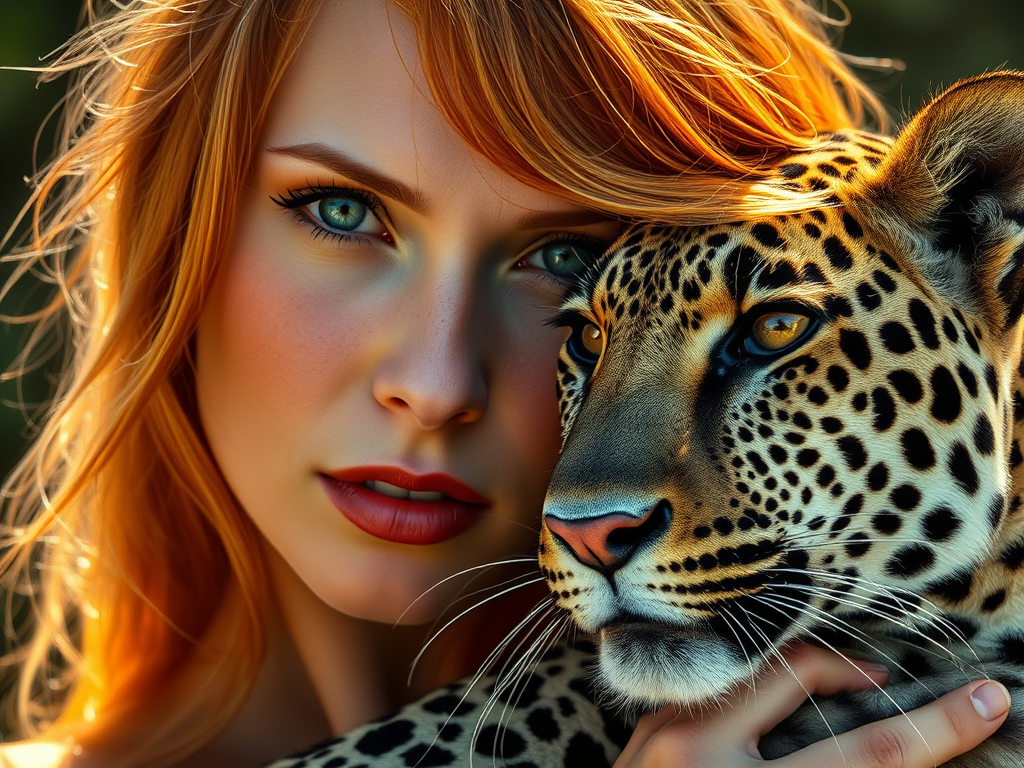
This is of course an AI generated image because all photos of Michaela are still protected by copyright. It is, however, not so different from the woman I remember, and true to my admiring childhood vision of her. She was, when not in bush clothes, very glamorous.

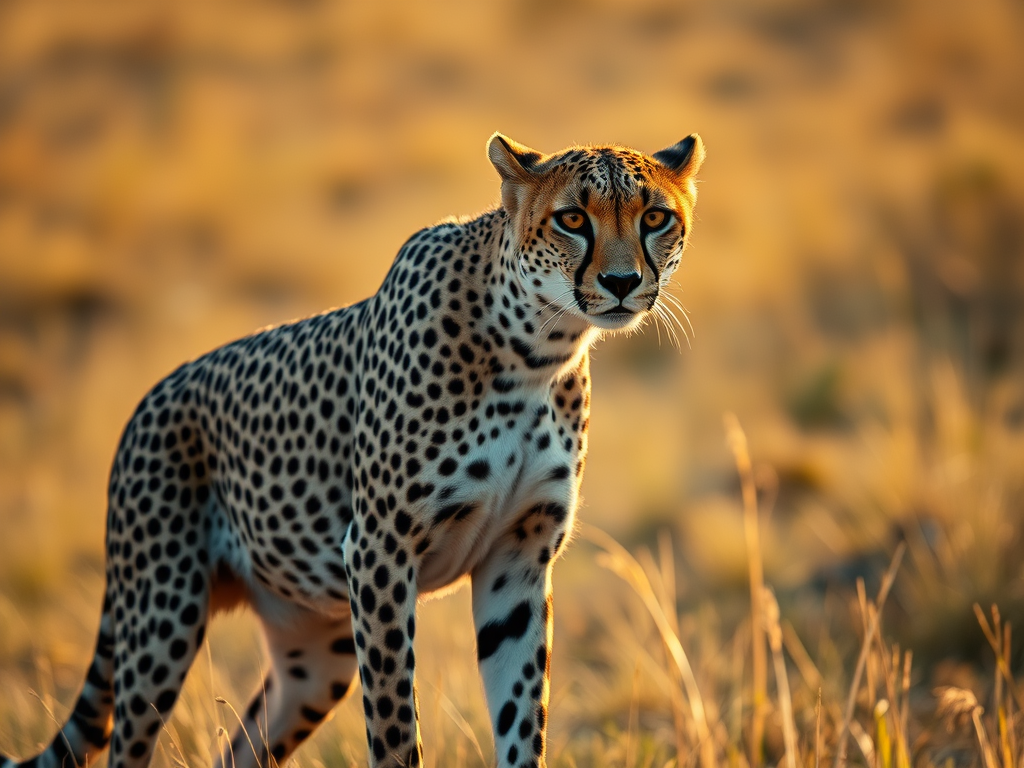
I walked down Delamere Avenue (as it was then known) one day, with my grandmother, and towards me came a woman trailing two cheetahs on a leash.

She was striking to look at, with glimmering red-gold hair and wearing a suit smarter than one normally saw on the streets of Nairobi, capital of colonial Kenya. But of course it was not her looks that impressed me, it was her two pets. 

I knew who she was, of course, because I had already met her.  As had my grandmother.  This was probably the best-known woman in East Africa in the 1950s – the fabulous, glamorous Michaela Denis: adventurer, writer and, with her equally famous husband Armand, a television star. Kenya was more than a decade then from getting television but we all knew of Armand and Michaela Denis.

A few months earlier the Denis’ had visited our school and brought the cheetahs with them as well as a mongoose.  The mongoose didn’t interest us much because they were common in Kenya and many of us had one as a pet at one time or another but the big cats were a thrill because unless our parents took us on safari, these animals were rarely seen. 

Though it is more than seventy years ago I still remember how much I loved Armand Denis’ talk; he was a big man, bulky around the middle, untidy hair, eyes kind behind his glasses.  He showed us what was then called a “ciné film” on a cloth screen and in his soft Belgian voice explained the images ofwild animals and pigmies and other strange West African tribespeople, similar and yet different to the tribes of our own Kenya. 
He was one of the first – and for a time – most famous of the world’s wildlife photographers, ahead, even, of the revered David Attenborough – and he lived in our backyard!  He and Michaela had built a rather unusual house in the suburb of Langata which bordered the Nairobi Game Park.  Here this ever-wandering couple maintained a menagerie of birds and animals because, like me, Michaela had been a little girl who adored wild things and collected everything from hedgehogs to beetles.  Just as I did.

My grandmother knew Michaela because she had a friend who lived next door to the Denis’ home and while they chatted I kept my adoring eyes on the cheetahs.  How I longed for a big cat of my own!  A lion cub, a leopard, even a Serval cat as one of my friends had, but, most of all, a cheetah.  They were said to be easier to tame than most wild creatures, good with children and domestic pets, able to be house-trained, better than dogs for hunting.  My father used to laugh at the very notion of keeping such an animal in an urban environment.  “They eat ten pounds of meat a day”, he told me.  “Their claws are not retractable, like those of other cats, and they will scratch you.  And just look at their teeth!” 

I gazed at the cheetahs and they gazed at the horizon, perhaps seeking the great Athi plains which were only a short distance from that city street. Their indifference was total, quelling to the spirit. 

“Can I touch them?” I whispered, shy in the presence of my goddess and her Olympian companions.  “No,” said my grandmother.  But Michaela, may her name be forever blessed, took my hand and placed it on the head of one of the cheetahs.  I moved my fingers, scratching the scalp as I did to our dog.  The fur, I remember, was very bristly and not as soft as it looked.  My hand, still covered by Michaela’s, moved tentatively down the neck. The cheetah continued to stand there, perfectly still, unresponsive.  The other one sat down with a grunt, as if resignedly making the best of things while these humans communicated with each other in ways mystifying to cheetah-kind and rather boring.  People passed us on the pavement, some stopping to stare or say hello.  Cars and bicycles went by only inches away.  The cheetahs remained unruffled and apparently unseeing, like carvings on an Egyptian tomb.
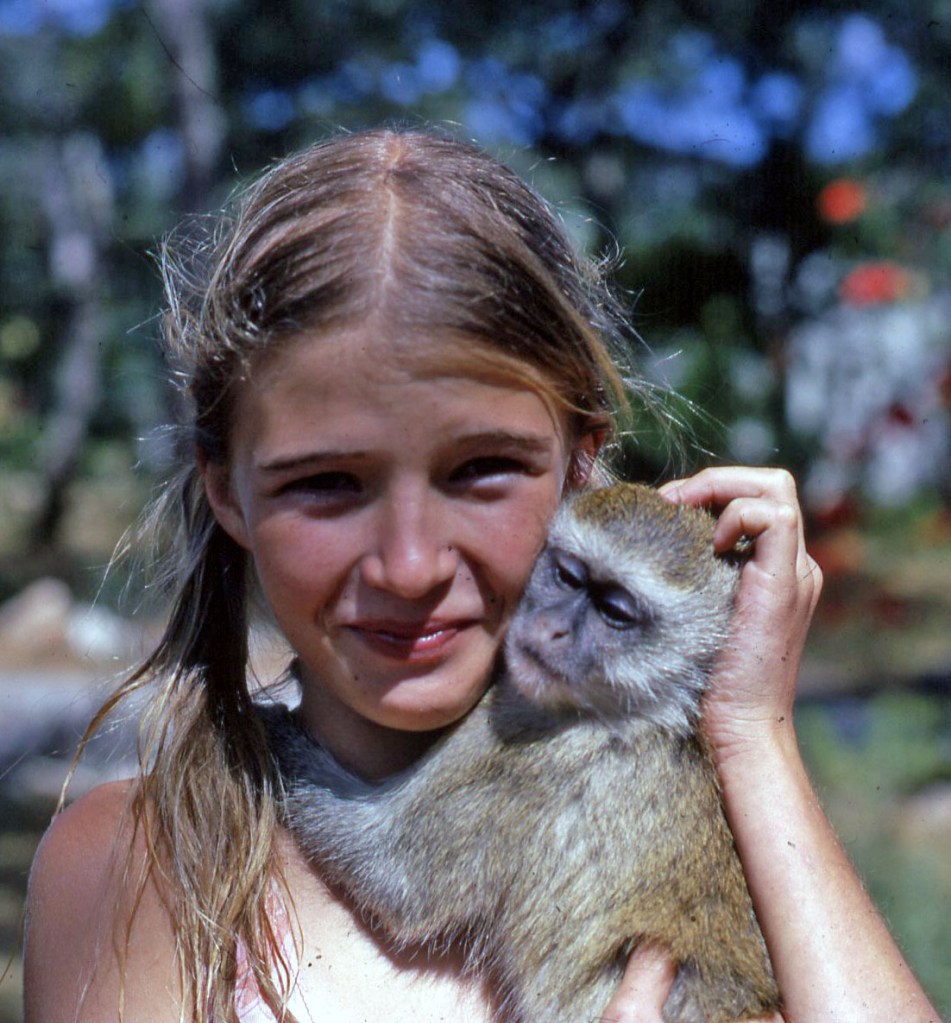
I never got to keep a leopard. Or a cheetah. But I did have a monkey – a coup0le of them, in fact, at different times. Here is our monkey Peppy with my daughter Amanda – circa 1971.

After that day I went several times to the Denis’ house, with friends, to “play” with their wild things.  Armand and Denis were very good with children, though they had none of their own.  Besides the cheetahs, of which at one time they kept about half a dozen, they also had a young leopard called, from memory, Chui.  Not very original as this is its Swahili name.  The leopard was playful and firmly imprinted on Michaela who would hug and kiss it and let it lick her face.  Those great canines, so close to her nose; those savage claws so close to her eyes!  It was tame, didn’t seem to mind our presence, walked happily around the house and garden but we were not permitted to touch it.  Leopards, we were told, were unpredictable around people, even when brought up as pets. 

Nonetheless, Michaela preferred her leopard to the cheetahs. She told us it was warmer, more affectionate, bonded better with humans.  Even though capable of doing much more harm.  “Look into the eyes of a leopard,” she would say, “You’ll see feeling.  A connection.  Look into a cheetah’s eyes and you see nothing.”

Though I admired and even adored her in that pre-pubescent way of girls I didn’t agree with her.  I looked into the eyes of Chui and I saw a creature that, even though well-fed and, it seemed to me, lazy because of it, would just as soon reach out one of those large paws and pull me within reach of its jaws.  Just to see what I tasted like! I saw, I believed, a glimmer of hostility.  Or avidity.

Whereas, to me, the cheetahs seemed to be always dreaming of somewhere far away; of running free on the savannah.  Non-threatening but disinterested. Unlike with the leopard, we were allowed to play with them once they got used to us and never did I know them to be even the slightest bit spiteful.  They tolerated our petting and would obligingly chase and pounce on objects towed on a string. They would even, sometimes, nuzzle our hands and rub against our legs, just like any cat.  They were always happy to be fed by us.

But always they retained that aloofness.  We just didn’t matter to them and they wouldn’t miss us when we left. 

Michaela’s big cats were never caged, to my knowledge, merely contained at night so they wouldn’t wander while their humans were sleeping. Cheetahs are daytime hunters while leopards hunt mostly at night but well-fed cats of any kind don’t usually stray too far.  Looking back, now, with the wisdom of years, I wonder whether, being hand-raised, they knew they would not fare well if they wandered over the fence to the national park beyond, where they would have to fend for themselves and their totally wild and free kind might not welcome them. 

The leopard did sometimes go exploring.  A friend’s father, who lived nearby, came home late on night to find a leopard sprawled across his stoep.  He did all the usual things…shouted, threw things, sounded his horn.  The leopard didn’t stir and nobody in the house, or in the servant’s quarters round the back, heard his shouts and horn-blowing so he had to stay there the rest of the night, sleeping in his car.  When he woke, the leopard had gone. 

It could, of course, have been a wild leopard because leopards were plentiful around the Nairobi suburbs back then – snatching dogs, frightening (though never to my knowledge actually harming) Africans on bicycles, always there in the darkness, swift and silent, rarely seen.

But, so the story went, a wild leopard would have run away if confronted by an angry and noisy human.  Or even, if frightened, attack.  The man swore it was Chui and many believed him.  Complaints were made.  The Denis’ denied it was their leopard but other neighbours had similar encounters and, so my grandmother told me, Michaela did take more care to keep her wandering pet confined because she was afraid that somebody might get trigger-happy.  Many people had guns back then, because of the Emergency. 

My family moved to the coast and I never saw Armand and Michaela again though their wildlife documentaries were sometimes shown in a Mombasa cinema and we saw the TV show when on holiday in England.  “I know them”, I used to say proudly to my English cousins. 

I never did get to own a cheetah.  Or even a Serval cat.  I am not in favour of keeping wild animals as pets and hate those American TV shows where people show off their tigers.  There are, I read, more tigers in captivity today in the USA than wild tigers in India and, sadly, they may well be better off there.  But it still doesn’t seem right. 

A natural successor to Michaela, of course, was Joy Adamson and Elsa.  But the Adamsons, living in a game reserve, always intended to return their lion to her wild condition.  Which shows how times – and attitudes –  can change, even within just a decade. 

I re-read one of Michaela Denis’ books recently (thus inspiring this article) and now realise she was a silly woman in some ways and often wildly incorrect…some people would even find her descriptions offensive.  But that is to judge the actions and opinions of the past through the filter of today and so, for her courage and kindness and glamour and passion for conserving wild places long before it became commonplace, she is still my hero!

Oh, and by the way, she couldn’t stand David Attenborough!  Described him as a fool and a thief – apparently for pinching one of Armand’s ideas for a wildlife television program.
Mrs R and the tiger

Though Kenya is famous for its wild game the island of Mombasa has always been rather poorly equipped with wildlife, if you exclude marine creatures.  Mongooses were plentiful, and birds and reptiles but no antelope or elephant or zebra and certainly no large feline predators.

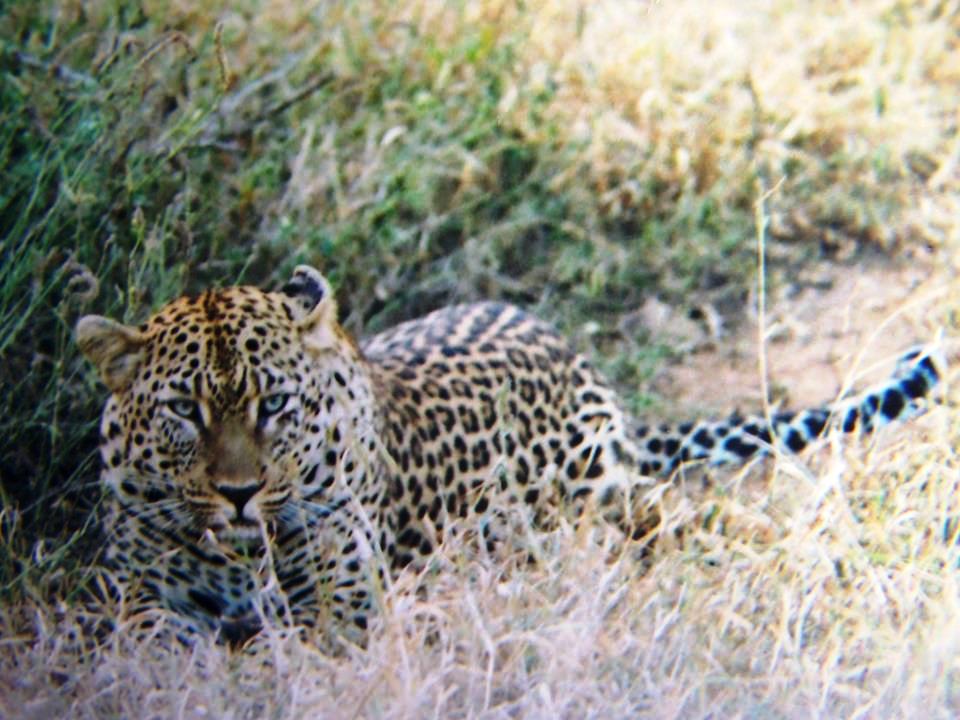
Until, that is, the Day of the Leopard.  Or, to be more correct, a couple of weeks of The Leopard because once, a long time ago, a rumour went racing round the island that a leopard had crossed from the mainland and was on the prowl.  I can’t exactly remember the year but it was possibly 1959 or 1960, and I missed all the excitement because I was at boarding school in Nairobi.

*

Africans on their way home at night reported a large, spotted cat – a chui for sure, glimpsed slinking through gardens or following them at a discreet but still nerve-wracking distance.  An Indian shopkeeper thought he saw the same creature skulking about when he was emptying some food bins one night.  Soon sightings were coming from all parts of the island and these gained credence among the scoffers – such as my father – when pug marks were found in the grounds of the Church of England cathedral.  The protestants of Mombasa considered this a definite triumph over the Papists down the other end of Fort Jesus Road and some wag suggested that the Provost of the Cathedral (not sure if it was still Rex Jupp at that time) buy himself a rifle!  The pug marks were identified, by those who knew how, as being definitely those of a leopard.

After that the search was on, but the leopard proved elusive which, consider how crowded was our little island, without a lot of natural bush left upon it, is a tribute to the ability of big cats to conceal themselves from human view. We were not, in fact, particularly frightened of this particular big cat because leopards were not known to attack humans unless seriously provoked.  However, a leopard is still a formidably strong and well-armed animal and who knew what it might do if it became hungry enough.  Children were warned not to wander too far and dogs were kept indoors at night.  As it was, any dogs that disappeared at that time were considered to have become leopard food and a couple of gung ho types actually sat up at night with native pi-dogs bought especially for the purpose and tied up as bait nearby, until the RSPCA put a stop to it.  Men – European men at least – seemed to consider the whole thing a good joke but women and Africans – who were of course less-securely housed and more likely to be out on foot at night – were frightened.  Indians were frightened too or at least the man behind the counter of our grocer, Beliram Parimal was, because, as he told us, “leopard is terrible man-eater”.  In India, said my father, that’s quite true, for there leopard are larger than ours and also seem to be fiercer. He was a great fan of the books of the Indian hunter Jim Corbett, whose brother lived at Bamburi, and had not long since read The Man-eating Leopard of Rudraprayag. Unfortunately others in Mombasa had read this book too, borrowed from the British Council Library at Tudor, which probably helped fuel the general hysteria.

Leopard were, of course, quite common on the mainland wherever there was heavy forest.  I myself saw them a few times – one on the roof of a cottage at Jadini Hotel, one crossing the road not far south of Malindi.  When calves were taken at Kilifi Plantations a leopard was the suspected culprit and when I lived at Port Reitz my servants were afraid to walk home after dark because leopard were often seen in the vicinity. But a leopard on Mombasa Island would have to have either crossed the causeway, or Nyali Bridge, or swum  across Tudor Creek or possibly the lower mangrove reaches of Kilindini Harbour.  Suggestions that it might have crossed on the ferry from Likoni were generally disregarded!  It all seemed so unlikely and even the reported pug prints in the church ground were regarded with suspicion by some – Mombasa was never short in those days of young practical jokers and some still remember the night a few of us drove all over Nyali pulling out name posts (remember those?) and swapping them around to confuse home owners and visitors.  And then, suddenly, the leopard did something quite unexpected.

We lived in Kizingo Road and not far from us was a collection of small, cheap, thatched houses known collectively as “the bandas” and inhabited by the lower-ranking  white local government employees.  Among them was a woman I shall call simply “Mrs R”.  She was married to a mechanic employed in the council workshops and her Lancashire origins were very obvious in an accent so broad that those of us who spoke “home counties” English could barely understand her – and thus she was much imitated behind her back.  For Mrs R was not popular.  She nagged her husband, gossiped spitefully about her neighbours, had few friends and was feared not only for her uncompromising opinions, loudly expressed in that harsh accent, but for her constant trouble-making.  She was particularly unpopular with the neighbourhood children because, childless herself, she was always shouting at us to stay well clear of her house and garden and “keep roody noise daown”.   I may be libelling the poor woman who has been dead many years now and thus unable to defend herself – but this is the way I (and others) remember her.

Mrs R was of that type and class – fortunately a tiny minority in Kenya – who went out to Africa purely for the job – and perhaps the sun – and appeared to get very little out of it.  They never learned Swahili, never went into the bush or even a game park, never in fact stirred very far from their government-supplied house.  They lived frugally in order to save to go “home” one day and buy a small bungalow at somewhere like Hove.  They employed only one servant to do everything and as their houses usually contained little besides the basic PWD furniture this little was not much.  In fact they feared and despised Africans and were, in turn, despised by those who did work for them and who preferred their bwanas and memsaabs to not interfere in the kitchen or lock up the pantry or dole out groceries with parsimony. 

Mrs R was a case in point – she had a succession of servants from tribes who did not take well to domestic service and she treated them with rudeness and suspicion.  Worse, she raised her voice to them in a way that other memsaabs would consider ill-bred as well as likely to be counter-productive.  Possibly she did this because she had never bothered to learn any Swahili and believed, in true British fashion, that the only way to get a foreigner to understand you was to shout at them.  Again, I am being rather harsh, and more than a teeny bit snobbish!  But that’s the way it was.  People like Mrs R never felt any kind of affinity with Africa, never felt the deep love felt by the rest of us, never tried to understand it, longed always for the day when she could finally return “home”.  Where, no doubt, she would bore her friends and relatives with tales of her glory days as a memsaab.  And people like Mrs R never took any interest in wildlife nor learned to tell one animal from another.

Ironic, therefore, that it was to Mrs R that the Mombasa leopard made its most famous appearance.  According to two close neighbours, they were awakened late one night by a scream and a terrified voice calling out “Wilf, Wilf, it be taiger!  It be taiger!”.  When they rushed outside they realised the voice they were hearing was that of Mrs R, emanating from the conjugal bedroom.  “Wilf, wake up!” she called.  “It be taiger!”.

The way it was reported to me (and to many around the neighbourhood) Mrs R had been lying awake in bed when she saw a large, spotted, bewhiskered face peering right in her bedroom window.  “When I realised what t’thing was,” she confided to my mother, “I were raight terrified”.  Mrs R might not have known her animals but she did know a big cat when she saw one in her window, and had then woken up her sleeping husband.  Loudly enough so that every one else in the neighbourhood (the bandas were very close together) could hear.  The Story of Mrs R and the “taiger” winged its way round the island next day and she may well not have been believed except…that one of the neighbours who rushed to her aid reported later that his dog, an Alsatian known for its savage nature, had cowered whimpering at his side.  And…the clincher…several pug marks of an unmistakable leopard nature were found in the soft sand of the garden bed outside Mr and Mrs R’s window.

The search was intensified but though expert trackers were brought in they found it difficult to find a trail through the little roads and gardens large and small that comprised the area between Kizingo Road, Prince Charles Street (as it was then) and Ras Serani Drive.  However a couple of days later an African wandering under a baobab tree not far from the Likoni Ferry looked up and got the fright of his life, for there,  draped nonchalantly over a branch, was the leopard.  I got a fright too, when I heard about it, as did some of my friends, because this tree was a favourite play spot of ours and we’d even built a small cubby house in its thick, protective branches.    The big cat was then captured, caged and (I think) released on the mainland.  Nobody ever knew, conclusively, how it had got on the island, let alone why.  The rumour mill ground out theories by the day – it had been brought on to the island deliberately as a joke; it was an escaped pet; it had escaped from one of Carr-Hartley’s zoo shipments at the port. The first might just possibly be true, albeit unlikely, the other two were obviously ridiculous because any escape would have been reported.  And you don’t keep a large creature like a leopard in your home without friends and neighbours knowing about it…I’m just repeating this now to show how so many people don’t bother to think before they theorise! 

We kids, of course, happily believed all the rumours in turn and even came up with a few of our own. One, I remember, was that the leopard (we always thought of it as “he”) would for sure have had a mate somewhere who would look for him everywhere and, through starvation and revenge, would prey on those who had taken him. Which shows that, back then, we knew little more about the habits of leopards than did poor Mrs R! 

A Baobab tree, found all over eastern Kenya in the dry nyika country between the Nairobi uplands and the coast. Mombasa island was covered in them and legend had it that under each one was an Arab soldier, slain during the wars with the Portuguese who occupied Mombasa for a while. Baobabs are useful trees; the fruit is edible (though not particularly palatable) and a good substitute for cream-of-tartar, birds and other wildlife find refuge in the branches, some people even made temporary homes in them and we kids made cubby houses in them. We had a big specimen in our garden and I (with help from our gardener) made a snug little refuge there, impregnable to my ayah and most adults but not, alas, to my agile father!