
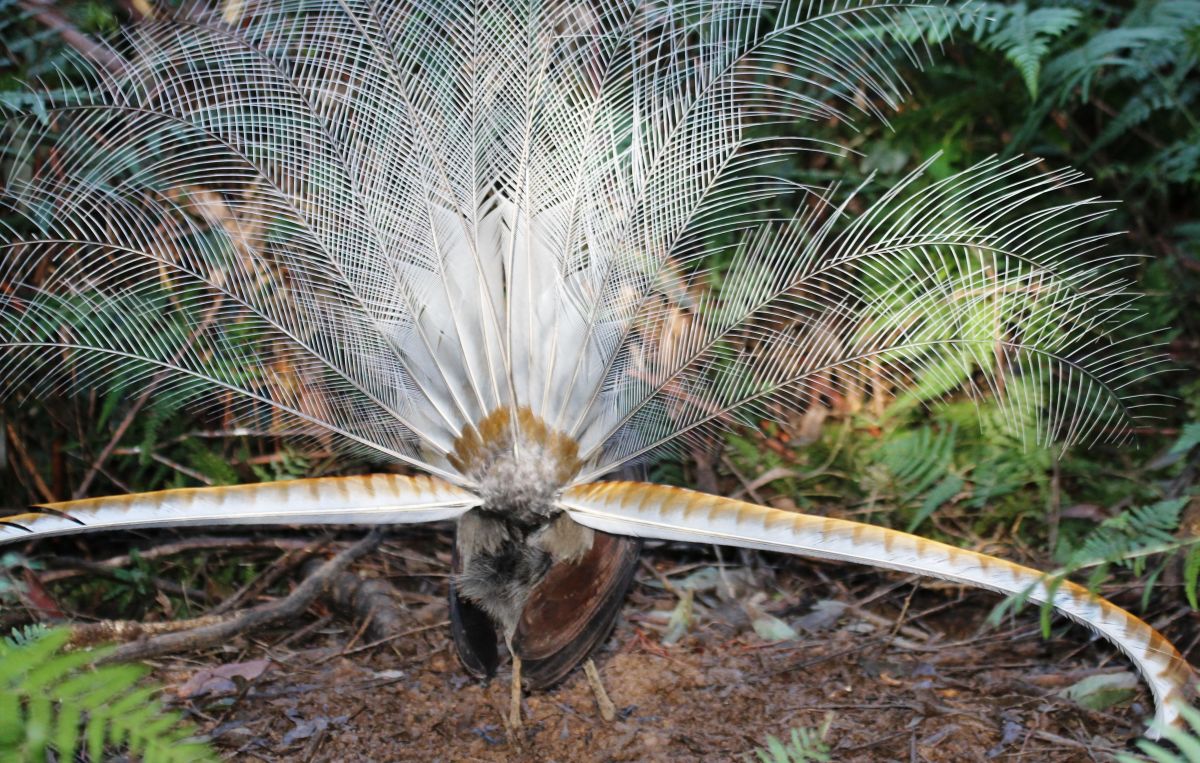
This page is very much a work in progress. I have spent many decades watching birds in my local subtropical rainforest and on this page you’ll meet some of my favourites. I hope to expand the page so that rainforest bird lovers from around the world can post their pictures and descriptions here.
All over the world, jungles or rainforests have always been home to some of our rarest, most colourful and least known bird species.
Ever since Long John Silver and other pirates took to walking around with parrots on their shoulders, we’ve coveted those brilliant and talkative birds, to the point where some species have been driven to extinction in the wild. Parrots, which are not of course limited to jungles (think Australian Budgerigar, think New Zealand Kea) are the poster species for those deep, mysterious places where the trees grow tall and the vines grow thick and the constant heat and moisture fosters rampant vegetative growth. Where the shadowed forest floor conceals furtive creatures and serpents can grow to monstrous size. Where insects buzz and seek blood or scuttle in the litter.
Birds are the true beauties of such an environment and some of the most interesting can be found in the rainforests of Australia, east of the Great Dividing Range.
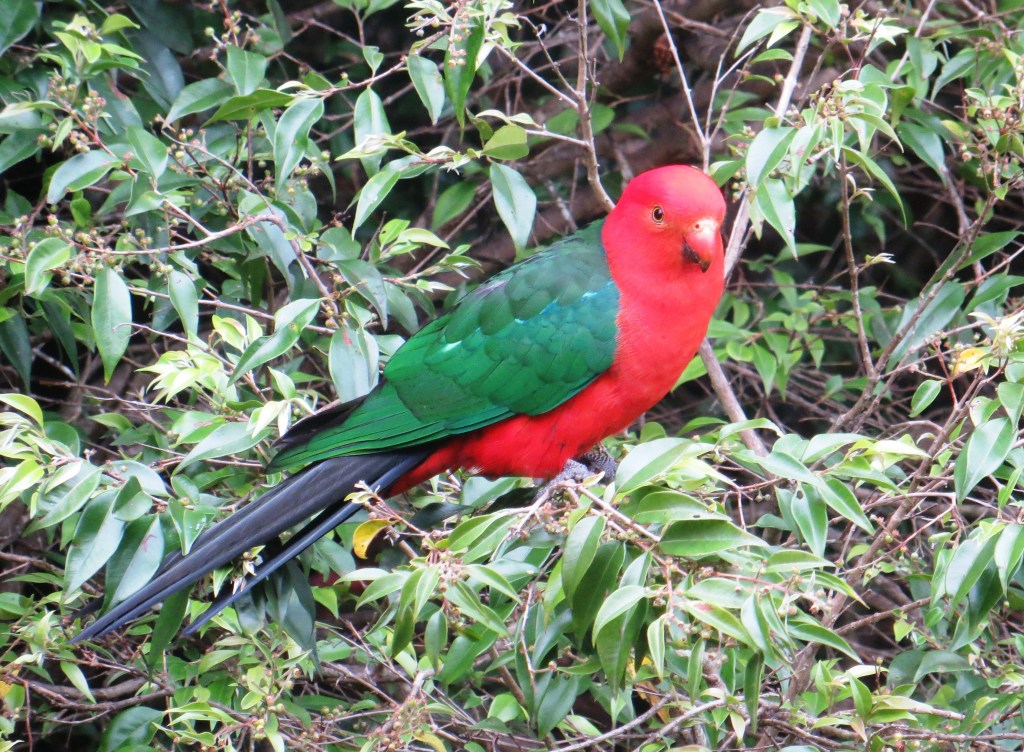
King Parrot (Alisterus scapularis)
The sweet whistle and chatter of the King Parrot rings out across the rainforest, and the adjacent wet sclerophyll woodland, and you’ll look up to see a flash or red and green as they alight nearby, usually in pairs but sometimes in small flocks.
This bird is as friendly as it is beautiful, with a gentle face and nature that makes it more lovable than many other parrots, which can be rather beady-eyed and spiteful.
The male has a read head, breast and belly with vivid green wings, banded at the top with turquoise, vivid blue feathers on the rump area above the blue-green tail. As is often the case with parrots, the female is a little more muted with greenish head, yellowy-green breast and crimson from breast to belly.
King parrots are sedentary but after breeding in the denser forests and mountains near the coast they wander further afield into drier lowland areas.
Call is a high-pitched one note whistle (males) usually accompanied by harsher chattering sounds when flying. Alarm call is more of a metallic screech, like “aaark”.
Breeding is from about September through to midsummer, and the birds nest high up in deep eucalypt hollows. Some of these holes go right down inside the trunk so the young chicks are pretty secure from predators. The nest is a layer of wood chips chewed or naturally decayed to a soft consistency. The female broods the eggs (usually 4 – 6, lustrous white), for three weeks while the male fetches food for her. When the chicks hatch they are fed by both parents for about five weeks until they are able to look after themselves, though they usually stay with the parents until it’s time for them to mate.
King Parrots have a varied diet of seeds, flower buds nuts, fruit and insects. They are frequent visitors to my garden and, though I do not feed wild birds, are tame enough to come and sit on my veranda chairs and look at me hopefully.
Regent Bowerbird (Sericulus chrysocephalus)
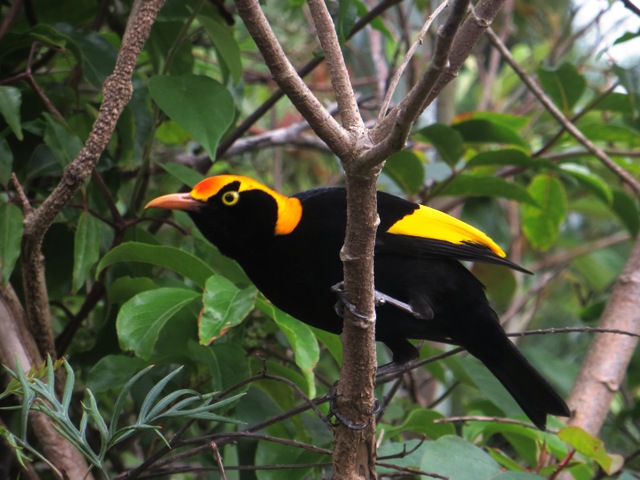
Few rainforest birds are as striking as he Regent Bowerbird, pictured here. This bird is slimmer than most bowerbirds, and while the female, poor thing, is rather a drab the slightly smaller male is a masterwork of black and golden yellow. He is yellow from bill and eye to neck to mantle and then again on the primary and secondary wing feathers. The rest is a dense jet black. On the forehead is a tiny tuft or patch of a bright, sub-irridescent sunrise orange-yellow quite impossible to describe and not seen in any painter’s palette.
Females are dull brown on the back with a few arrowhead-shaped pale spots on the shoulders, a black neckband, crown patch and darker-feathered cheek line. Bill is dull brown too. Breast and belly are off-white, with scalloping on the breast and fain dark wavy lines on belly. Juveniles are like females but without the black neckband and facial markings.
The Regent Bowerbird is a shy, retiring type who, like its nest and bower, is rarely seen. When you do see the male, it’s because of the yellow flash as he dives for cover. The bower is a modest two-sided affair, slightly less “finished” in appearance than its cousin the Satin Bowerbird. He decorates it modestly too, with a few pale petals and sail shells and sometimes blue artifacts placed carefully inside the bower. Rather than depending on this collection to attract his temporary mate the splendid Regent courts her up in the nearby trees and shows her the way to the bower of seduction where, once the deed is done, he goes looking for another. And she goes off to build a nest, lay a couple of eggs and raise the chicks.
The nest is very hard to find, usually (but not invariably) high in thick leaves and branches of tree or thick vine, shallow and made from thin sticks and twigs. Eggs are a delicate greenish or greyish white with darker streaks and blotches. Breeding season is October to January-February, before the usual onset of the subtropical wet season.
The Regent Bowerbird occurs mostly in the coastal and montane rainforests and adjacent wet sclerophyllof northern New South Wales and Southern Queensland, plus Eungella inland from Mackay and some isolated coastal rainforest north of Bundaberg.
The Regent BB is not much of a vocalist: the male communicates alarm calls and warnings to other males (and possibly come-ons to females) with typical harsh, raspy bowerbird calls. Those with keen ears may hear him apparently serenading the females with long, soft, meditative songs that mimic other birds. The female is usually silent.
Food is mostly fruit, with the native tamarind (Diploglottis australis) being a favourite.
Nest is a shallow saucer of long, thin sticks, less robust than that of Satin Bowerbird. Usually well above ground and in thick vines or tree foliage. Eggs: usually 2, Creamy white with faint tinge of grey or green, “painted” with wavy lines and spots and blotches and scribbles, dark brownish, olive and tinges of pale mauve.
Satin Bowerbird (Ptilonorhynchus violaceus)
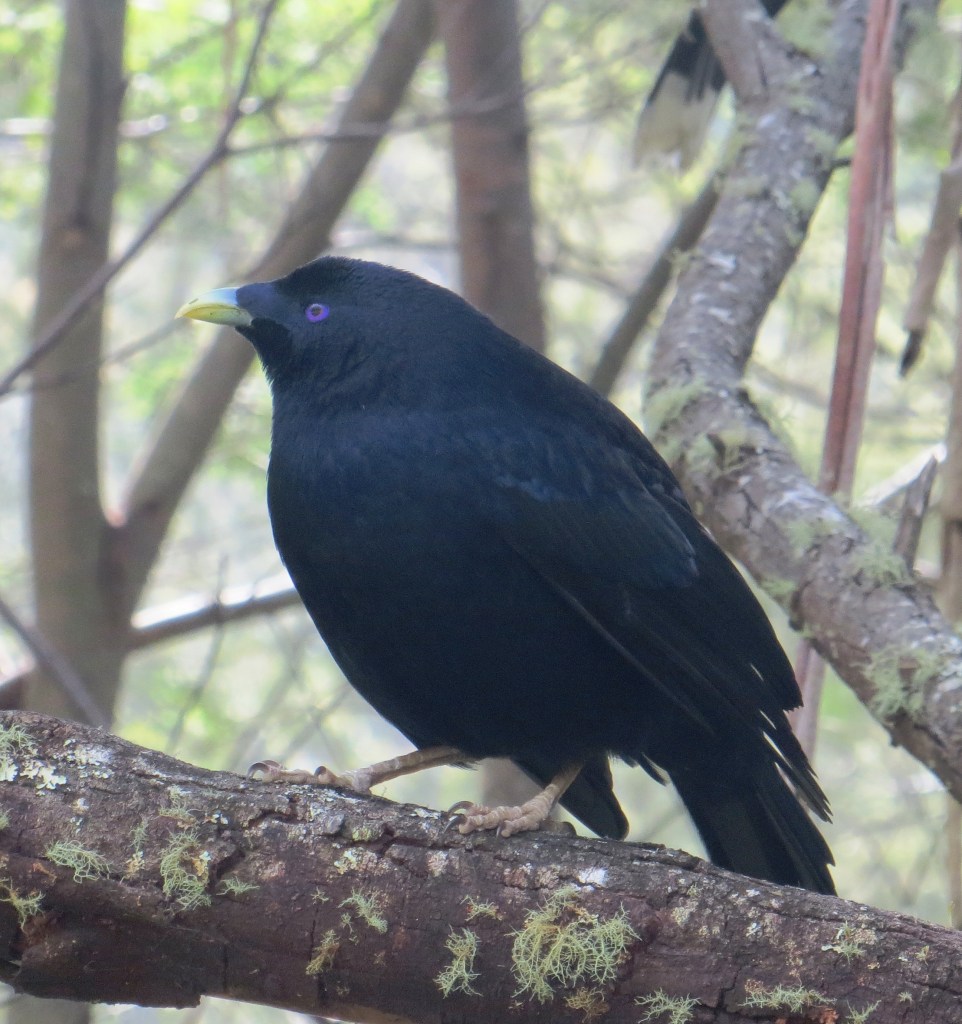
The Satin Bowerbid is familiar to most people who live on the east coast of Australia from the forests of south eastern Victoria to southern Queensland. This is a handsome, confident bird which boldly sets up bowers in parks and home gardens just as easily as it does in the forest, braving domestic pets, lawn mowers, people and cars to pursue its construction goals.
In fact I know a male Satin Bowerbird who has, for some years, persistently built and rebuilt his bower within ten metres of a house wall on one side and a busy barbecue/entertainment area on the other, right by a path and close to a well-maintained lawn. He prudently hops out of the way when people pass, or flies to a low nearby branch but is quite happy to hop around if you come with an offering of bright blue objects such as clothes pegs or Evolvulus flowers. (NOT ringed bottle tops!).
Male Satin Bowerbirds are chunky and smoothly rounded and always look rather pleased with themselves. They are a rich black all over, with an iridescent bluish sheen and lovely violet eyes. Beak is white. Females are greenish all over with dull brown wings and creamy buff breasts and bellies with a definite but sometimes hard to see greenish band around the chest. Beak is dark grey, appearing black in the field. Juvenile birds are similar but lack the breast band and have brownish foreheads.
The nest is shallow and made of small twigs and dry leaves, well-hidden in upright tree forks in outer foliage of treees, or in clumps of twigs or mistletoe. Casuarina trees are specially favoured. Eggs: 1 – 3. Dark cream or brownish cream with blotches, spots, streaks and wavy lines in dull brown or brownish green or pale mauve.
Wonga Pigeon (Leucosarcia melanoleuca)

These big, plump pigeons can drive people mad! True! In the summer when the males are calling their long, monotonous, medium-pitched call, repeated over and over, causes some folk to shut their windows, curse, and wish for a shotgun! And indeed, in days of yore, they were commonly shot for food though as they are usually solitary birds a single Wonga, however juicy of breast, wouldn’t provide much of a feed/
Wongas are usually found on the edges of rainforests (and inhabit wet schlerophyll forests too) where they can be seen waddling along peacefully, head down, pecking. They are dark grey on the head and back with a grey neck and chest dramatically decorate3d by a long, vee shaped collar. The underparts are white with many markings that from a distance look like spots but are in fact little “u” shaped patches.
Seeds, fruits and berries are their food and they forage for them on the ground rather than in trees and bushes.
They are true love birds, mating for life. The next is quite a large flat arrangement of twigs, on a tree limb or in a fork, very simple and without embellishment. Eggs: 2. White.
Noisy Pitta (Pitta versicolor)

(Photo courtesy of Geoff Eller)
The Noisy Pitta really isn’t all that noisy and in fact is no noisier than any other pitta but its distinctive “Walk to Work” whistle rings through the forest when it is breeding time and the males are proclaiming their territorial boundaries. This is a splendid bird to see as it hops along the rainforest path, poking into the tree litter for grubs. It will also eat small fruits and lizards and is particularly partial to snails, which it cracks open on rocks with workmanlike skill.
This is a truly beautiful bird of brilliant colour with its chestnut cap, black face and throat, vivid green and blue wings, buffy yellow-to-apricot breast and bright orange to scarlet vent.
Though the Pitta is quick to flee at the sight of a human it doesn’t go far on its stubby wings and if you stay still and quiet you will see it alight not too far away, watchful but happy to continue with its eternal search for food. The strong, longish bill is a useful tool for poking and prodding bark and tree roots.
There are two other types of Pitta found in Australia; the rare Red-bellied Pitta, much sought after by birdwatchers, is found in the far north of Cape York and the Rainbow Pitta is limited to the top end from Darwin across to the Kimberley. All have similar habits.
The Noisy Pitta is the most common, ranging from North Queensland down the east coast to south of Sydney. It’s a true rainforest bird but sometimes strays into adjacent wet sclerophyll forest or drier scrub.
Breeding season is shorter in the north of its range, from late spring through February; further south it starts in July. The number of eggs is usually four but can be half that, or as many as five when breeding conditions are good in the south. The southern eggs tend to be larger, too, than those of northern birds. Strange, because the northern rainforests offer better food and the heavier rainfall that brings out the big forest snails.
Nests, built by both sexes, are usually on or very near the ground at the base of roots, rocks or tree stumps. They are made, rather nicely, from locally available materials such as bark, twigs, plant fibres and moss, with feathers woven in for insulation and lined with soft material such as grass and lichen, bound with animal dung. Some birds make a little ramp at the entrance, from sticks and mud or dung. A spacious yet snug “home” is obviously important to parent Pittas who raise their brood together during the height of the wet season.
Pittas that inhabit and breed in montane areas usually migrate to lower, warmer ground in winter. In some areas numbers are believed to be decreasing due to human encroachment and disturbance.
Pale Yellow Robin (Tregellasia capito)
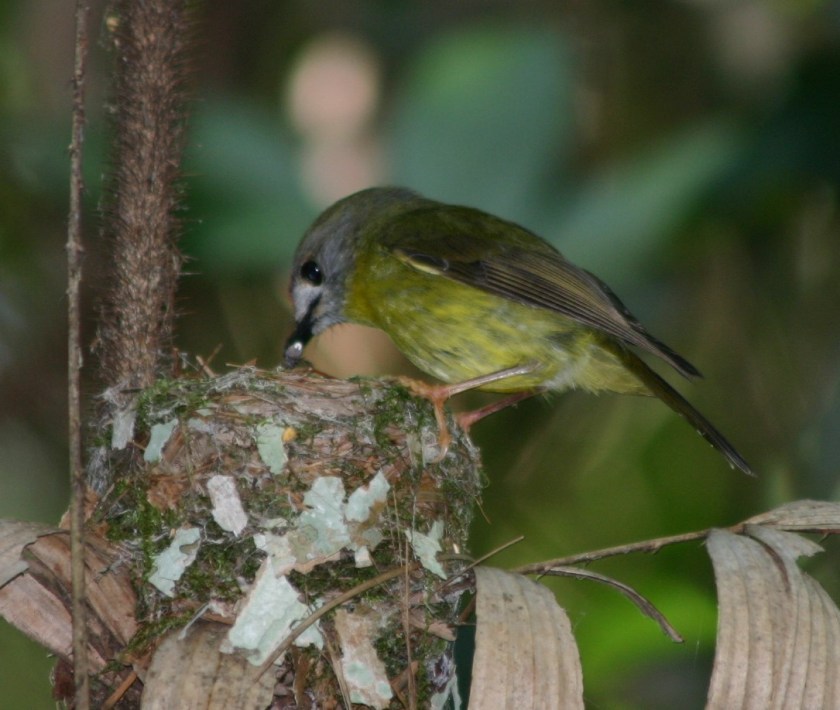
This shy little bird is a true denizen of the deep rainforest (though sometimes found in adjacent woodland) and is very easy to overlook as it flits quietly from tree to tree, often perching sideways on a vertical sapling to check you out. It’s certainly a lot less bold than the better-known Eastern Yellow Robin and in fact the two are not closely related.
The Pale Yellow Robin has a drab greyish green back with a white throat to just above the short, sturdy bill. The belly is pale yellow down to the vent and the legs are an inconspicuous buff. The head is quite large compared to the body; tail is short and squared at the end. The alarm call is a sharpish repeated chah and its other call is a quick, sharp whistle of three to four notes, sometimes more and best heard at dawn. Though a quiet bird, in the mating season the call rings out and may be followed by soft little tweets exchanged between the mated pair.
Range is limited to the forests of the coastal fringe from south east Queensland to norther eastern New South Wales; there is also a population in far north Queensland and, as often is the case, these northern birds are smaller.
This bird stays in the lower shrub layer of the forest and from its perch it can pounce on the small beetles and grubs that make up its diet, pecking at them with its strong little beak.
It nests in the forks of saplings or, more commonly, in the thick, well-protected cover of lawyer vine (Calamus muelleri), using leaves from the vine and other plant debris, including lichen, to build the little cup-shaped nest. It breeds once or twice in the July to December season, producing two pale green eggs with brownish markings.
Human encroachment on its habitat is reducing the numbers of the Pale Yellow Robin.
Sooty Owl
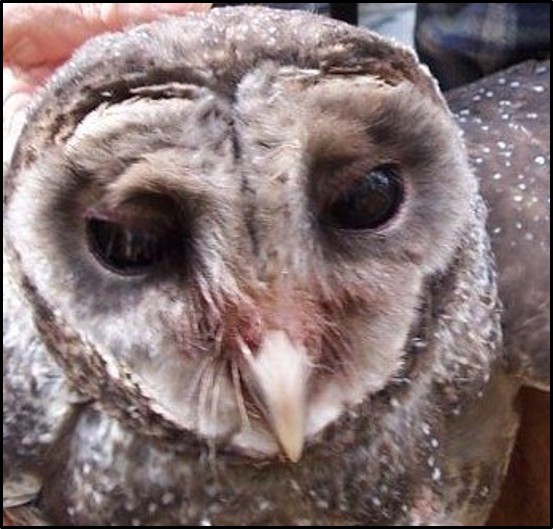
This is one of the most dramatic owls in looks and behaviour. It’s the third largest Australian member of the family though a fully mature female Sooty is close in size to her counterpart the Rufous Owl, found much further north.
The rainforest is not the prime habitat of this big owl; it prefers wet schleropyll coastal forests from south east Queensland to southern Victoria but where rainforest is adjacent it will hunt there, it’s long, descending, harsh whistle sounding like a falling bomb, often startling unsuspecting campers and forest dwellers on hot summer nights.
This is an owl more often heard than seen by humans as it is both stealthy and highly secretive. It’s darkish grey colouring conceals it well among the shadows and the big, mournful eyes set in a wide, pale, heart-shaped face can only easily be detected by torchlight, when they give off a ruby red shine that’s diagnostic.
The grey (with hints of russet) plumage is speckled with small white spots which give the bird a sparkling appearance when looked at by torchlight. The grey breast is also spotted with white. The pale facial disc is rimmed with darker feathers, the legs are thickly feathered like white leggings and the talons are massive, capable of seizing prey up to the size of a rabbit. Rabbits, small gliders and rodents are this bird’s main prey.
The secretive Sooty Owl likes to roost in deep tree hollows and trees that have become hollowed out from the inside. Here it also nests, as well as in caves. Breeding is usually March- June and again in spring. Eggs are large and white, usually two but only one chick survives to fledge – though two surviving chicks have been reported, at least in captivity. They don’t leave the nest until at least six months old.
There is a Lesser Sooty Owl in far north Queensland which is similar in most respects, though smaller and the sexes closer in size.
I used to do a regular walk where the track went right through an old, hollowed out Argyrodendron tree. A few metres up in this tree lived a lone Sooty Owl, or at least I never saw another owl with her. Every time anyone walked under the tree she would scream! Louidly! In fact it was quite fun to sit quietly nearby and watch the shock on the faces of hikers as they triggered this ghostly shriek! Sometimes I’d sit there at dusk and wait for her to emerge and you had to look hard because she would emerge like a silent dark shadow, wingbeats barely audible unless you were listening for them. And then she’d be away through the darkening trunks of the Bunya Pines, off to hunt. I’ve also listened to the Sooty Owls in my nearby forest at night and when their calls give them away I can sometimes catch them in the spotlight, sitting on a branch. It’s the red eyeshine that gives them away.
Lewin’s Honeyeater (Meliphaga lewinii)
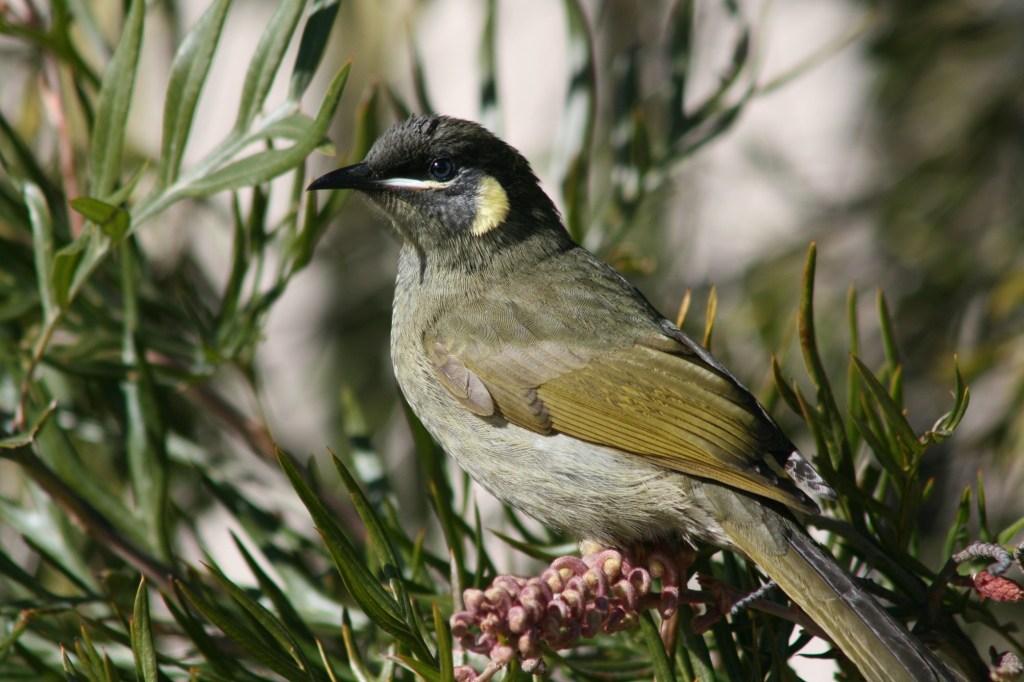
This bright, energetic small honeyeater can often be seen darting out from flower to flower in search of nectar, often hanging upside down from blossoms and dabbing at them with its curved black bill. It’s quite aggressive and the males will see off competitors in the breeding season (early spring to midsummer) or else engage in lively chases with females – for the casual observer it’s hard to tell the difference!
The call is unmistakable, a piercing staccato, frequently uttered and because this is a common bird in its habitat, the rainforests of the east coast from north Queensland to Victoria, any birding trip in those areas will yield several pairs of Lewin’s Honeyeaters in close proximity.
Sexes are similar, with olive, grey-green backs, greyish buff on the breast, more richly olive on the wings. Feathers around the eye are dark and the most conspicuous feature is the pale-yellow ear patch and creamy white line (gape) along the bill to the eye. Two north Queensland species, the Graceful and Yellow-spotted Honeyeaters, are very similar but smaller, with smaller ear patches and different calls.
The nest is a strongly built cup made from leaves, moss and bark strips, lined with down from the parents’ ‘breasts and woven with spiders’ webs. It is cunningly secured by the rim on one side to a thin branch, hidden among thick foliage. Eggs are two, sometimes three, creamy white with brown blotches at the fat end.
Though a common bird of rainforest, the Lewin’s Honeyeater is also found in wet eucalpyt forest and sometimes in adjacent lighter woodland.

 Lyrebird Mountain
Leave a comment