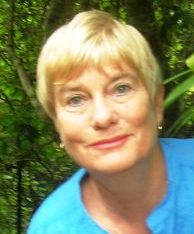
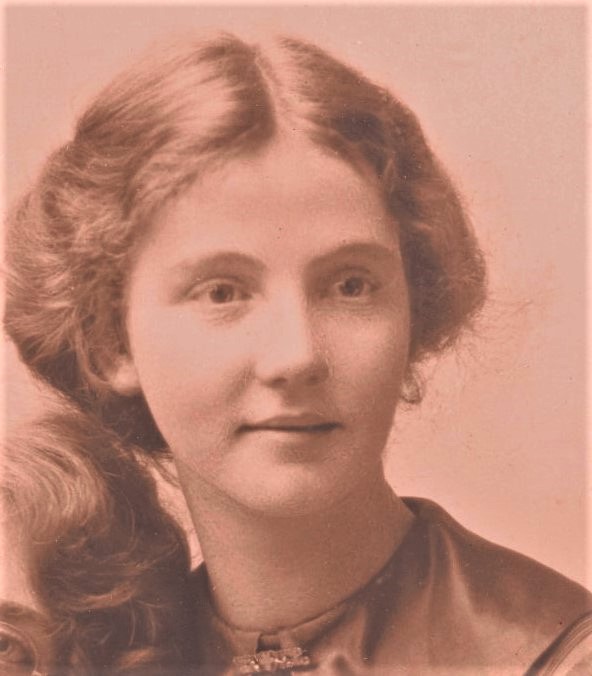
I based the early part of Lyrebird Mountain, and the character of Anna, on the lives of Australian naturalist-photographer Hilda Geissmann and her family.
The Geissmanns did indeed come to Tamborine Mountain, south of Brisbane, in the 1890s and established a famous guesthouse there, Capo di Monte, the name of which is perpetuated today in a building, a retirement community and two streets.
I wrote a short biography of Hilda, published in 2023, and put the research material gathered during the creation of that book to good use in the early chapters of Lyrebird Mountain.
Capo di Monte, like The Excelsior, was an instant success that lasted several years and did indeed attract visitors from all over Australia and the wider world – artists, writers, naturalists, scientists, theatre folk, politicians, graziers and wealthy merchants, minor royalty and the governors who represented the British Crown.
The Geissmann children served these luminaries, learned from them and, in the case of Hilda and her brother Barney, acted as guides through the rainforest that they knew so well.
Hilda, like Anna, loved the forest and always felt at home there. She learned to be an excellent ornithologist, orchidist and all-round naturalist, her photographs and articles appearing in many newspapers, magazines and learned journals.
The character of Berthe almost exactly corresponds with what we know of Elfriede Geissmann, whose second name was Berthe, and her physical description matches the photos of Elfriede I have in my possession. Her husband, William Felix, did indeed run off unexpectedly to Paraguay, never to be seen again or heard of by his family. The scene that takes place in the Brisbane Botanical Gardens, during World War 1, when his effects are handed over to his abandoned wife by a mysterious German woman, is exactly what happened in real life. And though “Madame Kurcher” is a character of my creation, the Geissmanns did become very involved in Theosophy and Hilda herself, as well as her siblings, was influenced by it all her life.
Once I have got Anna through her childhood, so like Hilda’s, my book takes flight and the Geissmanns are relegated to true history. Anna’s story and that of her brothers and sisters bears little resemblance to that of Hilda and her family, though facts do intrude here and there. For example, the guesthouse did burn down (though two years after the date in Lyrebird Mountain) and though one of the Geissmann brothers went to the 1914-18 war he returned only slightly wounded. Hilda and her sister Elsie married local farmers but they were cousins, not brothers, and though Hilda’s husband, Herbert Curtis, was wounded and did indeed convalesce in the English Lake District, and their house was named Windermere, he was a kind and good husband (or so I’ve been told by those who remember him) and Elsie’s husband, Willie, was certainly not a money-hungry philanderer.
I doubt very much Hilda ever had a love affair like Anna’s but her long friendship with the naturalist/journalist Alec Chisholm, very much her mentor, was reimagined by me into the friendship between Anna and Arnold Clemens. Chisholm, however, did not end his days on the mountain. His death was terrible to Hilda and she paid a moving tribute to him in a speech she gave to the Queensland Naturalists’ Club in 1976.
Again, Hilda’s lifelong closeness to her sister Elsie is mirrored in Anna’s with her sister Liza who lives close by to her on Lyrebird Mountain. Elsie was very musical – taught music in fact – just like Liza and there is some hint in my research material that she gave up a potential concert career to come home and help her mother run the guesthouse. I doubt, though, that Elsie was a lesbian or even knew what one was! She and Hilda grew cut flowers commercially, just like my Anna and her sister and were each other’s confidantes in all matters.
The character of Freddy does draw somewhat on that of Hilda’s best-known brother, Barney. Barney’s memoirs show him to be a charmer with a fine turn of phrase and a great sense of humour – and indeed, when the family first went to the mountain, he was for some poorly-explained reason left at the bottom overnight and had to find his own way up the next day. Imagine that, for a twelve year old town boy! And there was no part-aboriginal guide, either. Barney Geissmann was always a resourceful man who could turn his hand to most things. He is still remembered on the mountain today though, like his briefly famous sister Hilda, there are very few left who actually knew him. And they themselves are now old.
The character of Deirdre Bell is very loosely modelled on a sort of composite of the artists Daphne Mayo and Vida Lahey, both good friends of Hilda’s (especially Daphne) and both connected with Tamborine Mountain. In her, I have tried to convey some of the New Woman, often deliberately naughty and outrageous of prevailing morals, that appeared in Brisbane’s tiny, self-consciously kultured art community of pre-World War 1 Brisbane. A stuffy little city in a huge, barely populated state dominated by the competing values of graziers and blue-singlet unionised labour. Neither of them particularly sympathetic to the arts. Daphne and Vida were not really like Deirdre in character but their independence was unusual for the time and research shows there are some similarities
Arnold Clemens, in Lyrebird Mountain, is very obviously based on the writer/journalist/naturalist Alec Chisholm who is now almost forgotten in Australia, except by dedicated older naturalists. He was a self-educated prodigy with a childhood love of nature that became his life’s passion. He befriended and mentored Hilda early in the twentieth century and their friendship lasted until his death, despite the fact that both could be sharp-tongued and outspoken. Chisholm, in fact, could be downright cranky! And you see a touch of that in Arnold!
After I had published Hilligei, Hilda’s biography, I realised that aspects of her life would make the basis of a novel; in Anna I found the Hilda that my imagination had wanted her to be – more successful, more interesting, more desirable to men. I have set a mystery in the heart of Lyrebird Mountain – the death of Jack Resnik – and there was a mystery at the heart of Hilda’s life, too. Which was that, having achieved modest fame and recognition from the natural science world over a decade or so, she just packed it in. Her name no longer appeared in journals and she stopped taking photographs. Her correspondence with leading naturalists of the day dwindled. She remained a lifelong member of the Queensland Naturalists Club and continued to host and help organise club expeditions to Tamborine Mountain but the Hilda whose knowledge of birds and plants was so respected, who could find the elusive Albert’s Lyrebird nest and photograph it when nobody else could, who wrote articles about her interests that were full of charm and refreshingly non-stuffy, took early retirement. She lived to be almost one hundred, as a farmer’s wife, flower grower and pillar of her community. But by the time she was in her forties, these mundane activities had become her lot.
And as far as I know, she was quite happy with it. When I started my research for Hilligei I interviewed several people who had known her, both family and friends. They all remembered her as a nice old lady. But none of them had more than a vague awareness of her youthful fame and contribution to Australia’s natural science. Sic transit gloria and all that. The captains and the kings depart.
And I like to think that a little of Hilda Geissmann lives on in the Anna of Lyrebird Mountain.
Well, it’s not a murder mystery. Though there is a mystery at the heart of the book and that mystery may – or may not – be the result of a murder.
It’s not a romance novel. Though there is romance woven through the story, not just of the kind between humans but the romance of natural things; the romance that’s around us everywhere, every day, if we only learn to look for it.
It’s not a crime novel. Most of us go through our lives, thank the Powers, without being directly affected by crime, though we know it is out there and that we must try to avoid it. A crime may have been committed in Lyrebird Mountain – a terrible crime. And if it was, who dunnit?
It’s not a historical novel although the history of Queensland, Australia and the wider world is recorded through events that affect the characters in the book – over more than a century.
It’s not a family saga – in the usual sense of the word. It is essentially the story of one woman’s life but her story carries the reader through six generations of women with whom her life is linked, from mother to daughter.
It’s not women’s fiction even though the main character is a woman and the story looks at life through a woman’s eyes. I don’t pretend to know the hearts of men; I can only experience them from the outside. But there is other stuff in Lyrebird Mountain besides the affairs of women…war gets a mention and politics and historical events and…yes…even cricket.
An author is by trade and inclination an observer of life and my observation is that novels rarely tell about life as it is. Of course they don’t; the job of the novelist is to shock, excite, thrill, entrance, intrigue, move you to laughter or tears. It’s entertainment, baby, not real life.
And yet, I have learned more in my life from novels than I ever learned from a non-fiction book.
So Lyrebird Mountain is not a genre novel. I did not want my characters to be larger than life, I wanted them to be the kind of people we encounter in our own lives. Life is not well-organised like fiction and people do not always have clear motives. Nor behave logically. Situations go unresolved, mysteries remain unsolved. It’s not neat, it’s not tidy, it’s LIFE.
So when people ask me what Lyrebird Mountain is about, I find it hard to answer. I say it is about love and loss, strength and resilience in the face of misfortune, the power of passion and the even greater power of place. It’s about the relationship between grandmothers and granddaughters and the cruel impact of war. And it’s all set against the historical evolution of a still-young nation finding its place in a sometimes terrifying world. (Yes, yes, I knew it’s an old continent with an older set of inhabitants but I’m talking about nationhood.)
I have often relied on allusion to tell my tale, rather than spelling it all out. As much as possible I have tried to treat cliches like potholes in the road – to be avoided. I don’t insult my readers by telling them the bleedingly bloody obvious! I prefer to let them work it out for themselves. Those who can’t are welcome to discuss it here on my blog.
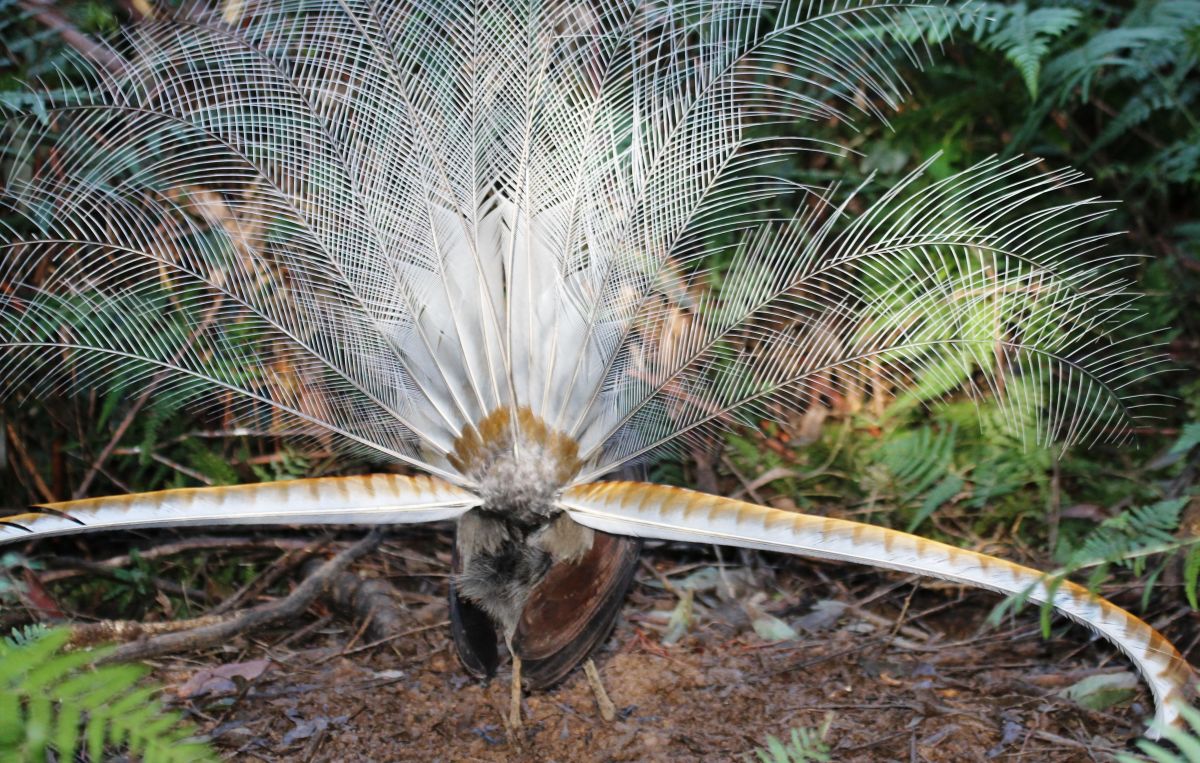
There is, for example, a constant allusion to the mystery of the rainforest, especially higher-altitude forest like that of Lyrebird Mountain, where mist throws a gauze over the trees and clouds of vapour float up the gullies. I have always found rainforests of any kind – from the mighty Tongass of Alaska to the jungles of Africa – to be mysterious places. Spirits lurk there, ancient as the trees, though spirits of what I am never sure. Like Anna, I sense them, I feel them around me. Whispering. The life of the rainforest, whether in the canopy or on the littered floor, is secretive. If you listen, there is always a scuffling or a rustling or the cries of birds that often have a wailing eeriness to them. As if song or cackle belongs only to sunlight.
Such mystery, such hints of a magic powerful but unseen, can affect people in strange ways. Men have gone mad in rainforests; especially those who have gone there to cut timber and found themselves alone among the tree shadows, their axes suddenly falling from their hands. Women, in my experience, have a better understanding that keeps them safer; visiting as they do mostly to seek and examine plants and birds, doing no harm.
In many ways Lyrebird Mountain is an old-fashioned book. Deliberately so. I’ve gone against the contemporary trend to recast history through modern eyes and ears, in film, in television in books. Where characters speak and act as they do today and not as they did then. For I have lived through much of the timespan of Lyrebird Mountain and know, too, how my parents and grandparents spoke and behaved. And those of earlier generations. And there are, quite simply, things they didn’t do or say because of the prevailing standards of behaviour. Some bold few might have said and done things that broke the code. But most people didn’t. And those are the people I’m writing about. People who set a high price on reticence, restraint, fortitude, good manners and self-control. And who understood the difference between compassion and sentimentality. This is how they coped with the tough stuff. Looking back, it seems amazing to me that they could be happy in a world where even the rich did not have the comforts, conveniences, services, safety measures, medical treatments, social support and readily-accessible entertainment that we take for granted.
But, by and large, they were. Like Anna and her family, they bore it all and carried on.
This is not, I know, the stuff of great drama. But I wanted to write something real. For the kind of readers who like it that way.
This page is very much a work in progress. I have spent many decades watching birds in my local subtropical rainforest and on this page you’ll meet some of my favourites. I hope to expand the page so that rainforest bird lovers from around the world can post their pictures and descriptions here.
Bird list so far:
King Parrot
Regent Bowerbird
Satin Bowerbird
Wonga Pigeon
Noisy Pitta
Pale Yellow Robin
Sooty Owl
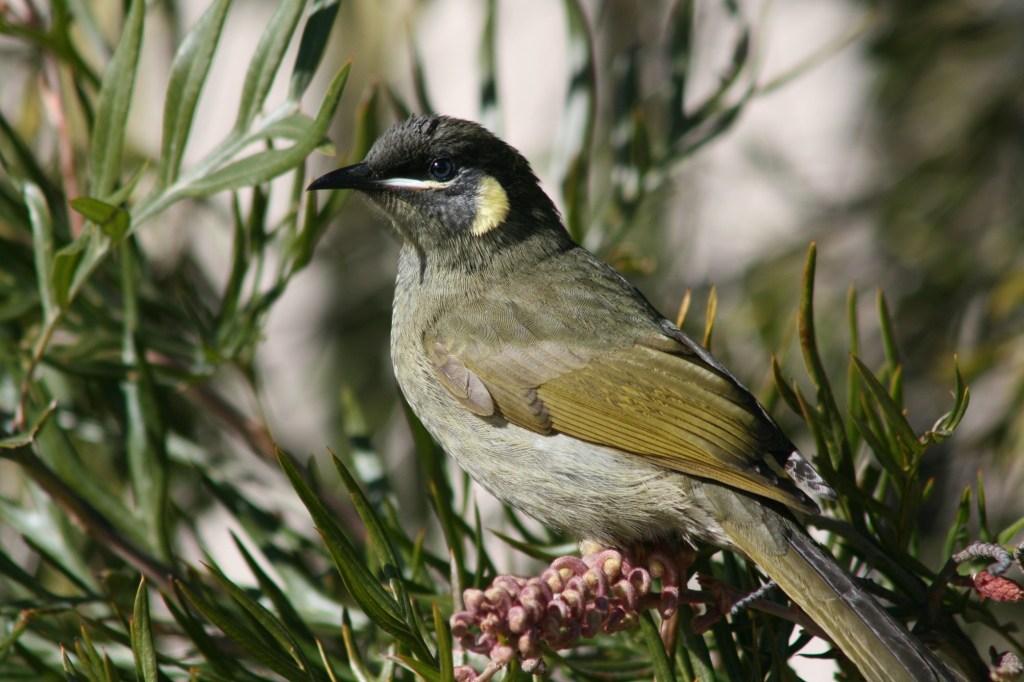
Lewin’s Honeyeater
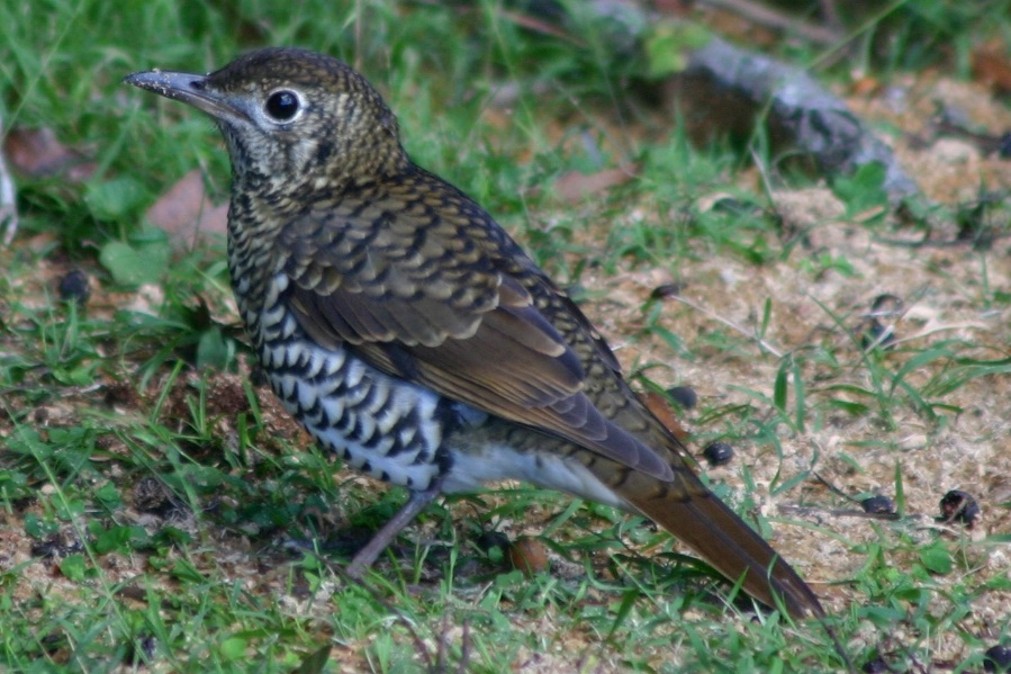
Bassian Thrush
More birds to come…
All over the world, jungles or rainforests have always been home to some of our rarest, most colourful and least known bird species.
Ever since Long John Silver and other pirates took to walking around with parrots on their shoulders, we’ve coveted those brilliant and talkative birds, to the point where some species have been driven to extinction in the wild. Parrots, which are not of course limited to jungles (think Australian Budgerigar, think New Zealand Kea) are the poster species for those deep, mysterious places where the trees grow tall and the vines grow thick and the constant heat and moisture fosters rampant vegetative growth. Where the shadowed forest floor conceals furtive creatures and serpents can grow to monstrous size. Where insects buzz and seek blood or scuttle in the litter.
Birds are the true beauties of such an environment and some of the most interesting can be found in the rainforests of Australia, east of the Great Dividing Range.
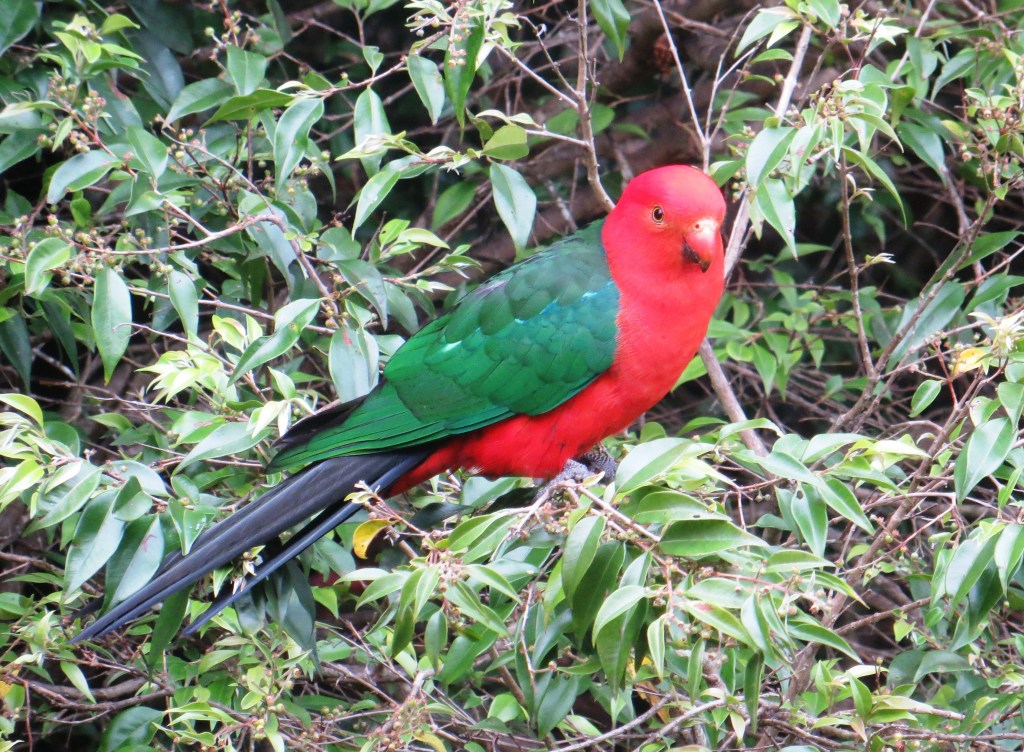
King Parrot (Alisterus scapularis)
The sweet whistle and chatter of the King Parrot rings out across the rainforest, and the adjacent wet sclerophyll woodland, and you’ll look up to see a flash or red and green as they alight nearby, usually in pairs but sometimes in small flocks.
This bird is as friendly as it is beautiful, with a gentle face and nature that makes it more lovable than many other parrots, which can be rather beady-eyed and spiteful.
The male has a red head, breast and belly with vivid green wings, banded at the top with turquoise, vivid blue feathers on the rump area above the blue-green tail. As is often the case with parrots, the female is a little more muted with greenish head, yellowy-green breast and crimson from breast to belly.
King parrots are sedentary but after breeding in the denser forests and mountains near the coast they wander further afield into drier lowland areas.
Call is a high-pitched one note whistle (males) usually accompanied by harsher chattering sounds when flying. Alarm call is more of a metallic screech, like “aaark”.
Breeding is from about September through to midsummer, and the birds nest high up in deep eucalypt hollows. Some of these holes go right down inside the trunk so the young chicks are pretty secure from predators. The nest is a layer of wood chips chewed or naturally decayed to a soft consistency. The female broods the eggs (usually 4 – 6, lustrous white), for three weeks while the male fetches food for her. When the chicks hatch they are fed by both parents for about five weeks until they are able to look after themselves, though they usually stay with the parents until it’s time for them to mate.
King Parrots have a varied diet of seeds, flower buds nuts, fruit and insects. They are frequent visitors to my garden and, though I do not feed wild birds, are tame enough to come and sit on my veranda chairs and look at me hopefully.
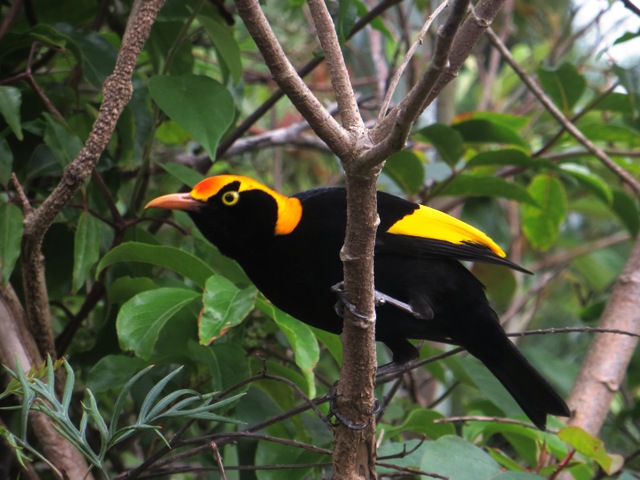
Regent Bowerbird (Sericulus chrysocephalus)
Few rainforest birds are as striking as he Regent Bowerbird, pictured here. This bird is slimmer than most bowerbirds, and while the female, poor thing, is rather a drab the slightly smaller male is a masterwork of black and golden yellow. He is yellow from bill and eye to neck to mantle and then again on the primary and secondary wing feathers. The rest is a dense jet black. On the forehead is a tiny tuft or patch of a bright, sub-irridescent sunrise orange-yellow quite impossible to describe and not seen in any painter’s palette.
Females are dull brown on the back with a few arrowhead-shaped pale spots on the shoulders, a black neckband, crown patch and darker-feathered cheek line. Bill is dull brown too. Breast and belly are off-white, with scalloping on the breast and fain dark wavy lines on belly. Juveniles are like females but without the black neckband and facial markings.
The Regent Bowerbird is a shy, retiring type who, like its nest and bower, is rarely seen. When you do see the male, it’s because of the yellow flash as he dives for cover. The bower is a modest two-sided affair, slightly less “finished” in appearance than its cousin the Satin Bowerbird. He decorates it modestly too, with a few pale petals and sail shells and sometimes blue artifacts placed carefully inside the bower. Rather than depending on this collection to attract his temporary mate the splendid Regent courts her up in the nearby trees and shows her the way to the bower of seduction where, once the deed is done, he goes looking for another. And she goes off to build a nest, lay a couple of eggs and raise the chicks.
The nest is very hard to find, usually (but not invariably) high in thick leaves and branches of tree or thick vine, shallow and made from thin sticks and twigs. Eggs are a delicate greenish or greyish white with darker streaks and blotches. Breeding season is October to January-February, before the usual onset of the subtropical wet season.
The Regent Bowerbird occurs mostly in the coastal and montane rainforests and adjacent wet sclerophyllof northern New South Wales and Southern Queensland, plus Eungella inland from Mackay and some isolated coastal rainforest north of Bundaberg.
The Regent BB is not much of a vocalist: the male communicates alarm calls and warnings to other males (and possibly come-ons to females) with typical harsh, raspy bowerbird calls. Those with keen ears may hear him apparently serenading the females with long, soft, meditative songs that mimic other birds. The female is usually silent.
Food is mostly fruit, with the native tamarind (Diploglottis australis) being a favourite.
Nest is a shallow saucer of long, thin sticks, less robust than that of Satin Bowerbird. Usually well above ground and in thick vines or tree foliage. Eggs: usually 2, Creamy white with faint tinge of grey or green, “painted” with wavy lines and spots and blotches and scribbles, dark brownish, olive and tinges of pale mauve.
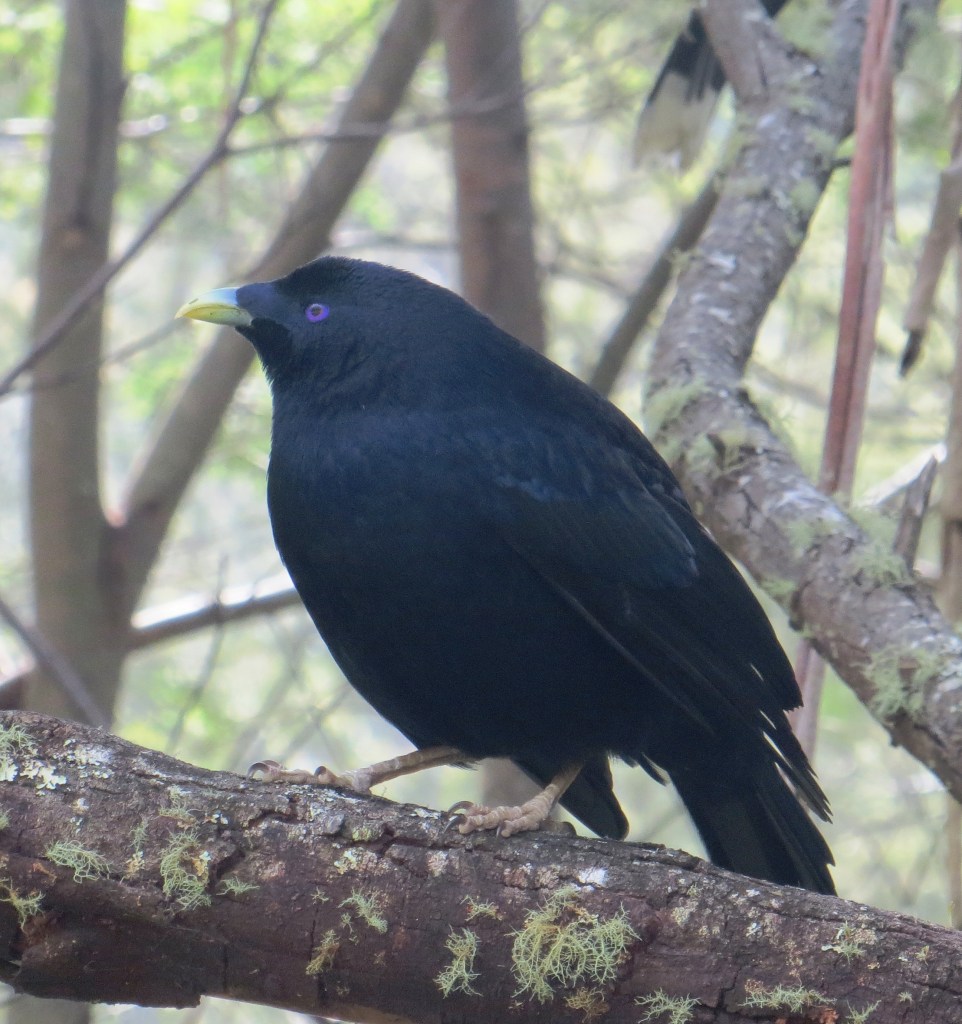
Satin Bowerbird(Ptilonorhynchus violaceus)
The Satin Bowerbid is familiar to most people who live on the east coast of Australia from the forests of south eastern Victoria to southern Queensland. This is a handsome, confident bird which boldly sets up bowers in parks and home gardens just as easily as it does in the forest, braving domestic pets, lawn mowers, people and cars to pursue its construction goals.
In fact I know a male Satin Bowerbird who has, for some years, persistently built and rebuilt his bower within ten metres of a house wall on one side and a busy barbecue/entertainment area on the other, right by a path and close to a well-maintained lawn. He prudently hops out of the way when people pass, or flies to a low nearby branch but is quite happy to hop around if you come with an offering of bright blue objects such as clothes pegs or Evolvulus flowers. (NOT ringed bottle tops!).
Male Satin Bowerbirds are chunky and smoothly rounded and always look rather pleased with themselves. They are a rich black all over, with an iridescent bluish sheen and lovely violet eyes. Beak is white. Females are greenish all over with dull brown wings and creamy buff breasts and bellies with a definite but sometimes hard to see greenish band around the chest. Beak is dark grey, appearing black in the field. Juvenile birds are similar but lack the breast band and have brownish foreheads.
The nest is shallow and made of small twigs and dry leaves, well-hidden in upright tree forks in outer foliage of treees, or in clumps of twigs or mistletoe. Casuarina trees are specially favoured. Eggs: 1 – 3. Dark cream or brownish cream with blotches, spots, streaks and wavy lines in dull brown or brownish green or pale mauve.
Wonga Pigeon (Leucosarcia melanoleuca)
These big, plump pigeons can drive people mad! True! In the summer when the males are calling their long, monotonous, medium-pitched call, repeated over and over, causes some folk to shut their windows, curse, and wish for a shotgun! And indeed, in days of yore, they were commonly shot for food though as they are usually solitary birds a single Wonga, however juicy of breast, wouldn’t provide much of a feed/
Wongas are usually found on the edges of rainforests (and inhabit wet schlerophyll forests too) where they can be seen waddling along peacefully, head down, pecking. They are dark grey on the head and back with a grey neck and chest dramatically decorate3d by a long, vee shaped collar. The underparts are white with many markings that from a distance look like spots but are in fact little “u” shaped patches.
Seeds, fruits and berries are their food and they forage for them on the ground rather than in trees and bushes.
They are true love birds, mating for life. The next is quite a large flat arrangement of twigs, on a tree limb or in a fork, very simple and without embellishment. Eggs: 2. White.
Noisy Pitta (Pitta versicolor)
(Photo courtesy of Geoff Eller)
The Noisy Pitta really isn’t all that noisy and in fact is no noisier than any other pitta but its distinctive “Walk to Work” whistle rings through the forest when it is breeding time and the males are proclaiming their territorial boundaries. This is a splendid bird to see as it hops along the rainforest path, poking into the tree litter for grubs. It will also eat small fruits and lizards and is particularly partial to snails, which it cracks open on rocks with workmanlike skill.
This is a truly beautiful bird of brilliant colour with its chestnut cap, black face and throat, vivid green and blue wings, buffy yellow-to-apricot breast and bright orange to scarlet vent.
Though the Pitta is quick to flee at the sight of a human it doesn’t go far on its stubby wings and if you stay still and quiet you will see it alight not too far away, watchful but happy to continue with its eternal search for food. The strong, longish bill is a useful tool for poking and prodding bark and tree roots.
There are two other types of Pitta found in Australia; the rare Red-bellied Pitta, much sought after by birdwatchers, is found in the far north of Cape York and the Rainbow Pitta is limited to the top end from Darwin across to the Kimberley. All have similar habits.
The Noisy Pitta is the most common, ranging from North Queensland down the east coast to south of Sydney. It’s a true rainforest bird but sometimes strays into adjacent wet sclerophyll forest or drier scrub.
Breeding season is shorter in the north of its range, from late spring through February; further south it starts in July. The number of eggs is usually four but can be half that, or as many as five when breeding conditions are good in the south. The southern eggs tend to be larger, too, than those of northern birds. Strange, because the northern rainforests offer better food and the heavier rainfall that brings out the big forest snails.
Nests, built by both sexes, are usually on or very near the ground at the base of roots, rocks or tree stumps. They are made, rather nicely, from locally available materials such as bark, twigs, plant fibres and moss, with feathers woven in for insulation and lined with soft material such as grass and lichen, bound with animal dung. Some birds make a little ramp at the entrance, from sticks and mud or dung. A spacious yet snug “home” is obviously important to parent Pittas who raise their brood together during the height of the wet season.
Pittas that inhabit and breed in montane areas usually migrate to lower, warmer ground in winter. In some areas numbers are believed to be decreasing due to human encroachment and disturbance.
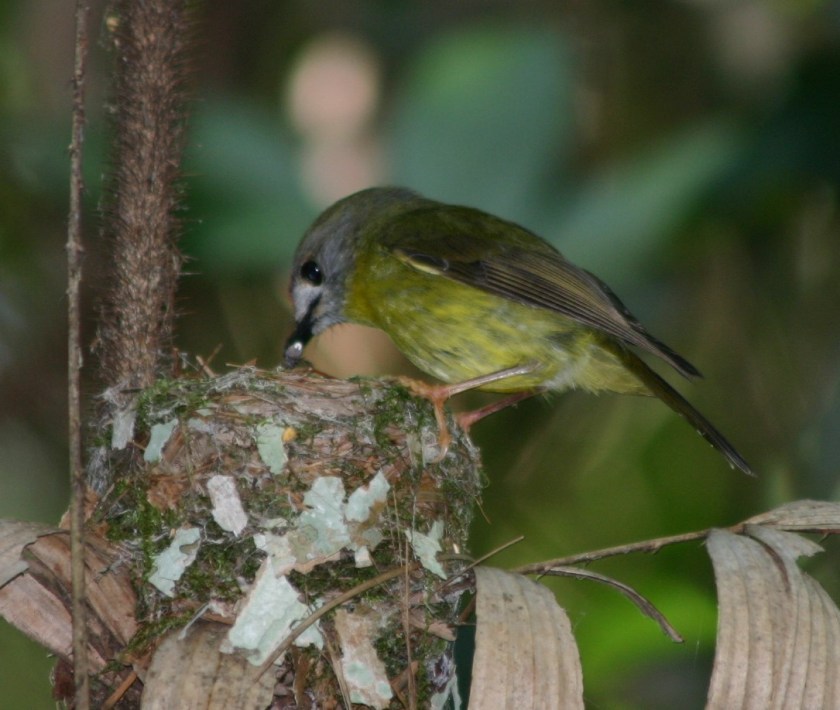
Pale Yellow Robin (Tregellasia capito)
This shy little bird is a true denizen of the deep rainforest (though sometimes found in adjacent woodland) and is very easy to overlook as it flits quietly from tree to tree, often perching sideways on a vertical sapling to check you out. It’s certainly a lot less bold than the better-known Eastern Yellow Robin and in fact the two are not closely related.
The Pale Yellow Robin has a drab greyish green back with a white throat to just above the short, sturdy bill. The belly is pale yellow down to the vent and the legs are an inconspicuous buff. The head is quite large compared to the body; tail is short and squared at the end. The alarm call is a sharpish repeated chah and its other call is a quick, sharp whistle of three to four notes, sometimes more and best heard at dawn. Though a quiet bird, in the mating season the call rings out and may be followed by soft little tweets exchanged between the mated pair.
Range is limited to the forests of the coastal fringe from south east Queensland to norther eastern New South Wales; there is also a population in far north Queensland and, as often is the case, these northern birds are smaller.
This bird stays in the lower shrub layer of the forest and from its perch it can pounce on the small beetles and grubs that make up its diet, pecking at them with its strong little beak.
It nests in the forks of saplings or, more commonly, in the thick, well-protected cover of lawyer vine (Calamus muelleri), using leaves from the vine and other plant debris, including lichen, to build the little cup-shaped nest. It breeds once or twice in the July to December season, producing two pale green eggs with brownish markings.
Human encroachment on its habitat is reducing the numbers of the Pale Yellow Robin.
Sooty Owl
This is one of the most dramatic owls in looks and behaviour. It’s the third largest Australian member of the family though a fully mature female Sooty is close in size to her counterpart the Rufous Owl, found much further north.
The rainforest is not the prime habitat of this big owl; it prefers wet schleropyll coastal forests from south east Queensland to southern Victoria but where rainforest is adjacent it will hunt there, it’s long, descending, harsh whistle sounding like a falling bomb, often startling unsuspecting campers and forest dwellers on hot summer nights.
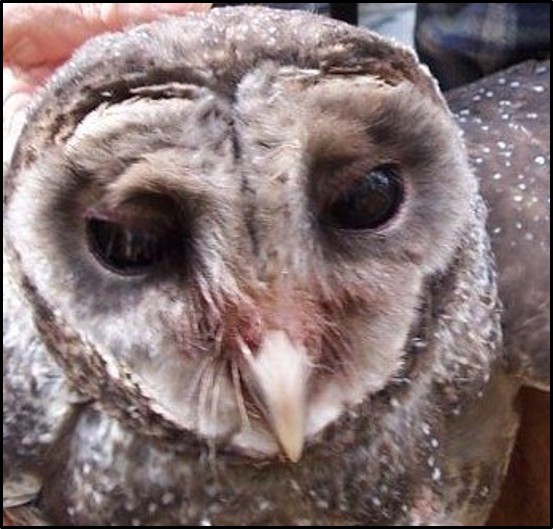
This is an owl more often heard than seen by humans as it is both stealthy and highly secretive. It’s darkish grey colouring conceals it well among the shadows and the big, mournful eyes set in a wide, pale, heart-shaped face can only easily be detected by torchlight, when they give off a ruby red shine that’s diagnostic.
The grey (with hints of russet) plumage is speckled with small white spots which give the bird a sparkling appearance when looked at by torchlight. The grey breast is also spotted with white. The pale facial disc is rimmed with darker feathers, the legs are thickly feathered like white leggings and the talons are massive, capable of seizing prey up to the size of a rabbit. Rabbits, small gliders and rodents are this bird’s main prey.
The secretive Sooty Owl likes to roost in deep tree hollows and trees that have become hollowed out from the inside. Here it also nests, as well as in caves. Breeding is usually March- June and again in spring. Eggs are large and white, usually two but only one chick survives to fledge – though two surviving chicks have been reported, at least in captivity. They don’t leave the nest until at least six months old.
There is a Lesser Sooty Owl in far north Queensland which is similar in most respects, though smaller and the sexes closer in size.
I used to do a regular walk where the track went right through an old, hollowed out Argyrodendron tree. A few metres up in this tree lived a lone Sooty Owl, or at least I never saw another owl with her. Every time anyone walked under the tree she would scream! Louidly! In fact it was quite fun to sit quietly nearby and watch the shock on the faces of hikers as they triggered this ghostly shriek! Sometimes I’d sit there at dusk and wait for her to emerge and you had to look hard because she would emerge like a silent dark shadow, wingbeats barely audible unless you were listening for them. And then she’d be away through the darkening trunks of the Bunya Pines, off to hunt. I’ve also listened to the Sooty Owls in my nearby forest at night and when their calls give them away I can sometimes catch them in the spotlight, sitting on a branch. It’s the red eyeshine that gives them away.
This bright, energetic small honeyeater can often be seen darting out from flower to flower in search of nectar, often hanging upside down from blossoms and dabbing at them with its curved black bill. It’s quite aggressive and the males will see off competitors in the breeding season (early spring to midsummer) or else engage in lively chases with females – for the casual observer it’s hard to tell the difference!
The call is unmistakable, a piercing staccato, frequently uttered and because this is a common bird in its habitat, the rainforests of the east coast from north Queensland to Victoria, any birding trip in those areas will yield several pairs of Lewin’s Honeyeaters in close proximity.
Sexes are similar, with olive, grey-green backs, greyish buff on the breast, more richly olive on the wings. Feathers around the eye are dark and the most conspicuous feature is the pale-yellow ear patch and creamy white line (gape) along the bill to the eye. Two north Queensland species, the Graceful and Yellow-spotted Honeyeaters, are very similar but smaller, with smaller ear patches and different calls.
The nest is a strongly built cup made from leaves, moss and bark strips, lined with down from the parents’ ‘breasts and woven with spiders’ webs. It is cunningly secured by the rim on one side to a thin branch, hidden among thick foliage. Eggs are two, sometimes three, creamy white with brown blotches at the fat end.
Though a common bird of rainforest, the Lewin’s Honeyeater is also found in wet eucalpyt forest and sometimes in adjacent lighter woodland.
Bassian Thrush
The Bassian Thrush (Zoothera lunulata) has a very large range – and yet it’s rarely seen and almost unknown to all except those birdwatchers who spend their time looking for it in the forests of Eastern Australia.
This is because it’s colouring is the typical brown-beige-olive of birds who spend their lives grubbing about in the rich litter on the forest floor. What’s more, it’s a remarkably self-effacing bird that seems perfectly content with its own company. It needs to keep quiet in order to listen for insects scuttling among the leaves and its own call.
In colour it resembles the feral Song Thrush though its undermarkings are a much stronger pattern of black and white rather than the dark-on-buff streaks of the latter. Its bill is much stronger and longer, too. They are both in the same overall family, the Turdidae, but apart from appearance their habitats are very different.
The Bassian Thrush inhabits the denser forests – rainforest and wet sclerophyll – of the eastern coast and mountains, from southern Queensland round to western Victoria and the Mt Lofty and southern Flinders Ranges in South Australia. It is also found in north Queensland. There has been a good deal of argument as to whether there are several races or even different species of this bird, known commonly as Olive or Russet or White-tailed. Different bird books will tell a different tale and the common name in former years was “White’s Thrush”! To my mind, they are all one species for general birdwatching purposes, with any perceptible differences reflecting differing habitats, individual feather patterns and even song.
The song is rather like that of a feral Song Thrush but truncated to a few strong notes, heard usually only at dawn or on heavily overcast days. In my experience it varies quite a bit from bird to bird.
Not much is known of its habits. Breeding is mid-to-late winter (depending on area, earlier in the north) and lasts until midsummer – or a bit later. The nest is a rather clumsily-assembled moss-covered open bowl of dried grass, leaves, bark flakes and other such matter. Eggs are a pretty pale green or bluish green with red-brown blotches, usually 2 – 3. Both parents contribute to nest-building and raising the chicks. Once this is over, the adults appear to go their separate ways.
You normally find them on a rainforest path where they forage among the litter, occasionally giving a little hop like an introduced thrush. When humans approach, they usually run a little way and either stand motionless, relying on camouflage to conceal themselves, or disappear into the surrounding cover.
Continuous clearing of forest means they are inevitably threatened and because they are so little seen, or understood, their numbers are unknown. That’s the problem with such shy birds – they can cease to exist as a species before anybody realises it! Let’s hope that doesn’t happen with our only true native thrush!


 Lyrebird Mountain
Leave a comment