A leopard in her lap

Remembering marvellous Michaela Denis

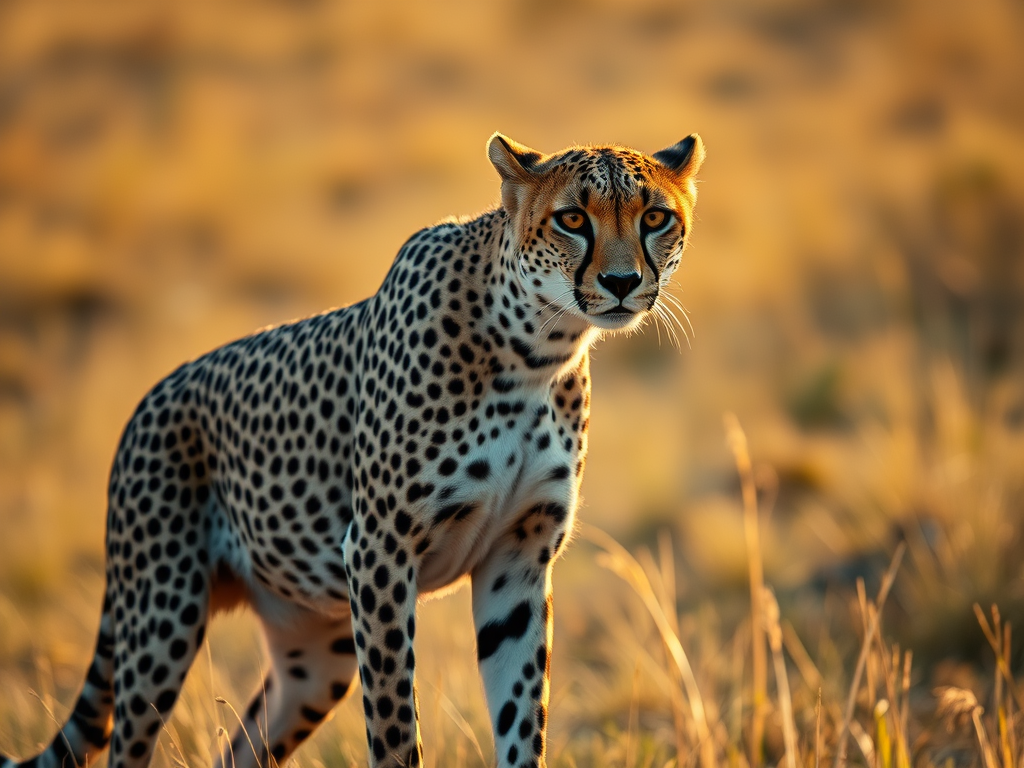
This is of course an AI generated image because all photos of Michaela are still protected by copyright. It is, however, not so different from the woman I remember, and true to my admiring childhood vision of her. She was, when not in bush clothes, very glamorous.

I walked down Delamere Avenue (as it was then known) one day, with my grandmother, and towards me came a woman trailing two cheetahs on a leash.

She was striking to look at, with glimmering red-gold hair and wearing a suit smarter than one normally saw on the streets of Nairobi, capital of colonial Kenya. But of course it was not her looks that impressed me, it was her two pets. 

I knew who she was, of course, because I had already met her.  As had my grandmother.  This was probably the best-known woman in East Africa in the 1950s – the fabulous, glamorous Michaela Denis: adventurer, writer and, with her equally famous husband Armand, a television star. Kenya was more than a decade then from getting television but we all knew of Armand and Michaela Denis.

A few months earlier the Denis’ had visited our school and brought the cheetahs with them as well as a mongoose.  The mongoose didn’t interest us much because they were common in Kenya and many of us had one as a pet at one time or another but the big cats were a thrill because unless our parents took us on safari, these animals were rarely seen. 

Though it is more than seventy years ago I still remember how much I loved Armand Denis’ talk; he was a big man, bulky around the middle, untidy hair, eyes kind behind his glasses.  He showed us what was then called a “ciné film” on a cloth screen and in his soft Belgian voice explained the images ofwild animals and pigmies and other strange West African tribespeople, similar and yet different to the tribes of our own Kenya. 

He was one of the first – and for a time – most famous of the world’s wildlife photographers, ahead, even, of the revered David Attenborough – and he lived in our backyard!  He and Michaela had built a rather unusual house in the suburb of Langata which bordered the Nairobi Game Park.  Here this ever-wandering couple maintained a menagerie of birds and animals because, like me, Michaela had been a little girl who adored wild things and collected everything from hedgehogs to beetles.  Just as I did.

My grandmother knew Michaela because she had a friend who lived next door to the Denis’ home and while they chatted I kept my adoring eyes on the cheetahs.  How I longed for a big cat of my own!  A lion cub, a leopard, even a Serval cat as one of my friends had, but, most of all, a cheetah.  They were said to be easier to tame than most wild creatures, good with children and domestic pets, able to be house-trained, better than dogs for hunting.  My father used to laugh at the very notion of keeping such an animal in an urban environment.  “They eat ten pounds of meat a day”, he told me.  “Their claws are not retractable, like those of other cats, and they will scratch you.  And just look at their teeth!” 

I gazed at the cheetahs and they gazed at the horizon, perhaps seeking the great Athi plains which were only a short distance from that city street. Their indifference was total, quelling to the spirit. 

“Can I touch them?” I whispered, shy in the presence of my goddess and her Olympian companions.  “No,” said my grandmother.  But Michaela, may her name be forever blessed, took my hand and placed it on the head of one of the cheetahs.  I moved my fingers, scratching the scalp as I did to our dog.  The fur, I remember, was very bristly and not as soft as it looked.  My hand, still covered by Michaela’s, moved tentatively down the neck. The cheetah continued to stand there, perfectly still, unresponsive.  The other one sat down with a grunt, as if resignedly making the best of things while these humans communicated with each other in ways mystifying to cheetah-kind and rather boring.  People passed us on the pavement, some stopping to stare or say hello.  Cars and bicycles went by only inches away.  The cheetahs remained unruffled and apparently unseeing, like carvings on an Egyptian tomb.

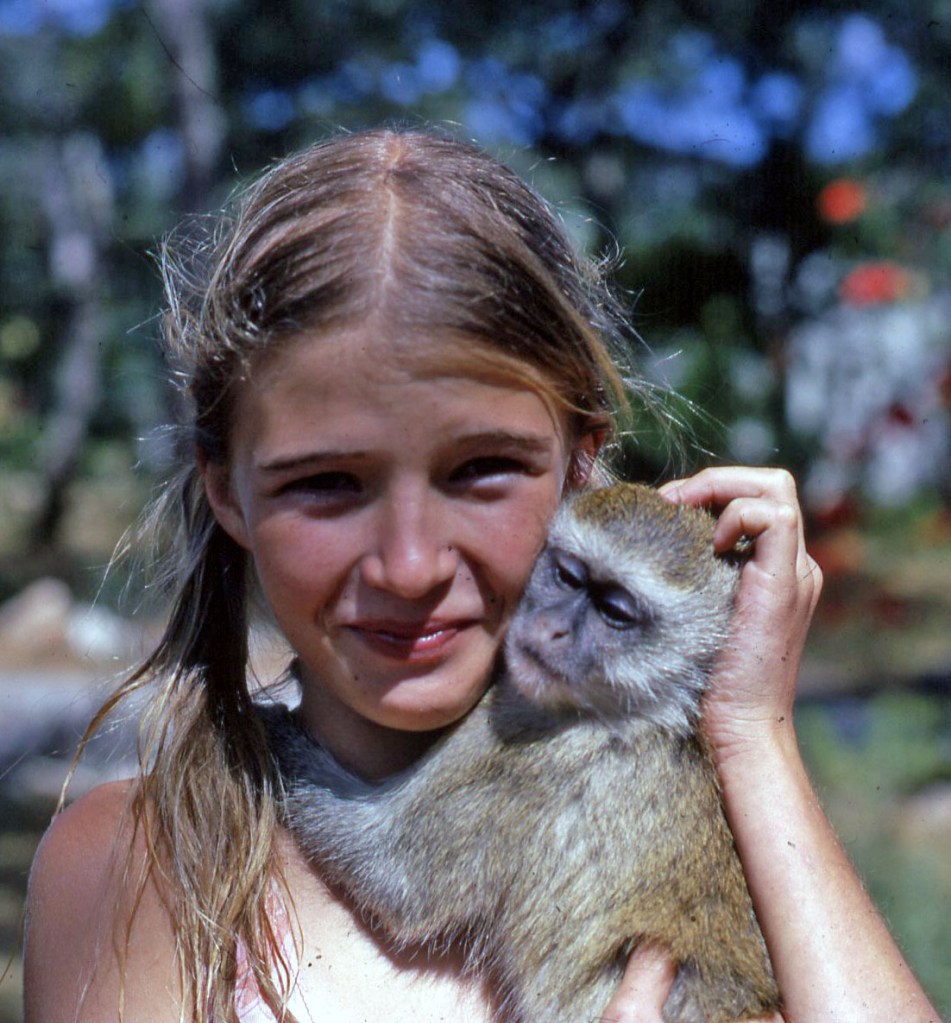
I never got to keep a leopard. Or a cheetah. But I did have a monkey – a coup0le of them, in fact, at different times. Here is our monkey Peppy with my daughter Amanda – circa 1971.

After that day I went several times to the Denis’ house, with friends, to “play” with their wild things.  Armand and Denis were very good with children, though they had none of their own.  Besides the cheetahs, of which at one time they kept about half a dozen, they also had a young leopard called, from memory, Chui.  Not very original as this is its Swahili name.  The leopard was playful and firmly imprinted on Michaela who would hug and kiss it and let it lick her face.  Those great canines, so close to her nose; those savage claws so close to her eyes!  It was tame, didn’t seem to mind our presence, walked happily around the house and garden but we were not permitted to touch it.  Leopards, we were told, were unpredictable around people, even when brought up as pets. 

Nonetheless, Michaela preferred her leopard to the cheetahs. She told us it was warmer, more affectionate, bonded better with humans.  Even though capable of doing much more harm.  “Look into the eyes of a leopard,” she would say, “You’ll see feeling.  A connection.  Look into a cheetah’s eyes and you see nothing.”

Though I admired and even adored her in that pre-pubescent way of girls I didn’t agree with her.  I looked into the eyes of Chui and I saw a creature that, even though well-fed and, it seemed to me, lazy because of it, would just as soon reach out one of those large paws and pull me within reach of its jaws.  Just to see what I tasted like! I saw, I believed, a glimmer of hostility.  Or avidity.

Whereas, to me, the cheetahs seemed to be always dreaming of somewhere far away; of running free on the savannah.  Non-threatening but disinterested. Unlike with the leopard, we were allowed to play with them once they got used to us and never did I know them to be even the slightest bit spiteful.  They tolerated our petting and would obligingly chase and pounce on objects towed on a string. They would even, sometimes, nuzzle our hands and rub against our legs, just like any cat.  They were always happy to be fed by us.

But always they retained that aloofness.  We just didn’t matter to them and they wouldn’t miss us when we left. 

Michaela’s big cats were never caged, to my knowledge, merely contained at night so they wouldn’t wander while their humans were sleeping. Cheetahs are daytime hunters while leopards hunt mostly at night but well-fed cats of any kind don’t usually stray too far.  Looking back, now, with the wisdom of years, I wonder whether, being hand-raised, they knew they would not fare well if they wandered over the fence to the national park beyond, where they would have to fend for themselves and their totally wild and free kind might not welcome them. 

The leopard did sometimes go exploring.  A friend’s father, who lived nearby, came home late on night to find a leopard sprawled across his stoep.  He did all the usual things…shouted, threw things, sounded his horn.  The leopard didn’t stir and nobody in the house, or in the servant’s quarters round the back, heard his shouts and horn-blowing so he had to stay there the rest of the night, sleeping in his car.  When he woke, the leopard had gone. 

It could, of course, have been a wild leopard because leopards were plentiful around the Nairobi suburbs back then – snatching dogs, frightening (though never to my knowledge actually harming) Africans on bicycles, always there in the darkness, swift and silent, rarely seen.

But, so the story went, a wild leopard would have run away if confronted by an angry and noisy human.  Or even, if frightened, attack.  The man swore it was Chui and many believed him.  Complaints were made.  The Denis’ denied it was their leopard but other neighbours had similar encounters and, so my grandmother told me, Michaela did take more care to keep her wandering pet confined because she was afraid that somebody might get trigger-happy.  Many people had guns back then, because of the Emergency. 

My family moved to the coast and I never saw Armand and Michaela again though their wildlife documentaries were sometimes shown in a Mombasa cinema and we saw the TV show when on holiday in England.  “I know them”, I used to say proudly to my English cousins. 

I never did get to own a cheetah.  Or even a Serval cat.  I am not in favour of keeping wild animals as pets and hate those American TV shows where people show off their tigers.  There are, I read, more tigers in captivity today in the USA than wild tigers in India and, sadly, they may well be better off there.  But it still doesn’t seem right. 

A natural successor to Michaela, of course, was Joy Adamson and Elsa.  But the Adamsons, living in a game reserve, always intended to return their lion to her wild condition.  Which shows how times – and attitudes –  can change, even within just a decade. 

I re-read one of Michaela Denis’ books recently (thus inspiring this article) and now realise she was a silly woman in some ways and often wildly incorrect…some people would even find her descriptions offensive.  But that is to judge the actions and opinions of the past through the filter of today and so, for her courage and kindness and glamour and passion for conserving wild places long before it became commonplace, she is still my hero!

Oh, and by the way, she couldn’t stand David Attenborough!  Described him as a fool and a thief – apparently for pinching one of Armand’s ideas for a wildlife television program.

The night of the siafu – an African horror story!

The siafu came, like all true horrors, at midnight.

They came stealthily as they always do, determined of purpose.  The leaders made their choice and the long columns followed, obedient as automatons, the scouts ahead and to the side, the stalwart marshals vigilant along the side of each column, keeping the foot soldiers in line.  There would have been several columns.  I didn’t see this for myself but knew it to be so because I had witnessed these sudden, forced marches before and, though well aware of their deadliness, had teased and provoked and dropped obstacles in their path, gleefully and fearfully watching the seething mass that soon sorted itself into order and marched on, over the bodies of comrades. . Overcoming everything.  Leaving me awed at such sacrificial resolve.

I was the giant, so immensely huge by comparison that they would barely have been aware of my existence.  I could destroy them, like a god, but while I had the size, they had the numbers and should I for any reason fall they would swiftly discover me to be no deity but mere flesh, and devour me.

On that night the siafu came I was asleep in my bed, in our solid-walled house of cream palnted coral block and terra cotta tiled roof in Kizingo Road, on the seaward side of Mombasa.  Across from us was a grassy vlei and beyond that a collection of small cottages separated by narrow laneways.  These were known collectively as the bandas and they housed  lower-ranking white employees of the City Council, many of them of South African origin.  These bungalows were tiny, two-bedroomed and hot, with kitchens out the back to be fire-safe, joined to the main house by narrow covered walkways.  There were no ceilings below the thatched roofs and geckos hunted along the beams while snakes and rodents made homes in the straw.  Those today who think all the colonial white bwanas and memsaabs lived in luxury should be taken back in time to live for a few nights in one of the bandas.

I had playmates living there and so spent some after school hours chalking out hopscotch squares on the melting black tarmac and throwing balls against the mud-and-wattle walls. One of my favourite activities was to visit a couple known as Aunty Bertha and Oupa and in the strange way that some children attach themselves to adult oddities, so I became enamoured of this couple, so very different from my parents and their friends.  Aunty Bertha was a large, fat, jolly woman and Oupa was her father, an immensely old (to me) man who rarely seemed to stir from his armchair.  They spoke mostly Afrikaans, at least to each other, and his English was poor or else, as was the way then of elderly Afrikaners, spoken grudgingly. 

Aunty Bertha loved children and always had sweeties for us.  They kept no servant – unheard of! – and she did her own baking so that we could be sure of gingerbread and sugary biscuits.  She kept bottles of Vimto for us in the old, noisy frig and had a forlorn monkey on a chain in the tiny baked-earth yard whose main amusement was to leap out at passing children, teeth bared.  We could not play with him but could instead fondle and throw balls for the sweet-natured golden cocker spaniel who was Bertha’s darling.  She had never been married and this dog, Meisie, was the object of all her maternal affection. She had a heart as big as her body, did Aunty Bertha and all the time in the world for the neighbourhood children whose own, more affluent parents were usually either at work or at the club. 

The old man would watch us play and listen to us prattle without saying much but we always assumed his presence was benign and, as he did not engage with us, we ignored him.  He, too, was very fond of the dog and would take it on his lap and feed it little treats – and as a result the dog was, like its mistress, very fat. 

It was to this modest household, on one dark night in, I think, 1957, that the siafu, in the inscrutable way of marching ants, directed their attack. 

It was all too well known in the Kenya of those days that once the safari ants went on the march, and your house was in their way, then all you could do was get out.  Africans, in their village huts, had long known this but a traditional hut only takes minutes to clean out and you can flee to a safe distance and wait while they trail relentlessly through and go on their way.  For the white folk and Indians, however, there was rarely enough time to remove everything except all foodstuff not in tins and as much clothing as possible.

Because the ants would consume everything except metal, stone and hard timber.  Soft fabric on furniture, clothing, bed linen, paper, carpeting, shoe leather and every kind of foodstuff could be chewed to pieces or totally gobbled up by those savage mandibles. 

Siafu invasions of urban areas were rare.  We did not live in daily fear of them.  But we knew they could happen, had seen them happen to others and had heard the stories – no doubt wildly exaggerated and the stuff of myth but – as I was to learn that night – sometimes true.

These ants of the Dorylus genus were indomitable.  They marched in their millions and nothing except wide water or fire would stop them.  Usually when they were spotted nearing houses or shops there would be a concerted community effort to deflect them – chemicals would be sprayed on them, water would be blasted at them through hoses and though millions would die, millions more marched over them towards their mysteriously-determined goal.  Mysterious to humans, that is. 

In the bush, one often came upon these columns which seemed to go on forever, consuming anything in their path such as vegetation, baby birds and young creatures too weak to run.  All things that could run, from bush mice to elephants, got out of their way.   But in this environment the siafu played their part in the natural way of things and no doubt it was a useful one.  It was only in the urban environment that they became a menace.

Houses like my own were better able to stand up to ant attacks but the Bandas, only a step up from African huts, were very vulnerable.  Full of nooks and crannies and entryways and the walls that ended just short of the thatched roof so that the air could move through and keep the place cool.

When the ants marched during the day they would usually be spotted well in advance and evasive action taken.  Or a line of fire lit to deter them, though it had to be continuous and wide or else the siafu would just march through across the bodies of their frizzled comrades.  But when they came at night the chances of detection were minimal.

As was the case that night, of which I write after nearly seventy years, when the siafu came to the Bandas and, of all the little houses there, chose to invade the home of Aunty Bertha and her father.

We heard the shrieks and shouts.  Even from our house, on the other side of the vlei , we heard them and woke.  Closer neighbours crowded the little laneways and some rushed in to help the stricken couple while others checked the lines of ants to see if their own houses were in danger.  The fire brigade was called.  And in this white residential area, the live-in servants emerged from their quarters and gathered in small groups, speculating and sending runners to find out what was going on.  Soon the dread word siafu was whispered around and my father, deciding this was not his affair, ordered us all back to bed. 

But I didn’t go.  I was twelve and curious.  So was one of my friends who lived across the road.  Together we sneaked out of our homes and across the grassy open space to where the action was.  There were so many people milling around that we could not get very close, but close enough that we could see Aunty Bertha and Oupa, wrapped in sheets, being ushed into a car, and that big, kindly woman dishevelled and in tears, arguing with those assisting her.  She was, I learned the next day, desperately trying to tell them something, and to get back into the house.  And they were just as desperately trying to urge her away. 

I could see a wide pathway that had been left between the roadway and the house and along it flowed a relentless river of ants which was, in the next minute, sprayed by the fire hose.  Other hoses were being sprayed on the house.  Here and there firemen and a mixed crowd of Africans and Europeans were beating – rather uselessly – at other ant columns, using brooms and sticks and even hippo-hide whips.  The lights of the fire engine whirled and made everything glow eerily.  Torches bobbed.  I heard men discussing the possibility of lighting a fire line and deciding it was too dangerous in that close environment of thatched homes.  It was the kind of chaotic drama that kids love. 

By this time we knew the bones of it.  The siafu had come and invaded the little house of Aunty Bertha and her father.  They had woken only when the ants were upon them, biting them, covering everything.  A horror too terrible to think about.  Overweight, aged and slow, it had taken them a while to yell for neighbours and get out of the house – but they had done so and, though shocked and badly bitten, would survive. 

“The ants were all in her hair,” I heard a woman say, and I shuddered.  “All over and…you know…up in every part of her”.  I envisaged this and shuddered again – fascinated as well as appalled. 

Nobody knew quite what to do in such a situation and it was decided that the stricken couple, beating at their bodies and in great distress and pain, should be taken to hospital.  But, good neighbours that they were, nobody wanted to use their own car for fear of filling it with ants, for the bite of one siafu is very painful, as I had long since learned to my cost, along with other overly-curious children.  The bit of many is true agony.

Later, my mother told me, a solution of a kind was found and the poor old couple was liberally sprayed with DDT, using the little barrelled flit guns that were found in every home, our only defence against the mosquitoes and other annoying insects which bedevilled the African night.  The chief of the fire brigade sent a departmental vehicle to take Bertha and Oupa to the hospital – but still she protested and struggled back towards the house.

And then I could hear…we could all hear…what she had been hearing.  The long, dreadful howl of a dog. A dog in agony. A dog in terror.  A dog abandoned. Poor Meisie was in the house.  People do strange things in time of panic.  Aunty Bertha, from sheer force of habit, had locked the door when she left the house! And in all the beating and the fumbling of clothing and the frenzied attempts to rid herself of the biting ants, she could not find the key! 

When this was conveyed to those standing by, there was talk of breaking down the door, or smashing a window.  But the ants were everywhere around the house as well as inside it, thick on the ground and up the walls, wreaking havoc on the thatch, a seething and malignant dark mass.  Nobody would be foolish enough to try and rescue a dog. 

The firemen were urged to spray the door and try to break it down so that Meisie might be able to rush out but they would not do it – their remit was to kill ants but not damage property, even if the owner was begging for it.  And really, what good could it do? Already the dreadful shrieking – so appallingly different from any dog howl that we had ever heard – was muting to faint whimpers.  And then silence. 

My friend and I sneaked back home and I lay in bed, deeply distressed and sleepless. I longed to tell my parents, next morning, what I’d seen and heard but didn’t dare.  However they soon learned about Meisie and it was a great relief that I could now share my misery with them.  We hugged our own dogs closer and wondered aloud what we would do if such an awful fate had befallen them.

 My mother and other members of the East African Women’s League visited the hospital with food and other comforts.

“Bertha is very brave,” she told me.  “But she blames herself terribly for leaving her dog behind.” The two women had never spoken before and my mother was gratified – and very surprised – to learn that in one household, at least, I was considered a “lovely little girl.”  Dear Bertha and her kind heart, no other adult had ever described me thus!

It was a week before Aunty Bertha and Oupa were released from hospital.  In that time their house had been thoroughly cleaned and replacements found for soft furnishings that had eaten by the ants.  They had not owned much and most of what they had was consumed or damaged so badly it had to be thrown away.  Pots and pans and china remained, as did the frig and the stove and the water filter.  The old man’s pipe was intact along with the tobacco tin.  Somebody had taken away the little skeleton which was all that had been left of pretty Meisie, with her soft floppy ears and lively eyes. 

The ants had disappeared as silently and mysteriously as they had arrived.

Charlie, the Vervet monkey, had survived.  His shrieks were one of the first things to attract attention to the unfolding threat and a neighbour had rushed into the yard and freed him.  For which act of mercy he was rewarded by a severe bite, requiring several painful rabies injections!

Somebody gave Aunty Bertha another dog; another golden cocker spaniel. I don’t know how she really felt about that, but she accepted it.

I, along with the other neighbourhood kids, grew up and moved away.  But for years I had nightmares about swarming ants and, as you can see, the sound of that little dog’s dying haunts me to this day. 

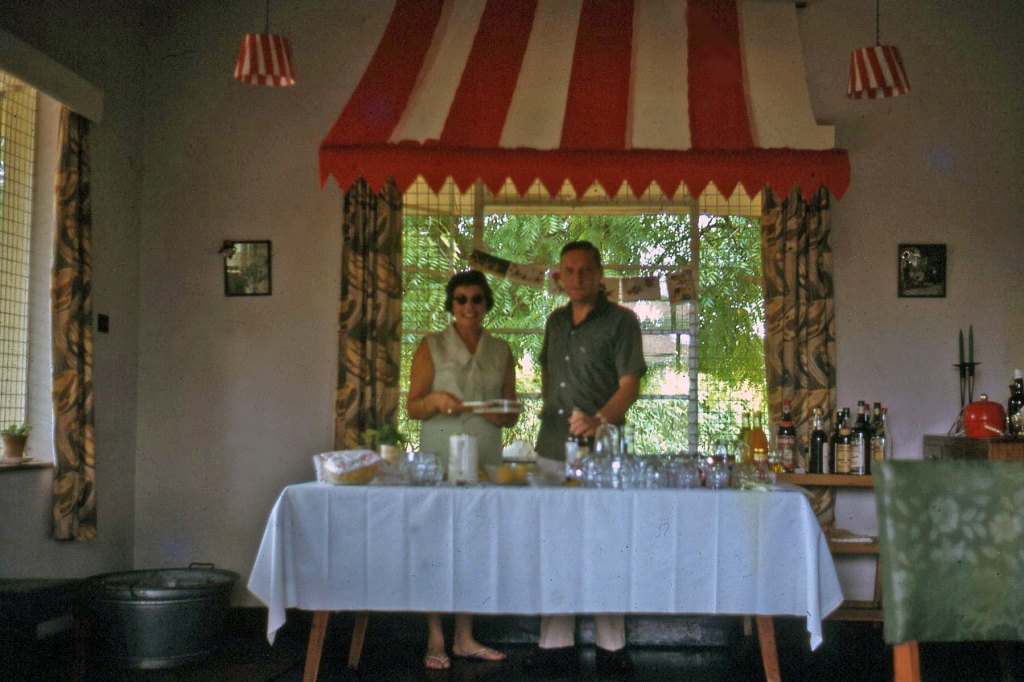
My parents in our house in Kizingo Road, getting ready for their usual Christmas morning Pimms party. This was taken not long after the night of the siafu invasion, which took place only a short distance away. And no, that’s not the family bath in the left hand corner, it’s the ice tub!

Ghostbusters of Mombasa

It was midnight and clouds were scudding across the moon.  By its fitful light we crept nervously up the ruined staircase to the turret, avoiding the jagged-edged holes where boards had rotted or been ripped away.  Everything was deathly quiet; the only sounds we could hear were our own breathing and a skitter of small, clawed feet somewhere in the darkness beyond.  Silently we sat on the littered floor, backs against the walls, hands touching for reassurance.  “Oh God,” I heard someone whisper, “What are we doing here? “ and I knew I was not alone in my fear.  Down through the window it was just possible to make out the shapes of trees and bushes in the weed-wild garden which suddenly seemed full of threat, barring all possibility of escape.  The moon came out from behind a cloud and lit full upon the black mouth of the old well…

From memory there were about eight of us.  I know” Kuku” Henn was there, and Ruth Brereton (as she was then) and Bryan Beardmore, and Mary Molloy.  Today, more than sixty years later, I can no longer remember who else – probably Bill Hurst and possibly Chris Selby-Lownes.  We were all rather into ghosts back then, and always trying to find something to do on a Saturday night besides going to the flicks and then on to Nyali Beach Hotel to dance, or crashing somebody’s party. So when it was suggested that we sneak into the empty Phantom Inn and look for the ghost, it seemed like a fun thing to do.

The Phantom Inn had previously been called The Golden Key (for some reason nicknamed by many The Golden Bollock) and in my memory of the 1950s and early 60s in Mombasa, it had never been much of a place before falling into disuse and dereliction.  My mother, however, told me that before World War II and possibly during, the small hotel on the northern side of Nyali Bridge had been quite a popular spot for drinking and dancing; a sort of night club.  It stood alone on the cliff just as you came off the bridge on to the mainland, overlooking Tudor Creek.  And by 1963, when this story takes place, the only interesting thing about it was The Legend – of a young Arab woman who had been thrown down the well by her husband as a punishment for some unspecified offense.  She was said to rise from the well at midnight when the moon was full, and wander around the hotel.  Certainly Africans avoided the place after dark and many white Mombasa-ites, too, claimed to believe the story.

Picture of the old Nyali Bridge that connected the island with the north shore, back in the time of this story. The Golden Key aka Phantom Inn aka The Golden Bollock is the two storey building at far left of the bridge. (Photo courtesy of Rajni Kant Shah).

So, late one night when the moon was suitably full, our gang of ghostbusters parked our cars on the island side of the bridge and crept across, eager to be in place by midnight.  Giggling and shushing each other we clambered through a window, pulling back the rotting shutter, and picked our way gingerly through the debris on the ground floor.  A dilapidated staircase led up to the next storey, where there was a sort of turret room.  Here we ensconced ourselves, sitting on the floor with our backs to the wall, where most of the inner lining had rotted away.  The whole place stank of rodents and bats and, I think, human piss.  It was quite horrible and I remembered wishing I’d stayed home!  When our watches showed midnight we all became breathless and silent.  I don’t think any of us REALLY expected to see a ghost, especially the older men who were less credulous than my 18 year old self (I was the youngest in the group by about four years).

But then…oh the horror!… all of a sudden we saw a wavering light creeping towards us.  We couldn’t see exactly where it was coming from, it just seemed to wander all about without purpose or direction.  At least for a while.   A pale, mysterious light with no sound to humanise it. “It’s the ghost…there really IS a ghost!” whispered Ruth, sounding slightly hysterical.  Mary Molloy, I remember, crossed herself and asked for some heavenly protection – I’d never known her be particularly religious before.  The men – Kuku, Bryan and the others – had been scoffingly sceptical about the whole adventure until then, just going along for the hell of it, but now they, too, had gone ominously quiet and that worried me most of all.

We sat there, group hysteria taking over, terrified and not quite sure what to do.  I can’t say we were frozen with fright because this was, after all, Mombasa on a hot Saturday night.  But we were certainly immobilised by it. What else, after all, could this mysterious light that seemed to hover a few feet off the ground be BUT an apparition of some kind?  The light came closer, we could see it diffused and indistinct but certainly THERE through the cracks in the floorboards.  And then – it began to ascend the stairs!  It now seemed to be accompanied by a sort of shushing noise which to me sounded JUST like the noise an ambulatory ghost might make, especially if she was wearing her buibui

“Omigawd!”, muttered Ruth.  “What will we DO?”  One of the men – can’t remember who it was, now, probably Bill, told us to stay calm and very quiet.  No screaming.  And so the light came nearer…and nearer…and the moonlight, quite ghostly in itself, shone through the window and cast shadows that made the whole thing seem more sinister.  And then a voice…a trembling voice that wavered fearfully behind the wavering light…said: “Nani huko?”

 It was the night watchman! 

We hadn’t thought of that!  Hadn’t realised there would be anyone watching over this derelict building but of course local watu might have found a use for the old timber and stuff.  So a night watchman had been employed, and a wizened, ancient and very frightened and indignant mzee he was too, carrying a kerosene lantern and wearing huge unwieldy thongs made of recycled tyre rubber, hence the “shushing” sound.  He was not at all amused by this bunch of young wazungu with nothing better to do with their time than disturb his peace of mind.  And, of course, we WERE trespassing.  So to soothe him down and shut him up (calling the policewas mentioned) we paid him a few shillingi and made our merry way back across the bridge.

This ultimately dispiriting experience didn’t in the least dim our enthusiasm for things supernatural and paranormal – far from it.  Our next ghostbusting adventure after that was spending a night in the Mombasa Cemetery – but that’s another story!

My first love affair

The sea was sparkling blue beneath the summer skies

And all alone with you I was in paradise

We wandered hand-in-hand, along the golden sand

Into my first love affair

That song was a big hit back in the late fifties when I was at boarding school in Nairobi.  It was made famous, I think, by an English singer named Craig Douglas (possibly not his real name; very few English boys were called “Craig” back then); a milkman who had enjoyed a brief flare of fame before sinking back into obscurity.  I feel I have a small claim on Craig Douglas because my cousin Susan, who lived (and still lives) on the Isle of Wight knew a girl who went out with him.  Presumably while he was still a milkman.  His songs, of which I can only remember two (the other is the more famous She Was Only Sixteen), seemed to echo the clopping sound of a milkman doing his horse-drawn rounds, or so my father once commented.  Though by the late 1950s I don’t suppose there were many milkmen still driving horses, not even on the Isle of Wight.

For those of us who WERE about sixteen when the bland but boyishly pleasant-looking Douglas (he didn’t smoulder like Cliff or have the cheeky charm of Adam) enjoyed his brief hit-parade success, it was a song for our time and place.  I was slightly younger but already well awake to the possibilities of love.  It was no accident that Shakespeare made Juliet fourteen; we forget as we age that the most intense love is felt in our teens, when our hormones are most urgent and our emotions untempered by reality.  

To live in Mombasa, back then, and walk along one of those endlessly pefect beaches, beside the  Indian Ocean which ALWAYS sparkles, hand-in-hand with the boy of our choice (and who had, oh bliss! chosen us) really was paradise enow!  True, our sand was white rather than golden, and all the better for that.  Our cousins in England, poor pale things, could only enjoy that gold for a brief summer each year, and that fleetingly.  Whereas we Kenya kids had our white beaches always there for our delight.

And so, for the teenagers of Mombasa, and those older than us who, for reasons which we found incomprehensible and faintly revolting, still insisted on romance in their lives, the beach was an essential factor in our love affairs.  So it was for me, and I still remember those moonlight walks and frenzied gropings in the sand with great affection.  But my first love affair was not with a boy – it was with Mombasa itself; the town and the coastlines north and south.  Mombasa was the first great love of my life; like all great loves the memory still warms my heart and like all lost loves it haunts me still.

I still remember the day I fell in love.  My father had taken up a new post and so we packed up the house in Nairobi and headed for the coast.  We were, I remember, all ecstatic about this.  Nairobi had come to seem grim with the dark shadow of Mau Mau still upon it.  We didn’t doubt that the British Government and the stalwart nature of the settlers on their fortified farms would ultimately prevail over a handful of disaffected and witch-ridden tribesmen but there was nonetheless a strong sense of unease in the European community, sensed even by children at a time when children were seen and not heard and certainly not informed about adult affairs.  It is not of course the done thing to say this now, but we felt betrayed by those we considered in our trust and wondered whether we could ever feel safe in that beloved country again.  Too, the winds of change were beginning to blow just over the horizon, perceptible to those astute at reading political weather.  Terrorism was all but defeated but those of us who thought we had won the battle were soon to find we had lost the war;  within a decade we would no longer rule the land and our way of life would be gone forever.

None of this weighed on my small family, however, as we took the red road to the coast.  We knew what to expect because we had holidayed at Jadini where the simple thatched banda with its iron beds and primitive bathroom, sited between the jungle and the splendid beach, was all that up-country folk expected of a holiday in those simple times.  But to actually live there with the beach forever at the door and the palm trees waving and the warm, moist seawind  blowing over the island was unimaginable bliss.  Especially after Nairobi which seemed colourless and dreary by comparison.

I should admit here that I never did really care for Nairobi.  Most Mombasa people didn’t.  Perhaps I associate the Kenya capital with boarding school (which I loathed and where I always felt I’d been exiled from my coastal heartland) and also the earlier period of Mau Mau with its curfews and alarms.  Beyond that, however, I always sensed  (and still do in memory) a darkness at the heart of the city which Ewart Grogan once described as “that miserable scrap heap of tin”.  Of course it had changed a lot since pioneering days and had its revered icons – the Norfolk Hotel, the New Stanley bar,  the markets, the game park at its boundary – as well as some fine social and civic developments such as theatres, shops, cinemas and Ledgco.  For me, though, there was always a faint sense of depression to be found in the neat suburbs where so many of the houses were built of a grim grey stone, imprisoned by dense hedges of cypress or kai apple.  I felt this most keenly on those Sunday afternoons when I was taken out of school on one of the precious exeats by well-meaning aunts who took me to their homes and tried hard to feed and amuse me.   The homes all seemed to be filled with a kind of sad Sunday silence .  Even the gardens were darkened by overhanging trees which seemed vaguely threatening to me;  occasionally  leopards were seen in those trees, hunting the suburbs for dogs.  Such leopards, the servant of one of my aunts once told me, were really were-creatures and therefore dangerous because they had no fear of people and were particularly fond of the flesh of children.  He was a Kikuyu and thus believed strongly in such things and I believed too, because it seemed quite natural that Nairobi would harbor black horrors behind its sombre hedges.

The coast, by contrast, was all lightness and sun and happy glitter.  We arrived there as eager new residents after the long drive which at that time was still an adventure.  Traffic was low enough that when you passed another car, in a cloud of red dust, everyone waved and sometimes we would stop and exchange news of conditions ahead of us.  Animals large and small crossed the road with insouciant frequency; everything from tiny ground squirrels by the dozens to buck and gazelle of various types, zebra and wildebeest on the Athi Plains as far as the scarp above Hunter’s Lodge, then rhino and elephant in the hot lowlands of the nyika.  The mandatory stops were Kibwezi and Mtito Andei where there was a passable roadhouse; Voi if you needed fuel or felt you couldn’t go any further.

On this occasion we drove across the Causeway and on to Mombasa Island late in the afternoon, our car covered in red dust that also lay thick and gritty in our eyes and throats.  Our first stop was the office of “Uncle” Peter.  This was a courtesy title only; he and “Aunt” Kay were friends of my parents and no relation at all but it was common then for children to address close family friends by familial titles.  The Japanese do it too, and the Australian aborigines.  It’s one of those little social niceties that we have now lost in an age where even very small children call all adults by their given names.

Uncle Peter worked for the government and though I don’t know exactly what he did it must have been reasonably high-ranking because he and Aunt Kay had rather a splendid house on the seafront, next-door-but-one to the Golf Club. 

And it was there, sitting outside his office, in the back of our brand-new albeit dusty Morris Oxford, that I fell in love.  I remember the moment perfectly, though I can’t remember for the life of me exactly where we were.  Somewhere around Treasury Square I should imagine.  My father had gone inside to announce our arrival and while he was there I looked up and saw a coconut palm, heavy with fruit, leaning over the pavement.  This tree, in all its slender elegance, repeated itself in shadow upon a white wall.  And that was it!  That’s all it took!  Something about the tree and the quality of light and the feel of the air pierced my young heart as surely as Cupid’s arrow and skewered it firmly into the sandy soil of the Kenya coast.  Seven decades or so later I remember the moment quite clearly.

We then drove round the seafront where the usual afternoon breeze freshened the humidity.  The grass on the golf course was bright green patched by the sandy bunkers.  Palms framed the large houses up on the cliff, huge baobabs spread their sparse branches below.  The sea was as blue as only the Indian Ocean can be on a fine day.  A large ship in the dove grey and red colours of the Union Castle Line lay just off-shore awaiting the services of the small white pilot boat that bobbed over the waves towards it.  Apart from one or two cars and a couple of golfers the whole expanse before our delighted eyes was devoid of human activity.

Just think, said Uncle Peter. I can walk out on to that course and play golf whenever I like – it hardly costs a thing.

Could you swim, I wondered?  Swimming was new to me and associated with waterholes in the Athi River where you had to watch out for crocodiles.

Not here,  said Uncle Peter.  It was all coral cliffs and no beach. But you could walk round to the ferry and back one way, or to Fort Jesus and back the other way and hardly see a soul.  And there were plenty of good beaches north and south of the island. 

I was to do those walks many times, as child and adult.  The seafront was to become focal to my life; a place to play in the baobab trees and the ruins of the wartime gun emplacements; to drive around for coolness of a Sunday afternoon and watch the bright-coloured Indian families debouch from their small cars; to buy peanuts in cones of newsprint from vendors pushing small carts; to ramble  from end to end while pondering everything from failing relationships to major life-changing decisions;  to swim away the school holidays in the Florida pool and, when it became a night club, to dance away the small hours.  It was here that my beloved island met the sea head-on; beyond lay a world which, back then, I had absolutely no desire ever to see.

We spent our first night in the Manor Hotel.  It was old and a bit fusty, with large and heavy wooden furnishings.  My brother and I went to the first sitting for dinner, the only people in the dining room and the only children in the hotel at all.  The waiters wore the standard uniform of white kanzu and red fez and served us with the kind, slightly irreverent deference with which African servants treated white children in those days.  I remember there were four courses and that we ended with floating puddings which we thought a great novelty.   Perhaps, like bread-and-butter pudding, they’ll make a come-back one day and be all the go in fashionable restaurants. 

That night we slept for the first time under mosquito nets; these had not been necessary in our Nairobi house and we found them strange and a bit claustrophobic when the hotel ayah tucked us in.  Funny to think that for many years after I left Mombasa I was unable to fall asleep easily because I missed the security of a net over me.  Large ceiling fans stirred the air, another novelty.  My parents, all dressed up to dine, came in to bid us goodnight.  Isn’t it exciting?, said my mother looking happier than she had for ages because she  was recovering from a serious illness that had left her thin and gaunt and very nervy.  I thought it was exciting and knew myself already besotted by this new home, though I couldn’t have put my feeling into words.

Next morning I awoke and saw the sunlight glinting through the heavy shutters and, once again, that already-familiar silhouette of the coconut palm with its fronds gently shivering.  The day would be full of new things; a house, a school, a different life.  I don’t remember feeling even the tiniest regret for whatever I had left behind.  I knew I was home.

In the years after that I came to know my island intimately, even to its furthest and least likely corners.  I walked everywhere, to school, to town, to visit friends on the other side of the island.  And where I didn’t walk, I cycled.  It was nothing to us then to cycle all around the island and across the ferry to the south coast or over the bridge to Nyali. I’ve sailed down Kilindini Harbour and up the further reaches of the creekways beyond Port Reitz where even African fishermen didn’t go.  I’ve explored the upper reaches of Tudor Creek, too, in the small and unstable canoe made by my father.  There was a world of adventure for children in those places and nobody told us we shouldn’t seek it out, though the waters were full of sharks, especially around the Kenya Meat Commission and the port.  I’ve swum across from the old Swimming Club to the Mombasa Club and back and cycled through the African townships and the commercial go-down area at Chamgamwe.  I’ve  trapped fish in the mangroves along the edge of Mbaraki and explored the forgotten caves near Fort Jesus.  I’ve walked to town down Cliff Avenue when the Poinciana trees were in full bloom and wandered the streets of the Arab old town where street vendors were generous to children and old women swathed from head to toe in black bui-buis would scold us and tell us to go home.

 Here, the old harbour could be glimpsed through narrow gaps between the pastel houses, busy with dhows in season, a glimpse of an earlier and more romantic epoch.  We learned about this time in school; of conflicts up and down the Zinj coast, of Portuguese adventurers and Arab sultans, of slavers and missionaries and the explorers who ventured into the interior for ivory and the renown of discovering the sources of great rivers.  The names of Speke and Burton, Grant and Thompson, Krapf and Rebmann were as familiar to us as were the names of Columbus and Magellan and Drake to children elsewhere.  There were missionary graves just north of the island and the remains of the old Freretown slave market.  Fort Jesus was a stalwart reminder of past battles; the small mosques dotted around the island a reminder that such battles had ended in compromise. We were taught that Mombasa meant “island of war” and Dar es Salaam meant “haven of peace” and that both had been havens for the pirates who sailed the waters from the Horn of Africa to Zanzibar, long before the slavers came.

I absorbed all this as if it was my birthright but strange to tell, when I learned all these things, it did not occur to me that there was anything extraordinary about the place in which I lived.  I used to sit in the hot classroom at Mombasa Primary School, head on one hand, and dream of places that I considered truly exotic;  Pago Pago,  Rangoon,  Rio di Janeiro, and great, slow-travelling rivers such as the Irrawaddy, the Brahmaputra and the Amazon.  When I pictured pirates they were always walking planks in the Caribbean. Those were the faraway places with strange-sounding names of which I dreamed; it never occurred to me that the Kenya coast was in any way exciting or exotic.  Like children everywhere we played at pirates and at one time our games were centred on an old wrecked boat that we found in the mangroves far up Tudor Creek.  We shouted “ooo aarrhhh” at each other in the accents (or so we thought) of Devon and wore eyepatches and made swords out of timber and made each other walk the plank.  We were always Blackbeard (a film that came out of Hollywood about that time) and never Sinbad.  It was a triumph of culturism over geographical reality; who we were – little colonial Bwanas and Memsaabs – was more powerful with us than where we were.

Looking back like this it can be seen that I had soon learned to take my great love for granted.  And yet I do think that one of the genii of the place had writhen its way into my spirit so that I “belonged” to the island in a way that my parents and other adults could not.  Adults of my own kind, I mean, who had come to Mombasa too old to fall wholly under its influence. They liked it for its easy working hours, its obvious beauties, its pleasant life of clubs and sport and parties and beaches.  I – and I know others who grew up there feel the same – knew something much older and deeper.  It came to me in strange moments but the feeling is impossible to describe though it has something to do with Kundera’s  unbearable lightness of being; a sublimity of soul envoked by a full moon over the sea, the sun shining in a certain way on a white wall, a dusty track between mbati-roofed shacks, the shocking contrast of white sand and green dune-plants and blue water, rain washing the squalid streets down the far end of Salim Road, the elegant stone fretwork of Islamic architecture,  the rattle of the planks on the old Nyali Bridge, the song of the men pulling a ferry across a sun-splashed creek.

And there is a feeling more powerful than all the rest that today, long-exiled, I associate with Mombasa.  It’s a purely personal feeling rather than one which others might share and though it manifests itself in the guise of memory it is not of any one particular memory but rather a synthesis of recollection that stands for a time and a place precious to my soul.  I call it my “red lamp feeling” for want of any more telling description.  There is a room, at that point of darkness which comes just after sundown on the equator, and in it are a mother, a father and two children.  I think they are reading or listening to one of those old fashioned radios with a cloth piece at the front – I can’t quite be sure because, as I say, this is not quite a memory and not quite a feeling but something in-between.  In  that room there is a red-shaded standard lamp whose light shines kindly on them all and is also reflected in a nearby window.  The room has window bars and the general appearance of my childhood home in Kizingo Road; beyond that I recognize and remember nothing.  I have no idea what triggers this feeling/memory today but when it comes it washes over me with indescribable intensity – a sort of hot flush from the past which is at once painfully nostalgic yet deeply comforting.  “This is absolutely the right time and the right place” it seems to say.  I’m an atheist and a rationalist but if I believed in Heaven I would want it to be back there and back then for eternity!

So deep was my attachment to Mombasa that throughout my youth I could not bear to be anywhere else.  I didn’t care much for going on long leave with my parents; the sea trip either way was fun but Europe – and England especially – seemed grey and cold and dreary to me in those years after the war.  Who could find pleasure in bathing in a grey sea where the beach is full of stones, when they had known the soft white sand and coral pools of the Kenya coast?  Who could enjoy the dull and rainy streets smelling of wet wool and the dank garden laurels of London suburbia when they were accustomed to dusty red-brown roads and flame-red poincianas and the beloved silhouette of palm trees? How could anyone LIVE in England, I wondered?  France was a giant gallery of art and architecture intimidating to children, Italy a place of ruins both ancient and modern inhabited by voluble fat women in flowery penziones who fed and minded my brother and me while our parents went out to dine in little cliff top restaurants overlooking the sea.  Well if that’s what they wanted they could do it just as well at Nyali Beach was the way I looked at it then.  All I wanted was to get back home where I belonged.

Even worse was being sent up-country to boarding school.  Again, it was as if all the colour had been taken from my life and I hated it!  I pined and wilted and begged my parents to let me stay and finish my schooling at the coast where the old Loreto Convent seemed to embody the spirit of every such school in every tropical colonial outpost, its deep verandahs shaded by frangipani and Poinciana trees, the  sound of chanting softening the wet and heavy air.  Eventually I got my way; on the day when I was sent home by train, in disgrace, though fearing (justifiably!) the retribution that awaited me all I could think of was that I would soon be back in Mombasa Island’s safe and sunny embrace.

And so the years passed and in my memory we danced them away with no concern for the future.  Dancing was very much part of our lives; we started when young at the Railway Club’s school holiday Wednesday night rock ‘n roll sessions for teenagers , graduating to the Sports Club at New Year and the Sunday night live band out at Port Reitz.  While my parents and their friends danced sedately at the Chini Club we younger folk did the twist on the floor under the stars at Nyali, or at the Sunday tea dances further up the coast, or at private parties on Saturday nights.  Nightclubs opened, seedy and mildly wicked, and we danced there, too.  We danced on New Year’s Eve and at Government House on the Queen’s birthday, and on board ships in the harbor.  We drove to the dances in open cars with the soft wind of the ocean blowing our hair, and back from them late at night on the long, empty roads, spoiled children of Empire who would dance forever as long as they never left the Enchanted Isle.

Yet leave we did, most of us.  The problem with all great loves, whether they be for people or for places, is that they change.  And so do we.  When this happens we either try and accept the changes and grow old together, wrinkles and all.  Or we part and go our separate ways.  When Independence came to Kenya and  Mombasa began to change, not dramatically at first but in small, insidious increments, I knew I couldn’t stay.   The reasons for leaving were all commonsensical but in my heart I felt that a serpent had entered Eden and I and my kind were being cast out and that Eden itself was about to be despoiled. Fanciful, I know, but then love is not a reasonable emotion. 

Sad to say, so disenchanted had I become with my Enchanted Isle that when I finally left I did so without a twinge of sorrow.  All I can remember is driving one last time through to Tudor to say goodbye to a friend and thinking how dull and flat everything seemed on a Sunday afternoon.  The very palm trees that I’d always so loved seemed to droop with lethargy.  I, by contrast, was filled with the vigour of seeking new and larger horizons and I felt quite sorry for those whom I was leaving behind!  It was only later, quite a bit later, that the soft and sweet memories stole over me and I wept for all I had given up, even though I knew that what it was I missed was gone from me forever, stolen by time as well as politics.

In time I learned to love a new land where the beaches, like those of my childhood, go on forever.  True the sand is not quite so white nor the sea quite so brilliantly aquamarine; the coconut palms have been planted and there is no protective line of reef.  Yet still it’s a fine place where I can wander the tideline safely and alone,  and where I can still recapture something of my magical childhood.

Because the essence of your first great love is that you never forget it.  Never, ever, quite manage to tear it from your heart.  In memory, Mombasa is never very far from me and because I have not been back that memory is pristine and preserved in time as perfectly as an insect in amber.I began this story with a song and I’ll end it with another; one that, when it came out, I felt had been especially written about Mombasa.  When I sing it today, it still makes me cry!

Oh island in the sun

Willed to me by my father’s hand

All my days I will sing in praise

Of your forest, waters your shining sand