
Remembering marvellous Michaela Denis
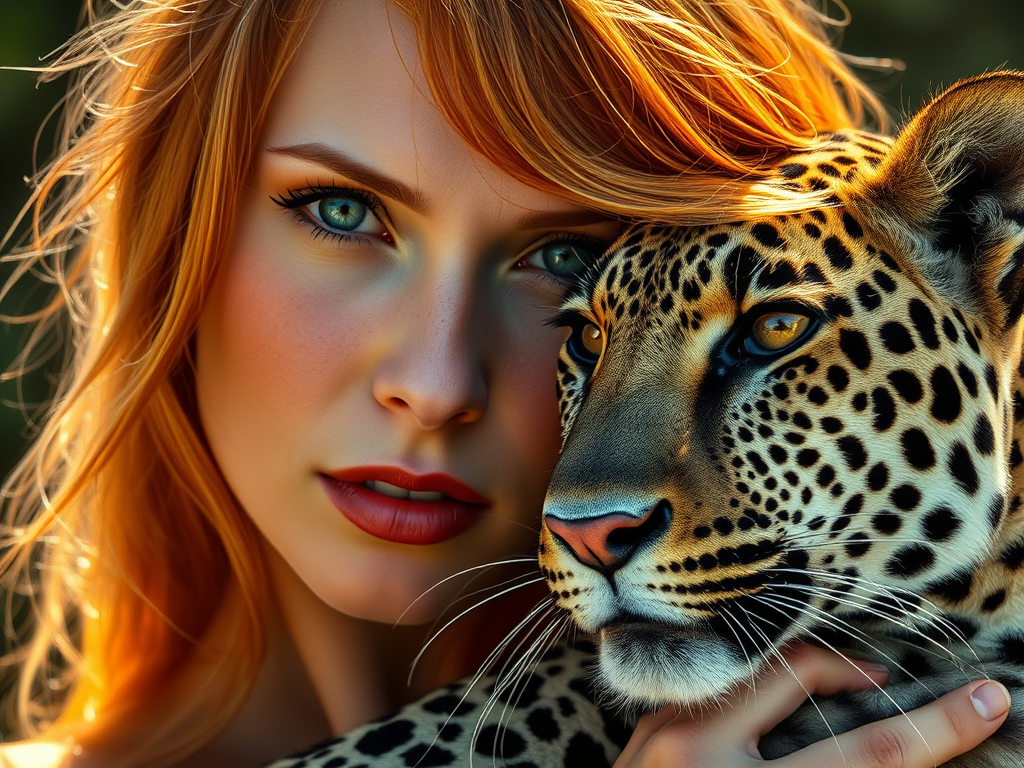
This is of course an AI generated image because all photos of Michaela are still protected by copyright. It is, however, not so different from the woman I remember, and true to my admiring childhood vision of her. She was, when not in bush clothes, very glamorous.
I walked down Delamere Avenue (as it was then known) one day, with my grandmother, and towards me came a woman trailing two cheetahs on a leash.
She was striking to look at, with glimmering red-gold hair and wearing a suit smarter than one normally saw on the streets of Nairobi, capital of colonial Kenya. But of course it was not her looks that impressed me, it was her two pets.
I knew who she was, of course, because I had already met her. As had my grandmother. This was probably the best-known woman in East Africa in the 1950s – the fabulous, glamorous Michaela Denis: adventurer, writer and, with her equally famous husband Armand, a television star. Kenya was more than a decade then from getting television but we all knew of Armand and Michaela Denis.
A few months earlier the Denis’ had visited our school and brought the cheetahs with them as well as a mongoose. The mongoose didn’t interest us much because they were common in Kenya and many of us had one as a pet at one time or another but the big cats were a thrill because unless our parents took us on safari, these animals were rarely seen.
Though it is more than seventy years ago I still remember how much I loved Armand Denis’ talk; he was a big man, bulky around the middle, untidy hair, eyes kind behind his glasses. He showed us what was then called a “ciné film” on a cloth screen and in his soft Belgian voice explained the images ofwild animals and pigmies and other strange West African tribespeople, similar and yet different to the tribes of our own Kenya.
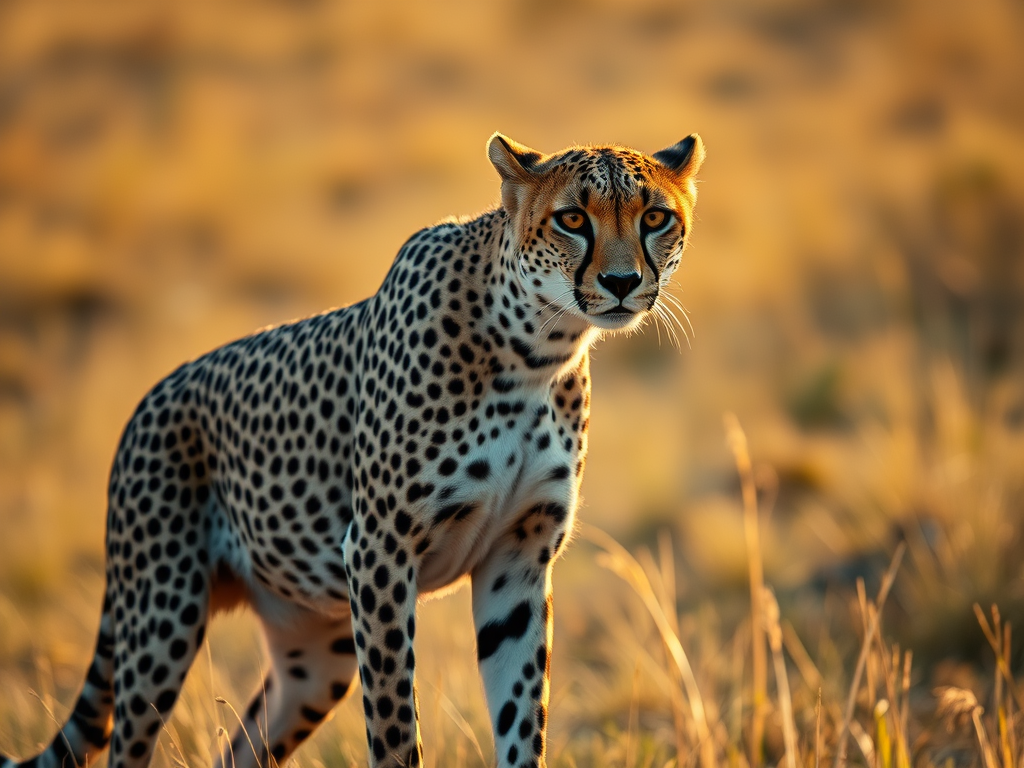
He was one of the first – and for a time – most famous of the world’s wildlife photographers, ahead, even, of the revered David Attenborough – and he lived in our backyard! He and Michaela had built a rather unusual house in the suburb of Langata which bordered the Nairobi Game Park. Here this ever-wandering couple maintained a menagerie of birds and animals because, like me, Michaela had been a little girl who adored wild things and collected everything from hedgehogs to beetles. Just as I did.
My grandmother knew Michaela because she had a friend who lived next door to the Denis’ home and while they chatted I kept my adoring eyes on the cheetahs. How I longed for a big cat of my own! A lion cub, a leopard, even a Serval cat as one of my friends had, but, most of all, a cheetah. They were said to be easier to tame than most wild creatures, good with children and domestic pets, able to be house-trained, better than dogs for hunting. My father used to laugh at the very notion of keeping such an animal in an urban environment. “They eat ten pounds of meat a day”, he told me. “Their claws are not retractable, like those of other cats, and they will scratch you. And just look at their teeth!”
I gazed at the cheetahs and they gazed at the horizon, perhaps seeking the great Athi plains which were only a short distance from that city street. Their indifference was total, quelling to the spirit.
“Can I touch them?” I whispered, shy in the presence of my goddess and her Olympian companions. “No,” said my grandmother. But Michaela, may her name be forever blessed, took my hand and placed it on the head of one of the cheetahs. I moved my fingers, scratching the scalp as I did to our dog. The fur, I remember, was very bristly and not as soft as it looked. My hand, still covered by Michaela’s, moved tentatively down the neck. The cheetah continued to stand there, perfectly still, unresponsive. The other one sat down with a grunt, as if resignedly making the best of things while these humans communicated with each other in ways mystifying to cheetah-kind and rather boring. People passed us on the pavement, some stopping to stare or say hello. Cars and bicycles went by only inches away. The cheetahs remained unruffled and apparently unseeing, like carvings on an Egyptian tomb.
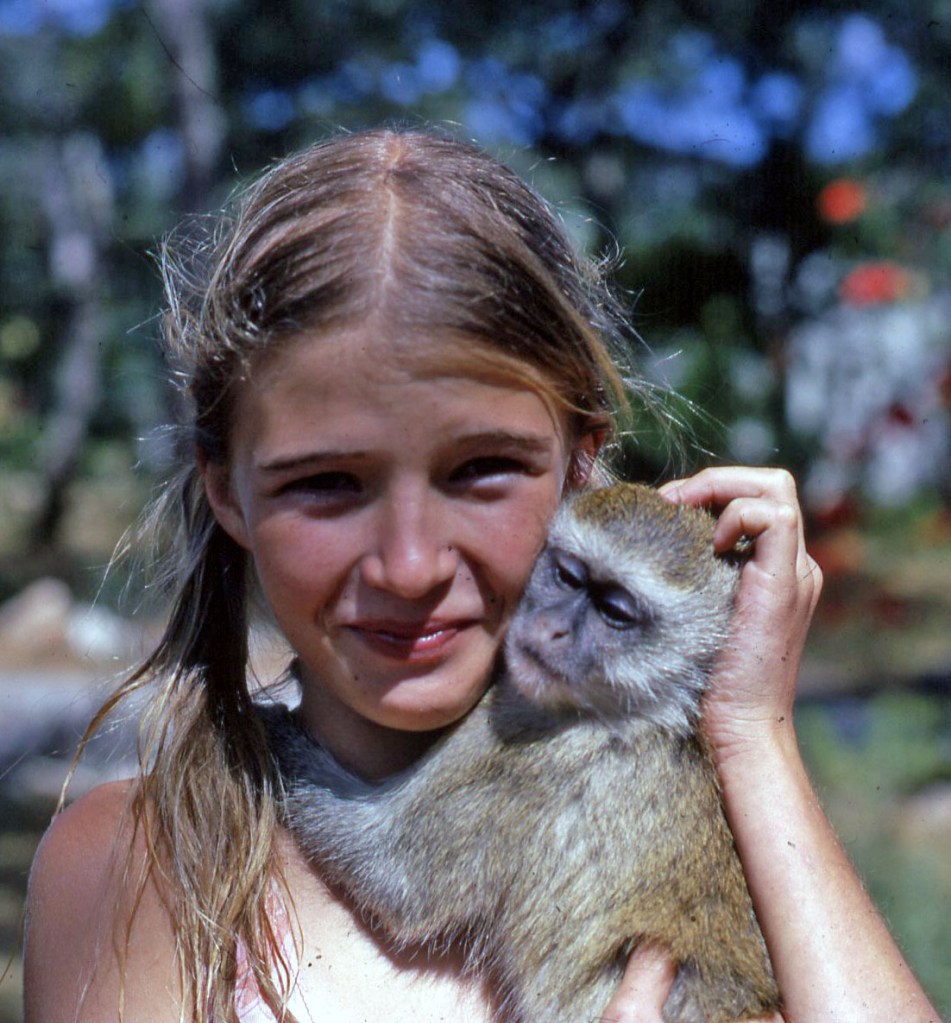
I never got to keep a leopard. Or a cheetah. But I did have a monkey – a coup0le of them, in fact, at different times. Here is our monkey Peppy with my daughter Amanda – circa 1971.
After that day I went several times to the Denis’ house, with friends, to “play” with their wild things. Armand and Denis were very good with children, though they had none of their own. Besides the cheetahs, of which at one time they kept about half a dozen, they also had a young leopard called, from memory, Chui. Not very original as this is its Swahili name. The leopard was playful and firmly imprinted on Michaela who would hug and kiss it and let it lick her face. Those great canines, so close to her nose; those savage claws so close to her eyes! It was tame, didn’t seem to mind our presence, walked happily around the house and garden but we were not permitted to touch it. Leopards, we were told, were unpredictable around people, even when brought up as pets.
Nonetheless, Michaela preferred her leopard to the cheetahs. She told us it was warmer, more affectionate, bonded better with humans. Even though capable of doing much more harm. “Look into the eyes of a leopard,” she would say, “You’ll see feeling. A connection. Look into a cheetah’s eyes and you see nothing.”
Though I admired and even adored her in that pre-pubescent way of girls I didn’t agree with her. I looked into the eyes of Chui and I saw a creature that, even though well-fed and, it seemed to me, lazy because of it, would just as soon reach out one of those large paws and pull me within reach of its jaws. Just to see what I tasted like! I saw, I believed, a glimmer of hostility. Or avidity.
Whereas, to me, the cheetahs seemed to be always dreaming of somewhere far away; of running free on the savannah. Non-threatening but disinterested. Unlike with the leopard, we were allowed to play with them once they got used to us and never did I know them to be even the slightest bit spiteful. They tolerated our petting and would obligingly chase and pounce on objects towed on a string. They would even, sometimes, nuzzle our hands and rub against our legs, just like any cat. They were always happy to be fed by us.
But always they retained that aloofness. We just didn’t matter to them and they wouldn’t miss us when we left.
Michaela’s big cats were never caged, to my knowledge, merely contained at night so they wouldn’t wander while their humans were sleeping. Cheetahs are daytime hunters while leopards hunt mostly at night but well-fed cats of any kind don’t usually stray too far. Looking back, now, with the wisdom of years, I wonder whether, being hand-raised, they knew they would not fare well if they wandered over the fence to the national park beyond, where they would have to fend for themselves and their totally wild and free kind might not welcome them.
The leopard did sometimes go exploring. A friend’s father, who lived nearby, came home late on night to find a leopard sprawled across his stoep. He did all the usual things…shouted, threw things, sounded his horn. The leopard didn’t stir and nobody in the house, or in the servant’s quarters round the back, heard his shouts and horn-blowing so he had to stay there the rest of the night, sleeping in his car. When he woke, the leopard had gone.
It could, of course, have been a wild leopard because leopards were plentiful around the Nairobi suburbs back then – snatching dogs, frightening (though never to my knowledge actually harming) Africans on bicycles, always there in the darkness, swift and silent, rarely seen.
But, so the story went, a wild leopard would have run away if confronted by an angry and noisy human. Or even, if frightened, attack. The man swore it was Chui and many believed him. Complaints were made. The Denis’ denied it was their leopard but other neighbours had similar encounters and, so my grandmother told me, Michaela did take more care to keep her wandering pet confined because she was afraid that somebody might get trigger-happy. Many people had guns back then, because of the Emergency.
My family moved to the coast and I never saw Armand and Michaela again though their wildlife documentaries were sometimes shown in a Mombasa cinema and we saw the TV show when on holiday in England. “I know them”, I used to say proudly to my English cousins.
I never did get to own a cheetah. Or even a Serval cat. I am not in favour of keeping wild animals as pets and hate those American TV shows where people show off their tigers. There are, I read, more tigers in captivity today in the USA than wild tigers in India and, sadly, they may well be better off there. But it still doesn’t seem right.
A natural successor to Michaela, of course, was Joy Adamson and Elsa. But the Adamsons, living in a game reserve, always intended to return their lion to her wild condition. Which shows how times – and attitudes – can change, even within just a decade.
I re-read one of Michaela Denis’ books recently (thus inspiring this article) and now realise she was a silly woman in some ways and often wildly incorrect…some people would even find her descriptions offensive. But that is to judge the actions and opinions of the past through the filter of today and so, for her courage and kindness and glamour and passion for conserving wild places long before it became commonplace, she is still my hero!
Oh, and by the way, she couldn’t stand David Attenborough! Described him as a fool and a thief – apparently for pinching one of Armand’s ideas for a wildlife television program.

 Lyrebird Mountain