
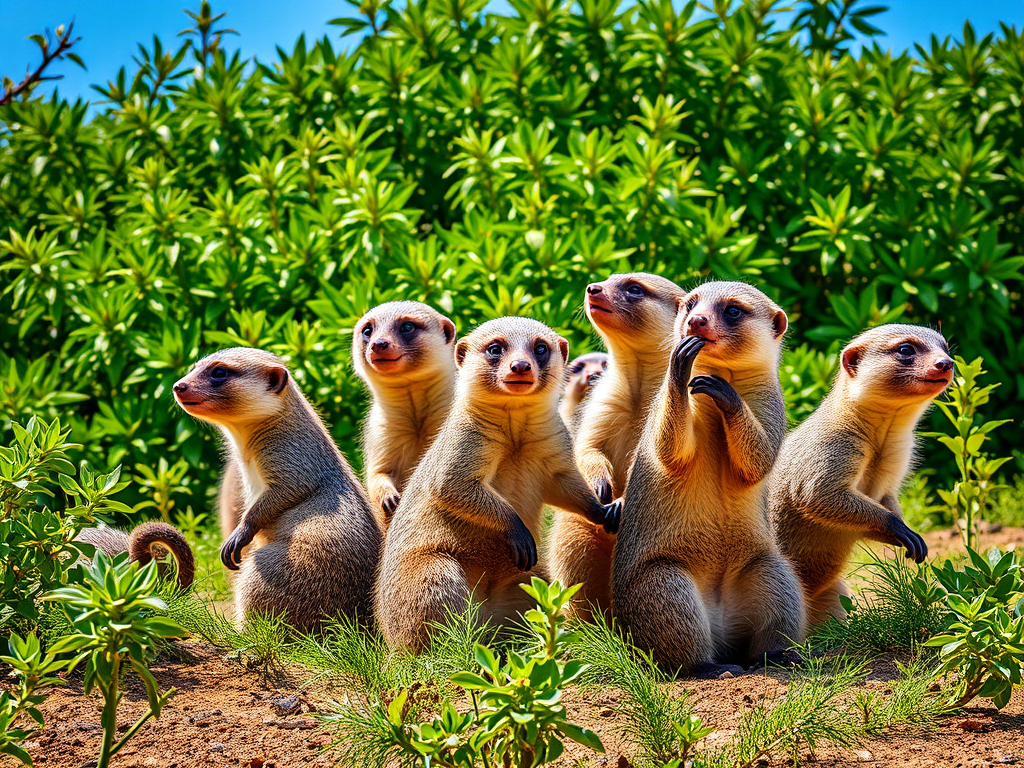
Once upon a time I had a mongoose and, like, most other pet mongooses of my acquaintance, he was called Rikki, after (in case you didn’t have a British childhood) the character in Rudyard Kipling’s story.
He was a chittering, chattering little fellow and very mischievous, as mongooses are, and also spiteful, cantankerous and hard to train into the ways of polite society.
Rikki:
- had a habit of appearing suddenly and biting our guests.
- was a positive Houdini who could escape from pretty well any sort of enclosure. He was also an adept burglar who could break into pretty well any sort of enclosure.
- was afraid of nothing and nobody, terrorised the servants, bossed our large dogs around, bullied the cat, aggressively tackled any wild thing, especially snakes.
Rikki came to us, as is usually the case, through injury and stayed because his mongoose family disowned him. But Rikki belongs in another story; in this one I want to talk about a very different mongoose experience.
Between our house in Mombasa and the next, some distance away and separated by a dilapidated fence, ran a sort of ditch that led from the road downhill to the creek. This wide, shallow drainage area was thick with low brush and home to lizards, snakes, various rodents and a family of Banded Mongoose.
I used to spend hours watching these creatures because they were always up to something. From memory, there was about a dozen in the den though numbers fluctuated according to the number of young – of which there were always a few. Mongoose are prolific breeders and very protective of their young and on Mombasa Island, where they were pretty much the apex predator, the survival rate was high.
Back then, in the 1950s and ‘60s, the island had plenty of open space and many nooks and crannies and places where small creatures could run free. And as mongoose were so efficient at keeping down vermin they were left to get on with their lives, unmolested by humans.
Most of my mongoose watching was done in the late afternoon and on weekends. Or in the early morning for they, like me, were up and about at dawn. At first they all looked alike to me, differentiated only by size, but after a while I could recognise individuals – and gave them names. There was the obvious Alpha male, whom I called BM, short for Bwana Mkubwa. There were a couple of grizzled old females, tough and bossy, whom I named Joan and Olive for two prominent members of the Mombasa branch of the EAWL (women with double barrelled surnames and self-conscious social status who were much mocked by my father behind their backs!) There was, inevitably, Scarface and Short-tail. And, my favourite, Kali. I can no longer remember the names or personalities of the other mongoose in that bunch, but I shall never forget Kali.
He was a young male and when I first knew him he was emerging from babyhood and already standing out from the rest for his sheer aggressiveness and constant trouble-making. Kali seemed to be never still; even when the others were dozing among the rocks and weeks, he’d be up and doing; searching for food, harassing his elders, fighting with his siblings, pursuing birds and other small creatures. Kali by name, kali by nature!
His favourite targets, though, were our dogs. We had at that time a large and fierce Alsatian, Rory, and a small dachshund-cum-terrier-cum goodness knows what, Toddles, and these two were the best of mates. They spent much of the day lying on the stoep or patrolling the long driveway, ever ready to tear up to the gate to welcome us home, and those visitors known to them, or repel any stranger foolish enough to cross our boundary.
Rory had a reputation in the neighbourhood, especially among the watu, but his cowardly heart was shamefully exposed when Kali and the Gang went after him. Which they did, every time Rory and Toddles went down the drive, which ran parallel to the drainage ditch and was clearly visible from mongoose territory.
Kali, even when sub-adult, took a great dislike to the dogs whom he clearly considered as interlopers. This was his land and that of the tribe and while humans might be tolerated their four-footed lackeys were not! So he was ever ready to attack, in guerrilla style, lurking in the underbrush and waiting for his canine enemies to appear. Even when he was occupied further afield, wandering in search of food or mischief, he had an uncanny sense of when the dogs were off the stoep and would summon his gang for an all-out assault.
In fact, I observed, the mongoose had their own alarm system, both defensive and offensive, with posted sentries ready to rally the rest. Then they would rush out, leaving a couple of sentries behind – usually the old ladies and BM.
I never saw them actually touch the dogs but they would go in close, chittering and showing their sharp little teeth. Rory would put down his tail and scarper for the stoep. Toddles, not much bigger than the larger mongoose, would sometimes try and stand his ground, his terrier side kicking in, snapping and barking. Once he tried to seize Kali and almost succeeded but there were a dozen or so other mongoose to contend with and so he, too, trotted away. With a few backward glances and growls as he tried to maintain some dignity.
When members of the family were on the driveway, the mongoose would not venture out but instead sat in a group along the edge, taunting the dogs. Who then behaved very haughtily, sneering at their enemies, growling a little to assure us that they were really on top of the situation and that these small, swift, irritating little savages were not worth their time or energy.
As long as the mongoose stayed in the driveway, they remained, if you’ll pardon the expression, top dog. But venture on to the stoep, or beyond, and it was a different matter. Rory remembered that he was a guard dog and would turn and drive the pesky fiends away, though it was Toddles who actually caught one, and killed it before we could intervene. He was, I remember, extremely proud of himself. “Look”, he seemed to say, shaking the poor little thing from side to side in his small jaws, before I could extract it. “When you get one on its own, it’s just another kind of rat!”.
But the house began to exert a fascination over the mongoose gang because somehow, perhaps thanks to their sharp little noses, they came to recognise the kitchen as a source of food. And one day, Kali (of course it was Kali!) made a sneaky reconnaissance through the doorway. Not long before that he and the others had discovered the dustbins and tried, without success, to push off the heavy metal lids. No luck. Our cook and house servant rushed out with sticks to frighten the marauders away.
Not that a human with a stick was going to deter Kali and the gang for long! They knew there were good things in the dustbins and could often be seen sitting on top of them, ramrod straight, paws out front, sharp little noses sniffing hopefully.
And then, one glorious day for mongoose kind, the kitchen was – for once – empty. The servants elsewhere in the house, the family out. Half-a-dozen mongoose, ever vigilant around the back door, crossed the threshold and leapt on to the table where there were some bananas in a bowl After demolishing these they clambered up on to cupboards. Not much there of interest. Then one of them – I always thought it must be Kali – discovered the bread bin, which for some reason was kept on the floor.
Unlike the dustbins, this was easily knocked over and the treasure discovered. These mongoose had already developed a taste for bread and that was down to me because, unable to resist their charms and the desire to be a benefactor in their eyes, to tame them, even, I had sometimes thrown scraps of bread to them, where they lurked in the ditch.
I knew it was the wrong thing to do. But in the Kenya of those days there seemed always to be, in those of European origin, a desire to tame the abundant animal life. To take some wild and even dangerous thing and make it your very own! I was certainly of this mind and always had some creature – a chameleon, a snake, a hedgehog, a bush baby, a monkey – in my keeping.
I felt an empathy with the mongoose, so cute and ever-entertaining. A connection, as we would say today. I had encouraged them with regular food gifts though they needed no help from me to get a good feed for the ditch provided all their needs in abundance. And much better for them than white bread from the Anglo-Swiss Bakery, full of salt and sugar. Now I would regret my “generosity”.
Because once the mongoose gang learned that there was food to be got in the kitchen they never let up their banditry. They didn’t worry about the dogs, who stayed pretty much in the front garden or on the stoep. They seemed to know that family members rarely ventured into the kitchen, which was slightly separated from the house by a short, covered walkway. As for the servants, they were to be feared when roused but they also valued the mongoose ability to rid the area of snakes and thus dealt mildly with all but the more outrageous intrusions. Once a cobra took up residence in some rocks at the base of the Neem tree – and paid dearly for its temerity because the mongoose made short work of it. They also scared away the Green Mamba that used to swing around in the branches, menacingly close to the kitchen window (in those days most houses had Neem trees outside the kitchen, thanks to the belief, originating in India, that the leaves had medicinal qualities and would keep away flies and mosquitoes).
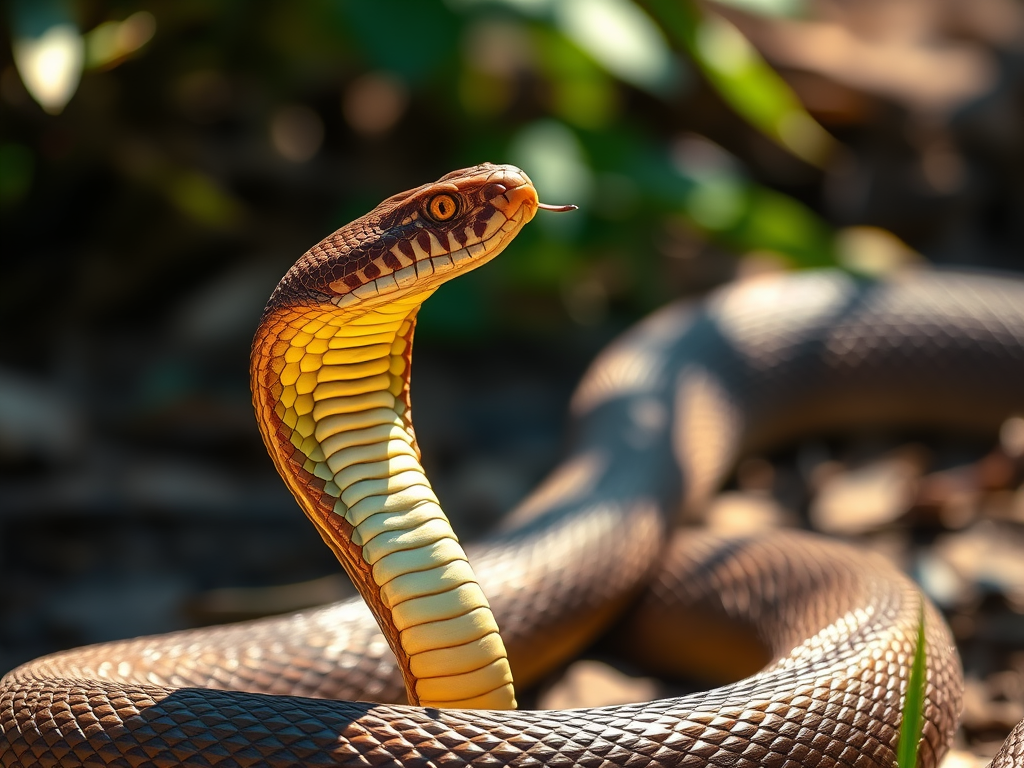
The mongoose’s natural enemy – the spitting cobra.
So, Kali, the smartest and boldest of the gang, soon learned that his presence would be tolerated provided he didn’t actually go indoors. And even then, when he did, all he’d have to face was a bit of shooing and perhaps a flapping apron to send him out again.
And soon enough the bread bin had to be put up on a bench top but Kali found it there and learned to knock it to the floor. We bought another type of container, with a door that slid up and down. Kali soon learned to push up the metal handle with his sharp nose and little paws.
Our kitchens were not the posh kind that we all have today. They were simple affairs: a red-painted concrete floor, a larder that could be locked, a central wooden table, a bench top along the wall with shelves underneath, more shelves above. An electric stove. A frig. A water purifier. A meat safe with mesh front, its legs in tin-lids full of DDT or kerosene to deter ants. Once refrigerators became common in urban areas the meat safes were used mostly to store fruit and root vegetables.
That meat safe was the mongoose Mecca, more attractive than even the bread bin which, finally, was removed from temptation because we took to keeping the bread in the frig, a novel idea back then. As the mongoose became even bolder, obviously realising that the worst any human within their territory would do was shout at them, they ventured into the kitchen more often. So it was not uncommon to find them sitting by the meat safe, turning their heads this way and that, planning a break-in. The indents of sharp little teeth could be seen all over the wooden frame and their paws would be busy at the lock.
This mechanism was a simple wooden peg, on a wire, which was pushed down into a slot, serving to keep the door closed. It would only have been a matter of time until those busy little paws and cunning little brains had figured out how to open this – anyone who has kept chickens in mongoose country knows just how hard it is to keep them out of even the most heavily secured enclosure. They are far more cunning than leopard, jackal or other predator when it comes to burglary; only the honey badger runs them close. So a proper bolt was affixed, plus a heavy metal padlock. A nuisance for the household but it did the trick.
You might, of course, ask why we didn’t just shut the door. We did, at night. But during the day it was left open for coolness and the window likewise. Mombasa is, after all, a tropical island on the equator. The heat and humidity can be unbearable, especially for a cook slaving over a hot stove. And if we closed the door, as was sometimes done, then the home-invading members of the mongoose horde would just climb through the window. Amazing to think that we had no insect screens back then. Metal burglar bars, yes, but no mesh. And burglar bars only served to keep out humans; mongoose can do amazing things with their lithe little bodies and easily squeezed through them.
The best solution was to encourage the dogs to patrol the back garden but apart from taking their food on the back veranda they preferred to be at the front, where they could watch for the family coming and going and do their job, which was to keep an eye out for unwanted strangers trying to come through the front gate from the road. The back garden ran down to the creek in a series of steep, stone-edged terraces and where our boundary ended was a thicket of mangroves extending for a long way in each direction – a natural barrier against casual crims.
And so life went on and: the mongoose mob continued to harass the dogs several times a day when they wandered down the driveway, the dogs still fled from them in a funk, Kali never gave up his raids on the kitchen, occasionally scoring a meal when a servant left something lying on the table. Once, it was a whole chicken, just ready for the oven. Another time a bag of groceries was left on the floor and later found shredded to pieces and the contents taken, except for a few tins of pilchards and sardines!
There were mutterings about “doing something” but I always vigorously defended my mongoose friends, citing their usefulness in keeping vermin at bay as well as their entertainment value. Which was significant, not only for the family but for our visitors who enjoyed coming round for drinks on the stoep and a bit of wildlife watching as the ever-active mob went through its evening antics. Kali, BM and co. had by this time become quite familiar with humans and when they were not grooming each other or hunting or chasing each other about would sit in a bunch and watch us watching them, beady little eyes alert for opportunity, such as a dropped biscuit or piece of cheese.
Disaster struck the mongoose mob very suddenly one hot June day in the form of a gang of workmen and a large yellow bulldozer. There had been some warning; notification from the council that sewerage was coming to Mombasa and pipes would be laid in due course. We didn’t think to ask where the pipes would go and we failed to see the implications. And when the fatal day came the family was out, at school or at work. Only the servants were home and it was they who greeted us dolefully when we returned, pointing to the ditch.
Where there had been a narrow wilderness of thick bush and tangled weeds was now a wasteland of bare earth and rock, from the road almost down to the creek. Where there had been abundant life – birds, insects, reptiles, small furry animals, nothing stirred. Sadly, our kitchen toto, Kaola, led us over to the fence where we found a female mongoose and two babies, not a mark on them but all dead. The day before I had been watching those kits taking their first amazed steps into the world as their eyes opened upon it for the first time. How endearing they were, full of the charm shared by all new-born things! So cute I just wanted to hug one, though knew better than to try. They had tumbled over each other and their mother, clumsy but already showing signs of the sinuous agility to come. I cried to see them lying there, all that innocent energy snuffed out.
Of the rest of the mob there was no sign. At least they all appeared to have got away, for we found no mangled remains, but where could they have gone? The whole area had become a noisy chaos of men and machinery as progress enveloped us. We no longer had a cesspit in the garden, which had to be regularly pumped out. The whole island was becoming a more sanitary place altogether and who would not rejoice in that?
But our family was black with bereavement. We had lost the mob and the old drainage ditch was now a strip of concrete with an inspection hole up near the road. In time, weeds and grasses took over again but the mongoose mob never returned.
Even the dogs seemed dispirited for a while. They could walk down the drive unmolested but when they did so they constantly glanced to their left, expecting an attack that never came. Sometimes they’d go with me to the fence and, it seemed to me, cock their heads and sniff and look about in puzzlement – maybe even hope, or so I liked to believe.
In time, we moved house. Moved country. But in all the years since I have not forgotten feisty little Kali and the rest of the mongoose gang, and hope that when they fled that day in terror that they did manage to find a new home somewhere, and a new family to adopt.
The island of Mombasa today is a busy metropolis and the places where we children used to play are no more. The village huts and bandas covered in thatch or mbati have been replaced by tarmac roads and shops. High rise apartment blocks have taken over the big gardens of the wazungu with their baobab trees and coconut palms and shrubberies. The town of my day has stretched outwards to swallow the island whole.
No place, no space, for a mob of mongoose.
 Lyrebird Mountain