
That old black magic

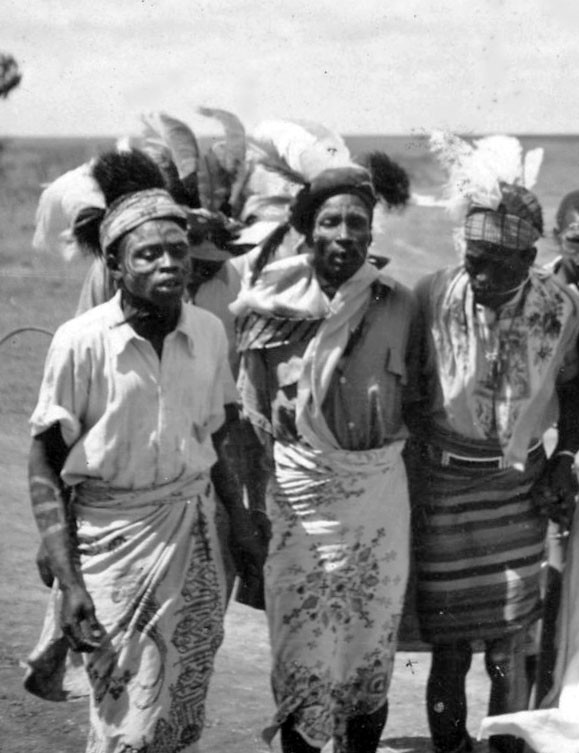
A witchdoctor (centre) and his two apprentices, circa 1958

A fine yet all but impenetrable veil separated Mombasa’s sunny exterior from its darker dimension.  Impenetrable, that is, to club-going commonsensical colonials like my parents whose spiritual needs, such as they were, found satisfaction in the churches they had built at either end of Fort Jesus Road; the catholic church almost in the centre of the town as befitted its greater age, the protestant church more discreetly tucked beneath trees and closer to the British enclave of banks and government.

These churches made it quite clear to everyone – Hindus, Muslims, Sikhs, those animist Africans who remained as yet unconvinced about Jesus – that clean and godly Christianity was one of the benefits that came from European rule, along with law, order, good government and decent drains.  Furthermore, it meant an end to witchcraft and superstition and all that mumbo-jumbo associated with primitive cultures that knew no better.  So there were to be no more were spirits inhabiting the bodies of wild beasts; no more jinni in charge of special places, and witchdoctors were either ridiculed or sent to jail.  Of course, it was okay to believe in angels and that Satan was still a force for evil in the world and that a man invested with sacred power could change water into wine.  But the only ghost sanctioned by the ruling civilization was the Holy Ghost.

Yet beyond the veil Africans and small white children knew differently.  We understood that ghosts and unquiet spirits haunted old buildings and certain places around the island.  We shuddered at the thought of leopard and hyena lurking in the forests that were no true animals but men, undead, in animal form.  We believed firmly that Fort Jesus was haunted by the ghosts of Portuguese who had died there and that under every baobab tree was the body of a slain Arab. 

The people of the coast, though mostly Muslim by profession, were deeply superstitious and believed in many things not found in the Koran.  In coral caves along the coast you would often find little bundles of sticks with coloured strips of cotton tied to them, like miniature flags.  These might or might not be accompanied by carefully laid out oddments – feathers, small stones, shells, driftwood.  We children knew that these were placed there by witchdoctors; knew also to leave them alone or we might find ourselves laid under a dark and probably fatal spell.  Eagerly we exchanged rumours about children who HAD interfered with these strange artefacts, and who had died awful deaths or simply disappeared.  Africans had great dread of these caves and would never go in there; it was marufuku – forbidden  – they warned us, and also ahatari – dangerous. 

The coral caves found in headlands north of Mombasa Island were a great playground for we children who made our own sort of magic in their dark depths.  At low water there were tiny rock pools full of sealife and we would clamber or crawl over the rough coral to sandy-floored chambers where we would play pirates or castaways, always with an eye for the incoming tide. But if we came upon one which showed evidence of uchawi we retreated at once – the broom-riding witches of our own folklore didn’t worry us much but every Kenya child, black or white, feared African witchcraft. 

I knew a boy who once came across one of those little collections of flags and, as ten year old boys will, gleefully broke and scattered them, and brought a few out of the cave with him to show his parents.  They were a family newly arrived from England and thus ignorant of such things; however when some African fishermen saw him flourishing his booty they became angry and shouted at him.  The parents, of course, were completely bewildered by this reaction but thought little of it until, a few days later, a very smooth young man in a cast-off European suit came to the door and told them in passable English that their son had committed a grave offense and compensation would have to be paid to the local witchdoctor.  Otherwise, he said politely, very bad things would happen.

The boy’s father, who had been fighting Germans not long before, was not easily intimidated.  He laughed and told the young African to go away or he would call the police.  Shortly after this small, strange, sinister artefacts appeared in places around the house and garden.  Sinister, that is, to those who recognized the signs of witchery.  It didn’t worry the boy’s father but it frightened the memsaab and it terrified the servants, who both left.  Nor could any others be found to replace them – nobody would work for a household that had been so obviously cursed. 

The story went round our small community like wildfire and we children waited hopefully to see whether the boy, our playmate, died a gruesome death or was turned into some demonic creature.  We teased him unmercifully but also kept a strategic distance – we feared contamination by association.

Finally, after a couple of uncomfortable weeks, the boy’s father sought advice from the head of his department, who happened to be MY father.  Should he call the police?  Was his family in any danger?  My father, who believed in nothing beyond the realities of this world, nonetheless counseled him to make compensation.  Some might have viewed this as giving in to blackmail but my father, wise in the ways of Africans, knew that a serious offence against local cultural and spiritual sensibilities HAD been committed and that while there was little likelihood of any major revenge  the witchdoctor would continue to make trouble and subject the family concerned to an ongoing series of petty annoyances.  Certainly they would never be able to employ another servant until the curse was lifted.  This advice was taken; a small (in European terms) amount of money was handed over, apologies were made and there the matter ended. 

I realize that this story would be more exciting if it had a suitably dramatic ending.  What it shows, however, is the indirect but still potent power of African witchcraft which could still affect the lives of Europeans through its effects on the people who worked for us.
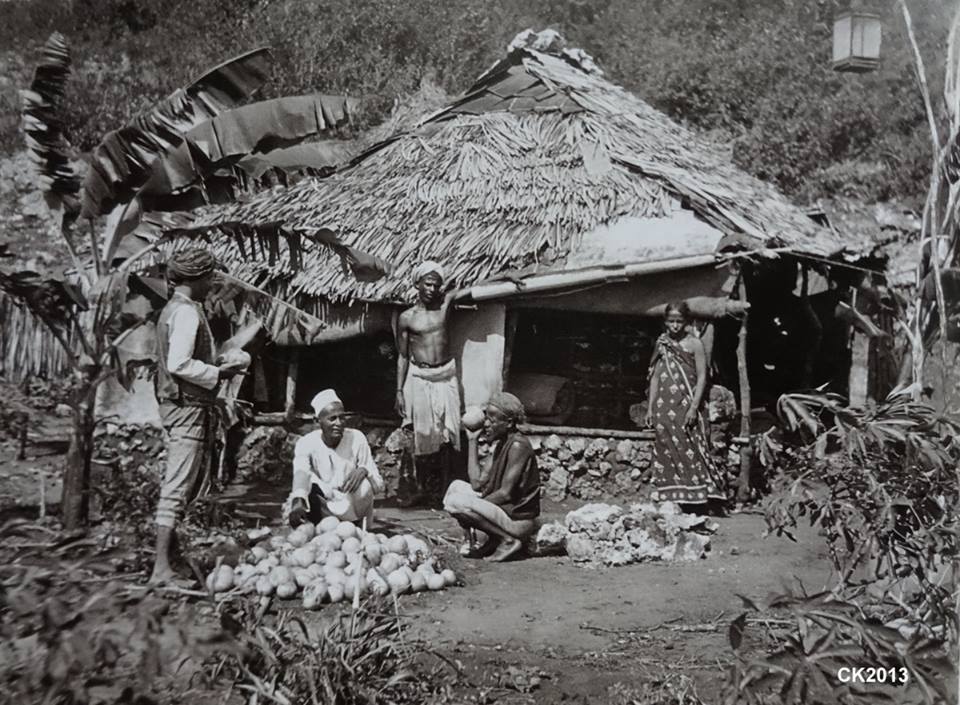
The people who lived on the coast north of Mombasa blended Islam with their animistic beliefs and and witchcraft – and its practitioners – flourished in those dark forests. According to recent newspaper accounts, it still does.

When I returned briefly to Kenya in 1971 I stayed with some friends who had bought land at Kisauni, just north of the island.  This was always one of the coast’s “dark” places, teeming with jinni and troublesome spirits according to local lore.  Few Europeans lived there in those days and those who did were the type to be dismissed by my mother as “peculiar” – her favourite word for anyone who didn’t quite fit her notions of middle class social norms.  My friends were planning to build a house on their couple of waterfront acres and everything was ready to go when they suddenly ran into a snag – the local witchdoctor had put a curse on the land and would not remove it unless promptly paid.  This was not something that could be laughed off because no workmen would set foot on the place as long as it was accursed.  In the end, payment was made. It all ended well enough because they lived there for more than 50 years.

Witchdoctors, both male and female, involved themselves in every aspect of life in the villages and shanty towns on and around Mombasa.  They were not all bad – some waganga  practiced herbalism  and spiritual healing  and the blessing of family endeavours.  Others, however, known in those days as wachawi – a word uttered always with dread –  practiced the black arts and were very much feared indeed – shape changers, demon-raisers, death dealers – their auto-suggestive powers were very strong.

My grandmother was known  as a witch to the Kamba people among whom she lived.  They called her Memsaab Susu – a word that meant grandmother but could also be synonymous for a witch of the benevolent kind.  What we’d call a white witch.  She earned this for her knowledge of basic medicines and fondness for herbal remedies.  Unlike her family, the Africans whom she dosed with her disgusting nostrums were impressed and grateful and obligingly inclined to recover from whatever was ailing them.  They often begged for Milk of Magnesia which they regarded as a cure-all more efficacious than any remedy from one of their own witchdoctors but the medicine which impressed them most – and which they feared most – was Andrews Liver Salts.
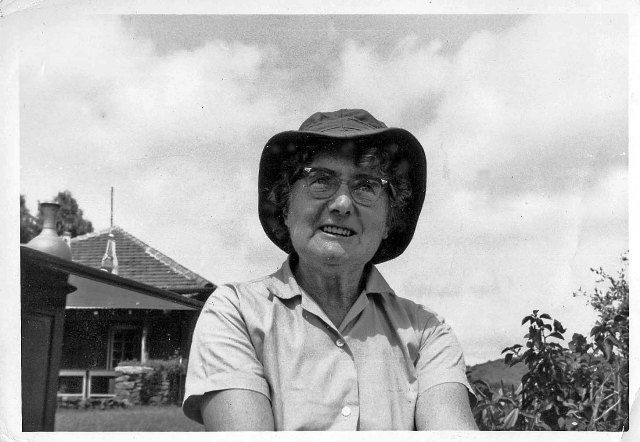
My grandmother, a “witch” whose most powerful potion came from a tin of fizzy stomach salts! 

My grandmother was in the habit of taking a glass of this stuff every morning and attributed her own excellent health to its properties.  To the Wakamba of earlier and less sophisticated years, this foaming drink looked like boiling water and once my grandmother realised this she used it to advantage.  If there was trouble in the household or theft among the farm workers my grandmother would subject them to what we called “Trial by Andrews”.  All suspects would be given a cup of water into which she would pour a couple of teaspoons of the magical liver salts.  Those who were telling the truth could drink safely.  Those who were lying, however, would have their mouths badly burned – no liar could evade the curse of Memsaab Susu.  Those who were trying to lie did not dare to drink the fizzing water, so strong was their conviction that it would, indeed, burn.  “The day will come”, my father used to warn her, “when you’ll try this on one of these chaps who’ve had a bit of education and he’ll drink the water.  And then where will you be?”  As far as I know, that never happened.  My grandmother retained her reputation to the end. I have heard this story of European “smoking water” from others and whether it originated with my grandmother or others coincidentally tried the same scam I don’t know; I only know it worked for her.

I was staying with her during my school holidays when, one evening,  there was a ruckus in the kitchen.  We rushed out there to find one of the servants cowering in front of a large, very dark-skinned man wielding a knife.  Without hesitation my grandmother (who was only just over five feet tall) marched up to him, seized his arm, made him drop the knife and then demanded to know who he was and what was going on.  It turned out that the cowering servant had recently purchased a wife who had been promised to the tall stranger, who was determined to claim his own, by force if necessary. My grandmother ordered him off the farm but he hung around the labour lines for a few days, trying to foment trouble and making threats against both the servant and my grandmother.

 He was, we learned, a well-known m’kora – spiv –  greatly feared by the locals and said to be under the protection of a powerful witchdoctor – a mchawi.  “We’ll soon see about that”, snorted my grandmother or words to that effect, and promptly put a spell on him.  Her spells consisted of waving a riding crop in the air and reciting English poetry, usually that one  that begins ” Sunset and Evening star, and one clear call for me…” which she chose, as she said, for no reason other than she’d always liked it.  The watu were enthralled, for Memsaab Susu’s spells were considered more fearful than any local thug.  Sure enough, a few days later, my grandmother was told that the stranger had gone to a hut in a nearby village, lain down on the ground, and since refused to move or talk or eat.  This went on for a while – I can’t now remember how long but it was during the Easter school holidays so can’t have been more than another week.

  I returned to boarding school and learned later that the villagers had come to my grandmother and informed her the man was certainly dying.  Sceptical, but a bit worried by now, my grandmother went to see for herself and, sure enough, the big, very dark stranger whom I remembered as being well-muscled and quite frightening in his obvious strength was now lying there shrunken, grey of skin, comatose.  My grandmother hastily produced another of her spells and ordered the man to recover.  Within a few days he did so and, terrified by this small white woman with her tin of Andrews Liver Salts and riding crop, left the district.

This all occurred up-country but those tribespeople who went to the coast to work, as our Kamba servants did, took their superstitions with them and then had to confront a whole new lot of what my father and his friends called “mumbo jumbo” but we children believed in as firmly as did the servants who helped raise us. 

We knew of the devilish spirits that inhabited certain baobab trees and were afraid to go out after dark, even into the garden, for fear of the big, black nyangau – a flesh-eater with certain similarities to the hyena, only scarier.  I’ve already mentioned the were  creatures that also lurked after dark; leopard and hyena were the most popular choices for those men and women who transformed themselves into animals but just about any creature could be thus inhabited – any creature with teeth and claws that is.  I’ve heard of were jackals and even were serval cats but never of a were elephant!  These and other horrors had much in common with vampires because their aim was to suck your blood or your entire essence and then inhabit your body.

In the late 1950s there was a sudden fad for “hugabug dolls”.  These hideous inflatable black plastic dolls with staring eyes became an object of desire for every little white girl in Mombasa – and probably in Nairobi too.  The fact that they were quite unlovely to look at mattered nothing to us, if one girl was seen at school or in town with a hugabug clinging around her arm then the rest of us wanted it too. 

When I eventually got mine, from the local toy shop, I went and showed it to the children next door.  Their ayah promptly threw up her plump arms and gave a startled hiss.  She would not be in the same room as the doll, nor allow it near “her” children.  Our own servants were similarly uneasy and the houseboy avoided looking at it when cleaning my bedroom , asking my mother if it could be kept in the wardrobe.  This story was repeated in households all over Mombasa, with some servants threatening to leave if the dolls were not removed from the premises.  When pushed, they would not say exactly what it was they feared and disliked, but would just mutter that it was “mbaya” and “uovu” and look down at their feet in that way that Africans of that time used to do when the Europeans upon whom they depended were being particularly obtuse.

To be honest, I never really liked my hugabug doll very much.  One night, perhaps influenced by our servants’ unease, I woke up and saw it staring at me from its habitual place on the top of a bookcase.  Its round eyes with their white outer edge, its red mouth and fat little ever-reaching arms suddenly struck me as sinister.  I turned on the light and huddled under my mosquito net, hardly daring to sleep in case it came for me.  In the morning, of course, it looked perfectly harmless but I pricked it with a pin, nevertheless, and threw away the deflated carcass.  When I unwisely confided this to a boy down the road he told me to watch out at night because the hugabug would return, reinflated, to take its vengeance on me.  So I slept with the light on again, that night and many nights thereafter, despite my parents’ exasperated assurances that it was all a lot of nonsense.

As with all such things the hugabug craze died as swiftly as it had arisen but the fear stayed with me for quite a while – and that was many years before Chucky!

Africans could create terror out of almost anything.  One of the strangest stories involved the truck that went around pumping out septic cisterns in the villages along the south coast.  This “honey wagon” was introduced as part of a move by the local government to improve village sanitation.  Somehow, a story was put about that this wagon was in fact a kind of vampire that would suck out the souls of villagers.  Witchdoctors were brought in to curse it and to protect the villagers.  Attempts were made to block the tracks so that the septic truck couldn’t get into some villages.  Stones were thrown at it.  People would hide their children and retreat among the coconut palms when the wagon came to do its work and the crew could count on no assistance from local men in playing out the pipe and setting up the pump.

I can’t remember the name they gave this creature but it was something like “tamiami”.  Nor can I remember how the matter was resolved, though it obviously was. 

Africans, whatever their tribe, did not readily surrender their belief in witchcraft to European influence but under Colonial rule they had learned to keep it to themselves; a dark and sometimes dangerous secret which only came to the attention of White settlers when something overtly dramatic occurred.  In which event, the matter would be discussed around the dinner table or in the club; scornfully, perhaps, or with amused condescension, but often with an uneasy sense that “maybe the watu knew a thing or two” that we sophisticated White people had forgotten.  One such case – a tragic one – comes to mind, dating from the early 1960s.

It concerned the cook, in the household of one of Mombasa’s wealthier European merchants.  The cook was a Taita, as was our own mpishi, and this is why I remember the story so well.  It was much discussed in Mombasa at the time, in all the usual places where such things were discussed by the white population, but as our cook Mboji was a friend of the man in the centre of the story, our household was given an unique perspective.

 The Taita cook, who lived in the spacious servants quarters behind a grand house in Kizingo Road, had a wife with a very bad temper.  Fortunately for him, she lived in their tribal village somewhere around Taveta.  Alone at the coast, he did what so many other men in his position did, and took a girlfriend.  This girlfriend was said to be a malaya – prostitute – or at least a woman of easy virtue – but this may just have been a malicious rumour.  In any case she became pregnant and the cook moved her into his quarters (unbeknown to the Bwana!).  Somehow, the wife got to hear of this and came down to the coast in a jealous rage.  She found the girlfriend in situ and (according to witnesses) a spectacular cat fight took place.  The girlfriend fled – but not before the wife had cursed her unborn child.  The baby was, indeed, born dead or else died soon after birth.  The (presumably) distraught and vengeful girlfriend then employed a witchdoctor of legendary powers to put a curse on the wife.  Now it was the wife’s turn to die.  The cook came into his quarters one night and there she was, on the kitanda, eyes open and staring, not a mark on her, no signs of illness and dead as the proverbial doornail.

 Our family got all this information from Mboji, who had time off to attend the funeral.  Of course, there was an inquest and the whole affair even made the papers.  The examining medical officer could find no satisfactory cause of death so it couldn’t be certified as accident, murder or natural causes.  Nonetheless the police hauled both the girlfriend and the witchdoctor in for questioning and it turned out that the latter had been in their sights for some time – apparently the cook’s wife was not his first “victim”.  They charged him with various nuisance violations but had no chance of getting him on a murder rap – witchcraft, if proved, WAS a banned practice but it didn’t rate as a capital crime.  And these were sensitive times – with Independence just around the corner.  So the whole matter just fizzled away.

The cook’s employer decided to get rid of all his servants and start afresh for the affair had seriously embarrassed him and caused a lot of nuisance The cook was a very good cook – said to be one of the best in Mombasa in fact – but his philandering ways had proved fatal for some and indeed, as the police’s first suspect, he had spent a fair bit of time in gaol.  The rich merchant was unmarried and his household was presided over by his spinster sister – a gentle, deeply religious woman who ran a small Christian youth group in their large house, and used to take me to church on Sundays when I was at primary school.  She urged her brother to employ only avowed Christians from then on, so that there would be no more immoral and ungodly fitina.  Poor innocent, she had lived many years in Africa but still didn’t understand that even those Africans who embraced Christianity tended regard it as a comfortable addition to, rather than a replacement for, their own centuries-old beliefs.

Uchawi would continue to exert its powers over the people of the coast, even though the new government claimed to be just as keen as the Colonial Government had been to stamp it out.  Why, just the other day I read of a couple of cases in Kenya which had come to the attention of the authorities – and the media. These took place in the highly-superstitious, overtly Muslim region north of Mombasa where poverty is endemic and village life has not greatly changed since Independence more than sixty years ago.  Though it could have been just about anywhere in outwardly-sophisticated modern Africa where old ways may have been forced underground but don’t easily die.

Mboji and the chicken

Our cook, Mboji, was, by Kenya standards, better than average at his job.

There is a tendency today among the ci devant bwanas and memsaabs to eulogise the skills of the cooks of their youth, and to remember the meals they prepared more fondly than is warranted.  The truth is, we ate very plainly in those days, at best, and very badly indeed, at worst.

My parents were both rather keen on their food and demanded a reasonably high standard of their cook.  By “reasonably” I mean that meat should be tender or at least chewable and cooked to the right degree, neither overcooked in the case of beef nor undercooked in the case of pork.  Vegetables should not be boiled to a fare-thee-well.  Custard should not be lumpy.  A cook should have a reasonable repertoire of recipes, be prepared to try new things and have some understanding of how to creatively use condiments and spices.

 Mboji met those standards, which was more than could be said for the mpishis employed by some of my parents’ friends.  Down the road lived my friend Irene, whose mother was not very interested in housekeeping and whose father knew better than to protest.  They employed a truly awful cook.  His idea of that perennial nursery favourite of our youth, macaroni cheese, was to use spaghetti instead of the more usual macaroni, cover it in a lumpy cheese sauce and then bake it in an oven until it dried out to the consistency of a pudding, with the pasta all crisp and crackly.  We’d pour HP sauce all over this and I, for one, used to think it yummy and be very happy to be invited down for supper on a Sunday evening (as with most people we knew, they had dinner on six nights a week but a light lunch – usually out somewhere – on Sundays and “supper” in the evening). My mother, however, ate it once and could never be persuaded to do so again. This cook also used to do a “curry” every Saturday which, like most Kenya curries served in European households was a stew with curry powder added.  I liked this a lot because it had potatoes in it, which Mboji’s curries did not have.  Mboji, in fact, made a pretty good curry.  I say this after years of learning about and cooking Indian food.  His curries would not have passed muster in an Indian household but at least he used fresh spices and authentic condiments and they bore an acceptable resemblance to the real thing, especially his prawn pulao.  Mboji did not believe in putting potatoes in a curry.  He would serve them as a side dish, cooked in ghee with appropriate spices.

I had another girlfriend, Ann, who lived across the road, and she also had a mother who was not interested in housekeeping.  In fact this woman had no interest in her family at all and, in my memory, was rarely home.  I shan’t mention her name here because she was very well-known in the Mombasa of the late fifties and early sixties.  Her husband did something obscure in the PWD and they were rarely seen about together.  Their bungalow was dreary beyond belief, furnished only with the ugly PWD furniture common to many Kenya houses back then.  My mother would have had cheerful covers made for the furniture and put vases of flowers everywhere but in this home there were few books or ornaments;  no pictures on the wall except a calendar; no comforts anywhere.  The bedrooms were bleak and barely furnished beyond a couple of iron beds in each.  I stayed the night there once, as girls do even though they are only a stone’s throw from home, and hated it.  Even though I wasn’t much concerned with comfort and decor at that age and thought my own parents rather finicky because one couldn’t drop food on the floor or put your feet on the furniture in our house.

In my friend’s house, the cook-cum-houseboy (they only had one servant; how odd we thought that!) was worse than awful.  He barely cooked at all but seemed to be employed merely to throw an occasional broom around the painted concrete floor (no rugs) and open a can.  Every time I ate there, we had baked beans on toast.  Now this was a popular dish in our house, too, at least for my brother and I who were of course fed separately in the evening from our parents (at least until we were in our teens).  These suppers consisted mainly of baked beans on toast, sardines on toast, tinned spaghetti on toast, cheese on toast and scrambled egg on toast.  We did sometimes have other things – I remember tinned salmon salad and also tinned corned beef (which we called “potted human”) and salad.  But it’s the somethings-on-toast I remember because these were our favourites and, like most kids, we detested salad.

Ann’s family cook, however, rarely seemed to adventure beyond the baked bean for the evening meal and they didn’t always have a hot lunch, either.  The mother, a career woman, ate out a lot, and the rest of the family survived on tinned stuff and the occasional flavourless stew or – when spoiling themselves – a leathery roast topside or chicken.

So I was considered very lucky by some of my friends and my home a haven of comfort, with good meals and well-trained servants.  They loved to come and stay over, or just have a meal, and my mother – and Mboji – were always happy to lay an extra place at the table. 

When  I look back, our meals were very simple.  The delicacies we take for granted today were just not available to most of us in those days, or cost too much for the average household.  Meat was abundant and cheap but usually of poor quality and tough.  I remember Ginger Bell’s butchery in Mombasa, where the carcases used to hang overhead, so that I would avert my eyes when buying meat there, which I did when I grew up and had a home of my own to run.  He was a good butcher but the quality of the meat, while flavoursome, was not what we would tolerate today.  Every week Mboji used to order a large piece of topside and this was roasted on Monday and served with roast potatoes and usually fresh carrots and tinned (later frozen,) peas.  Fresh peas, like so many other “English” vegetables, were difficult and mostlyimpossible to get in Mombasa.  Cabbage was rare and cauliflower almost unknown.  My parents used to reminisce happily about the brussels sprouts and parsnips of England, which were only well-flavoured if they’d “had the frost on them” .  As neither of my parents knew anything about horticulture and had never grown a vegetable in their lives, I doubt they really understood what this meant, but I remember them saying the same about “new” potatoes.

Back to the beef – this was our standard weekly fare.  On Tuesdays we had cold beef with salad and boiled potatoes.  On Wednesdays it was served as shepherd’s pie.  Thursdays were a bit exciting because this was Mboji’s day for spontaneous creativity and we never knew what we’d get, though it was always delicious.  I remember the remains of the joint being cut into thick slices and recooked in the oven in a casserole dish, with a flavoured sauce made from tinned tomatoes and onions poured over it.  Or chopped into a tasty hash and served with rice.  Friday’s meal was often fish, not because we were Roman Catholic but because it fitted in with all the other meals.  Fresh fish of course was freely available in Mombasa, from the markets, but when frozen food became available we used to have Tilapia from Lake Victoria, packaged and frozen by Tufmac.  It seems wicked now that with all the parrot fish and kingfish in the sea at our door, we ate frozen fish!  But so we did sometimes, served either grilled or in a mornay sauce.  We never had it fried – for fish and chips we went to the Rocco fish bar in Kilindini Road and either ate it there or brought it home wrapped in newspaper.  That was often a Sunday night supper and we considered it a great treat.

Saturdays my parents either entertained or ate out.  When entertaining, the meal would usually be soup, then something with prawns and/or fresh fish, followed by a roast of pork.  Pork was a great treat then, brought down from up-country.  If my parents were REALLY putting on the dog we had a leg or saddle of Molo lamb.  Sundays were always less structured in our household, due to it being Mboji’s day off.  Mukiti, our houseboy, used to do the honours instead but he could only cook a bit and in any case we usually went to the beach for the day.  Either to picnic, when we children were small or, when we grew up, to lunch at one of the beach hotels.  The Sunday evening meal was always quiche, which we called egg-and-bacon pie back then, or, as stated, fish and chips or a takeaway curry from town.  But Saturdays live on in my memory as the special day of the week for meals.  Of course, we children didn’t take part in the dinner parties when we were small and were given the usual early supper – but on Saturdays we got a treat.  This was usually sausages, but not any old sausages.  These were Walls skinless sausages and we adored them!  My father did too so we sometimes got sausages on other days too – but usually they were a Saturday night treat for the kids. 

Best of all, though, were those rare Saturdays when my parents were neither going out nor entertaining.  We usually had a curry then, with all the trimmings.  Or else we had Mboji’s signature dish – roast chicken.  My father maintained to the day he died that Mboji’s roast chicken was the best in the world and it, too, was served with all the trimmings – bacon on the top, roast potatoes, assorted vegies, sage and onion stuffing (from a packet) bread sauce (home-made the traditional way) and gravy.  We sometimes ate chicken in other ways; in curries for example, or a casserole.  These were the tough village birds that were brought live to the house, purchased after much argument with the sellers by Mboji, and then killed by Kaola our garden “boy” under the Neem tree near the kitchen door.  When we had roast chicken, though, the bird was especially purchased from our grocers, Beliram Parimal, and for a higher price that guaranteed it to be tender and succulent.  The comparatively high cost is what made it a treat for special days.

The smell of that chicken roasting had us salivating all morning as it drifted right through the house and across the garden.  To this day it remains my favourite dish, even in this age of TV superchefs and cooking contests and sundried tomatoes and aioli and truffle oil.  Mboji, dressed in his spotless white uniform and beaming with pride, would bear in his kuku on a large platter, and we would all murmur with delight and anticipation.  Visitors (for we sometimes had close friends or casual visitors to lunch on Saturdays) would be similarly impressed by the sight of this glistening, golden brown bird on its big white plate.  Few other homes in Mombasa, we smugly believed, could boast such a bird – or such a cook.  My father would carve with ceremony, legs for the children, breast for the adults, the parson’s nose (for some reason considered a delicacy) retained for himself.  I longed for the white breast meat but knew it as a right of passage that one day I, too, would be serving up such a bird and would be able to eat whichever part of it I liked!

Mboji worked for us for many years, but not without a brief hiatus.  He was a Taita, from near Voi, so was able to get back to his family often, apart from the usual two weeks holiday a year.  We had quite large servants’ quarters and the wife and two small girls came down to live with us from time to time, but Mboji preferred them back in the village tending to the family plot. He seemed always to get on very well with our other servants, who were Wakamba, but perhaps he was lonely because though in all ways clean, cheerful, competent and decently-behaved he did occasionally go on a bender and my father would be called in the middle of the night to go and bail him out of the local clink.  For the next few days he would skulk about the kitchen, reddened eyes lowered in shame,  having assured my father he would never disgrace us all again.  But of course he did, though never more than once a year.  One year, however, when my father’s responsibilities for the finances of the province were weighing heavy, he received the familiar call in the middle of the night and THIS time he refused to go.  Instead, he left Mboji to enjoy Kingi Georgi’s hospitality for another day before paying the fine, and then he sacked him.  We were all very shocked and my mother was livid;  where, she said, in the tones of The Mikado’s Kadisha, Will I Get Another?! But my father would not be moved and the household went into a sort of subdued mourning because Mboji was, to us, part of the family and we missed him.  We also had to make do with Mukiti’s cooking for a few days, with some necessary but reluctant assistance from my mother.

Then, with as much self-assurance as an angel sent from Heaven, Andrea appeared.  He was from the Congo, of some tribe unknown to us, and spoke French as well as a very correct Swahili in a strange accent.  He came to us by way of a friend of a friend, and was said to have worked for the French Ambassador in Nairobi, or at least for a Frenchman of high standing in the colony.  Certainly he had impressive references.  My father took him on at once and our mealtimes were transformed!  Andrea was not just a cook, he was a CHEF par excellence.  His cassoulet was a poem, his casseroles sublime.  His pastry was perfect and for afternoon tea we got éclairs instead of scones; tortes instead of Victoria sandwich or fruitcake. And as for his soufflés…well…let me just say that I have never tasted anything so light and perfect since – certainly I have never myself quite managed to attain that standard.  My mother was in ecstasy and her reputation as a hostess shot up to new heights.  To be invited to our place and eat Andrea’s cooking was considered a great privilege.  My mother reviewed her entertainment schedule and decided she could risk bigger and bolder dinner parties.  Andrea responded to this with great enthusiasm, helping her plan wonderfully exotic menus, giving her new ideas that her simple English (well, and Italian too) soul had never dreamed of, telling her of a fine foods emporium in Nairobi that imported cheeses from France, at a cost.  For the first time we tasted brie and camembert.  It is not an exaggeration to say that our family was the envy of Mombasa – or at least the European section of it.

Oh, and Andrea could do a pretty good roast, too.  True, it had flourishes that were strange to us. Gone was the familiar weekly joint of topside, replaced by sirloin served very rare.  Lamb, too, that most precious of meats, was served up gigot in style and  rather more rare than my father liked.  Pork, for some reason, Andrea despised.  And yes, he could (at our request) roast a chicken.  And a very fine chicken dinner it was, too.  And yet, as my father used to say, it was not QUITE as good as Mboji’s.  My mother vigorously denied it but secretly we kids agreed with our father.  Maybe it was the garlic, which though not entirely strange to us was nonetheless used sparingly in our household.  Maybe it was the exotic stuffing – chestnut puree, celery and walnut – that took the place of the dear old packet sage and onion.  Maybe it was the lack of bread sauce, which Andrea did not know and refused to make when it was explained to him. 

We children, too, benefitted a bit from Andrea’s haute cuisine though he made it obvious he was not frightfully keen on wasting his talents on the nursery supper table.  Gone were the baked beans (le baked bean!  Quel horreur!) and the tinned sardines.  Instead we got eggs scrambled in orange juice or poached over spinach (which we hated).  Sardines were served rather deliciously in a baked dish over potatoes, which we loved. 

There was, sad to say, a definite downside to all this culinary euphoria.  Andrea, like all great chefs, was temperamental to a fault.  He despised the other servants and bossed them around in a tone as deadly as a cobra.  In fact he despised our whole household and made it clear he was accustomed to better things, like some Upstairs, Downstairs butler who finds himself forced to work for a socially inferior family.  He launched into furious tirades which went right over my mother’s head; for one thing she was rarely around to hear them and, when she was, dismissed them airily as “temperament”; understanding neither French nor much of Andrea’s high-flown up-country kiSwahili she really had no idea what he was going on about.  She continued to be his champion, despite the fact that he was always criticising the kitchen and bullying her into buying expensive culinary gadgets that had to be purchased  in Nairobi or even from overseas.  I remember an omelette pan that had to be ordered from Johannesburg. 

Andrea was also rather fond of fitina – ever ready with a complaint.  These were generally about the other servants or we children, especially myself.  He was quite gentle with my often-sickly brother but found my rambunctious tomboyish ways not at all to his taste.  He particularly disliked me going into the kitchen and helping myself to cheese from the ‘frig, or sitting on the back stoep and chatting with Kaola, who was a great friend and occasional companion in adventure.  Andrea’s complaints were made to my father, generally when he came home from the office at lunchtime, and always began with: “Ah Bwana, shauri kidogo….”.  My father learned to dread these complaints which always led to unpleasant confrontations with either his staff or his children.  In any case, after a short honeymoon period of fabulous feasting, he was not quite so keen as the rest of us on our new cook.  My father liked French food well enough, in a restaurant, but at home he preferred plainer English fare.  Also, Andrea (who had demanded, and got, higher wages than Mboji and probably any other cook in Mombasa at that time) was proving very expensive.  The grocery bill had shot up and there were always extras being brought in from elsewhere.  My mother did not like to rein in Andrea’s enthusiasm because he sulked if thwarted and implied that no hostess of HIS wide experience would quibble about such bagatelles as the cost of importing pate de foie gras direct from France – or at least from Leopoldville!

Certainly we were eating well, but our formerly happy household was becoming a place of strife.  The servants were grumpy, we children were constantly being chastised, my father was irritated and even my mother was becoming increasingly anxious.  Over it all presided Andrea; tall, thin, supercilious and constantly critical.  Then, after some months of this, my grandmother arrived to stay.  Andrea, though he would not have thought it when he first encountered this small, apparently insignificant woman, had met his match.

My grandmother’s visits were regarded with apprehension by all the household, except myself who unreservedly loved her.  Days before her arrival Mboji and the rest would be scrubbing the kitchen from top to bottom and turning out the cupboards.  Our kitchens were plain places then and not at all like the fancy “hostess” kitchens of today.  Usually they were furnished with a large wooden table, a stainless steel sink and draining board, a white electric stove/oven with two round and one rectangular hot plates, a meat safe, a charcoal water-purifier on a stand, and a few dingy cupboards painted pale green or cream or possibly a combination of both.  There would be a large pantry in one corner and a scullery near the back door.  It was a room for preparing food, without pretension.  No decor to speak of except a fly paper hanging from the ceiling, and a generally inadequate single-bulb light either naked or with a plain shade.  This somewhat dreary part of the house was the cook’s fiefdom and memsaabs rarely ventured here.  My grandmother, however, had an unusually un-memsaab-like preoccupation with hygiene, and was contemptuous of women who never set foot in their own chikoni.  How else would you know whether it was being kept clean?  How else prevent your family from being poisoned by germs?  Our Kamba servants feared her but were accustomed to her ways; she lived near Machakos and spoke quite a bit of Kamba as well as functionally-fluent and often pungent kitchen Swahili, so during her first day or two with us there was always much warm Kamba greeting  and exchanges about families and acquaintances back in the Ukumbani – Kenya could be a small country like that and servants that worked for you were often related to those working for members of your own extended family.     Nonetheless, however hard our lot had worked to put the kitchen into tiptop shape, Memsaab Susu (as they called her – it means “witch”l) was never satisfied and it all had to be done over again until she was.  My mother, considerably irritated by this bald attack on her housekeeping standards, kept well out of the way.  Like most memsaabs we knew, she was content to leave her servants alone and not worry too much about what they did with their time, provided they were always there to tend the family as and when required.  She liked a comfortable and aesthetically pleasing home but otherwise maintained a benevolent distance.

My grandmother, however, was different.  When she’d done with our house she’d go and inspect the servants quarters and they, too, would have to be scrubbed down and disinfected.  Servants’ children would be inspected for headlice and ringworm, stern lessons would be given on personal hygiene, hands would be inspected before preparing and serving food to ensure they had been properly washed with yellow Sunlight soap.  The smell of Dettol and Jay’s Fluid was everywhere.  Worse, my grandmother had an obsession with constipation; the state of our bowels was checked daily and all of us, servants included, were liberally dosed with Milk of Magnesia or Andrew’s Liver Salts.

Mboji and my grandmother had always enjoyed a wary (on his part) but amicable (on both parts) relationship.  Though not a Kamba, he was a Taita, which she considered the next best thing.  Andrea, however, she detested from the start, and it was reciprocated.  Firstly, my grandmother did not appreciate his cooking, which was an insult to his pride so severe as to be almost mortal.  For the first time we saw his self-esteem droop when she casually waved away his most tempting dishes.  The truth was, though I don’t expect anyone bothered to tell him, that my grandmother rarely ate what my mother would have called “a normal meal”.  She had a small appetite and preferred merely to nibble between meals, on cheese and biscuits, fruit, celery and pickles, anything that could be cut into small pieces and eaten anywhere but at the dining table. 

When I look back, we ate a lot then, though we were all thin.  Breakfast was always eggs cooked in one of several ways, with cereal and juice and toast as well.  Kippers, too, when available.   Mid-morning snacks were rare, but lunch was always a two-course meal, even if (when we were adults) we also had a full dinner in the evening.  This meal was usually served no earlier than 8pm so between lunch and dinner we had afternoon tea at four o’clock, between work (or school) and whatever activities (usually sport) were planned for the late afternoon and evening.  This “tea” always consisted of at least one kind of sandwich, biscuits and/or scones and a cake.  Children had “supper” at about 6 – 7pm and this, too, was quite substantial; the something-on-toast already mentioned.   

My grandmother didn’t bother with any of this, except on high days and special occasions, but stuck mainly to her cheese and bikkies, or the brown bread she bought specially in Nairobi.   “I never eat,” she would say grandly and my mother would mutter something like “Well of course she doesn’t ever eat a proper meal, she’s always nibbling between meals.”  Mboji used to make up little trays of things he knew my grandmother would like to pick at but often she would go into the kitchen and cut herself some cheese and take an apple from the ‘frig.  This infuriated Andrea, who didn’t like memsaabs in his chikoni and had already suffered the indignity of having it cleaned, and himself along with it.  For my grandmother was the type of Englishwoman who believed that only the English really understood cleanliness.   And I mean the English, not the British, because though she might have accepted the Welsh (she was herself Welsh) and the Scots as practicing suitable standards she was very dubious about the Irish. She certainly had no high opinion of the French as a nation of clean-livers and any African trained by them must in her mind be in need of some strong instruction on the subject of both kitchen and personal hygiene.  Domestic espionage was my grandmother’s forte and one day she caught Andrea not washing his hands before making his perfect pastry.  Some pithy views were exchanged on both sides.  And when my father came home for lunch that day, Andrea was waiting for him with his familiar:  “Ah, bwana, shauri kidogo”.

This time he went too far.  My father might often have found his mother-in-law irritating but he was not about to have her dissed by a servant.  That would indeed have been letting the side down because though he was not a hard employer my father did expect both respect and obedience from those paid to serve us. So he very sharply put Andrea in his place and the latter, not over-endowed with humility, promptly resigned.   A short while after he rather sullenly apologised and said he hadn’t meant it, but my father was not one to miss so good an opportunity and remained adamant.  My mother was upset but not as much as the rest of us might have expected because even she was getting tired of Andrea’s tantrums and unfavourable comparisons of our household with others for whom he’d worked. 

For a few days we had to put up with Mukiti’s efforts once more, and we ate out a lot, or fetched in fish and chips from Rocco’s or Chinese from the Hong Kong Restaurant.  Then, in the mysterious way of Africans, Mboji arrived at the back door, asking for his old job back.  To say our family was happy is to understate it.   We were ecstatic!  He must have been gratified by the warmth of our welcome.  Of course, he fell off the wagon a few times after that and had to be bailed from gaol, but we put up with itfor the sake of his cheerful face and plain but honest food, and above all his roast chicken.

As I said at the beginning, my father maintained to his dying day that Mboji’s roast chicken was the best in all the world and for him no other, however wonderfully cooked, would do.  Of course, he was quite wrong.  I make a much better roast chicken than Mboji ever did, partly because I’m a better cook but mainly because chickens today, though perhaps not quite so tasty as those leggy, free range African kukus, are a lot more reliably tender and succulent. 

And yet, like so many of my African memories, Mboji’s chicken has become sanctified by time and distance and, as with Proust’s little cake, one sniff of a chook roasting in my own oven and I’m back there in Kizingo Road waiting for our proudly smiling cook to bring his masterpiece to the table.