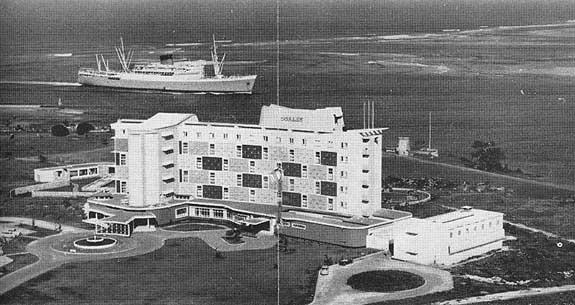
The Oceanic Hotel, built on the cliff ovedrlookiing the Mombasa seafront, with a Union Castle ship coming through the malango and into Kilindini Harbour. The hotel, long gone now, was built in the late 1950s and I used to play in the scaffolding. My home was nearby.
I was very young when I first went to live in Mombasa but I still remember my first impression of the seafront.
We had moved down from Nairobi which to my child’s mind seemed a dark place in those days, shadowed by Mau Mau and that dreariness that often seemed to imbue this city built on swamp and plain with the dark bulk of the Ngong Hills looming nearby.
Mombasa, by contrast, was all sunlight and sparkle and nowhere did it shine more brightly than on the narrow strip that stretched from the Golf Club to the Likoni Ferry; a mere shelf between cliff and ocean. Most of it covered with the smooth green of the golf course, coconut palms streaming their fronds in the sea breeze and, at the Kilindini end, the solidly reassuring bulk of baobab trees.
My home was not far away and thus the seafront was a ready playground for myself and friends. Something was always going on there. Ships came into Kilindini Harbour from all parts of the world, bringing a whiff of faraway places. Or else they went out again, the little white pilot boar bobbing behind, ready to take off the pilot once the malango had been safely passaged. The malango was the gap in the reef and through it came not only ships but also sharks, to make the harbour a dangerous place to swim, though it didn’t stop those of us who sailed small boats out from the Mombasa Yacht Club venturing upon its narrow waters. So narrow that when a large ship came down the creek it appeared to be steaming through the landscape when you glimpsed the funnels from a distance. I remember seeing the Ark Royal and, later, an even larger American aircraft carrier come into harbour and it was a fine sight – breathtaking because you wondered – hoped even! – if it would get stuck in the shallow beds of coral that lay either side of the creek entrance or, even worse, hit the high cliff bank at Likoni.
Most things of worth or interest entered Mombasa that way, in those days and if there was nothing else to do it was always worth going down to Ras Serani Drive to wave at the ships. On a couple of memorable occasions we waited excitedly down by the water, or up on the high cliffs where the Oceanic was built, to watch the Royal Yacht Britannia sail in bringing her royal cargo. We loyal little white children of Empire, Union Jacks in sticky hands, greeted the visitors with enthusiasm but then so did our parents and others of Her Majesty’s subjects whether white, brown or black. Innocent days! During Princess Margaret’s 1956 visit a splendid fireworks display was organised on the southern side of the creek. Alas, something went wrong and after a few preliminary rockets and Catherine wheels the whole lot went up in one big whizzbang, including the set-piece of Her Royal Highness’ head over which the firework makers had laboured lovingly and long. It was a big disappointment to the authorities but we kids thought it was great fun, especially as the event nearly turned into an even worse disaster when grass along the Likoni clifftop caught on fire and had to be put out by the fire brigade.
Besides the ships, there was the sea itself. While the coasts north and south of the island were protected by the long, white reef that prevented large waves from breaking on the beaches, the rough, brown coral cliffs on Mombasa’s ocean side were constantly battered by an unfettered ocean that, at times, could become very rough indeed. This was a matter of great excitement to children and we would spend hours watching the bigger waves as they surged over the ragged coral and sent their wild white spray high into the air. Or, the more daring among us would descend the flesh-tearing rocks into Glassy Cove, so named for the thousands of brightly coloured pebbles that surged in and out with the tide. These were the sea-smoothed remains of a long-lost cargo of bottles, precious to us as jewells, and I have written about this cove elsewhere, in the story “C.J..” Here we would play in the cave and wait for the incoming tide, running out to touch the edge of the water when it surged backwards, then racing the waves back to higher and still higher ground, knowing we dared not slip and either slash ourselves on the jagged coral or be sucked out into the ocean.
What freedom children had then! The seafront, when one thinks back, offered its share of hazards but no parent forbade us to play there and we would be gone for hours without supervision. And none of us came to any harm, that I can recall. Those of us who lived locally in the area bounded by Cliff Avenue, Kizingo Road and the smaller streets roundabout had a secret path down to the front which in itself was a source of pleasure for it was bounded by Lucky Bean trees and there was a house to one side, believed by us to be haunted and with a very large and romantically overgrown garden. We strung the hard little red seeds into necklaces and played in the garden, when its fierce caretaker wasn’t about. In the late ‘50s my friends and I formed a small gang and we would waylay other children found using “our” path and take them prisoner and tie them to trees until anguished ayahs or mothers came looking for them.
Glassy Cove and other clefts in the cliff face offered another opportunity at low tide – golf balls. On the seaward side of the golf links (as we called them then) and not far from the clubhouse, golfers had to go close to the water’s edge and drive across an indentation in the cliffs. Very often their balls didn’t make it safely across and dropped short instead, to roll down the decline into Glassy Cove. We kids would race the young African caddies to retrieve these balls and then sell them back to the golfers. Some of whom were our parents. My father, for one, strongly objected to this and when I brought a couple home one day, refused to pay me. He was greatly chagrined when I promptly went down to the Golf Club and found another client! It was rather mean of us, really, because the caddies probably needed the money more than we did; our meagre pocket money may not have gone far in buying toys and sweets and comics but at least we were well housed and fed!
Here and there along the font were the remains of fortifications and gun emplacements, reminders of the two world wars in which Mombasa had been vulnerable to German attack. At the time of which I am writing the second of those wars was not long behind us and the concrete platforms and bunkers made good places to play, or just sit and watch the sea. They were subject to a bit of graffiti even in those days, and the first time I ever saw the word “fuck” it was scrawled on one of those pocked grey walls. I didn’t know what it meant but knew, by some instinct, that it was not a word I could go round repeating. Little did we guess that it would one day become a common word in the vocabulary of primary school children and just about everyone else!
A strange African took possession of one of these old gun emplacements for a while and made it into a home. He was hideous, toothless and quite mad and we children were very frightened of him because when we approached what we considered, after all, was OUR territory he would chase us away, shouting incomprehensible things. Children can be cruel little beasts and it became our great delight for a while to tease this poor creature, whom we inevitably nicknamed Majinga. He used to feed himself by going down among the rock pools at low tide and picking things out of the pools – tiny shellfish and sea slugs and such. Seaweed, too. Madness made him incontinent and he turned the gun emplacement into a latrine, filthy and stinking, until at last some authority came and took him away. “To Mathari”, we children whispered in awe, knowing that this was the name of the asylum in Nairobi where lunatics were housed.
Another seafront character was the man who used to sell peanuts from his hamali cart, mostly to those waiting for the ferry to Likoni. He was an Afro-Arab – what we wazungu used to call a “Shirazi” or “Shirry” for short – dressed usually in a red-and-white check kikoi and a white embroidered cap. He always had a kind word for children as he dished out his peanuts into cones made from newspaper pages. The taste of those “nuts” – which we called njugu but are now, I believe, called kajanga, rich in salt and oil, remains in my tongue’s memory and all the more tasty for being forbidden – parents considered this cheery entrepreneur dirty and his peanuts unhygienic – but we bought them surreptitiously and ate them with relish!
By far the biggest attraction on the seafront during the 1950s, for children anyway, was the Florida Swimming Pool. For those of us who lived on the island this provided the only safe swimming and during the school holidays, when we couldn’t get out to the north and south coast beaches, we would spend long hours here. Free, mostly, from adult supervision. The long seawater pool was filled through the simple expedient of opening two sluice gates set low in the thick wall that divided the pull from the ocean. So it was rather like swimming in the sea, complete with the odd small fish or bits of seaweed. I saw my first seahorse here, floating serenely in the deep end and there were always stories about sharks being washed over the seawall on very high tides, though of course even if this had been possible any such creature would have been instantly visible from the pool surrounds! We would spend hours in that pool, as only children can. In between swims we would lie around the edge or clamber on to the seawall where we could watch the waves break. A game evolved by which we older kids – and I’m talking eleven and twelve-year-olds here – would dare each other to jump into the ocean and wait for a wave to carry us back near enough to grab the wall and pull ourselves up and over. Only the bolder among us did this, and the best swimmers. It was said that a couple of boys bolder than all the rest had actually gone out through the sluice gates when they were opened (which happened once a day) and then swum back in again but, like the shark story, the wisdom of age has taught me that this oft-repeated tale is probably not true. Most of us were pretty handy little swimmers, though, equally at home in pool or ocean.
The Florida had two spring boards at the deep end of the pool which provided us with endless fun and those of us who went on to become notable divers at our up-country boarding schools learned our skills here. They were excellent boards with good length and plenty of bounce, covered in a rough sort of coir matting. Even greater thrills were provided by the diving platform which had, from memory, four levels (though it could have been five – not sure, now). This served as a rite of passage for young pool-goers: we would start on the lowest platform and work our way up to the high board as fast as our ability – and our courage – would allow. Some never made it but those of us who did were as triumphant as Olympians, grinning down at the lesser mortals before plunging, bodies stretched and arms extended, to the green depths below. The top board seemed very high to me then though it was probably not as high as my child’s eyes perceived it; certainly not as high as the top board of the diving platform at the high school swimming pool to which I graduated at the age of twelve. High enough, though, to permit jack knifing and swallow diving and a double (but not triple) somersault. How I – and others – worked on our diving once we’d got the hang of it. For two years, every holiday, my friends and I would do little else. We brought to diving that single-minded concentration which only children can bring to any new activity until – like jacks and hopscotch and other passions the diving craze gave way to some other and equally impassioned interest.
A boy was killed one day, diving from that top board. A slight boy with sun-streaked blond hair who would have grown into a handsome man had he lived. During the times when the pool was being emptied and filled a sign would be placed on the diving platform steps, forbidding us to dive. Of course, we ignored it and it became another rite of passage that when the caretaker’s back was turned we would sneak up on to the boards and practice our skills in shallow water. The trick was to flick your body upwards immediately it touched the surface, arms extended and fingers flexed ready to bend upwards too. Surprisingly, when one looks back, we managed to do this successfully time after time though I remember the dry-mouthed fear of it and the relief when each dangerous dive was safely completed.
On that terrible day I was in the changing rooms when it happened and remember being furious that others had seen the accident and I had not. I soon learned the details, though, for children are gory little beasts. I heard about the neck that snapped with a sound audible to those already in the half-filled pool, and the blood and brains that floated to the surface. None of it true, of course. In this age of ever-ready counselling it’s hard for those raised in a different time and place and social code to understand how little this affected us emotionally, except as a subject of gossip. The only “counselling” we got was a sharp warning from parents and teachers as to what happens when you disobey rules set in place for your own good. Needless to say, the diving board steps were more closely guarded after that and as far as I know nobody ever dived into the half-filled pool again – but then this may have coincided with my being sent away to boarding school, an improved ability to get to the beaches in the school holidays and, not so long after, the closing of the pool.

The Florida pool, in the late 1950s or possibly early ’60s. You can see my parents’ house a couple of streets back from the top of the cliff top. Also part of the golf course, across from the pool. A great playground for children of that era who lived and went to school nearby.
The era of “going down to the Florida” passed, as all such childhood phases pass, to morph into a very different Florida experience when the place was turned into a nightclub. This set out to be a stylish place and for a while, when I was in my late teens, it seemed to have taken on all the glamour of those nightclubs I’d seen in films of the ‘30s and ‘40s: smoky dimness lit only by red-shaded table lamps, a small and crowded dancefloor, women in cocktail dresses, palms in pots, live jazz and torch songs, an atmosphere imbued with the musky perfume of forbidden delight. Here, in the sinful hours after midnight, when respectable people were abed, you might see men dancing with other men’s wives and women holding hands under the table with other women’s husbands. Here you could rub shoulders with shady characters whom you would not acknowledge in daylight. Here you might say things that could only be whispered anywhere else.
“I know…a dark…secluded place
A place…where no-one…knows you face
A glass…of wine…a swift embrace
It’s called…Hernando’s Hideaway. (Ole!)
So they had sung, to a tango beat, not so many years before my own time on the dance floor of youth. And, to me, it described the Florida Night Club quite perfectly. Alas, it became steadily sleazier in the years following Independence as the European patrons took flight and newer, smarter places took its place. But the dear old Florida did not fade away and, after several new beginnings, is today a fashionable restaurant as befits its splendid position on the seafront.
Ahhhh, the seafront. How its soft sea breezes sing forever in my memory. In that magic period just before and after Independence when I and my friends were in full hormonal bloom at a time when doing “it” was nominally forbidden outside marriage, the seafront became our main trysting place. We could sit and neck in the gun emplacements, or fondle each other in the steamy backseats of our Volkswagens and old Peugeots. Many a woman of my age lost her virginity beneath the baobab trees or on the grassy parking areas facing the sea. Sex then was softened and sweetened by romance –we knew all the love songs by heart and they underscored the lovely clichés of our environment – the sound of the waves, the moonlit pathway over the water, the swaying palm trees, the humid air so conducive to passion. Few young people have ever been quite so blessed.
Yet this idyll, too, did not last. As the stringencies of British rule were relaxed crime became more prevalent – and more dangerous. Petty pilfering and house breaking gave way to serious assault and even murder. A girl I knew was raped on the seafront by five men, one of them a taxi driver, and her boyfriend savagely beaten. No longer would the seafront offer a safe and romantic haven for lovers.
Yet in daylight hours the dear old seafront remained a place for promenade and pleasure as well as one of the world’s most delightfully-located golf courses. In those far off days it was a quiet place during the week with little traffic, but on weekends it drew the people of the island from their hot houses; not just the comparatively small European population but Indians, also, and on Sundays it resembled the marine parade at Bombay-sorry-Mumbai. Africans back then, unless in domestic service, lived mostly on the further and landward side of the island and couldn’t afford cars. Nor were they enthralled by the ocean. Indians, however, could drive there – and did. In fact it was a standard joke among Europeans as to how many Indians could fit into a Morris Minor!
Rather a cruel joke, really, reflective of the attitude felt by some Europeans towards those with browner skins and different customs. Never mind that they provided the community with its groceries and most other commodities, and were the major philanthropists, too. I can see, looking back, what a relief it must have been for most of those Indians – Muslims, Hindus, Sikhs, Parsees, Catholic Goans – to escape from their small, crowded, stiflingly hot flats for just a few hours each week to enjoy the cool breezes that came from “their” ocean. In any case, the bright saris and salwar kameez of the women added a touch of colour to the generally sportive and cheerful atmosphere that was the Mombasa seafront when everyone was out and about. It reminded us that we were all living in an exotic and generally happy place even though it lay on the edge of a huge, dark and often frightening continent. So much more exciting and spicy than life in Surbiton or Wolverhampton – or even Delhi – on a Sunday afternoon!
When I think of the Mombasa seafront I’m reminded of how simple were our pleasures back then. To have a car to take us for a Sunday drive and a bit of a promenade along a lovely seashore where we might meet friends and stop for a chat; where there was space for children to run around and dogs to frolic; where we might buy a cone of peanuts or an ice cream, looking forward to an evening of music and perhaps a play on the radio, or a curry from the Elias Hotel or fish and chips from the Rocco because it was the cook’s night off. Would people today be content with such modest pleasures, I wonder? In this age of non-stop digital self-gratification? Probably not, yet the Mombasa seafront endures as a place to walk and talk and admire the view.
It’s even livelier today, and much more crowded. A multi-cultural horde gathers there on weekends – and even weekday evenings – to enjoy what we used to enjoy yet with many additions. Music blares from car speakers, today’s pleasure seekers can buy a wide assortment of things to eat and drink, tourist “attractions” abound. There is a certain tattiness replacing the pristine expanse of grass that used to be. Gone forever are the silent sunsets of my memory, but for a new generation in a new age the dear old seafront is still a wonderful place to be.

 Lyrebird Mountain