

The siafu came, like all true horrors, at midnight.
They came stealthily as they always do, determined of purpose. The leaders made their choice and the long columns followed, obedient as automatons, the scouts ahead and to the side, the stalwart marshals vigilant along the side of each column, keeping the foot soldiers in line. There would have been several columns. I didn’t see this for myself but knew it to be so because I had witnessed these sudden, forced marches before and, though well aware of their deadliness, had teased and provoked and dropped obstacles in their path, gleefully and fearfully watching the seething mass that soon sorted itself into order and marched on, over the bodies of comrades. . Overcoming everything. Leaving me awed at such sacrificial resolve.
I was the giant, so immensely huge by comparison that they would barely have been aware of my existence. I could destroy them, like a god, but while I had the size, they had the numbers and should I for any reason fall they would swiftly discover me to be no deity but mere flesh, and devour me.
On that night the siafu came I was asleep in my bed, in our solid-walled house of cream palnted coral block and terra cotta tiled roof in Kizingo Road, on the seaward side of Mombasa. Across from us was a grassy vlei and beyond that a collection of small cottages separated by narrow laneways. These were known collectively as the bandas and they housed lower-ranking white employees of the City Council, many of them of South African origin. These bungalows were tiny, two-bedroomed and hot, with kitchens out the back to be fire-safe, joined to the main house by narrow covered walkways. There were no ceilings below the thatched roofs and geckos hunted along the beams while snakes and rodents made homes in the straw. Those today who think all the colonial white bwanas and memsaabs lived in luxury should be taken back in time to live for a few nights in one of the bandas.
I had playmates living there and so spent some after school hours chalking out hopscotch squares on the melting black tarmac and throwing balls against the mud-and-wattle walls. One of my favourite activities was to visit a couple known as Aunty Bertha and Oupa and in the strange way that some children attach themselves to adult oddities, so I became enamoured of this couple, so very different from my parents and their friends. Aunty Bertha was a large, fat, jolly woman and Oupa was her father, an immensely old (to me) man who rarely seemed to stir from his armchair. They spoke mostly Afrikaans, at least to each other, and his English was poor or else, as was the way then of elderly Afrikaners, spoken grudgingly.
Aunty Bertha loved children and always had sweeties for us. They kept no servant – unheard of! – and she did her own baking so that we could be sure of gingerbread and sugary biscuits. She kept bottles of Vimto for us in the old, noisy frig and had a forlorn monkey on a chain in the tiny baked-earth yard whose main amusement was to leap out at passing children, teeth bared. We could not play with him but could instead fondle and throw balls for the sweet-natured golden cocker spaniel who was Bertha’s darling. She had never been married and this dog, Meisie, was the object of all her maternal affection. She had a heart as big as her body, did Aunty Bertha and all the time in the world for the neighbourhood children whose own, more affluent parents were usually either at work or at the club.
The old man would watch us play and listen to us prattle without saying much but we always assumed his presence was benign and, as he did not engage with us, we ignored him. He, too, was very fond of the dog and would take it on his lap and feed it little treats – and as a result the dog was, like its mistress, very fat.
It was to this modest household, on one dark night in, I think, 1957, that the siafu, in the inscrutable way of marching ants, directed their attack.
It was all too well known in the Kenya of those days that once the safari ants went on the march, and your house was in their way, then all you could do was get out. Africans, in their village huts, had long known this but a traditional hut only takes minutes to clean out and you can flee to a safe distance and wait while they trail relentlessly through and go on their way. For the white folk and Indians, however, there was rarely enough time to remove everything except all foodstuff not in tins and as much clothing as possible.
Because the ants would consume everything except metal, stone and hard timber. Soft fabric on furniture, clothing, bed linen, paper, carpeting, shoe leather and every kind of foodstuff could be chewed to pieces or totally gobbled up by those savage mandibles.
Siafu invasions of urban areas were rare. We did not live in daily fear of them. But we knew they could happen, had seen them happen to others and had heard the stories – no doubt wildly exaggerated and the stuff of myth but – as I was to learn that night – sometimes true.
These ants of the Dorylus genus were indomitable. They marched in their millions and nothing except wide water or fire would stop them. Usually when they were spotted nearing houses or shops there would be a concerted community effort to deflect them – chemicals would be sprayed on them, water would be blasted at them through hoses and though millions would die, millions more marched over them towards their mysteriously-determined goal. Mysterious to humans, that is.
In the bush, one often came upon these columns which seemed to go on forever, consuming anything in their path such as vegetation, baby birds and young creatures too weak to run. All things that could run, from bush mice to elephants, got out of their way. But in this environment the siafu played their part in the natural way of things and no doubt it was a useful one. It was only in the urban environment that they became a menace.
Houses like my own were better able to stand up to ant attacks but the Bandas, only a step up from African huts, were very vulnerable. Full of nooks and crannies and entryways and the walls that ended just short of the thatched roof so that the air could move through and keep the place cool.
When the ants marched during the day they would usually be spotted well in advance and evasive action taken. Or a line of fire lit to deter them, though it had to be continuous and wide or else the siafu would just march through across the bodies of their frizzled comrades. But when they came at night the chances of detection were minimal.
As was the case that night, of which I write after nearly seventy years, when the siafu came to the Bandas and, of all the little houses there, chose to invade the home of Aunty Bertha and her father.
We heard the shrieks and shouts. Even from our house, on the other side of the vlei , we heard them and woke. Closer neighbours crowded the little laneways and some rushed in to help the stricken couple while others checked the lines of ants to see if their own houses were in danger. The fire brigade was called. And in this white residential area, the live-in servants emerged from their quarters and gathered in small groups, speculating and sending runners to find out what was going on. Soon the dread word siafu was whispered around and my father, deciding this was not his affair, ordered us all back to bed.
But I didn’t go. I was twelve and curious. So was one of my friends who lived across the road. Together we sneaked out of our homes and across the grassy open space to where the action was. There were so many people milling around that we could not get very close, but close enough that we could see Aunty Bertha and Oupa, wrapped in sheets, being ushed into a car, and that big, kindly woman dishevelled and in tears, arguing with those assisting her. She was, I learned the next day, desperately trying to tell them something, and to get back into the house. And they were just as desperately trying to urge her away.
I could see a wide pathway that had been left between the roadway and the house and along it flowed a relentless river of ants which was, in the next minute, sprayed by the fire hose. Other hoses were being sprayed on the house. Here and there firemen and a mixed crowd of Africans and Europeans were beating – rather uselessly – at other ant columns, using brooms and sticks and even hippo-hide whips. The lights of the fire engine whirled and made everything glow eerily. Torches bobbed. I heard men discussing the possibility of lighting a fire line and deciding it was too dangerous in that close environment of thatched homes. It was the kind of chaotic drama that kids love.
By this time we knew the bones of it. The siafu had come and invaded the little house of Aunty Bertha and her father. They had woken only when the ants were upon them, biting them, covering everything. A horror too terrible to think about. Overweight, aged and slow, it had taken them a while to yell for neighbours and get out of the house – but they had done so and, though shocked and badly bitten, would survive.
“The ants were all in her hair,” I heard a woman say, and I shuddered. “All over and…you know…up in every part of her”. I envisaged this and shuddered again – fascinated as well as appalled.
Nobody knew quite what to do in such a situation and it was decided that the stricken couple, beating at their bodies and in great distress and pain, should be taken to hospital. But, good neighbours that they were, nobody wanted to use their own car for fear of filling it with ants, for the bite of one siafu is very painful, as I had long since learned to my cost, along with other overly-curious children. The bit of many is true agony.
Later, my mother told me, a solution of a kind was found and the poor old couple was liberally sprayed with DDT, using the little barrelled flit guns that were found in every home, our only defence against the mosquitoes and other annoying insects which bedevilled the African night. The chief of the fire brigade sent a departmental vehicle to take Bertha and Oupa to the hospital – but still she protested and struggled back towards the house.
And then I could hear…we could all hear…what she had been hearing. The long, dreadful howl of a dog. A dog in agony. A dog in terror. A dog abandoned. Poor Meisie was in the house. People do strange things in time of panic. Aunty Bertha, from sheer force of habit, had locked the door when she left the house! And in all the beating and the fumbling of clothing and the frenzied attempts to rid herself of the biting ants, she could not find the key!
When this was conveyed to those standing by, there was talk of breaking down the door, or smashing a window. But the ants were everywhere around the house as well as inside it, thick on the ground and up the walls, wreaking havoc on the thatch, a seething and malignant dark mass. Nobody would be foolish enough to try and rescue a dog.
The firemen were urged to spray the door and try to break it down so that Meisie might be able to rush out but they would not do it – their remit was to kill ants but not damage property, even if the owner was begging for it. And really, what good could it do? Already the dreadful shrieking – so appallingly different from any dog howl that we had ever heard – was muting to faint whimpers. And then silence.
My friend and I sneaked back home and I lay in bed, deeply distressed and sleepless. I longed to tell my parents, next morning, what I’d seen and heard but didn’t dare. However they soon learned about Meisie and it was a great relief that I could now share my misery with them. We hugged our own dogs closer and wondered aloud what we would do if such an awful fate had befallen them.
My mother and other members of the East African Women’s League visited the hospital with food and other comforts.
“Bertha is very brave,” she told me. “But she blames herself terribly for leaving her dog behind.” The two women had never spoken before and my mother was gratified – and very surprised – to learn that in one household, at least, I was considered a “lovely little girl.” Dear Bertha and her kind heart, no other adult had ever described me thus!
It was a week before Aunty Bertha and Oupa were released from hospital. In that time their house had been thoroughly cleaned and replacements found for soft furnishings that had eaten by the ants. They had not owned much and most of what they had was consumed or damaged so badly it had to be thrown away. Pots and pans and china remained, as did the frig and the stove and the water filter. The old man’s pipe was intact along with the tobacco tin. Somebody had taken away the little skeleton which was all that had been left of pretty Meisie, with her soft floppy ears and lively eyes.
The ants had disappeared as silently and mysteriously as they had arrived.
Charlie, the Vervet monkey, had survived. His shrieks were one of the first things to attract attention to the unfolding threat and a neighbour had rushed into the yard and freed him. For which act of mercy he was rewarded by a severe bite, requiring several painful rabies injections!
Somebody gave Aunty Bertha another dog; another golden cocker spaniel. I don’t know how she really felt about that, but she accepted it.
I, along with the other neighbourhood kids, grew up and moved away. But for years I had nightmares about swarming ants and, as you can see, the sound of that little dog’s dying haunts me to this day.
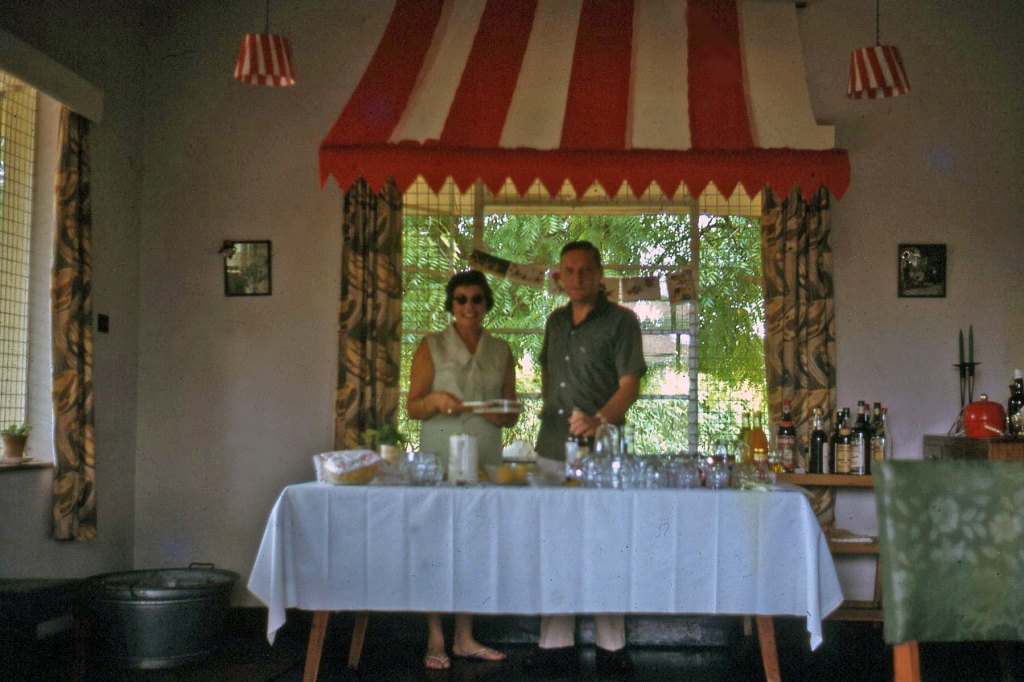
My parents in our house in Kizingo Road, getting ready for their usual Christmas morning Pimms party. This was taken not long after the night of the siafu invasion, which took place only a short distance away. And no, that’s not the family bath in the left hand corner, it’s the ice tub!

 Lyrebird Mountain