A reader of Lyrebird Mountain wrote to me recently and asked about the strange, “waking dreams” experienced throughout her life by Anna, the book’s main protagonist.
Was she psychic? Was she epileptic? Did she suffer from some psychotic disorder such as dissociative states?
The truth is, I don’t really know!
The narrator of this book is Anna’s unnamed granddaughter who suffers from the same strange episodes and is never able to name them. Her evidence for her grandmother’s experience is mostly from family memories and diary entries and from these it seems that the wachtraum, as this German-descended family called it, was believed by her parents to be spiritual. Given, as they were, to a belief in Theosophy and the existence of a spirit world beyond this one. And so they took their daughter’s occasional fugue states in their stride. No big deal here. Let’s not make too much of it.
By her own admission, the child Anna, on coming out of her waking dream, sometimes embroidered the experience. What she could recall was muddled and vague and so she attempted to give it coherence. Thus distinguishing herself from the rest of her siblings. Not just one of the “middle” siblings but a child with special powers.
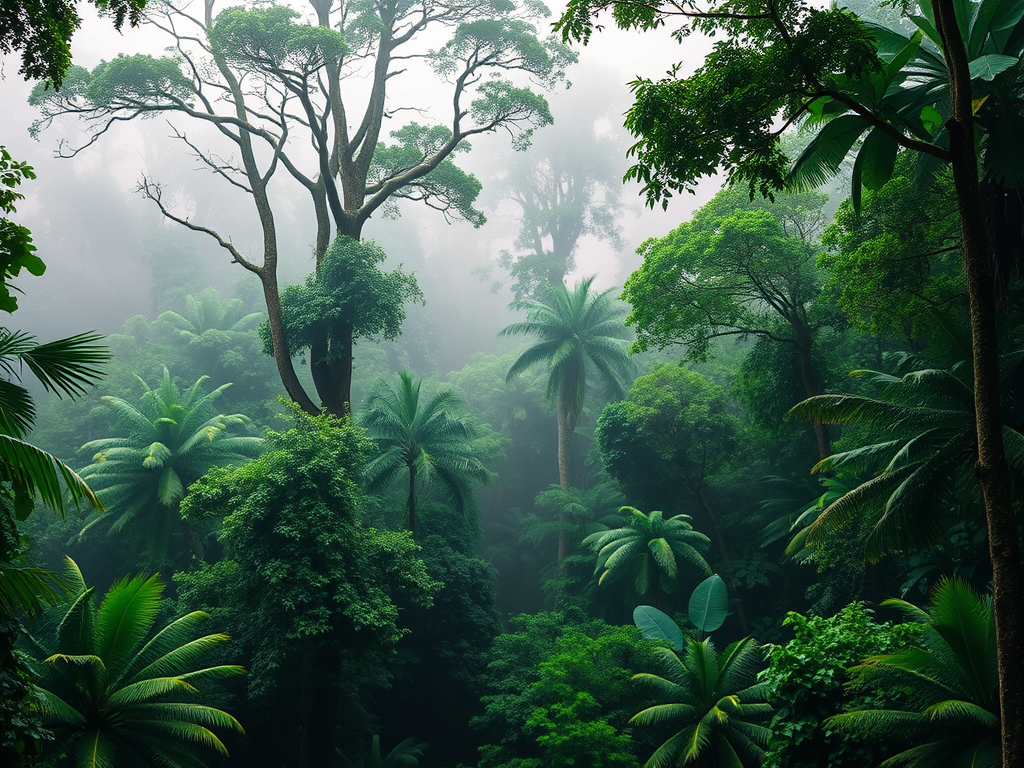
When she was older, Anna identified these experiences very strongly with her powerful connection to the rainforest. Here, she said, she found her true spiritual home. Her church, if you like. Among the great trees and in the misty gullies where the only sounds were the birds and the trickling – seasonally rushing – streams there was enduring mystery. More ancient things existed here just beyond perception, which was granted only to those humans who were spiritually and emotionally attuned.
Here, too, Anna believed she encountered the spirits…or trace memories…of the indigenous people who had hunted on the mountain for millennia.
Airy -fairy stuff you might say, unless you, too, have an affinity for such beliefs. But I based Anna’s mystical experiences on those of a friend who sometimes found herself strangely “coming to” after unexplained periods of absent consciousness. She had no concrete memories of these episodes except vague ideas of voices and shadows and a general sense of otherworldliness. She was tentatively diagnosed with, and briefly treated for, epilepsy and when this did not stop the waking dreams she sought psychiatric help. Also with no useful result. And as the incidents caused her no harm, she learned to live with them, even to hope for them!
I do have to say, though, that she was the kind of person who did believe in some sort of alternative reality and afterlife and was very keen on angels, spirits and natural remedies!
Novels, to some extent, create themselves. The characters take over the author and develop lives of their own. Somehow this happened with Anna and it seemed to me right and natural that she should be infused with the mystery of the mountain rainforest, which we all feel to some extent, and that this in turn should inspire and inform her work as a writer and illustrator. The work that makes her famous because its characters and setting, unique to her particular genius, enthral generations of readers.
I wanted my book to have this small spiritual dimension because that is the way in which I myself feel about the place I live – a mountain whose rainforests still retain, in the face of increased urbanisation, a mysterious power that thrills me every time I enter those green portals to that other world of rock and water, trunk and buttress, moss and fern, frond and thorn.
I believe that everyone needs the forest – any forest – to keep us connected to our wildside. Why? Because civilisation is a marvel of cultural interconnectedness and its embodiment is the modern city – the buildings, the road and rail networks, the invisible map of air routes above, the sewers below, the art, the music, the cultivated gardens, the monuments to human endeavour. And in all of that amazing human creation it is all too easy to forget that underpinning it is an even more amazing interconnection of natural processes, beautifully evolved over aeons.
Vital to life on earth.
In her only significant journey away from the mountain Anna travels to one of the most famous and beautiful cities on earth – Vienna. Yet she does not record her reactions to this triumph of architectural and cultural achievement. No doubt the buildings impressed her, even in her terrible grief and urgent seeking. And she does note the loveliness of the countryside, even in the aftermath of war.
But Anna knows that we are, deep in our blood, not so far from our wild nature that long pre-existed recorded history – and she feels the tug of her mountain home. Her story, like all our stories if we live long enough, is one of increasing loss. Only the natural world endures.
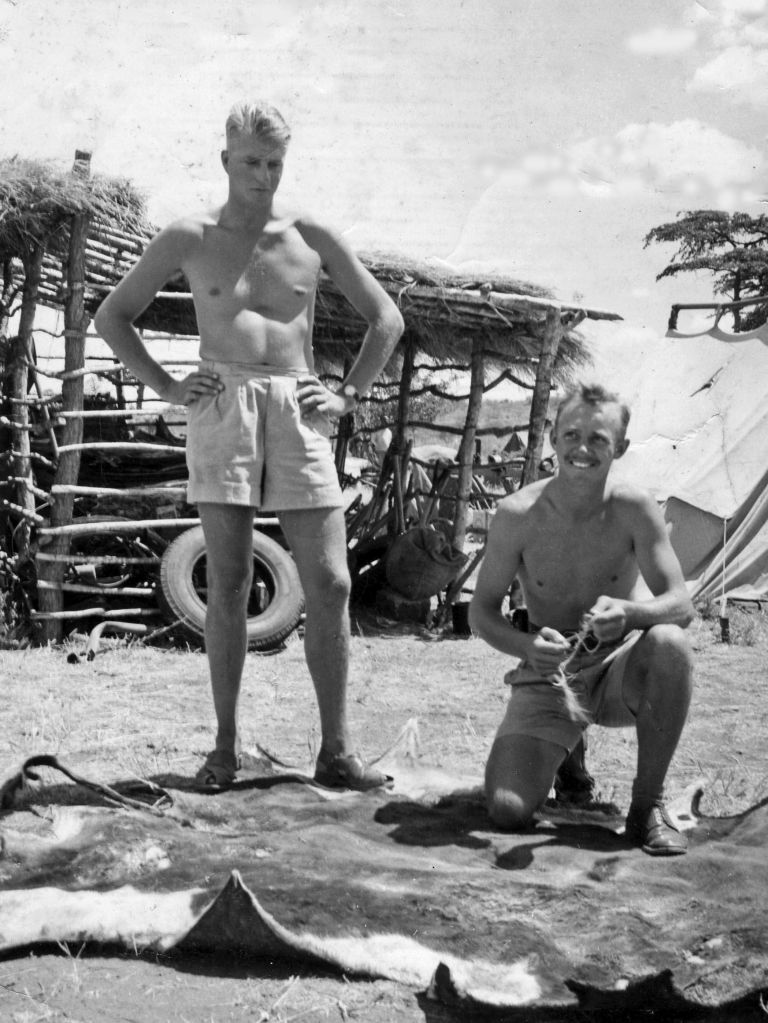
This is the story of two young men, a mob of cattle and a year spent under canvas battling lion, rhino, drought, deluge and the many diseases of the African bush. All they had were a few basic supplies, a nervous labour force and their guns. It’s an adventure that Ernest Hemingway, that great lover of African adventure, could never even have dreamed of. And it recalls a time and a way of life that is long gone.
Kenya, like much of Africa, is a climate of extremes and it’s always, as Bob Lake used to say, one or bloody other! Bob is one of the two young men in this story, and the one who endured this adventure the longest. It is from his memoirs that the account is drawn.
In the three years up to 1961 the annual rainfall in Kenya fell from just over 304.8 millimetres (12 inches) a year to 76 millimetres (3 inches). . This severe drought caused problems for the cattle farmers in the Machakos district, south of Nairobi, and stock condition began to deteriorate. Then, as grazing turned to dust, huge herds of game – mainly zebra, wildebeest, gazelle and antelope, hartebeest and eland – moved out of the neighbouring Maasai reserve and on to the farms.
This led to a concerted effort to drive the wild game back into the Maasai country. Farmers and friends from the city gathered to shoot the vast herds and drive them back towards the railway line that ran between Nairobi and Mombasa. Bob Lake and his friend and neighbour Mark Millbank, the heroes of this tale, between them shot several hundred head in less than a month and drove many more than this on to other farms, where the shooting continued. Thousands of carcases were left for the vultures. It was brutal, bloody work and, in current terms, unacceptable but for them at that time, it was survival.
And, as Bob recalled, seventy years later: “It was all in vain. When I was out shooting with Major Joyce’s William Evans shotgun, on his property on the evening of April 11, 1961, I was surrounded by huge clouds of moths – as heavy as a snow storm. On top of the drought, the dreaded army worm moth had arrived. Within days our land was covered by millions of caterpillars, eating the last bits of vegetation down to the roots of grass.”
The caterpillars devastated acres of crops and pastureland as well as the greenery that kept the herbivores alive in the wild areas. They made the roads treacherous and stopped the trains from running. It was a plague of biblical proportions, consuming what little pasture had survived the drought. Something drastic had to be done.
Another local cattle farmer, Dennis Wilson, located 250,000 acres of ungrazed land at Athi Tiva, known then as the B2 Yatta Controlled Hunting Block and mostly uninhabited. It wasn’t good land, which is why nobody lived there; it was a dry, thorny part of the nyika that lies between the high plains country of the Athi, just south of Nairobi and the green hills that run behind the coastal strip. The nyika is not desert and it has rivers but it’s inhospitable country and home only to lion, rhino, elephant, cheetah, hyena, various tough-mouthed antelope and a lot of ground squirrels. Today it’s all been subdivided into small holdings and shanty villages and you have to wonder how they make a living there. Back then, nobody wanted it, except to shoot things for sport.
To save the herds around the Konza and Ulu areas, Bob and Mark set out to move 5,200 head of cattle belonging to nine farmers to the Yatta plateau, on to land given by the Kenya government as temporary grazing until the drought broke.
Each farmer provided herdsmen for his/her own livestock and contributed to the expenses of the venture on a per head of cattle basis. Bob was appointed manager and Mark as his assistant. Their only transport was Bob’s old, stripped down Land Rover.
For the two men, both 21, it was a great adventure – and a big responsibility. Athi-Tiva was home to the dreaded tetse-fly as well as ticks carrying cattle diseases such as anaplasmosis, east coast fever and redwater. The area had no roads, only rough tracks through the hunting block; nor were there any buildings or development of any kind.
The journey involved moving, at very quick notice, the 5,200 head of cattle south by rail for 150 km, then unloading them and walking them another 80 km north-east along the bush tracks and game trails. The herdsmen had to be constantly vigilant because the local Big Cat population soon got word that there was beef takeaway to be got for very little effort – it’s a lot easier to bring down a cow than a wildebeest or buffalo! Bomas – rough enclosures of thorny brush – had to be erected at night and the Wakamba youth taking it turns to be on guard were armed only with spears, clubs and pangas (machetes). Bob and Mark had rifles, shotguns and sidearms and the former were in constant use, to scare away predators or shoot for the pot.
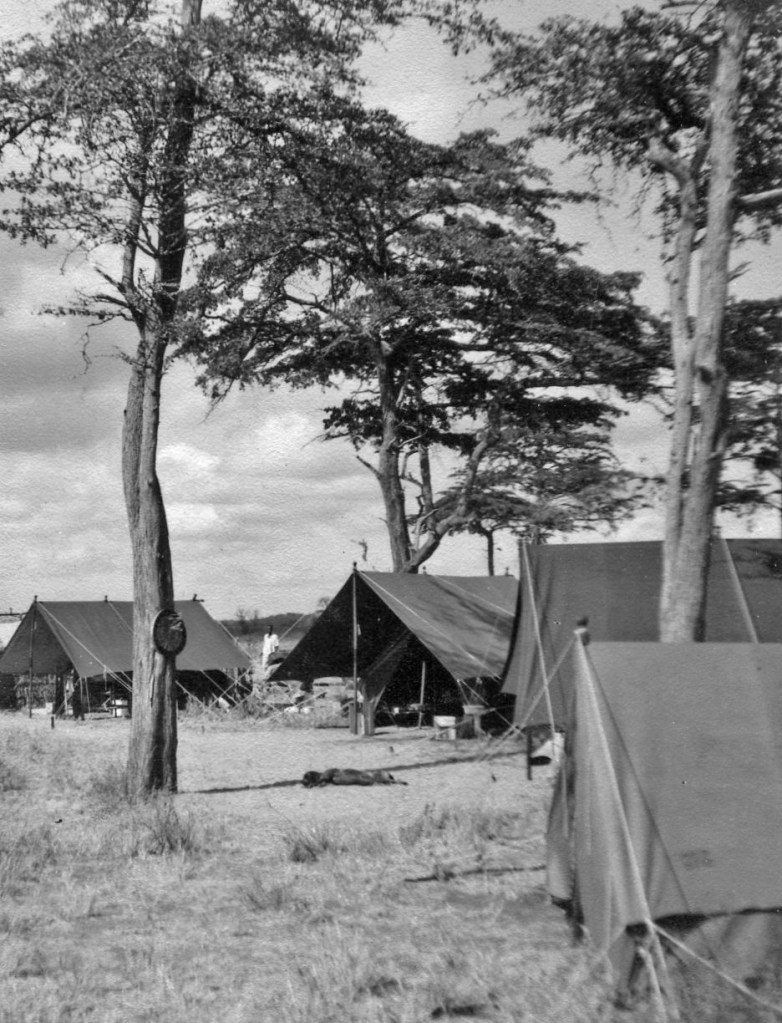
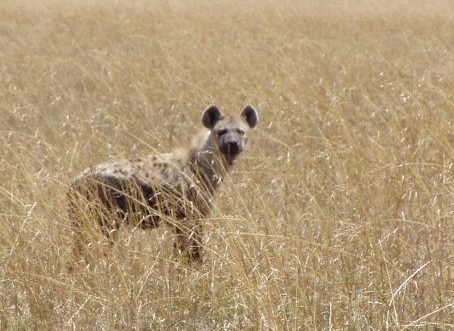
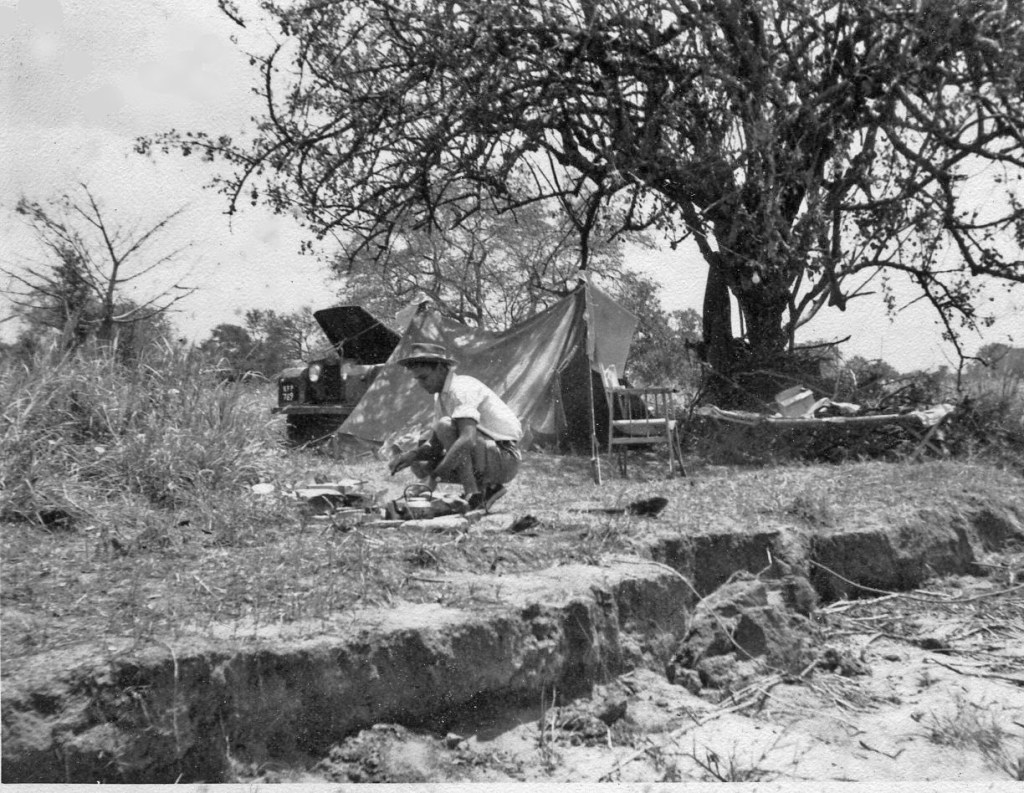
When Bob, Mark and the labour force reached their destination a camp was set up near the Athi River – which was only a series of shallow pools in that dry season – and eventually Bob had the labour build him a long-drop loo up on a hillside where he could look out over the countryside – king of the world! Because he loved it there! Loved the whole, wild, hard life of it. A solitary man by nature, he was content to spend his days supervising the men and tending to the cattle, hunting and yarning with Mark, eating simple meals cooked over a campfire, going to sleep with the sounds of the bush in his ears. Lion prowled around the camp at night, attracted by the beef carcasses hung in one of the tents, covered only in a mesh to keep away flies. These steers, as well as various buck and antelope, had been killed to keep the camp in meat. A vigil had to be kept to prevent rhino from barging through the camp and knocking it down, there were a couple of near misses with elephant herds wandering past. Hyenas came to scavenge for any scraps or rubbish left lying around, their weird, wittering calls making it difficult to sleep.
*
They were not completely isolated. A few weeks after the camp had been established, a small village appeared further down the river. A few huts roughly put together from mud-daubed branches and corrugated iron, a dozen families, some goats and chickens. In the Kenya of those days, such habitations could appear almost overnight. Bob questioned the menfolk who blandly replied that they had squatters rights as the land was uninhabited. Bob pointed out that it was government land, set aside for hunting and not habitable anyway. Before long, a cow disappeared and then another. Bob’s men reported finding horns and hooves half-buried in the sand along the riverbank. Then food and small items were stolen from the camp. The Kamba herders went and searched the new “village” and found incriminating evidence. They threatened to drive the newcomers away and burn down their shanties. Things looked ugly and the two young white men had to try and calm things down; concerned also by the fact that the squatters were obviously starving in that savage country.
They shot some Grants gazelles as an emergency food supply, much to the disgust of the herders who clearly regarded these non-Kamba invaders from further south and east, lacking in all the bush skills needed to survive, as opportunistic parasites attracted by what they obviously saw as some sort of new farm settlement. More would come, they warned darkly, and Bob knew this was probably true. So he contacted the authorities in Kitui who eventually sent down an African police officer and his askari to deal with the problem. By now the number of squatters was steadily increasing, though they had neither food nor water nor protection from wild animals. A child had died, and it was reported that an old man, too, had died and been put outside the loose boundary of the squatter village, among the trees, where he was consumed by hyenas. Bob was skeptical about this story but the Kamba labour force firmly believed it and shook their heads at the young bwana’s tender British innocence.
In any case, the brief and lacklustre appearance of uniformed authority seemed to work and the squatters disappeared as quietly as they had come – one morning they were there and by nightfall the bush had swallowed them, leaving scarcely a trace.
Visitors, too, came from time to time to relieve the loneliness – friends, family, the other cattle owners, government inspectors and a vet bashed their way through the thorny terrain to reach the camp. All had to bring their own camping gear and at times the little canvas boma became quite festive – there would be rough shooting by day and singalongs by night; the Wakamba labour force would put on a bit of a dance. Better than that, the visitors would bring whisky, gin, beer, tinned delicacies, newspapers, books and magazines. But nobody stayed for long. Which was just the way Bob liked it. He was happy with Mark’s company and with learning more about the ways of the Wakamba and the wildlife all around. In the evenings they would read by the light of torches and spirit lamps. They turned in early because the work began at dawn, the days were long and in any case sleep was often interrupted by troublesome wildlife including, once, an invasion of Safari Ants which consumed everything in their path that wasn’t wood or stone or iron and could only be halted – though not completely stopped – by splashing around kerosene and petrol and setting it on fire, then battling to prevent the fire from spreading to the surrounding bush.
“Of all the dangerous things that happened in that year,” said Bob later, “That was by far the worst and it was lucky one of the watu gave the alarm before the ants got into the sleeping tents.” Trapped animals – and humans – have been devoured alive by the dreaded siafu – the remorseless, relentless Dorylus ants of Africa.
As it was, any food that wasn’t in a tin was consumed and a perilous trip in bad weather had to be made to Kitui the next day to re-supply; not just food but petrol and kerosene. “We kept a good supply after that,” Bob remembered.
Another constant threat was the scarcity of water and seeking it involved risk as the cattle were moved to the nearby river, and waterholes, and back. Water storage tanks were trucked in, small dams were built, pumps were put in place with great difficulty in and over the hard ground.
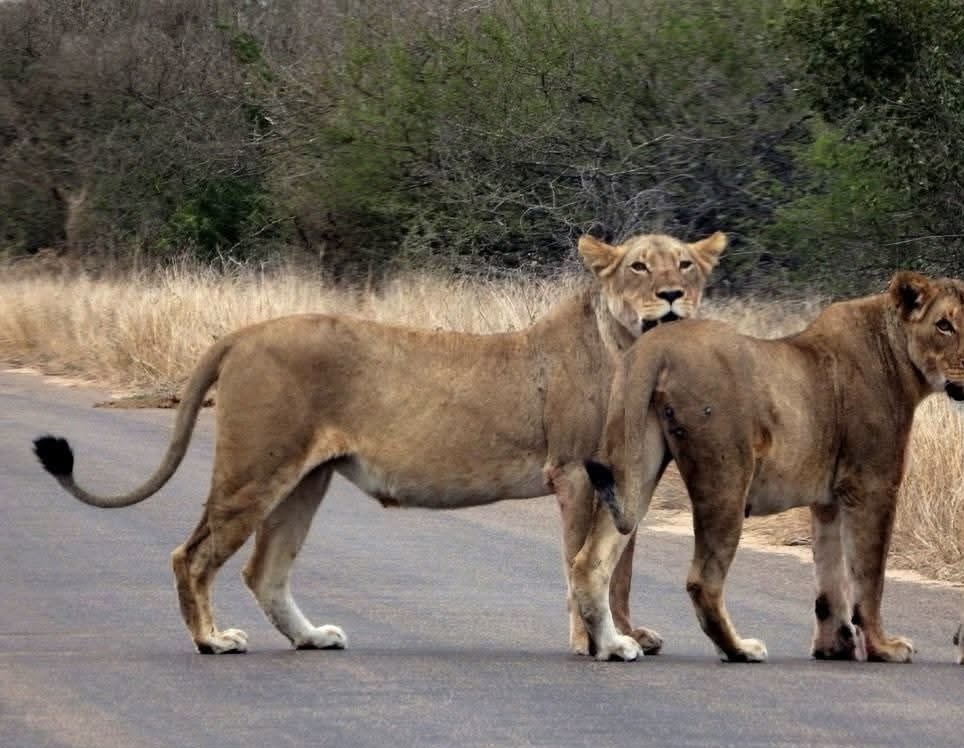
Bob and Mark were both keen hunters and good shots but had some narrow escapes – especially when an enraged rhino chased them, and Bob’s gun bearer, up a small and very prickly thorn tree. On another occasion, Bob and one of the senior herders were walking back to camp in the dusk when they got a strange feeling. They turned round to see two lionesses walking a few metres behind them. The men stopped. The lionesses stopped. Then, seemingly uninterested, moved into the bush. The men started walking again, turning their heads to see, after a few minutes, the lionesses back on the track behind them. Athi Tiva is not so far from Tsavo, where the famous pair of man-eaters once roamed and the area had always had a bad reputation for producing lion with a taste for human flesh. So the men were worried. After this continued for a few more minutes, and the camp still some distance away, Bob turned and shouted at the animals, who hesitated, lashing their tails, then, as Bob told it later, looking at each other as if to say “What’s that puny human think he’s doing?”
“I think, Bwana,” said the senior herdsman, a little agitated,, “That you should shoot them, not shout at them. These simba do not like to be shouted at.”
The lionesses were now only a few bounds away. Lion are curious creatures and Bob felt that if they meant serious trouble they would have just attacked without warning; perhaps they just wanted to know what these two strange two-legged creatures were, wandering through the bush.
“It was for all the world like they were two girls just out for a stroll and not particularly interested in us at all,” he always said in later years, when recalling the incident. “They knew where they were going and they obviously had no intention of getting off the track just because we were there. I got the feeling that if we’d just stopped and stepped back to one side they’d have passed us by with hardly a glance. But of course I couldn’t take the risk.”
So he raised his gun and fired over their heads. Even in those days, you couldn’t just kill a lion without a permit, except to save your life, though of course nobody would have known, in so remote a place. Nor blamed you, for there was no shortage of lions. Bob knew he might have to shoot them both and hoped they’d have the sense to bound away – which they did. Snarling.
“They stopped once and looked back at us,” he recorded in his game diary, “And I’d swear they were looking annoyed and reproachful. And then they melted into the bush and we didn’t see them again.”
Lions weren’t the only danger. When the rains came, which they did with shocking force, the almost-dry riverbed suddenly became a torrent, washing away bridges and tracks. This meant that the cattle could not be moved and Bob had to stay for longer than planned. Mark had gone by then, called to other duties, and two other young men came down, at separate times, to lend a hand. Two other young adventurers. But it all proved overly rough for them; too dangerous and lonely, and, like the occasional visitors, they didn’t stay long.
One of them, though, stayed long enough to give himself some grief. When the rain eased off the Athi ran more gently and pools formed among the rocks. Almost overnight, hippo appeared, just a few of them, lounging in the water with their watchful eyes above the surface by day, coming on to the riverbank at night to feed on the fresh new grass. Grass which was needed for the cattle.
The men tried scaring the hippo away and Bob’s new offsider, James, even went to Kitui – a long journey in the Land Rover – and brought back some cheap firecrackers which they set off gleefully – but after an initial panic and a lot of bellowing and splashing the hippos ignored them. Bob then shot one, and made biltong from the flesh and whips from the hide but while the hippos moved further down the river they didn’t go away.
James, who was in Kenya for a year after finishing Agricultural College, to gain experience before finding a job in South Africa, was a hot-headed 19 year old who came to look upon the small mob of hippo as a personal challenge. Though he had never done any shooting before, he took to it with enthusiasm and spent hours driving Bob and the African camp servants mad by practicing on a variety of targets – mostly old Heinz soup cans. Bob taught him rough shooting with a shotgun, for birds, and they bagged francolin and guinea fowl which made a pleasant change from the main diet of beef with maize meal and tinned vegetables.
But James’s mind was set on something bigger and as this was still a hunting block he was able to obtain a license to go for it. And the shooting of almost anything could be justified as necessary to conserve cattle feed. Bob had a good relationship with the Game Department, which trusted him to do the right thing, so he warned James several times to be prudent with his new-found skill.
Rain had made everyone’s work harder. No visitors could get through to relieve the tedium, this included the vet so Bob had to do a lot of the veterinary work himself; inoculating and dipping the cattle in the rough timber yards which had been hurriedly erected upon arrival, helping cows give birth, castrating young bulls. These were tough beasts with a strong dose of Sariwal in their bloodlines but they were still subject to the pests and diseases that makes raising cattle in Kenya such a challenge. Some of them were mauled in attacks by lion and leopard, which also took calves, others were bitten by snakes or harassed by hyena. Bob was out for long hours each day, fixing problems and encouraging the labour, many of whom had got fed up with the whole venture and wanted to leave, or had already gone.
James, young and heedless, went down to the river one evening and shot a hippo. He thought he’d missed because it disappeared under the water; when its head popped up he shot again. And again it disappeared, only to reappear a minute later. James decided to take a closer position and moved from behind his rocky vantage point closer to the water. And then he noticed three hippo carcasses floating along in the current, towards the camp. He’d shot three different animals! Half thrilled, half scared, he raced down the bank to have a closer look. Whereupon a couple of huge males came out of the water, straight at him. Instead of standing his ground and trying for another shot, James turned and ran towards the camp, screaming. Bob and some of the labour came from their tents to see what was up, in time to see the boy stumble and roll down the bank, on to some rocks. As Bob told it, the two hippos stomped about a bit but the sight of so many humans proved discouraging and they waddled back into the water to join the herd.
James had broken his right arm. It was put in a sling and he was given some aspirin, the only painkiller they had in camp, apart from whiskey. He had to endure the agony for several days before Bob was able to get him to Kitui in the Land Rover – an excruciating journey for someone with a bad fracture and a
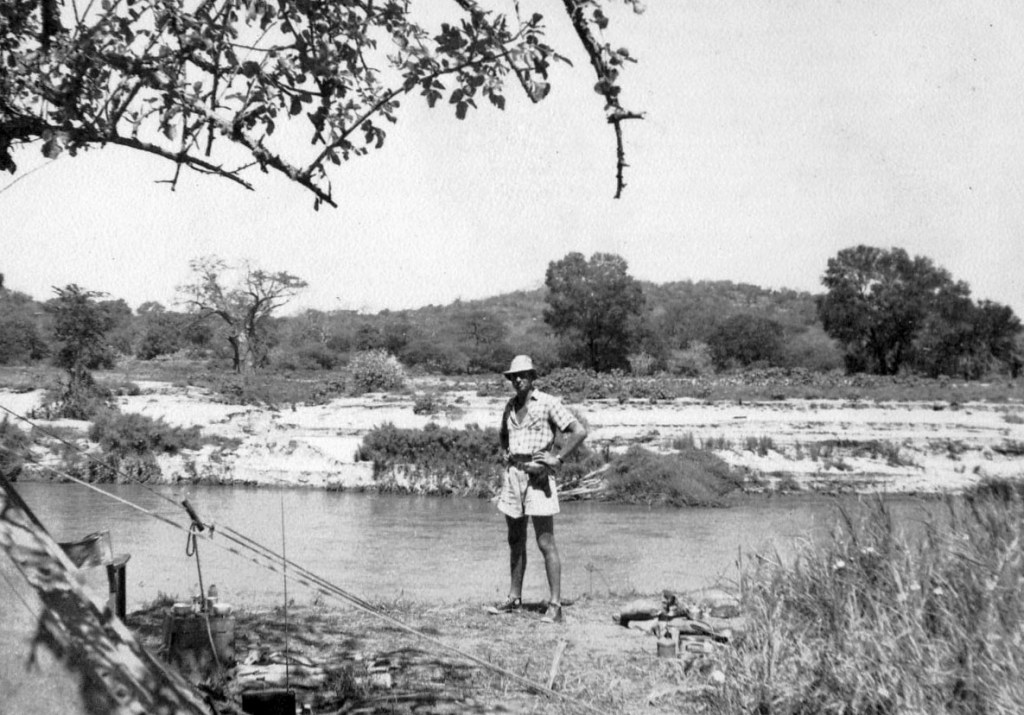
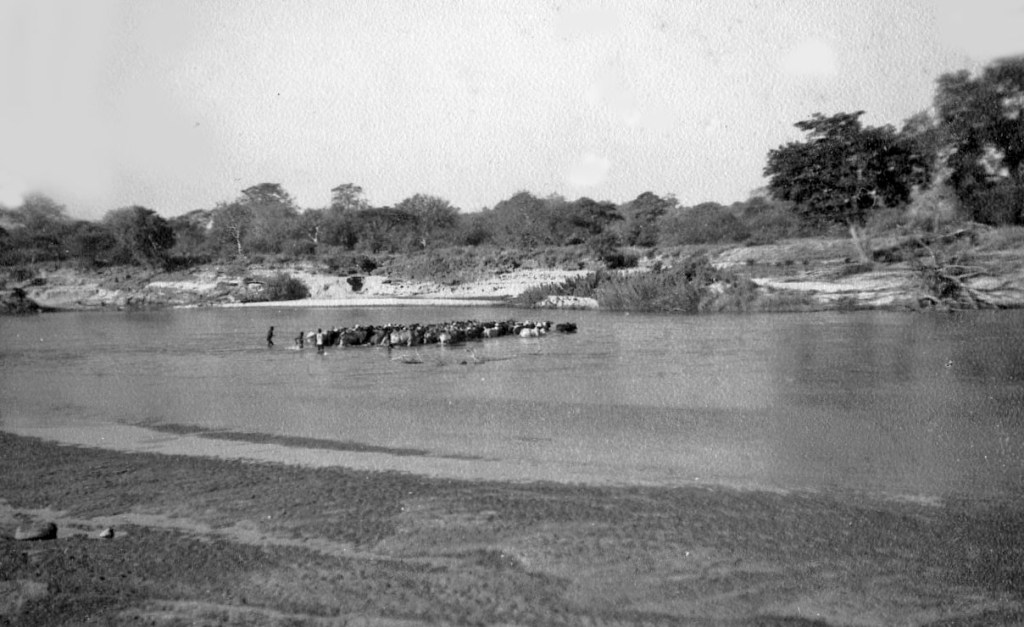
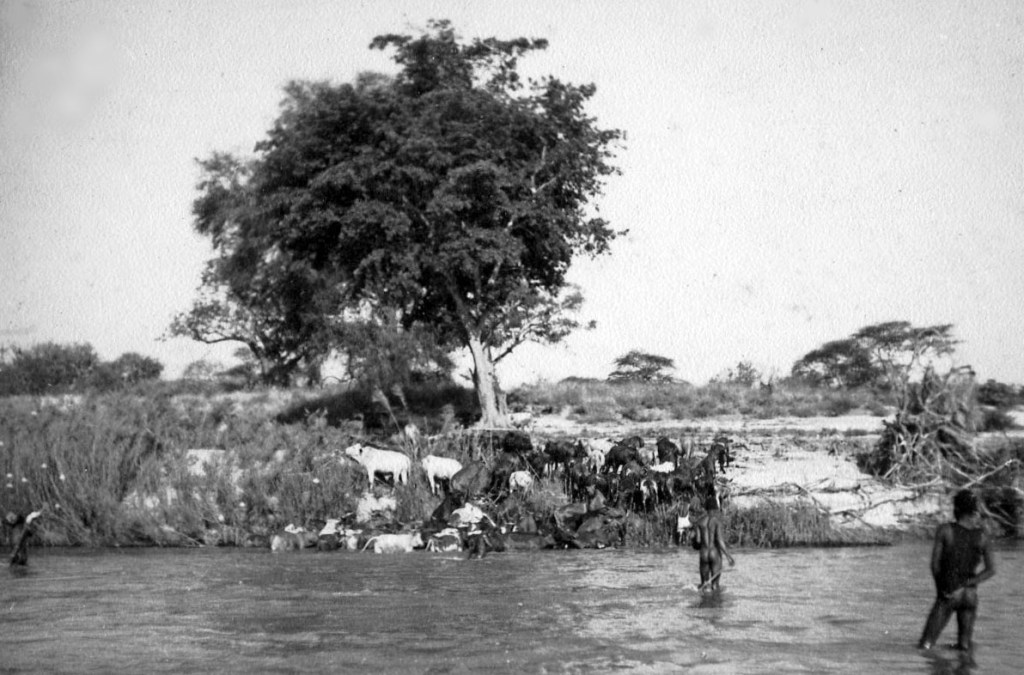
Down on the Athi River in 1961 From top left, Bob by the river near where his offsider James shot three hippo and then had to run for it; taking cattle across was always a risky business; James in the camp, just before his hippo hunting trip. Botom from left: When the drought broke and the rains came the river flooded and carried away the bridge; watering the cattle; an askari and his officer from Kitui questioning one of the squatters who mysteriously came to take up residence near the Athi Tiva camp.
Bob stayed for a year, living under canvas, happy in his comparative solitude and well-aware that he was undergoing a rare Boy’s Own adventure. Eventually, after the rains had come and gone and the grass grew quickly again on the plains, under the hot African sun, he and others took the cattle back to their home farms, with remarkably few losses considering the long period of privation and danger. Another long and difficult trek, another rail journey. And the acclaim of those whose livelihoods had been saved.
Bob Lake, my husband, lived to be 85. He had many adventures, both in Africa and in Australia where we eventually migrated and where we lived in some of the country’s toughest cattle country. Yet he always considered the Athi Tiva expedition the greatest adventure of his life and it’s a good job he wrote it all down because otherwise I wouldn’t be able to share it with you now.
The world boasts many great train journeys. The Orient Express, the Trans-Siberian, the Rocky Mountaineer, South Africa’s Blue Train, Australia’s Ghan or Indian Pacific. I contend, however, that there have been few train journeys to rival the overnight trip between Mombasa and Nairobi in the years before 1963.
I’m going to try now and recreate that journey in my memory and because I was a Mombasa girl, and because the beginning of a journey is usually more exciting than the way home, it is always the “up” journey I remember, from the coast to Nairobi. Up-country types will, of course, remember it the other way around.
Travelling by train back then was more than just a journey, it was an Occasion. People dressed for it, casual but smart. No jeans or shorts for women and men planning to eat in the dining car had to wear long trousers and a tie. There was only one passenger train a day and it left at 6pm. It’s possible some travellers arrived at the last minute and flung themselves into their carriage just in time, enjoying none of the gracious ceremony of departure. But these would have been few and far between because most of us liked to arrive at the small but immaculate station in good time and, having checked out our compartment and found a porter to load our luggage, repair to the bar-cafeteria for a tea, a beer or a cocktail. You could buy a very good small plate of potato chips for next-to-nothing, I remember, or sandwiches and other snacks.
Leaving on the train was a social affair and the more people who came to see you off the more fun it was. Sitting there on the raised dais of the cafeteria you could survey your fellow passengers. There would be bashful honeymoon couples shedding confetti, businessmen in formal garb with briefcases, sun-reddened holidaymakers heading back home to Nairobi or Nakuru or even Kampala, smart young women on shopping trips to the superior retail outlets of the capital, men in safari suits, Indians in turbans or dhotis or vivid saris, perhaps a priest or two in dog collar and cassock, or a family of soberly-dressed missionaries. It was all very noisy and chaotic as people yelled greetings to acquaintances or farewells to those who came to see them off, and porters dodged in and out trying to get all the luggage safely stowed before departure, and station staff made occasional announcements over the tannoy which could barely be heard above the general din.
And, behind it all, the slow, steady, deep chuffing of a great engine getting up a head of steam. You were hardly aware of it at first, until it began to build to its crescendo of imminent departure and your pulse began to throb with it, excitement building along with the steam. You began to withdraw, a little, from those who had come to see you off and make common cause instead with your fellow passengers who, like you, were now moving purposefully towards the train that huffed and puffed like a great animal anxious to be on its way. You felt a sense of importance – The One Who Was Travelling, who was going places – and a sense of pity for those poor domestic creatures being left behind. A flurry of kisses, a hug or two, many more handshakes (for most of us were, after all, British!) and the usual banal injunctions “not to miss the train”. As if you would! Though inevitably there were one or two folk 1`frantically running and gesticulating and grabbing at door handles when the rest of the passengers were already safely aboard and taking up their positions at the windows, waving and grinning. Unless, of course, they had nobody to see them off, in which case they quietly took possession of their seats and took out their books, immune to the emotions of parting.
Then – the guard would blow his whistle and the last door would slam and there would be some flag waving from the boiler plate up front and the guard’s puny toot would be obliterated in memory by the thrilling shriek of the engine’s great steam whistle and all the romance of train journeys everywhere – from Dodge City to Bhowani Junction to the Coronation Scot – came together in one glorious moment as the pistons began their steadily-increasing rhythm and the mighty engine left the station, its many dull red carriages with their eager travellers following obediently behind. Oh, those mighty steam engines of my childhood! No wonder people still love them today; enough to collect them or buy books about them or gaze at them in museums. To us, they were neither quaint nor remarkable; merely the way we travelled. Yet we were not immune to their charm and power – even as a young woman I enjoyed going to look at the engine before departure and others did, too, with awe. When I was about ten, and not travelling myself but seeing somebody off, my dearest wish was realised when the engine driver invited me (and a couple of other kids) into his cab and showed us the controls and let us pretend we were driving the train. Everything in that cabin gleamed and shone with brass and rich wood. If only my father had been an engine driver and not a government official who went, dressed in tropical whites, to his dull old office every day. I would have much preferred him with dirty hands and a smut on his nose and a huge, powerful steam engine under his command!
In my memories those engines were either green and black or entirely black. I’ve been told there were also red ones but I never saw them. They always gleamed, their paintwork and brasswork immaculate, the letters “EAR & H” born proudly. Sometimes it took two of them – one at the back as well – to get the carriages up the two main scarps between the coastal strip and the plains of the Athi; I don’t know why this was; perhaps it was when the number of carriages exceeded the norm. Mostly, though, when there was still light in the sky, you could lean out the window and see, on a curving line, the fine sight of the engine up ahead, smoke pouring from its funnel (and putting smuts into your eyes if you weren’t careful!), pulling its line of carriages with apparent ease.
In those days (and maybe today also) there were three classes of train travel. First class compartments had two berths and a spare, modern blue-grey décor with pull-down tables. Second class compartments had changed little in design since Victoria’s day and had four berths with green leather seating and lots of dark timber panelling. Whichever class you travelled, you did so in a propinquity quite alien to English people of the time, who under other circumstances would rarely speak to a stranger unless properly introduced, let alone dress and undress in a confined space and share the intimacies of sleep. In fact my husband once travelled in a second class compartment with three other men and none of them spoke a word until, next morning, one broke the ice by introducing himself.
My generation was much less formal and we would soon be chatting happily with whoever our co-travellers might be – some lasting friendships were formed on the overnight journey between Mombasa and Nairobi. In my day, only the distinctly better-off whites travelled first class. Most people – those of European origin and the wealthier middle-class Indians – travelled second. Only black Africans and the poorer sorts of Indians travelled third class and this was a very different affair. No compartments but open carriages with wooden seats where passengers stowed their baggage, goats, chickens and children and took along their own food. Third class was noisy and lively and probably great fun but few Europeans ever risked it. One who did was my grandmother, always a bit eccentric and very curious. Just why she did so I never knew, being very young at the time. But she often talked about it. She got on the train at Ulu station at about seven at night and sat there with all the tribespeople and livestock, sleepless on the hard and upright seats, until the train arrived in Mombasa at six the next morning. Apparently she was made very welcome; women shared their mealies and cold posho with her; she shared her sandwiches and fruit and biscuits with them. She’d thought to take several packets of polo mints with her and these, no doubt, proved very popular. She never drank coffee and didn’t care all that much for tea so I don’t know what she drank – probably water infused with Andrew’s Liver Salts, which she took daily. Most of those in her carriage were Wakamba and as this was the tribe among which she lived, and was most fond, I expect they all got on very well together. Those who travelled third class tended, as much as possible, to congregate in tribal groups though all seemed to get on well together, whatever their tribe, and the close carriages would be filled with the sound of Swahili as well as a dozen tribal languages. Men sat with men and women with other women, and children. This applied to both Africans and Indians, and the latter, in any case, sat usually in their own carriages – there was no official segregation but unofficially the two races did not mix. I can just imagine the smells – Africans rarely bathed in those days, as we would understand bathing, and had no deodorants. And there were, in any case, no bathing facilities on the train. The lavatories were pretty foul, too. Goodness knows how my ultra-fastidious grandmother managed – but she always spoke of the whole journey as a great adventure (though her doing so odd a thing infuriated my staid parents!).
Back in first and second class, life was both more ordered and less lively. At first, you could look out the window as the train climbed the steep grade from the coastal plain, as it was described in my book A Garden in Africa: “through hills of red earth planted with coconut palms and banana trees, African children waving, chickens running among the mud-walled houses, women of the coastal tribes in their bright cotton kangas or short skirts of fibre strips, naked from the waist up”. By the time the first station was reached, at Mazeras, it was already dusk – that brief equatorial blink between blazing daylight and the cool of night. I cannot be sure after all these years but the first sitting for dinner was called about this time. Those travelling with children would answer this call, and others wishing to get fed and to bed as early as possible. Some took along their own meal of sandwiches and fruit and cake.
Most, however, opted for the later sitting at about 8.30 and I remember regarding this as a significant right of passage the first time I travelled on the train as an adult. When the second dinner gong was sounded by African train staff immaculate in their starched EAR & H uniforms we would hurry down the swaying, rocking corridors from carriage to carriage until we reached the dining car. People dressed for the second sitting – men in ties and light jackets, women in frocks with high heels and well-coiffed hair. And making your way down those narrow passageways in three inch heels involved quite a balancing act, let me tell you! The dining car harked back to earlier and even more gracious times – all white linen and gleaming silver and each four-seater table with its cosy little red lamp. Attentive staff brought the beautifully-presented menus and though the food was plain and very English it was well-cooked and with all the advantages of a country generous in fish and seafood and fresh tropical fruits. How the chefs managed to produce such meals in the tiny galley was a matter of wonder. Outside, the night was speeding by and wild things were seeking their own sustenance. But there, inside that softly-lit carriage, with its cheerful chatter and chinking glasses, you could have been in any civilised restaurant in any civilised city in the world.
That, to me, is one of the enduring fascinations of train travel. Ships take us over the ocean, an element of which we can never truly be a part. Planes take us up so high that we no longer feel connected with the earth. A train, however, remains earthbound and the everyday world of earth and trees and houses is still visible and only inches away as we move through that stationary landscape in our own time and space, untouchable and unreachable by what’s outside and snug within our own frame of reference. No wonder Einstein used a train to illustrate his Theory of Relativity. And that is what it was like, in my memory, back on the Mombasa-Nairobi train in the nineteen-fifties and sixties. After dinner we tended to turn in early for by this time the train staff had been round to make up the bunks and there was nothing to do except chat to your fellow passengers or do a crossword puzzle. Some people passed the time with cards and I know one regular train traveller from those days who always carried a couple of packs with him and says he made some good friends over those late night card games. The fact remains, though, that in a second class compartment with four people of, usually, different ages and habits and inclinations, it was better to climb into your bunk and read yourself quietly to sleep. Some people find it hard to sleep on a train that judders and rattles but I always find it soothing. Today, it’s true, I’d find it impossible to sleep in a confined space with four other people, probably strangers if you were travelling alone, with all the snoring and snuffling and coughing and clambering up and down the ladder from the top bunk to get to the loo at the end of the corridor. Back then, though, a veteran of the school trains, I found all that rocking, rolling and riding very conducive to deep slumber. And as you snuggled down in your narrow bunk, in your crisp white EAR & H linen, outside was all the vast red thorny wilderness of the nyika that lies between the coastal scarp and the high plains country around Nairobi – a wilderness in those days little inhabited by humans but rich in species such as elephant, rhino, lion and cheetah.
Oh, to go to sleep with all of Africa around you. And then to wake to chill air and the vast plains of the Athi, alive with herds of zebra, wildebeest, kongoni, and antelope of all kinds. Ostriches would seem to race the train, their great legs mimicking the pistons. Tommies would skitter away, tails wagging. Warthog families would trot busily over the dusty ground, sometimes with several little piglets in a well-behaved line. How many of the world’s great train journeys could offer a Movietone panorama such as that? In the small compartments we would modestly try to dress ourselves without inconveniencing our fellow-travellers- or baring too much flesh. Early-risers would lay claim to the loos while others queued up outside. Overnight baggage and handbags would be gathered, goodbyes would be said, people would start to hang out of the windows as the train steamed through the dull outlying area around Embakasi before making its final huffing run into Nairobi station. Greatest of all the beasts in Africa, the mighty locomotive of the EAR & H had brought its consignment of passengers and mail safely through almost 330 (530 km)or so miles of night and trackless bush, scaling almost 6000 feet (1700m).
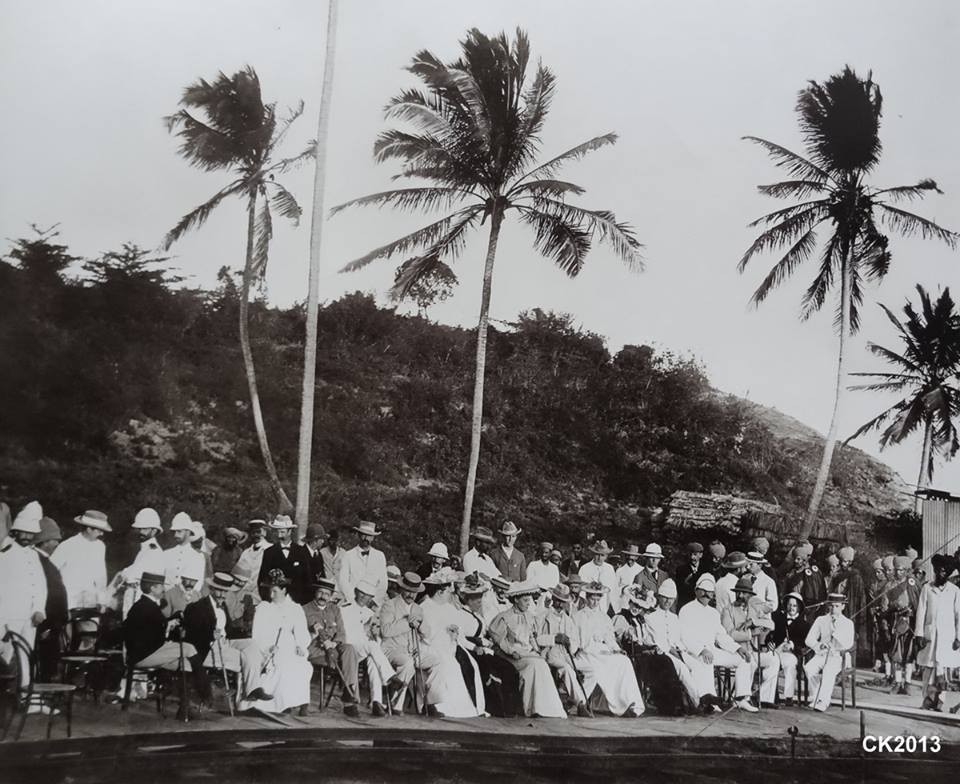
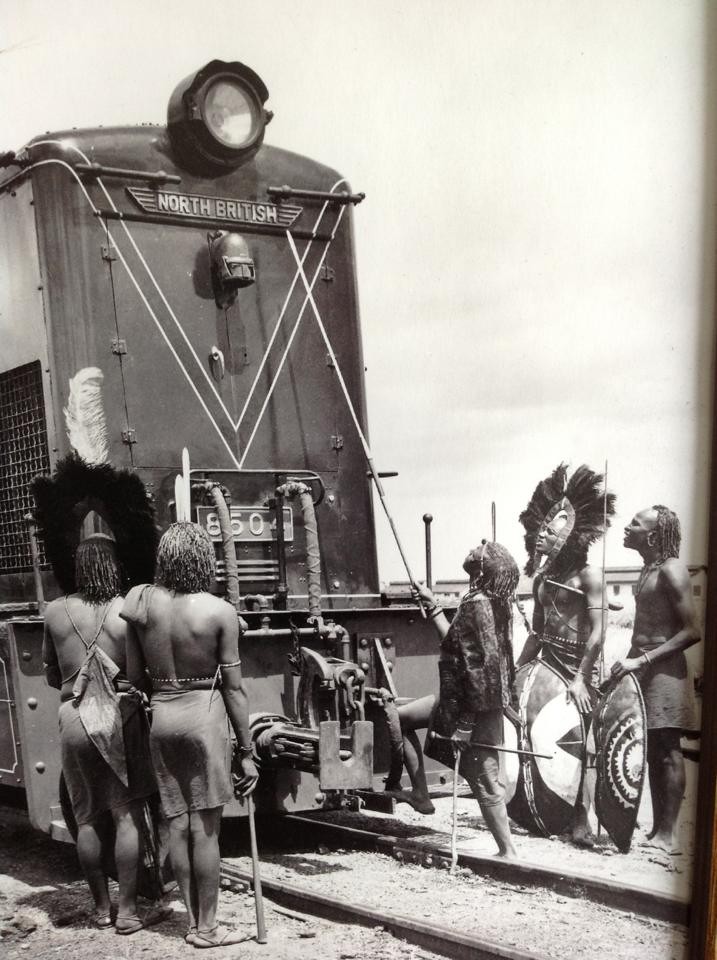
The railway was pivotal in the development of colonial Kenya, linking the coast with the inland and carrying early settlers from Europe to take up their farmsteads (though the doughtier Boers came up from South Africa by wagon!). In the centre, the opening of the Mombasa railway station, at left, the carriage from which Inspector Ryall was dragged to his death by a man-eating lion and right, tribal society gets a first taste of technological change to come.
To school and back
Travelling on the school train offered a slightly different experience. We high school girls would arrive at the station in full uniform (grey flannel skirt, white blouse, red and black tie, grey felt hat – blazer over the arm) despite the Mombasa heat with our hockey sticks and tennis rackets and big tin trunks, rushing about excitedly to greet friends while our parents retreated thankfully to the bar. I have some faint memory of boys and girls travelling back to boarding school on the same train, at some earlier time, but by my time at boarding school (1958 – 1961) we travelled on different days. Not hard to guess why! It’s interesting to reflect on how self-focussed are the young because for the life of me I can’t remember anyone else travelling on those trains except our lot. Presumably there were other passengers on those school trains but I have no recollection of them, nor of girls travelling to any of the other up-country boarding schools – Limuru, for example, or Loreto Msongari. All I can see in my mind’s eye are the grey-clad KGHS lot milling about in a crowd large enough to eclipse all over travellers – shrill little thirteen year-olds going up for the first time; dignified sixth formers in their distinctive blue ties; a couple of harassed-looking teachers trying to herd us all together.
The journeys “up” were tinged with sorrow and trepidation – at least for those of us who didn’t like boarding school. Another term looming: of compulsory games and sarcastic prefects; of stodgy food and conduct marks; of Sunday church and a life ruled by electric bells. Coming home on the “down” train, though, was a different matter. How happy we would be as the train puffed its way out of Nairobi station, past the carriage where the man-eating lion had snatched the unfortunate police inspector Ryall years before, and southward across the Athi plains as night began to fall. Schoolchildren travelled second class and didn’t eat in the dining car – instead we were supplied with sandwiches and fruit by the school, and a large bottle of cordial each to drink. Of course, we’d already had a cooked lunch and were, I think, quite happy to sit in our compartments munching our sandwiches and knowing that our next meal would be in Mombasa…at home!
Those long nights on the school train were filled with happy chatter as we gossiped about our friends and enemies, shared secrets about boys we admired, or whom we fervently hoped admired us, made plans for the holidays that seemed to stretch endlessly ahead even though we only got four weeks at Christmas, two at Easter and two in August (or was it July?). To us coast girls the holidays were all about the beach – those long, white, empty, palm-lined beaches divided only by the dark lines of native fish traps and the occasional headland, beyond them and the aqua sea with its protective line of offshore reef. How we longed to be back on our dear little island with its baobabs and scarlet poincianas and glorious architectural fusion of the Arabic and the Portuguese. Sailing at the Yacht Club, dancing at the Sports Club or Railway Club, lounging happily over a Coke at the Nyali lido, waterskiing on Tudor Creek, eating samosa and playing the jukebox at the Cosy Café, listening to the latest hit singles at Shankardass where the patient owner put up with us crowding into his listening booth even though we rarely had the money to buy anything.
And, once we were old enough, there would be boyfriends waiting to meet us in town, or at the pictures, or cycling with us over the bridge to Nyali, or across the ferry to the south coast beaches. It was a wonderful time, and a wonderful place, to be a teenager on holiday. Though of course, nothing is quite THAT wonderful and I have to think hard, now, and honestly, to remind myself that being young had its share of anguish. Spots that erupted overnight. Parents who wouldn’t let you stay out late. The boys whom you desperately wanted to date and who wouldn’t look at you. Boys with whom you wouldn’t be seen dead who kept asking you out. Quarrels with your best friend. Jealousy of girls prettier than you. Frustration that your mother wouldn’t let you have a new dress for the teenage dance, or let you wear lipstick, or pierce your ears. Worry about what your father would say when he saw the latest term’s school report. No, being a teenager wasn’t always perfect bliss but on the school train, going home, with all those glorious days of comparative freedom ahead, it certainly seemed that way.
At that age we pretty much took for granted the great wonder of Africa that lay beyond the train windows. Elvis or Cliff or Buddy were of much greater interest to us than wild animals and those of us with transistor radios were very popular in the small four-berth compartments, where we might be lucky enough to pick up Forces Overseas Broadcasting, which played the best pop music. Sometimes, though, Africa forced itself upon us. There was the time, for example, when the line was so slippery with the bodies of millions of army worms that the train had to halt while workers cleaned the tracks. Elephant sometimes crossed the line, necessitating another slowdown. And once we hit a rhino, somewhere around Tsavo, in the middle of the night. There was a thud that travelled down the length of the carriages and the great engine juddered to a halt. You can imagine the pandemonium with a great mob of teenage girls in their nightdresses and pyjamas, having been suddenly awoken, hanging out of the windows to see what was going on and, despite the furious exhortations of the two teachers, actually getting down on to the ground by the side of the track. Hysteria prevailed – we’d hit another train, the tracks had buckled, a Maasai herdsman had been crossing the line with his cattle (at that hour!). Then word was passed back that it was a rhino. Of course we all longed to see, and crowded to the front of the train, but could see nothing in the darkness beyond the steaming bulk of the engine. We waited for what seemed like hours though it was probably only an hour before a truck arrived, with men and ropes, and after a lot of that typical African argy-barging and fitina the poor beast – quite dead – was dragged off to one side. The engine (one supposes) was inspected and found fit to travel and we got up steam again and continued the journey, we girls hanging out of the window to stare at the remains of the poor, foolish rhinoceros. Some said it had probably charged the engine, rhinos being notoriously cantankerous and always ready to take on creatures bigger than themselves. Though this was obviously nonsense, we liked to believe it.
In my memory we rarely slept on the school train, though of course we must have done. Mostly, I remember lying awake and chatting in the darkness, then getting up and peering out every time we stopped at one of those little lonely stations along the line where mysterious goods were noisily loaded and unloaded and young tribal boys would run alongside trying to sell ostrich eggs and bananas to the newly-awakened passengers. One night I remember in particular for I was sitting curled up on my lower bunk, by the window, and noticed a falling star, and then another, and another. A meteorite shower of some extent, because it went on intermittently through the night. It was 1960 and a time of turmoil – some religious group had forecast the end of the world, there had been a great earthquake in Chile and not long after that the newly-independent Belgian Congo had erupted into civil bloodshed that sent thousands of white refugees across the border. Which was, in fact, the reasons we Boma girls were on that train because the school had been opened to house the refugees and we were all being sent home early – and in a heightened state of excitement. So, being fifteen and credulous at the time, I saw those scattering “stars” as a sinister omen and was both frightened and awed. Perhaps the end of the world really WAS at hand! I have seen meteorite showers since, and Halley’s Comet, but nothing so spectacular as what I saw out of my train window that long ago night, in the clear skies over Africa.
When we awoke in the morning –IF we slept – it was to the languorous warmth of the coast and a series of fiercely competed-for “firsts” – the first palm tree, the first glimpse of the sea. Down we went through the green and terraced hillsides of Mazeras and Mariakani, waving enthusiastically at the Watoto carrying bananas and the women cutting maize. Down, down, down to the flatness of the coastal strip and the water everywhere. Across the causeway, where in the distance the dockside cranes of Kilindini Harbour stood like giant giraffes. It was our custom to throw our emptied drink bottles from the window and over the causeway into the creek below. That muddy creek bed must be lined with glass fragments to this day, to mystify future archaeologists. This practice was forbidden but we did it anyway! Term after term, year after year. It was part of the ritual of coming home.
Once we had crossed the causeway the train slowed right down and seemed to take an interminable…an unreasonable…an unbearable time to meander through the sheds and godowns around Changamwe. Until…at last…oh longed-for at last!…we would round the bend among all the shunting yards and myriad tracks and huff our way into the station. There, waiting for us, would be parents, smiling and waving. Even my bothersome little bro was a welcome sight. EVERYTHING was a welcome sight…the palm trees, the distinctive clothing of the coastal tribes, the splendid tusks on Kilindini Road under which we passed, the servants welcoming us home with a bountiful breakfast, the beloved baobab tree in the garden, the gleaming blue ocean, the feeling of holiday and above all the heartfelt happiness that is HOME!
That’s where I’d like to end my story but it does have a slight, sad sequel. Some years after I’d left Kenya I returned there with my husband and, for old time’s sake and ignoring the warning of friends still living there, we decided to travel down to the coast by train. We so looked forward to this experience and were as excited about it as children when we left Nairobi Station. Alas, even in a short time, things had changed for the worse. Our First Class compartment was not very clean and nor was the bedding – the crisp, white sheets and coarse but sweet-smelling EAR & H blankets of yesteryear were no more. The dining car looked much the same, albeit shabbier and the silverware tarnished, but of course the clientele had changed. Instead of smiling at each other intimately across a red lamp-shaded table as the African night rushed past we found ourselves facing two very large, very fat, very cheerful Luo police inspectors with rather awful table manners. They couldn’t have been more friendly and we chatted away quite happily – about our new home, about our recent travels, about the changes that had come to Kenya – but it wasn’t what we’d imagined our journey would be. And the food – some grey and indeterminate stew – was even worse than boarding school grub.
It was a lesson that has stayed with me ever since – for it can be a mistake to go back. Kenya, more than most places, exerts a magic so powerful that our nostalgia haunts us even half a century or more after we’ve left. Ex-Kenyans gather wherever they can, even when very old, to remind each other of how it was, back then. What we are inclined to forget is that our longing is for another time, as well as another place. It’s possible to go back to the place, and even try to put a positive spin on changes that, in our hearts (and eyes) offend us. But we can never recapture that special time not only of youth – everyone has that – but of rare privilege. The privilege of being such as we were, in such a place, at such a time – and all the rarer because it can never be quite that way again.
And so, in my memory and that of many others now approaching the twilight of their lives, the dear old train puffs forever on through the African night.
Of course all rainforest trees bear flowers. Many of them are too large for the home garden but some are just the right size and will reward you with beautiful flowers in season. It may take some years – up to seven – for the trees to bear their first flowers and fruit – but they are worth waiting for!
(NOTE: The trees on this page are well suited to growing in the warmer parts of the United States and other parts of the world where there is no ice, snow or heavy frost. If you need further advice, just email me or use the comments section below).
Beach Acronychia, Logan Apple (Acronychia imperforata)
This is a nice little bush tucker tree, growing to about 15 metres, very common in coastal areas north from Port Stephens in New South Wales.
Vital statistics
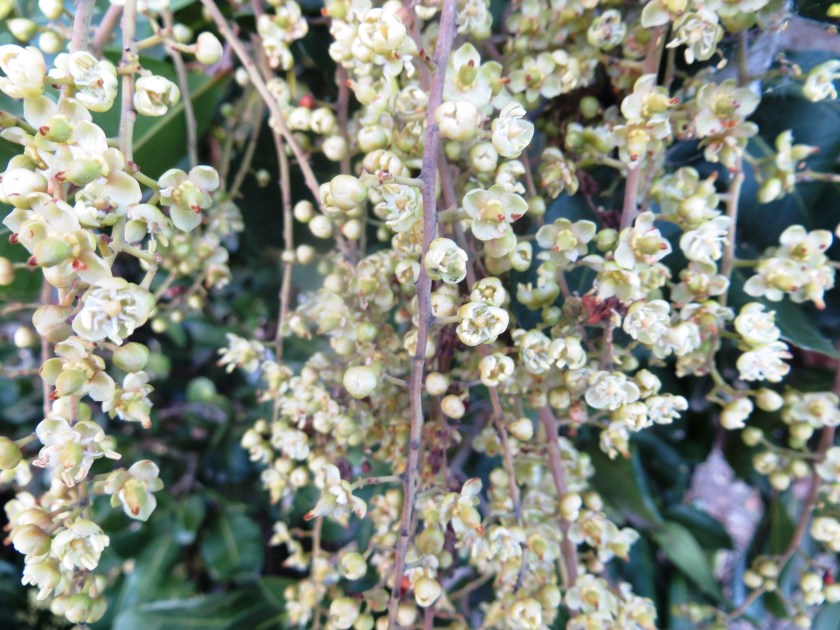
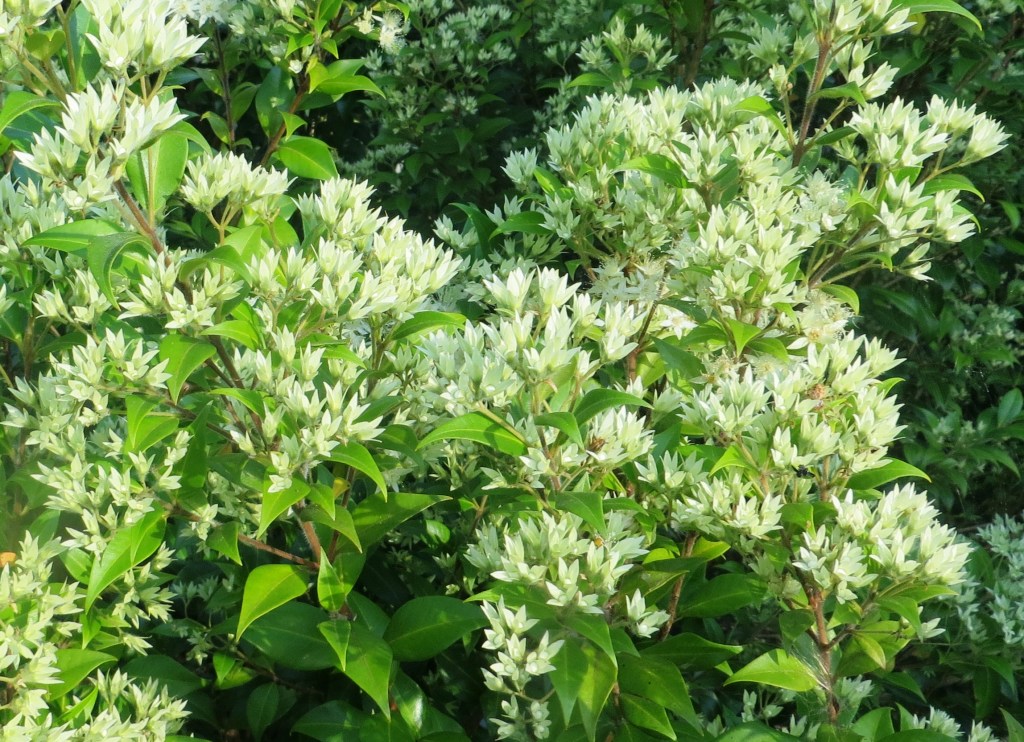
Flowers are a bit like apple blossom, born in creamy-white clusters throughout summer to the end of April, four-petalled and very attractive to bees and butterflies.
Leaves are simple, opposite and 1-foliate (bump/joint at the bottom where leaf joins petiole); stiff, very bright green, elliptic to ovate, up to about 12 cm long with a notch at the end.
Fruit is a pale yellow drupe, rounded to slightly pear-shaped. Tart but edible and very good for making jam and chutney, or cooked with sugar into a syrupy dressing over ice cream.
Bark is distinctive; smooth but with fine vertical cracks.
In the garden
This is a tough customer! It will grow almost anywhere but does best near the coast with sandy soils, tolerating long, dry periods as well as sea winds and salt spray. An excellent screening plant.
No need to fertilise, nor water once established. Prune lightly for good shape and desired height.
The similar North Queensland tree/shrub Acronychia acidula (Lemon Aspen) has creamy white, round, usually slightly ribbed fruit which is even tastier than A. imperforata.
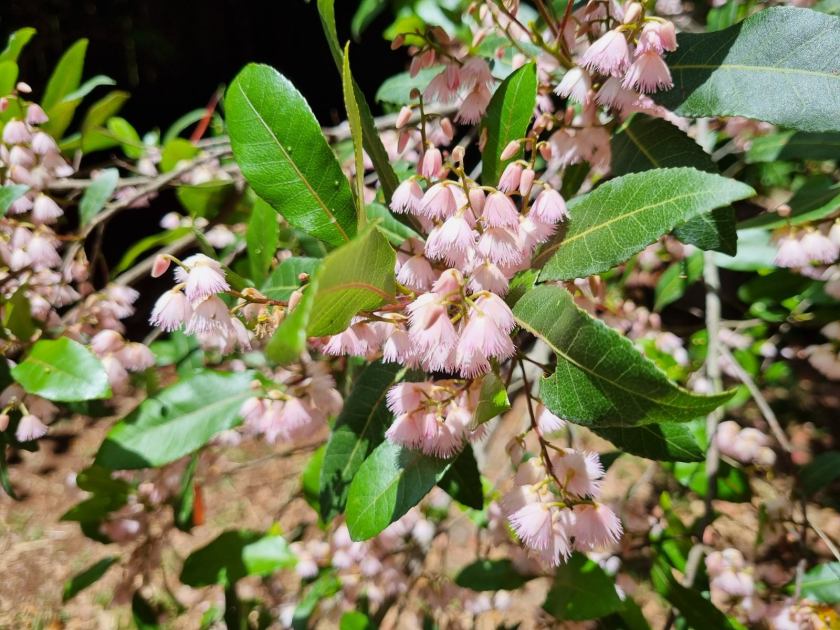
Blueberry Ash – (Eleocarpus reticulatus)
Vital statistics
Flowers: Small, pink or white and fringed, like delicate little lampshades or ballerina skirts. The variety sold as “Prima Donna” in garden centres has pink flowers.
Leaves: Oblong or obovate, elliptical, up to about 12 cm long with strongly marked lateral veins. Domatia form small, reddish pockets in the vein angles, tough. 1-foliate, though the swollen joint where it joins the stem may not be prominent. As with all Eleocarpus the leaves turn an attractive red when they fall.
Fruit: An oval drupe, small, a bright blue that attracts birds.
In the garden
This plant occurs naturally in most types of rainforest and also adjoining wet sclerophyll (eucalypt) forest so will tolerate most conditions including light frost when established. Quite easy to propagate from seed.
Give it plenty of space from other trees/shrubs and once it gets to a couple of metres high start pruning the tips so it develops a good growth habit. This tree or large shrub grows very tall and straggly, like most rainforest species, if it is allowed to grow untrimmed or is planted too close to other trees. This may inhibit flowering when young but once it has reached maturity it will reward you with a spectacular burst of colour every spring.
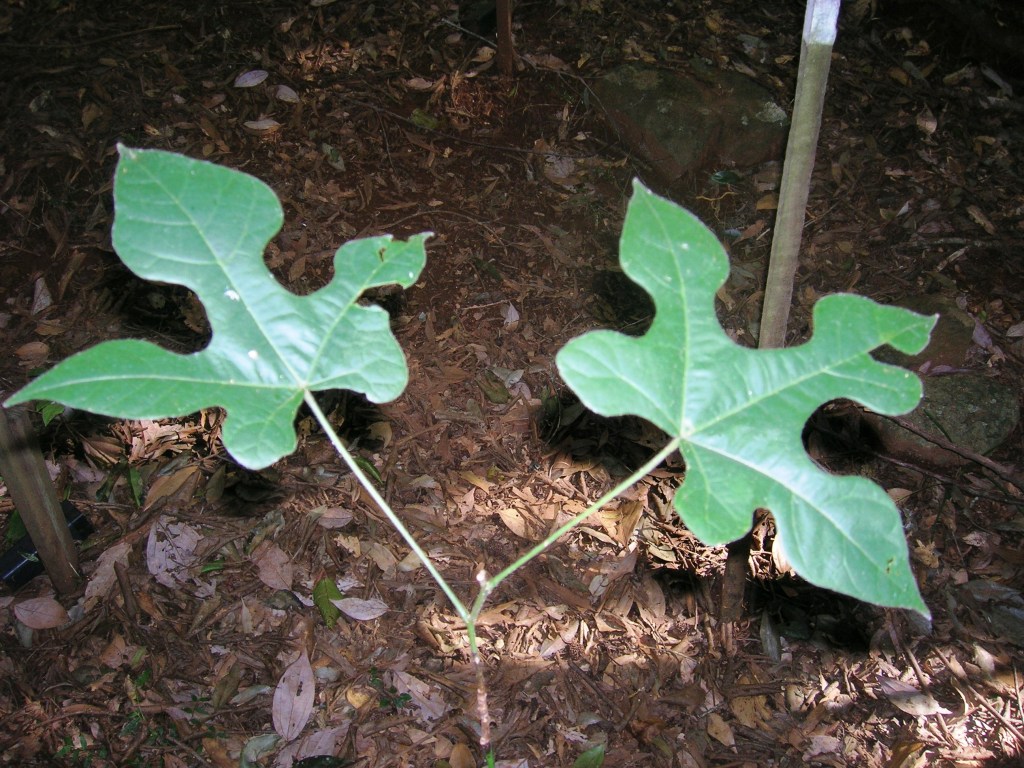
FLAME TREE (Brachychiton acerifolius)
A familiar tree to Australians everywhere because it is one of the few of our rainforest trees to really make it big in the cultivated landscape. The name “Flame Tree” is also used for the African Tulip Tree (now a week in Queensland) but the only thing the two species have in common is red flowers. In winter to early spring this gorgeous tree warms and brightens our streets and gardens wherever it’s planted, while in the tropical and subtropical forest it stands out like…well…a flame among all the greenness of the canopy.
Vital statistics:
The large, simple, alternate leaves, margins lobed or entire are borne on long stems (petioles). They are shed in winter. Flowers can vary from vivid scarlet to a deeper red and are very showy,each one a little five-petalled bell borne in clusters. The seed pods are shaped like boats and can be used in floral decoraion. The yelowish seeds are edible. The bark is distinctive; smooth and lightish green with fawn-coloured roughish horizontal lesions and blotches.
In the garden
This tree is too large for most home gardens though it takes a long time to reach maturity and tends not to grow taller than about 20 metres when in full sun. Pruning when young will keep it under control and promote denser branch growth. It grows almost everywhere except snowy and very arid areas. Propagation is easy from seed or cutting and in warmer areas young plants often seed themselves and pop up in the landscape.
Lacebark is another rainforest species of Brachychiton and though not common in cultivation it is a better size for the home garden. The flowers are a velvety pink and very pretty. This tree needs plenty of careful pruning when young to stop it becoming straggly; if managed in this way it makes a delicious garden specimen. It tolerates up to three months without water, once established.
Oh what a delight this tree is when it reaches the age of full flowering, usually at about six years old. And every year after that it gets bigger and better – a shower of gold and creamy white cascading down from the top every spring.
Vital statistics
Small tree or large shrub that grows northwards from the Blue Mountain forests, in rainforest and close by open forest. Leaves are bright green, growing in whorls around the branchlet, obovate to a sharpish point, veins strongly marked, to about 16 cm in length. Fruit is a capsule containing brown two-winged seeds.
In the garden:
Very easy to propagate from seed. Tolerates all soils. Likes plenty of water when young. Does best in areas with good rainfall but can survive short droughts, up to 3 – 4 months. Young plants susceptible to frost.
This is a good tree for all but the smallest gardens but if space is limited keep to about three metres with trimming. Regular pinching out of new growth when young will form a neat, rounded shape.
This tree was pruned when young to make it bushy.
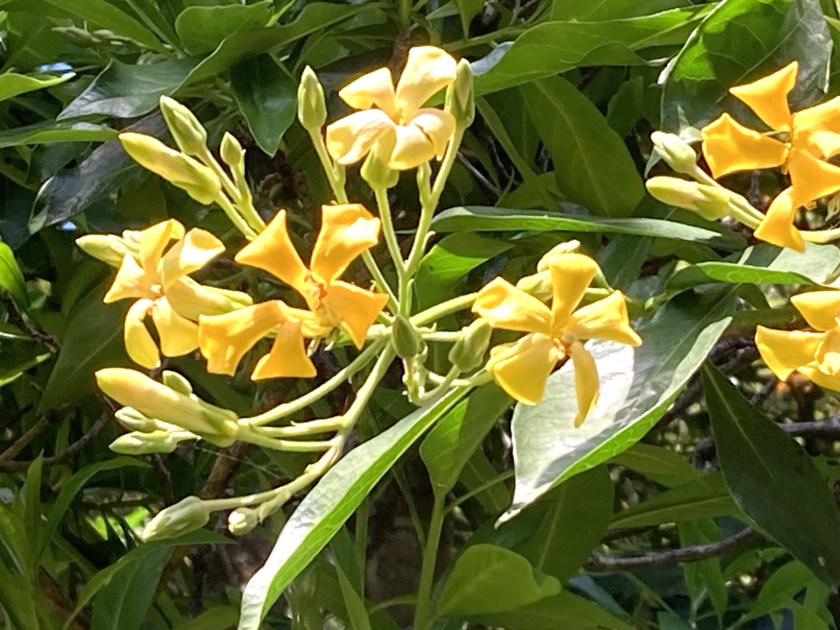
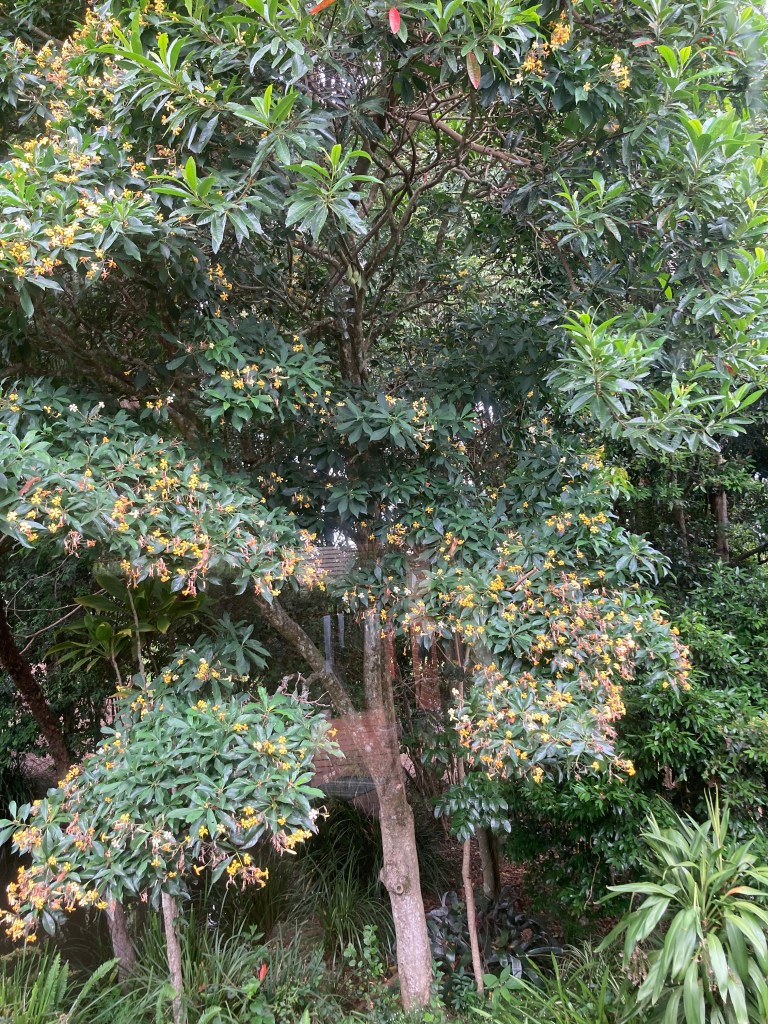
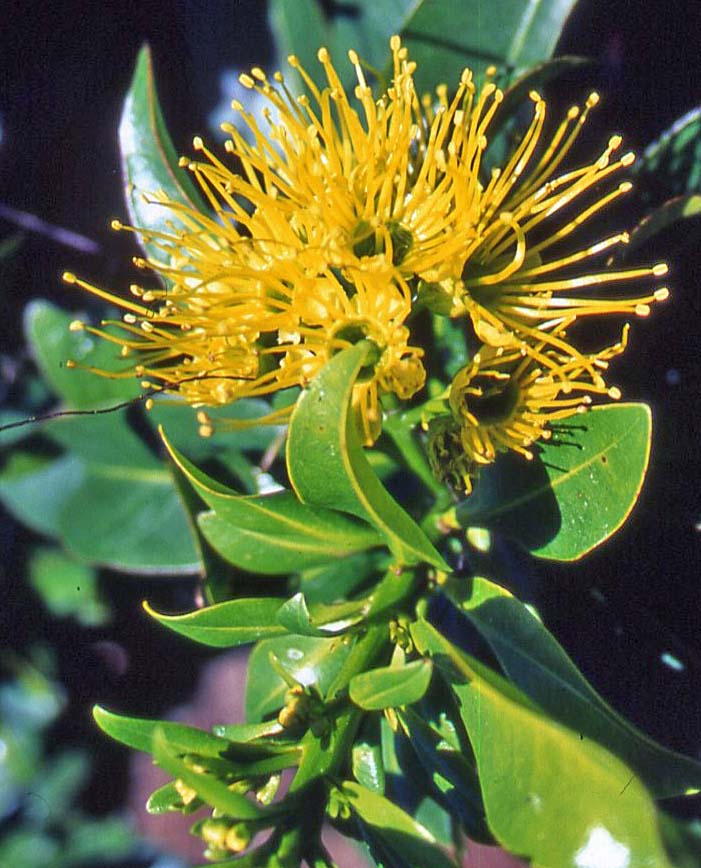
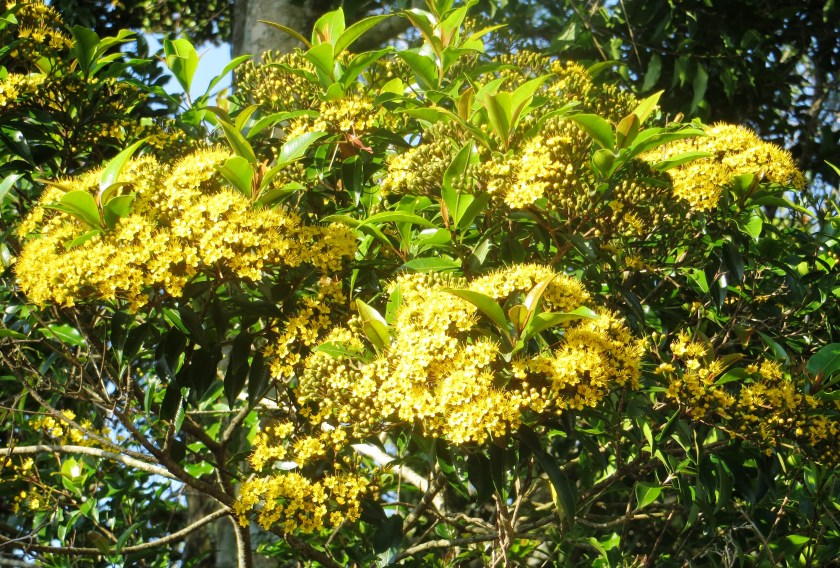
GOLDEN PENDA(Xanthostemon chrysanthus)
This golden treasure of a garden tree is well named – gold in colour, gold in overall size and appearance, gold in trouble-free growing. What’s not to like about this lovely North Queensland tree that grows anywhere that’s frost free and has good rainfall – or at least plenty of available water in dry seasons.
Vital statistics
Leaves are simple, alternate or whorled, long (to about 20 cm), thick and leathery, usually eliptic with a blunt point and yellowish mid-vein. Flowers are born prolifically in panicles of golden petals containing many long bright yellow stamens. Flowers may appear at any time but are most spectacular in summer to autumn. When the tree is not in flower it still looks good, with a naturally tidy habit and bright green leaves
In the garden
Very easy to grow in most conditions but does best with a reasonably loamy soil. It doesn’t need fertilising, just regular mulching with leaf litter or sugar cane. It makes a spectacular single specimen in full sun or light shade but like most rainforest plants it grows faster when it has a few companions around such as low growing shrubs. If you border it with annuals or other plants that require fertilising, be careful, because this is another plant in the Proteaceae family that can’t take too much high-phosphorus fertiliser. It’s best to give your flowering annuals light sprays of liquid formulation that doesn’t seep to deep into the surrounding soil.
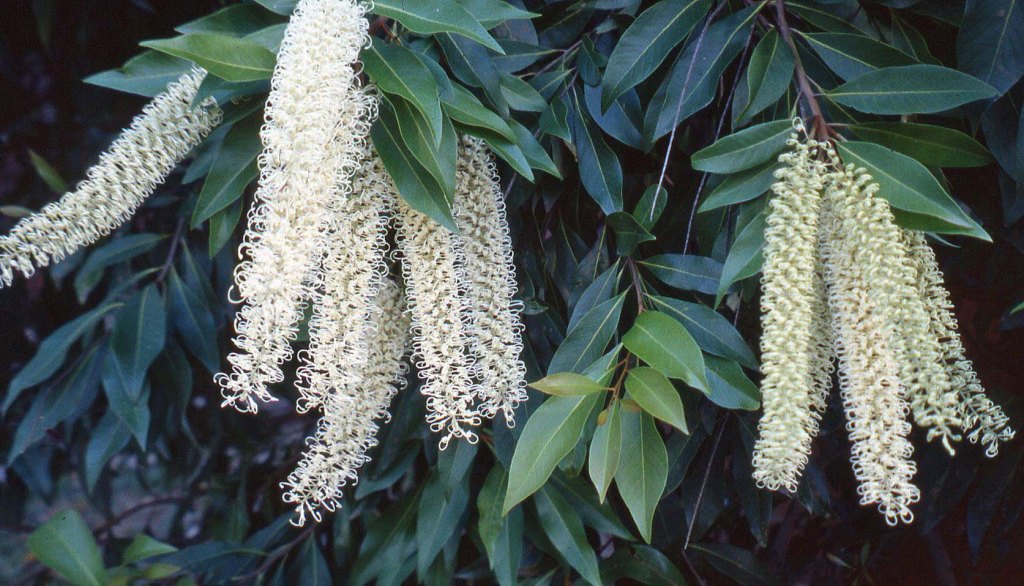
IVORY CURL (Buckinghamia celsissima)
This north Queensland rainforest beauty can be grown as either a tree or a shrub. In the forest it stretch to 30 metres but when it is grown as a single specimen out in the open where it doesn’t have to compete with other trees the Ivory Curl will multi-stem and grow to the height of a tall shrub or tree to about eight metres. It’s a very popular street tree in Queensland and northern New South Wales but is also comfortable in Melbourne gardens.
Vital statisics
Leaves are long (to 20 cm), simple, young plants with lobes but margins entire in mature plants with a strongly marked mid-vein. Flowers are typical of the Proteaceae; creamy white, in pendant clusters, each long raceme made up of tiny flowers. These appear for a long time during autumn-winter and the tree can be so thickly covered that from a distance it looks like snow! Seed pods are green and clustered along the stem after the flowers have gone, turning first a greyish-buff colour and then a dull black. They have a little tendril-like appendage at the tip and are very attractive when dried.
In the garden
Ivory Curl will tolerate the worst clay and rocky soils though growth is faster in richer, loamier ground. There is no need to feed when young but if you wish to give your seedling a boost, make sure to use a native plant formula because plants in the family Proteaceae are sensitive to phosphorus overdose, having evolved on soils deficient in this nutrient. Water regularly when young; as the plant matures it can tolerate long periods without rain. Prune for a neat, rounded shape.
This really is one of the best and toughest and prettiest small trees for the home garden. Plant them in a row and you’ve got a spectacular hedge.
Lemon Myrtle (Backhousia citriodora)
This is a MUST for any home garden. It’s a small tree that can be encouraged to multi-stem and remain at shrub height, the flowers are pretty and bright green leaves are lemon-scented and flavoured – in my opinion it’s the best source of lemon flavour to use in cooking apart from lemons themselves. A lot more palatable than, for example, lemon grass.
If I could choose only one rainforest tree/shrub for my garden, this would be it!
Vital statsitics
Leaves are simple, opposite, light green, narrowly elliptic to a drawn-out point, margins can be lightly toothed, oil dots typical of rainforest plant leaves in the Myrtaceae family (myrtles) and give out a strong lemony smell when crushed. Flowers are creamy white and fluffy. The fruit has a flower-like appearance because of the five sepals arranged around the central capsule.
In the garden
Lemon myrtle is a tough performer in all climates except the coldest and driest. It tolerates any soil but grows faster and with brighter, lusher foliage in moderately deep, loamy soils. Water regularly when young, mulch with sugar cane or any vegetative matter at least once a year in spring, feed with any general tree/shrub fertiliser. Prune early and regularly to limit height and encourage bushiness.
This is a hard plant to propagate from seed; cuttings will take but very slowly. Leaves can be harvested for cooking when needed, or dried and kept bagged. Both fresh and dry leaves make a fragrant tea.
In the home
Lemon myrtle leaves can be used in the kitchen whenever you want a lemon flavour. The leaves are especially useful in infusing dishes made with either milk or cream as they don’t cause curdling. They can also be used in pickles and chutneys.
And there is one more thing about this marvellous plant – the essential oils in the leaves have disinfectant and biocidal properties. When distilled they are used a great deal in homeopathic medicine and also in mainstream products for treatment of minor skin problems and household cleaning. Using the leaves as an infusion in hot water MAY help with intestinal parasites and maintain good health in the digestive and urinary tract. There is no hard scientific evidence of this but it won’t do you any harm! I have a friend who for years has drunk infusions of leaves (fresh and dried) three times a day for years and claims she owes her excellent health and digestion to this. I often drink lemon myrtle “tea”, from my own tree, and chill infusions to make a lightly-flavoured, slightly astringent lemonade, with whole leaves and lemon slices floating in it. This infusion can also be frozen into ice blocks.
Grey myrtle, Carroll (Backhousia myrtifolia)
The Grey Myrtle doesn’t possess the lovely lemony qualities of its better known Lemon Myrtle cousin but it is still an attractive shrub with a light, spicy-sweet aroma. It looks very similar, though the leaves tend to be shorter and more ovate with more tapered tips. It’s a small enough tree for any garden if trimmed to an appropriate height. The leaves can be used in cooking, in the same way that you would use nutmeg or cinnamon.
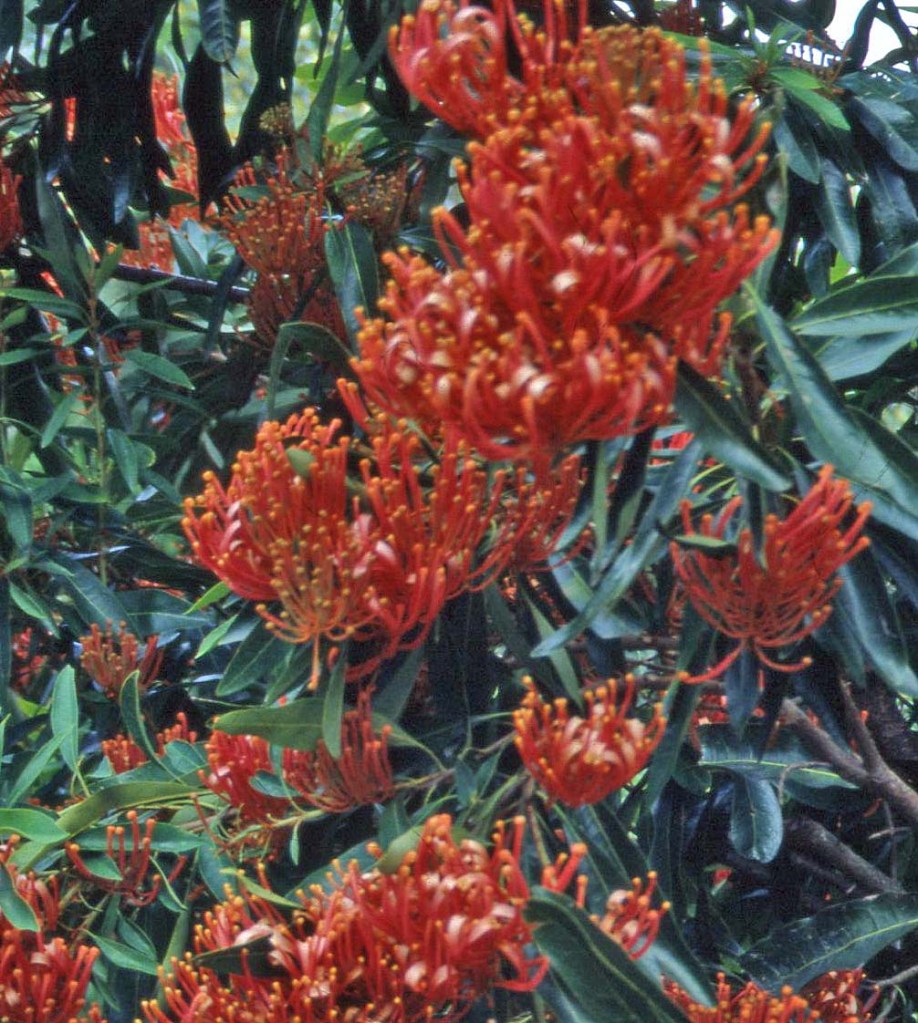
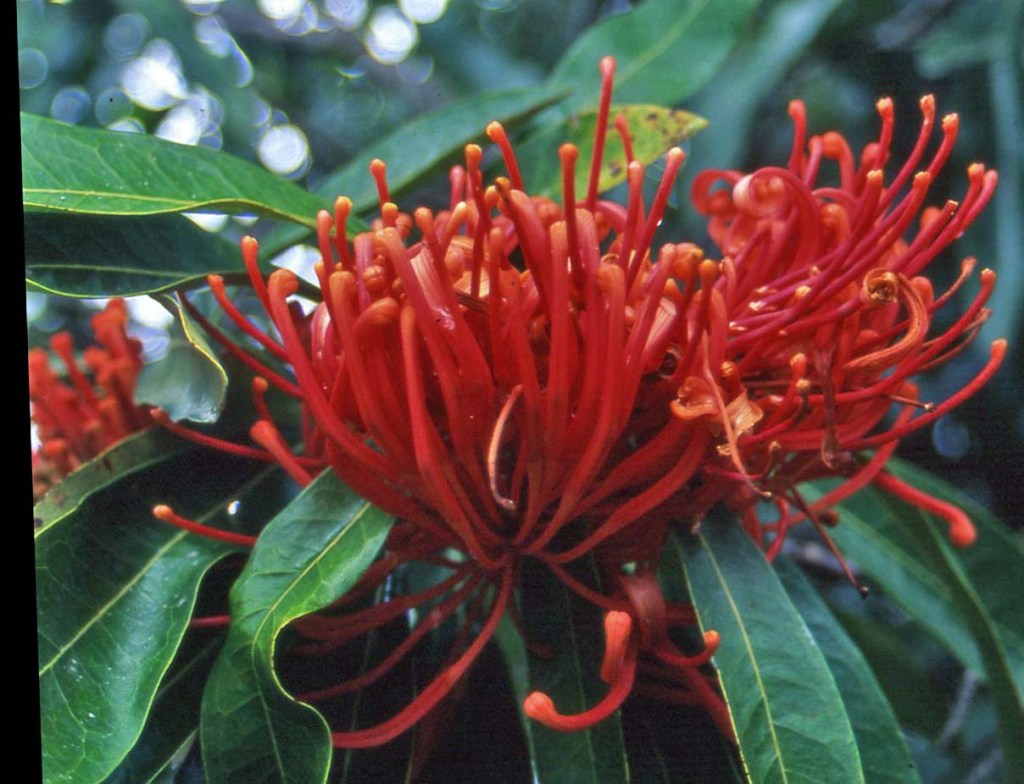
Tree Waratah (Alloxylon flammeum)
Now here’s a showy spring-flowering tree for the larger home garden, which is quite easy to grow in warmer, wetter areas. It doesn’t usually flower until it’s about ten years old but when it does the big, red blooms are worth the weight.
Vital statistics
The leaves are handsome: large, shiny, simple, alternate and often lobed when mature. Flowers are rather like those of grevillea species, large and clustered, bright orange-red with long, tubular perianths arranged in a corymb. The seed pods are interesting too, long and rectangular containing flattish, winged seeds. These pods can be dried and used in floral arrangements.
In the garden
Not a tree for small gardens but a lovely as a specimen tree or in a cluster of other trees and shrubs. It’s frost-tender when young and needs plenty of water at this early stage. Some light feeding with a low phosphorous native plant fertiliser for strong growth will help too though is not essential except in very poor soils. Trim new growth regularly to stop the young tree becoming straggly.
Propagate from seed or hard wood cuttings (slow!).
The Dorrigo Waratah (Alloxylon pinnatum) has proved difficult to propagate past the seedling stage but if you can find one in a native plant nursery it’s worth growing. For one thing, it’s not as tall as its more flamboyant cousin. The flowers tend to be less prolific but are an attractive pinkish red and look great in a vase.
Golden myrtle (Thaleropia, formerly Metrosideros queenslandica)
Thaleropia is a lovely tree from the mountain forests of far north Queensland and it doesn’t grow very large, 10 metres at most, making it suitable for the home garden.
Vital statistics: The glossy green simple leaves are slightly serrated with a prominent mid vein. They are born close to the stem and have typically pointed rainforest species “drip tips” at the apex. The bright golden flowers are five-petalled and slightly cupped from the centre, with long and prominent stamens.
In the garden: Thaleropia will do well in any warm climate garden and, once established, needs very little care. It can be pruned every autumn to control height and promote bushiness, if desired. Regular watering is required in dry periods – just a good soaking with the hose once a week will do.
I’m Julie Lake writer, gardener, music lover, horticulturalist and long-time student of the plants and ecology of the subtropical rainforest.
I write books, too. If you are interested in Africa, you might like to read A Garden in Africa, about the remarkable Flora who created a famous garden out of the dry Kenya bush. If you love Wagner and enjoy the novels of the late Terry Pratchett you’ll get a laugh out of Ringtones, a satire on The Ring, where Gods behave badly and dwarves, giants and dragons behave even worse. Both are available on Amazon at http://www.amazon.com/dp/B00HNTL18Q and http://www.amazon.com/Ringtones-Julie-Lake-ebook/dp/B00HNVHLBA.
Both these gardening books are cheap to buy and full of useful advice in an easy-to-read format.
And then there’s my new book, a novel. Lyrebird Mountain. About Anna Bachmann, an ordinary woman who lives an extraordinary life on a mountain just like my own. It’s a family saga of love and loss, triumph and tragedy, war and peace – all those ingredients which make up a good read! Available now on Amazon in printed, ebook and audiobook formats. Go to: https://www.amazon.com.au/Lyrebird-Mountain-Julie-Lake-ebook/dp/B0FMMNDJS7?









 Lyrebird Mountain