

The world boasts many great train journeys. The Orient Express, the Trans-Siberian, the Rocky Mountaineer, South Africa’s Blue Train, Australia’s Ghan or Indian Pacific. I contend, however, that there have been few train journeys to rival the overnight trip between Mombasa and Nairobi in the years before 1963.
I’m going to try now and recreate that journey in my memory and because I was a Mombasa girl, and because the beginning of a journey is usually more exciting than the way home, it is always the “up” journey I remember, from the coast to Nairobi. Up-country types will, of course, remember it the other way around.
Travelling by train back then was more than just a journey, it was an Occasion. People dressed for it, casual but smart. No jeans or shorts for women and men planning to eat in the dining car had to wear long trousers and a tie. There was only one passenger train a day and it left at 6pm. It’s possible some travellers arrived at the last minute and flung themselves into their carriage just in time, enjoying none of the gracious ceremony of departure. But these would have been few and far between because most of us liked to arrive at the small but immaculate station in good time and, having checked out our compartment and found a porter to load our luggage, repair to the bar-cafeteria for a tea, a beer or a cocktail. You could buy a very good small plate of potato chips for next-to-nothing, I remember, or sandwiches and other snacks.
Leaving on the train was a social affair and the more people who came to see you off the more fun it was. Sitting there on the raised dais of the cafeteria you could survey your fellow passengers. There would be bashful honeymoon couples shedding confetti, businessmen in formal garb with briefcases, sun-reddened holidaymakers heading back home to Nairobi or Nakuru or even Kampala, smart young women on shopping trips to the superior retail outlets of the capital, men in safari suits, Indians in turbans or dhotis or vivid saris, perhaps a priest or two in dog collar and cassock, or a family of soberly-dressed missionaries. It was all very noisy and chaotic as people yelled greetings to acquaintances or farewells to those who came to see them off, and porters dodged in and out trying to get all the luggage safely stowed before departure, and station staff made occasional announcements over the tannoy which could barely be heard above the general din.
And, behind it all, the slow, steady, deep chuffing of a great engine getting up a head of steam. You were hardly aware of it at first, until it began to build to its crescendo of imminent departure and your pulse began to throb with it, excitement building along with the steam. You began to withdraw, a little, from those who had come to see you off and make common cause instead with your fellow passengers who, like you, were now moving purposefully towards the train that huffed and puffed like a great animal anxious to be on its way. You felt a sense of importance – The One Who Was Travelling, who was going places – and a sense of pity for those poor domestic creatures being left behind. A flurry of kisses, a hug or two, many more handshakes (for most of us were, after all, British!) and the usual banal injunctions “not to miss the train”. As if you would! Though inevitably there were one or two folk 1`frantically running and gesticulating and grabbing at door handles when the rest of the passengers were already safely aboard and taking up their positions at the windows, waving and grinning. Unless, of course, they had nobody to see them off, in which case they quietly took possession of their seats and took out their books, immune to the emotions of parting.
Then – the guard would blow his whistle and the last door would slam and there would be some flag waving from the boiler plate up front and the guard’s puny toot would be obliterated in memory by the thrilling shriek of the engine’s great steam whistle and all the romance of train journeys everywhere – from Dodge City to Bhowani Junction to the Coronation Scot – came together in one glorious moment as the pistons began their steadily-increasing rhythm and the mighty engine left the station, its many dull red carriages with their eager travellers following obediently behind. Oh, those mighty steam engines of my childhood! No wonder people still love them today; enough to collect them or buy books about them or gaze at them in museums. To us, they were neither quaint nor remarkable; merely the way we travelled. Yet we were not immune to their charm and power – even as a young woman I enjoyed going to look at the engine before departure and others did, too, with awe. When I was about ten, and not travelling myself but seeing somebody off, my dearest wish was realised when the engine driver invited me (and a couple of other kids) into his cab and showed us the controls and let us pretend we were driving the train. Everything in that cabin gleamed and shone with brass and rich wood. If only my father had been an engine driver and not a government official who went, dressed in tropical whites, to his dull old office every day. I would have much preferred him with dirty hands and a smut on his nose and a huge, powerful steam engine under his command!
In my memories those engines were either green and black or entirely black. I’ve been told there were also red ones but I never saw them. They always gleamed, their paintwork and brasswork immaculate, the letters “EAR & H” born proudly. Sometimes it took two of them – one at the back as well – to get the carriages up the two main scarps between the coastal strip and the plains of the Athi; I don’t know why this was; perhaps it was when the number of carriages exceeded the norm. Mostly, though, when there was still light in the sky, you could lean out the window and see, on a curving line, the fine sight of the engine up ahead, smoke pouring from its funnel (and putting smuts into your eyes if you weren’t careful!), pulling its line of carriages with apparent ease.
In those days (and maybe today also) there were three classes of train travel. First class compartments had two berths and a spare, modern blue-grey décor with pull-down tables. Second class compartments had changed little in design since Victoria’s day and had four berths with green leather seating and lots of dark timber panelling. Whichever class you travelled, you did so in a propinquity quite alien to English people of the time, who under other circumstances would rarely speak to a stranger unless properly introduced, let alone dress and undress in a confined space and share the intimacies of sleep. In fact my husband once travelled in a second class compartment with three other men and none of them spoke a word until, next morning, one broke the ice by introducing himself.
My generation was much less formal and we would soon be chatting happily with whoever our co-travellers might be – some lasting friendships were formed on the overnight journey between Mombasa and Nairobi. In my day, only the distinctly better-off whites travelled first class. Most people – those of European origin and the wealthier middle-class Indians – travelled second. Only black Africans and the poorer sorts of Indians travelled third class and this was a very different affair. No compartments but open carriages with wooden seats where passengers stowed their baggage, goats, chickens and children and took along their own food. Third class was noisy and lively and probably great fun but few Europeans ever risked it. One who did was my grandmother, always a bit eccentric and very curious. Just why she did so I never knew, being very young at the time. But she often talked about it. She got on the train at Ulu station at about seven at night and sat there with all the tribespeople and livestock, sleepless on the hard and upright seats, until the train arrived in Mombasa at six the next morning. Apparently she was made very welcome; women shared their mealies and cold posho with her; she shared her sandwiches and fruit and biscuits with them. She’d thought to take several packets of polo mints with her and these, no doubt, proved very popular. She never drank coffee and didn’t care all that much for tea so I don’t know what she drank – probably water infused with Andrew’s Liver Salts, which she took daily. Most of those in her carriage were Wakamba and as this was the tribe among which she lived, and was most fond, I expect they all got on very well together. Those who travelled third class tended, as much as possible, to congregate in tribal groups though all seemed to get on well together, whatever their tribe, and the close carriages would be filled with the sound of Swahili as well as a dozen tribal languages. Men sat with men and women with other women, and children. This applied to both Africans and Indians, and the latter, in any case, sat usually in their own carriages – there was no official segregation but unofficially the two races did not mix. I can just imagine the smells – Africans rarely bathed in those days, as we would understand bathing, and had no deodorants. And there were, in any case, no bathing facilities on the train. The lavatories were pretty foul, too. Goodness knows how my ultra-fastidious grandmother managed – but she always spoke of the whole journey as a great adventure (though her doing so odd a thing infuriated my staid parents!).
Back in first and second class, life was both more ordered and less lively. At first, you could look out the window as the train climbed the steep grade from the coastal plain, as it was described in my book A Garden in Africa: “through hills of red earth planted with coconut palms and banana trees, African children waving, chickens running among the mud-walled houses, women of the coastal tribes in their bright cotton kangas or short skirts of fibre strips, naked from the waist up”. By the time the first station was reached, at Mazeras, it was already dusk – that brief equatorial blink between blazing daylight and the cool of night. I cannot be sure after all these years but the first sitting for dinner was called about this time. Those travelling with children would answer this call, and others wishing to get fed and to bed as early as possible. Some took along their own meal of sandwiches and fruit and cake.
Most, however, opted for the later sitting at about 8.30 and I remember regarding this as a significant right of passage the first time I travelled on the train as an adult. When the second dinner gong was sounded by African train staff immaculate in their starched EAR & H uniforms we would hurry down the swaying, rocking corridors from carriage to carriage until we reached the dining car. People dressed for the second sitting – men in ties and light jackets, women in frocks with high heels and well-coiffed hair. And making your way down those narrow passageways in three inch heels involved quite a balancing act, let me tell you! The dining car harked back to earlier and even more gracious times – all white linen and gleaming silver and each four-seater table with its cosy little red lamp. Attentive staff brought the beautifully-presented menus and though the food was plain and very English it was well-cooked and with all the advantages of a country generous in fish and seafood and fresh tropical fruits. How the chefs managed to produce such meals in the tiny galley was a matter of wonder. Outside, the night was speeding by and wild things were seeking their own sustenance. But there, inside that softly-lit carriage, with its cheerful chatter and chinking glasses, you could have been in any civilised restaurant in any civilised city in the world.
That, to me, is one of the enduring fascinations of train travel. Ships take us over the ocean, an element of which we can never truly be a part. Planes take us up so high that we no longer feel connected with the earth. A train, however, remains earthbound and the everyday world of earth and trees and houses is still visible and only inches away as we move through that stationary landscape in our own time and space, untouchable and unreachable by what’s outside and snug within our own frame of reference. No wonder Einstein used a train to illustrate his Theory of Relativity. And that is what it was like, in my memory, back on the Mombasa-Nairobi train in the nineteen-fifties and sixties. After dinner we tended to turn in early for by this time the train staff had been round to make up the bunks and there was nothing to do except chat to your fellow passengers or do a crossword puzzle. Some people passed the time with cards and I know one regular train traveller from those days who always carried a couple of packs with him and says he made some good friends over those late night card games. The fact remains, though, that in a second class compartment with four people of, usually, different ages and habits and inclinations, it was better to climb into your bunk and read yourself quietly to sleep. Some people find it hard to sleep on a train that judders and rattles but I always find it soothing. Today, it’s true, I’d find it impossible to sleep in a confined space with four other people, probably strangers if you were travelling alone, with all the snoring and snuffling and coughing and clambering up and down the ladder from the top bunk to get to the loo at the end of the corridor. Back then, though, a veteran of the school trains, I found all that rocking, rolling and riding very conducive to deep slumber. And as you snuggled down in your narrow bunk, in your crisp white EAR & H linen, outside was all the vast red thorny wilderness of the nyika that lies between the coastal scarp and the high plains country around Nairobi – a wilderness in those days little inhabited by humans but rich in species such as elephant, rhino, lion and cheetah.
Oh, to go to sleep with all of Africa around you. And then to wake to chill air and the vast plains of the Athi, alive with herds of zebra, wildebeest, kongoni, and antelope of all kinds. Ostriches would seem to race the train, their great legs mimicking the pistons. Tommies would skitter away, tails wagging. Warthog families would trot busily over the dusty ground, sometimes with several little piglets in a well-behaved line. How many of the world’s great train journeys could offer a Movietone panorama such as that? In the small compartments we would modestly try to dress ourselves without inconveniencing our fellow-travellers- or baring too much flesh. Early-risers would lay claim to the loos while others queued up outside. Overnight baggage and handbags would be gathered, goodbyes would be said, people would start to hang out of the windows as the train steamed through the dull outlying area around Embakasi before making its final huffing run into Nairobi station. Greatest of all the beasts in Africa, the mighty locomotive of the EAR & H had brought its consignment of passengers and mail safely through almost 330 (530 km)or so miles of night and trackless bush, scaling almost 6000 feet (1700m).

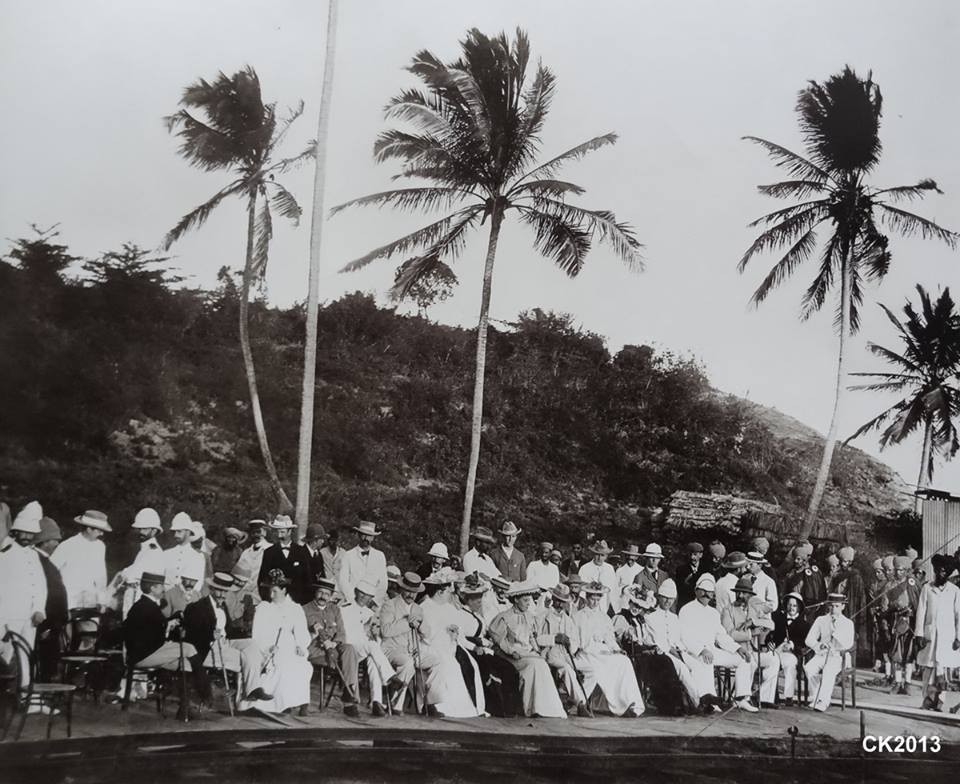
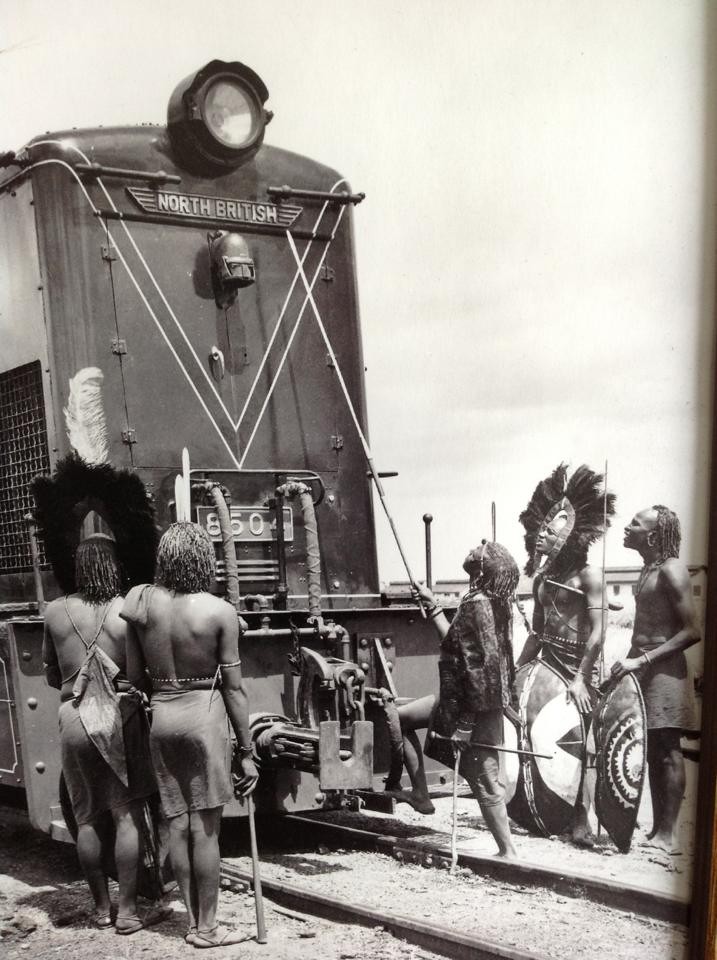
The railway was pivotal in the development of colonial Kenya, linking the coast with the inland and carrying early settlers from Europe to take up their farmsteads (though the doughtier Boers came up from South Africa by wagon!). In the centre, the opening of the Mombasa railway station, at left, the carriage from which Inspector Ryall was dragged to his death by a man-eating lion and right, tribal society gets a first taste of technological change to come.
To school and back
Travelling on the school train offered a slightly different experience. We high school girls would arrive at the station in full uniform (grey flannel skirt, white blouse, red and black tie, grey felt hat – blazer over the arm) despite the Mombasa heat with our hockey sticks and tennis rackets and big tin trunks, rushing about excitedly to greet friends while our parents retreated thankfully to the bar. I have some faint memory of boys and girls travelling back to boarding school on the same train, at some earlier time, but by my time at boarding school (1958 – 1961) we travelled on different days. Not hard to guess why! It’s interesting to reflect on how self-focussed are the young because for the life of me I can’t remember anyone else travelling on those trains except our lot. Presumably there were other passengers on those school trains but I have no recollection of them, nor of girls travelling to any of the other up-country boarding schools – Limuru, for example, or Loreto Msongari. All I can see in my mind’s eye are the grey-clad KGHS lot milling about in a crowd large enough to eclipse all over travellers – shrill little thirteen year-olds going up for the first time; dignified sixth formers in their distinctive blue ties; a couple of harassed-looking teachers trying to herd us all together.
The journeys “up” were tinged with sorrow and trepidation – at least for those of us who didn’t like boarding school. Another term looming: of compulsory games and sarcastic prefects; of stodgy food and conduct marks; of Sunday church and a life ruled by electric bells. Coming home on the “down” train, though, was a different matter. How happy we would be as the train puffed its way out of Nairobi station, past the carriage where the man-eating lion had snatched the unfortunate police inspector Ryall years before, and southward across the Athi plains as night began to fall. Schoolchildren travelled second class and didn’t eat in the dining car – instead we were supplied with sandwiches and fruit by the school, and a large bottle of cordial each to drink. Of course, we’d already had a cooked lunch and were, I think, quite happy to sit in our compartments munching our sandwiches and knowing that our next meal would be in Mombasa…at home!
Those long nights on the school train were filled with happy chatter as we gossiped about our friends and enemies, shared secrets about boys we admired, or whom we fervently hoped admired us, made plans for the holidays that seemed to stretch endlessly ahead even though we only got four weeks at Christmas, two at Easter and two in August (or was it July?). To us coast girls the holidays were all about the beach – those long, white, empty, palm-lined beaches divided only by the dark lines of native fish traps and the occasional headland, beyond them and the aqua sea with its protective line of offshore reef. How we longed to be back on our dear little island with its baobabs and scarlet poincianas and glorious architectural fusion of the Arabic and the Portuguese. Sailing at the Yacht Club, dancing at the Sports Club or Railway Club, lounging happily over a Coke at the Nyali lido, waterskiing on Tudor Creek, eating samosa and playing the jukebox at the Cosy Café, listening to the latest hit singles at Shankardass where the patient owner put up with us crowding into his listening booth even though we rarely had the money to buy anything.
And, once we were old enough, there would be boyfriends waiting to meet us in town, or at the pictures, or cycling with us over the bridge to Nyali, or across the ferry to the south coast beaches. It was a wonderful time, and a wonderful place, to be a teenager on holiday. Though of course, nothing is quite THAT wonderful and I have to think hard, now, and honestly, to remind myself that being young had its share of anguish. Spots that erupted overnight. Parents who wouldn’t let you stay out late. The boys whom you desperately wanted to date and who wouldn’t look at you. Boys with whom you wouldn’t be seen dead who kept asking you out. Quarrels with your best friend. Jealousy of girls prettier than you. Frustration that your mother wouldn’t let you have a new dress for the teenage dance, or let you wear lipstick, or pierce your ears. Worry about what your father would say when he saw the latest term’s school report. No, being a teenager wasn’t always perfect bliss but on the school train, going home, with all those glorious days of comparative freedom ahead, it certainly seemed that way.
At that age we pretty much took for granted the great wonder of Africa that lay beyond the train windows. Elvis or Cliff or Buddy were of much greater interest to us than wild animals and those of us with transistor radios were very popular in the small four-berth compartments, where we might be lucky enough to pick up Forces Overseas Broadcasting, which played the best pop music. Sometimes, though, Africa forced itself upon us. There was the time, for example, when the line was so slippery with the bodies of millions of army worms that the train had to halt while workers cleaned the tracks. Elephant sometimes crossed the line, necessitating another slowdown. And once we hit a rhino, somewhere around Tsavo, in the middle of the night. There was a thud that travelled down the length of the carriages and the great engine juddered to a halt. You can imagine the pandemonium with a great mob of teenage girls in their nightdresses and pyjamas, having been suddenly awoken, hanging out of the windows to see what was going on and, despite the furious exhortations of the two teachers, actually getting down on to the ground by the side of the track. Hysteria prevailed – we’d hit another train, the tracks had buckled, a Maasai herdsman had been crossing the line with his cattle (at that hour!). Then word was passed back that it was a rhino. Of course we all longed to see, and crowded to the front of the train, but could see nothing in the darkness beyond the steaming bulk of the engine. We waited for what seemed like hours though it was probably only an hour before a truck arrived, with men and ropes, and after a lot of that typical African argy-barging and fitina the poor beast – quite dead – was dragged off to one side. The engine (one supposes) was inspected and found fit to travel and we got up steam again and continued the journey, we girls hanging out of the window to stare at the remains of the poor, foolish rhinoceros. Some said it had probably charged the engine, rhinos being notoriously cantankerous and always ready to take on creatures bigger than themselves. Though this was obviously nonsense, we liked to believe it.
In my memory we rarely slept on the school train, though of course we must have done. Mostly, I remember lying awake and chatting in the darkness, then getting up and peering out every time we stopped at one of those little lonely stations along the line where mysterious goods were noisily loaded and unloaded and young tribal boys would run alongside trying to sell ostrich eggs and bananas to the newly-awakened passengers. One night I remember in particular for I was sitting curled up on my lower bunk, by the window, and noticed a falling star, and then another, and another. A meteorite shower of some extent, because it went on intermittently through the night. It was 1960 and a time of turmoil – some religious group had forecast the end of the world, there had been a great earthquake in Chile and not long after that the newly-independent Belgian Congo had erupted into civil bloodshed that sent thousands of white refugees across the border. Which was, in fact, the reasons we Boma girls were on that train because the school had been opened to house the refugees and we were all being sent home early – and in a heightened state of excitement. So, being fifteen and credulous at the time, I saw those scattering “stars” as a sinister omen and was both frightened and awed. Perhaps the end of the world really WAS at hand! I have seen meteorite showers since, and Halley’s Comet, but nothing so spectacular as what I saw out of my train window that long ago night, in the clear skies over Africa.
When we awoke in the morning –IF we slept – it was to the languorous warmth of the coast and a series of fiercely competed-for “firsts” – the first palm tree, the first glimpse of the sea. Down we went through the green and terraced hillsides of Mazeras and Mariakani, waving enthusiastically at the Watoto carrying bananas and the women cutting maize. Down, down, down to the flatness of the coastal strip and the water everywhere. Across the causeway, where in the distance the dockside cranes of Kilindini Harbour stood like giant giraffes. It was our custom to throw our emptied drink bottles from the window and over the causeway into the creek below. That muddy creek bed must be lined with glass fragments to this day, to mystify future archaeologists. This practice was forbidden but we did it anyway! Term after term, year after year. It was part of the ritual of coming home.
Once we had crossed the causeway the train slowed right down and seemed to take an interminable…an unreasonable…an unbearable time to meander through the sheds and godowns around Changamwe. Until…at last…oh longed-for at last!…we would round the bend among all the shunting yards and myriad tracks and huff our way into the station. There, waiting for us, would be parents, smiling and waving. Even my bothersome little bro was a welcome sight. EVERYTHING was a welcome sight…the palm trees, the distinctive clothing of the coastal tribes, the splendid tusks on Kilindini Road under which we passed, the servants welcoming us home with a bountiful breakfast, the beloved baobab tree in the garden, the gleaming blue ocean, the feeling of holiday and above all the heartfelt happiness that is HOME!
That’s where I’d like to end my story but it does have a slight, sad sequel. Some years after I’d left Kenya I returned there with my husband and, for old time’s sake and ignoring the warning of friends still living there, we decided to travel down to the coast by train. We so looked forward to this experience and were as excited about it as children when we left Nairobi Station. Alas, even in a short time, things had changed for the worse. Our First Class compartment was not very clean and nor was the bedding – the crisp, white sheets and coarse but sweet-smelling EAR & H blankets of yesteryear were no more. The dining car looked much the same, albeit shabbier and the silverware tarnished, but of course the clientele had changed. Instead of smiling at each other intimately across a red lamp-shaded table as the African night rushed past we found ourselves facing two very large, very fat, very cheerful Luo police inspectors with rather awful table manners. They couldn’t have been more friendly and we chatted away quite happily – about our new home, about our recent travels, about the changes that had come to Kenya – but it wasn’t what we’d imagined our journey would be. And the food – some grey and indeterminate stew – was even worse than boarding school grub.
It was a lesson that has stayed with me ever since – for it can be a mistake to go back. Kenya, more than most places, exerts a magic so powerful that our nostalgia haunts us even half a century or more after we’ve left. Ex-Kenyans gather wherever they can, even when very old, to remind each other of how it was, back then. What we are inclined to forget is that our longing is for another time, as well as another place. It’s possible to go back to the place, and even try to put a positive spin on changes that, in our hearts (and eyes) offend us. But we can never recapture that special time not only of youth – everyone has that – but of rare privilege. The privilege of being such as we were, in such a place, at such a time – and all the rarer because it can never be quite that way again.
And so, in my memory and that of many others now approaching the twilight of their lives, the dear old train puffs forever on through the African night.

 Lyrebird Mountain
One thought on “The great romance of travelling by train through the African bush”