
October 5
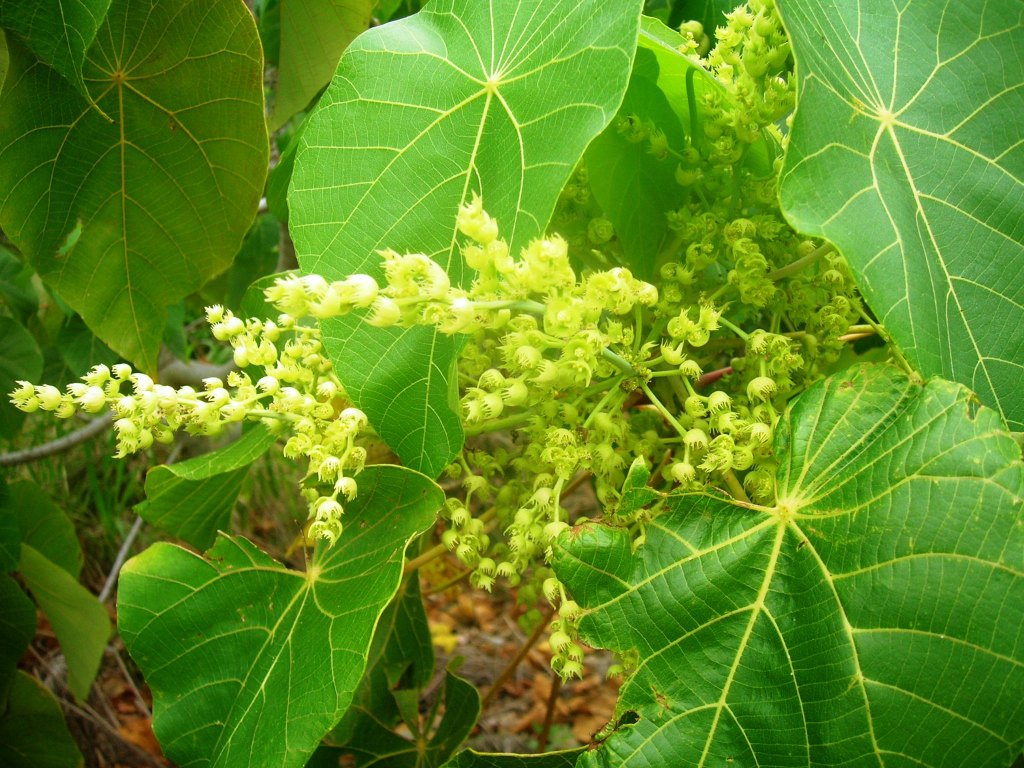
Not all flowers need to be spectacular to attract our attention. Above is an example of the common rainforest margins plant Macaranga tanarius, in flower, and while these inconspicuous blossoms wouldn’t win at a flower show their profusion adds a bright note to the bush in spring.
Up close, they are exquisitely formed as to petal and reproductive parts, with male and female flowers on different trees (dioecious).
Macarangas are common throughout the south Pacific and south-east Asia where the flowers are used as a dye in hand-made nets and mats and also as a preserver of leather goods. Combined with cane sugar, flowers and leaves can be used to make a type of rum. Here in affluent Australia, where the tree/shrub grows down the east coast, we don’t make any use of it at all though it is possible our own indigenous people did so.
Years ago I tried soaking the flowers to make a dye for home-made hessian curtains, along with other local plants. The result was awful! But a more skilled crafswoman might have done better!
There were plenty of macarangas in flower as I walked into the rainforest this week and while I was photographing a thicket of them a female Regent Bowerbird flew out and landed in a nearby Hoop Pine. I wondered about a nest higher up in the pine but couldn’t see one. The males have been observed to use Macaranga flowers and leaves in “painting” their bowers.
Regent Bowerbirds are elusive here, though where people put out food for them they’ll become bolder around the house and garden. Unlike their Satin cousins who live easily around humans and build their bowers in gardens, close to houses, as if they know this might afford them some protection from troublemakers. In all my years of birdwatching I have never seen a Regent’s bower and yet I know they are there, modest things, not neatly arched over at the top like those of Satin, and well-concealed. The males do go to the trouble of painting their bowers in dull blue-grey or a brighter green, using mushed-up plant material.
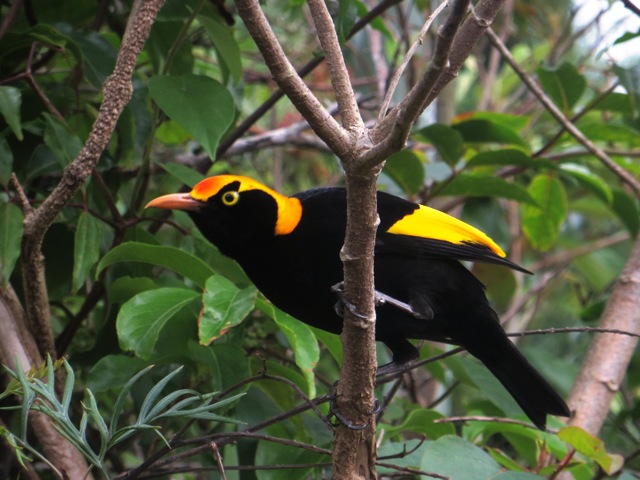
Male Regent Bowerbird
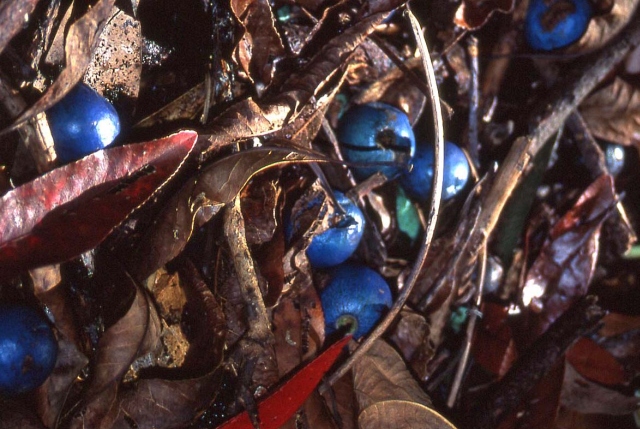
It’s been a good week for birds. I saw White-eared Monarchs along with the more common (around here) Black-faced and Spectacled Monarchs – three types of Monarch in one day is pretty good! Red-backed wrens were active in the grassy swamp adjacent to the forest and Golden Whistlers were calling loudly. The Brown Gerygones seem to be steadily extending their modest territory and the thick carpets of Quandong (Eleocarpus grandis) fruit everywhere is attracting both Figbirds and Wompoo Pigeons.
And oh, after dusk the Tusk Frogs are calling along the creek.
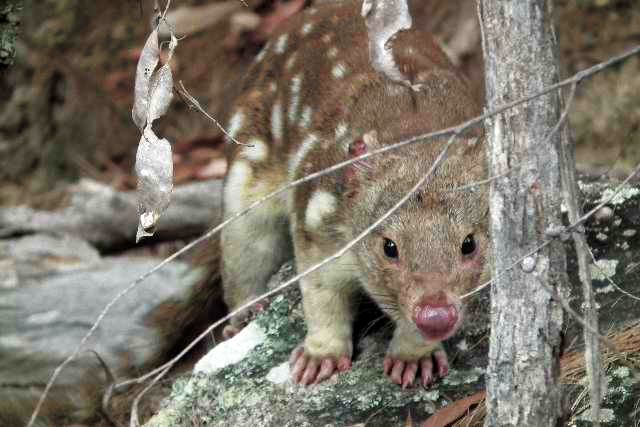
This week I walked the rainforest at night as well as during the day. The birds were silent, bats and Brush-tailed Possums were vocal and I saw a pair of lovely little Ringtail Possums. They came quite close, inquisitive to see who was invading their domain. The forest in the night hours is full of mystery and possibility; mostly silent in the cooler months but in summer noisy with frogs, flying foxes, crickets and the tiny clicks of microbats. Possums snarl at each other and if you are lucky you will hear a Spotted-tail Quoll giving its fierce, rasping cry. Alas, these feisty little creatures are not so common now.
One of the most characteristic sounds of the rainforest at night is the harsh, high screech of the Sooty Owl which sometimes tails off downwards with a whistle like a descending bomb. The friendly little Boobook gives its mopoke call and is the most vocal – and abundant – of all owls around here, except for the mostly silent Tawny Frogmouth which perches on wires and fences and flies flat-winged and silent across the track.
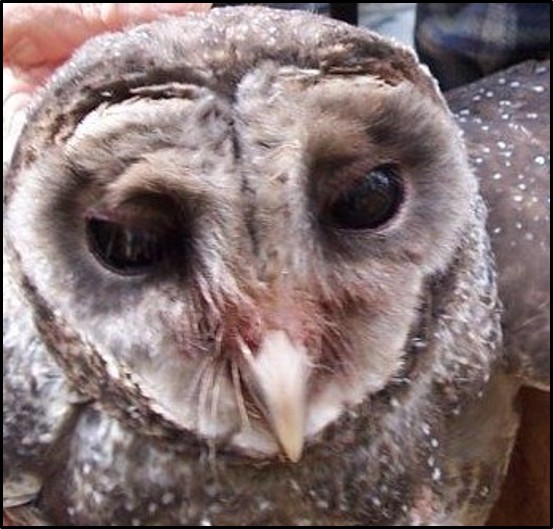
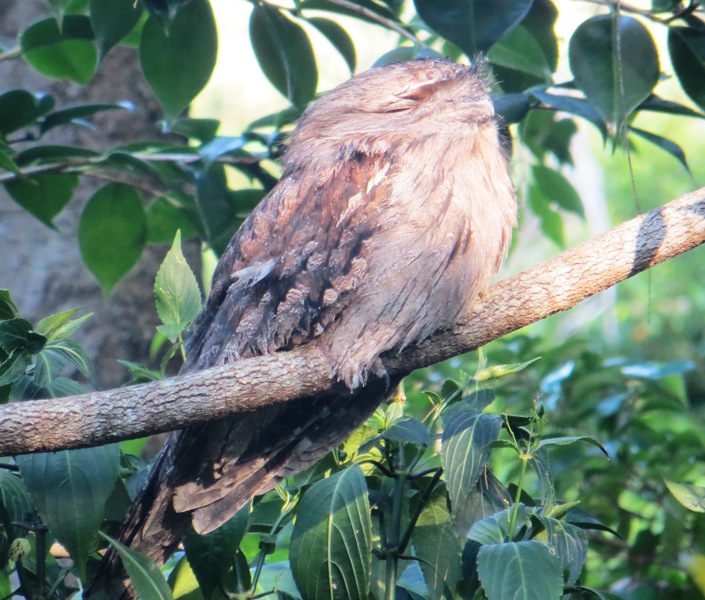
Left: Sooty owl. Right: Tawny frogmouth
And…listen carefully…that deep, whoooom whom call is the sound of the mightiest night hunter of them all, the Powerful Owl, slayer of possums, eyes big and yellow in the beam of a torch. I didn’t hear a Powerful Owl last night – but I’ll be out again at night next week in the rainforest and maybe I’ll hear one then!
*************************************************************
September 15
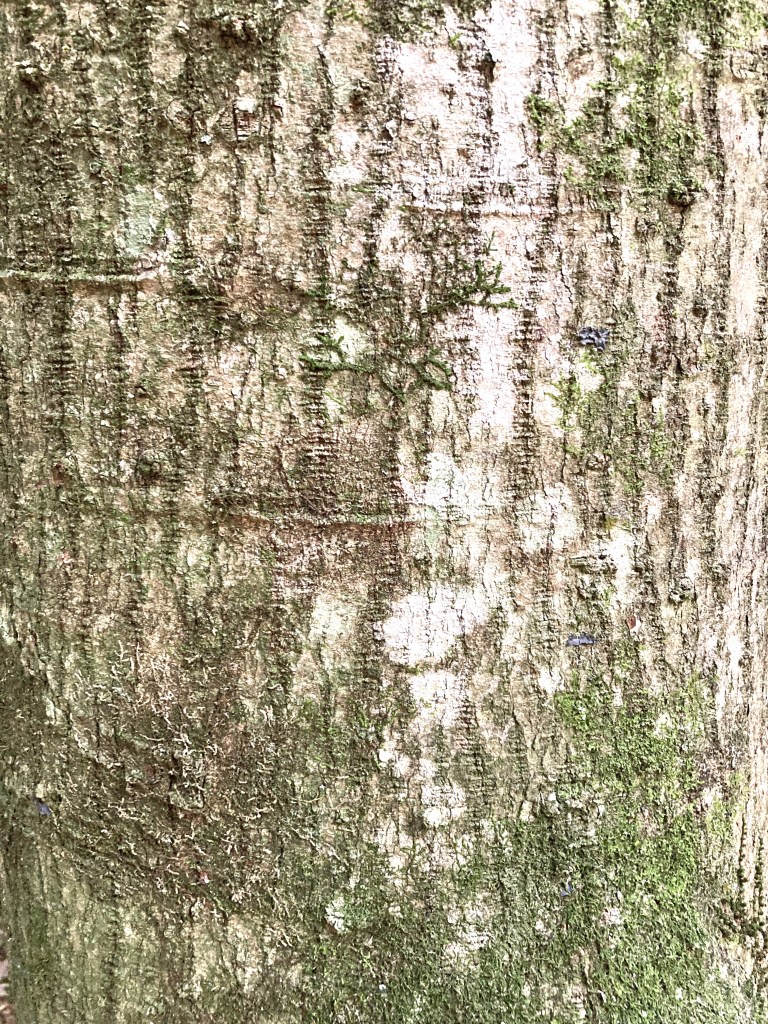
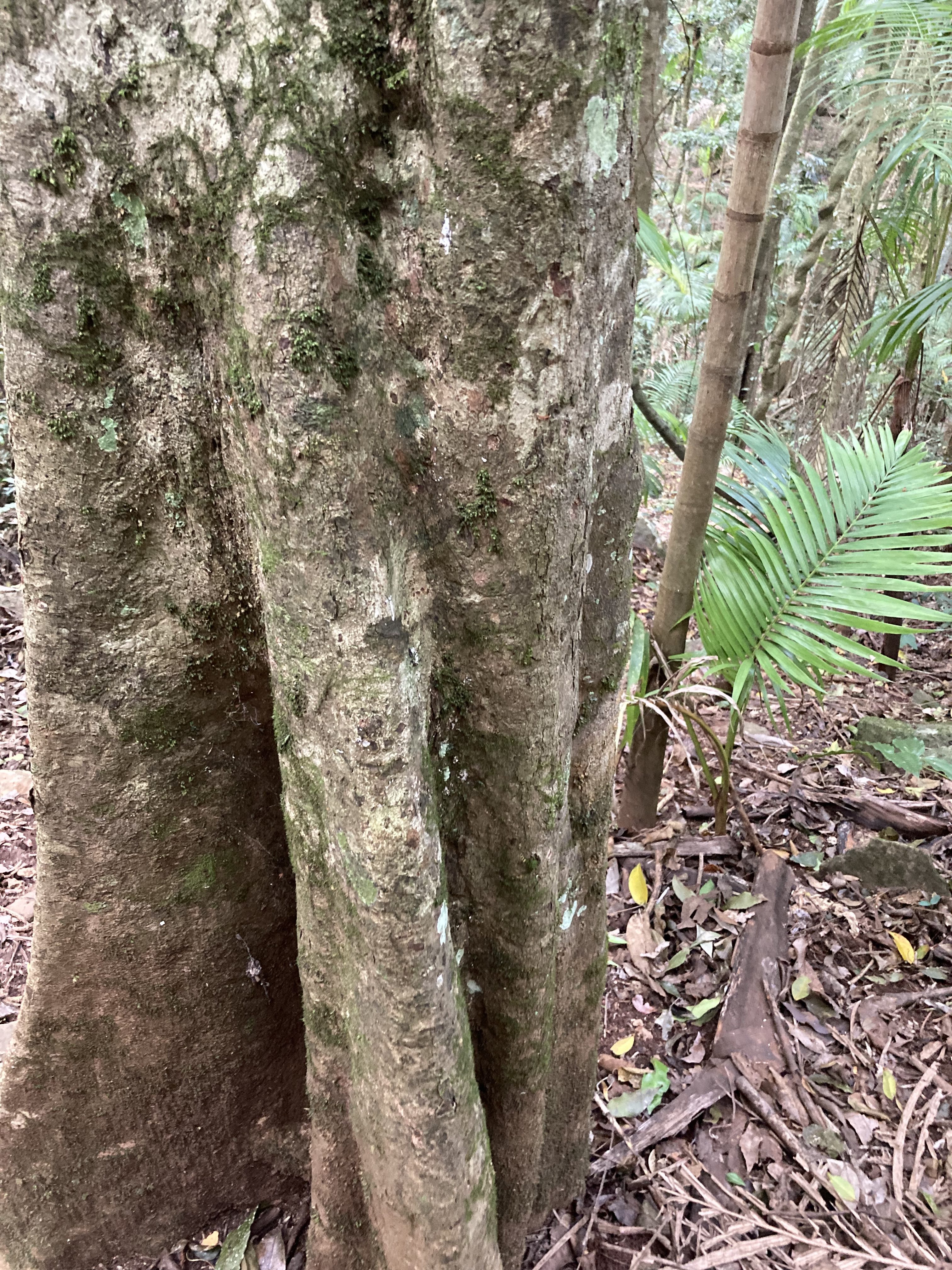
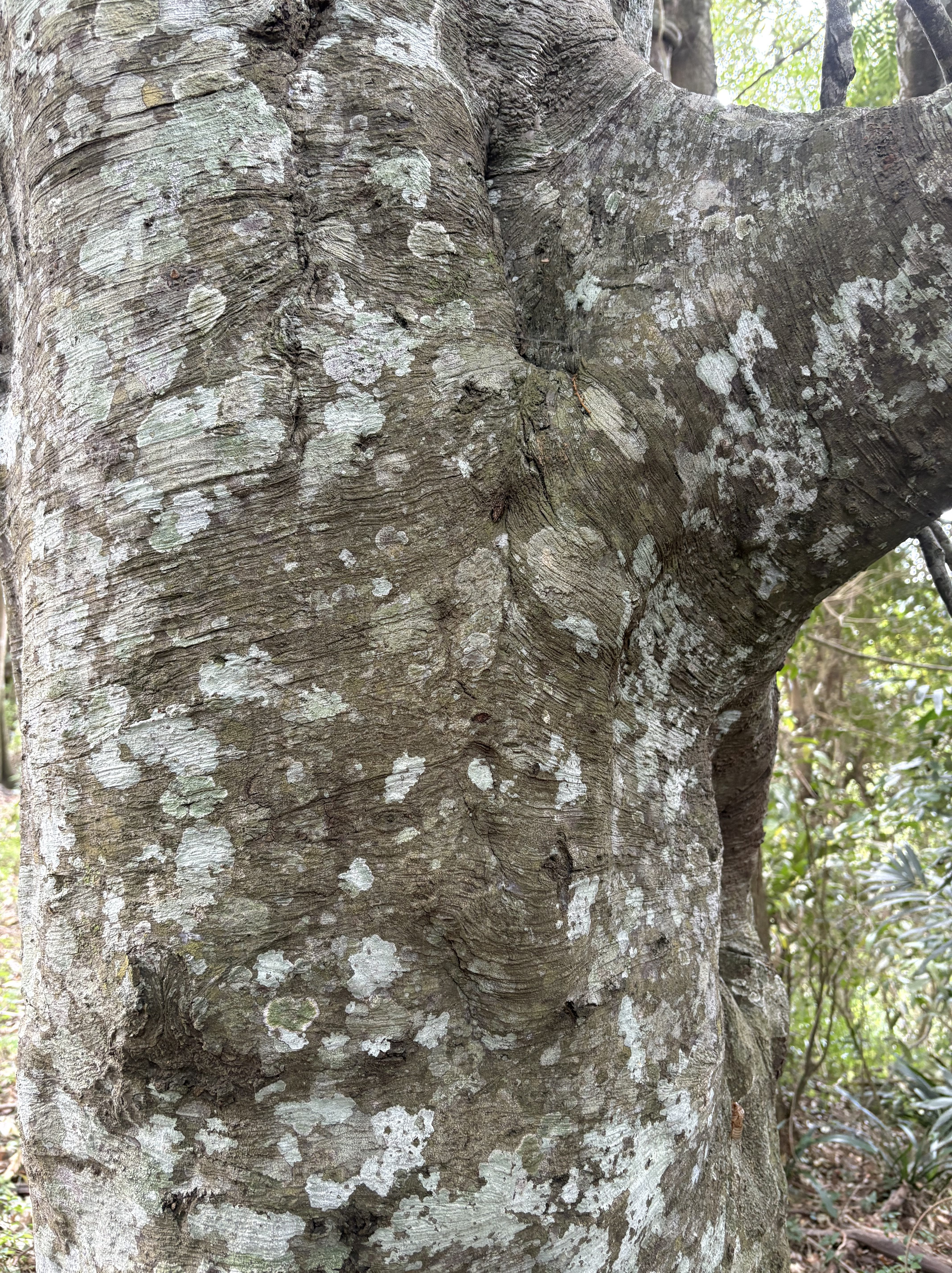
Superficially alike – and yet different. Three examples typical of a subtropical rainforest, from left, the vertical striations typical of Brachchiton spp., buttresses on a fairly young Endiandra pubens and the horizontal wrinkles on the bark of a full-grown Foambark Tree (Jagera pseudorhus).
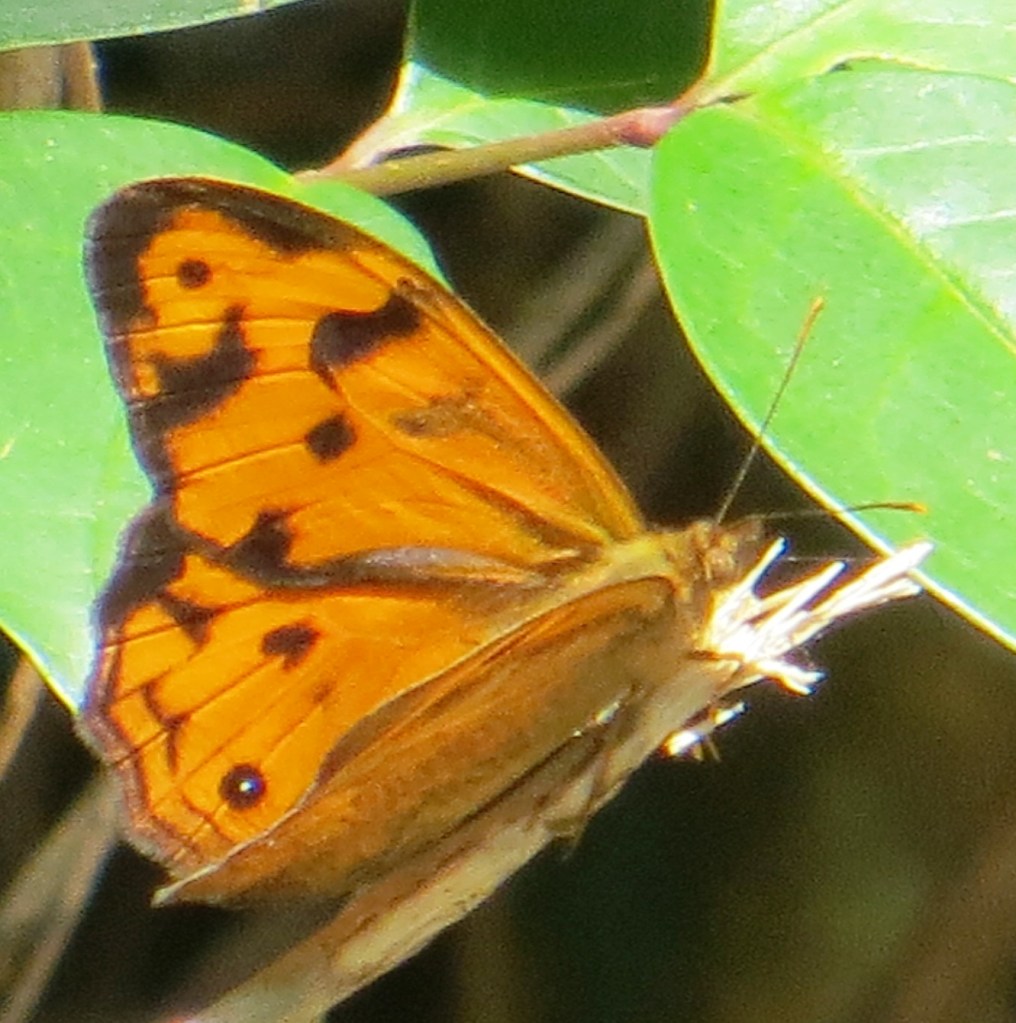
A Wonder Brown (Heteronympha mirifica), one of the first butterflies to appear this spring.
The bark of a tree is like a book written in a language that only few can read.
Those include foresters and the very small number of botanists who specialise in that area of plant science.
Foresters are the best at bark reading, generally speaking, but their ability to identify trees by their trunks is limited to those growing within the sphere of their work.
And yet the bark – and trunk – tell us a lot about a tree. They tell us about its age and health, its likely height and girth at maturity, the type of soil it prefers, the kind of climate in which it thrives, even the sort of creatures with which it interacts, such as birds, insects, reptiles and mammals. Those who seek to identify a tree by its bark will examine it for structure, wrinkles, lenticels (tiny bumps and openings facilitating gas exchange), buttresses, branching habit and much else besides.
Look at any tree and you will see that the trunk can be straight or crooked, branching low or with its lowest branches high above your head; the bark can be permanent or peeling away, smooth or corky, arranged in vertical platelets (tessellated), dimpled, thin or very thick, hanging in long strips like some eucalypts.
Every tree species has different bark. And there are thousands upon thousands of trees in the world, no one of them the same, even in monocultured pine plantations.
Ponder this for a moment and think how amazing it is!
The subtropical rainforest that inspires this column has many hundreds of different tree species. Telling them apart by trunk and bark alone is very difficult. I myself, having spent more than 40 years studying this rainforest, can only with pick a few with certainty. I need to see the leaves and, when possible, the flowers.
This week I found myself contemplating the trunk of a fine, big Foambark Tree (Jagera pseudorhus), and wondering why its smooth grey trunk, lightly wrinkled here and there, is so different from the reddish-brown corky branchlets. And then I looked at some Red Cedars and noticed that the fissured bark that distinguishes them in the open is different from the smooth, greyish bark of younger trees in the forest. I need, I think, to spend a lot more time examining tree trunks!
I am beginning to see butteflies along the track; no Richmond Birdwings yet, alas, but a few Wonder Browns (Heteronympha mirifica)busy in the prostanthera bushes.
In the deeper bush away from the path I was attracted by the sound of White-browed Scrubwrens calling as they foraged for insects; some of these appeared to be young birds and as I kept my binoculars on them I saw a couple of Large-billed Scrubwrens close by. And THEN I heard the unmistakable long chiiiirp of a male Brown Thornbill followed by lots of chattering and for a few utterly delightful moments I found myself surrounded by small brown birds, all cheerfully feeding and calling.
I’ve had this experience many times before and it always makes my day! It’s not really a mixed flock but appears that way; if you look closely you’ll see that for the most part the White-browed Scrubwrens are near the ground, the Large-billed are hopping about the higher shrubs and the thornbills are mostly in the lower branches of the overhanging trees. Yet they hop into each other’s feeding ranges here and there, giving the impression of a mixed flock.
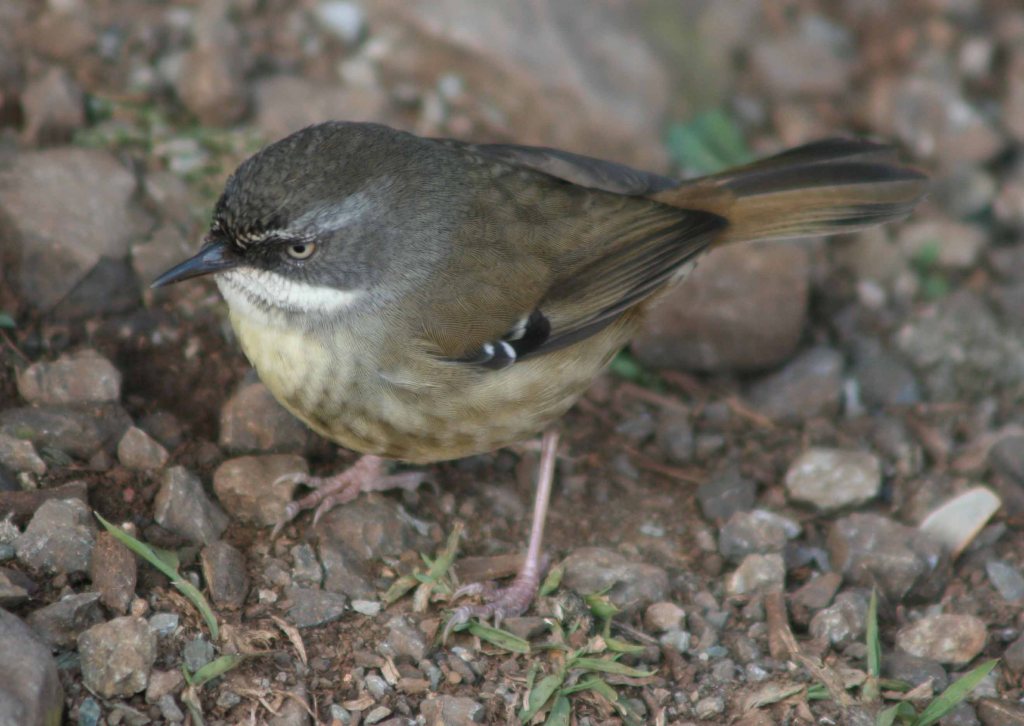
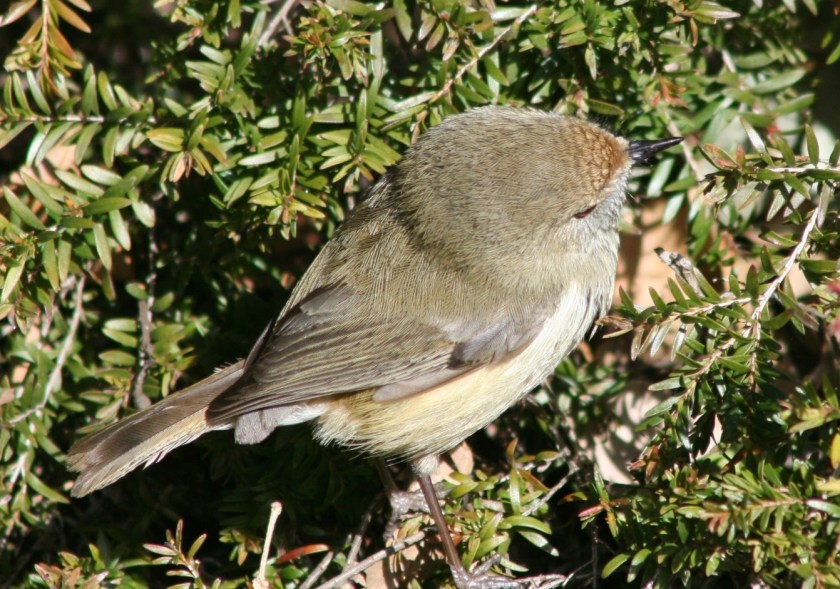
Top: White-browed Scrubwren, Bottom, Brown Thornbill.
love all these little birds and don’t find them boring, as many people say they do, dismissing them as LBJs (Little Brown Jobs)! If you stay still they will come close around you, shy but confiding, always in motion and fun to observe.
September 1
Now it really IS spring, September 1, and although the temperatures had already started to rise by mid-August and spring-flowering plants were putting on an early show, there is still something special about this week. Something intangible that tells me that in the southern hemisphere the quarter of the year that we have named for its northern counterpart is well underway.
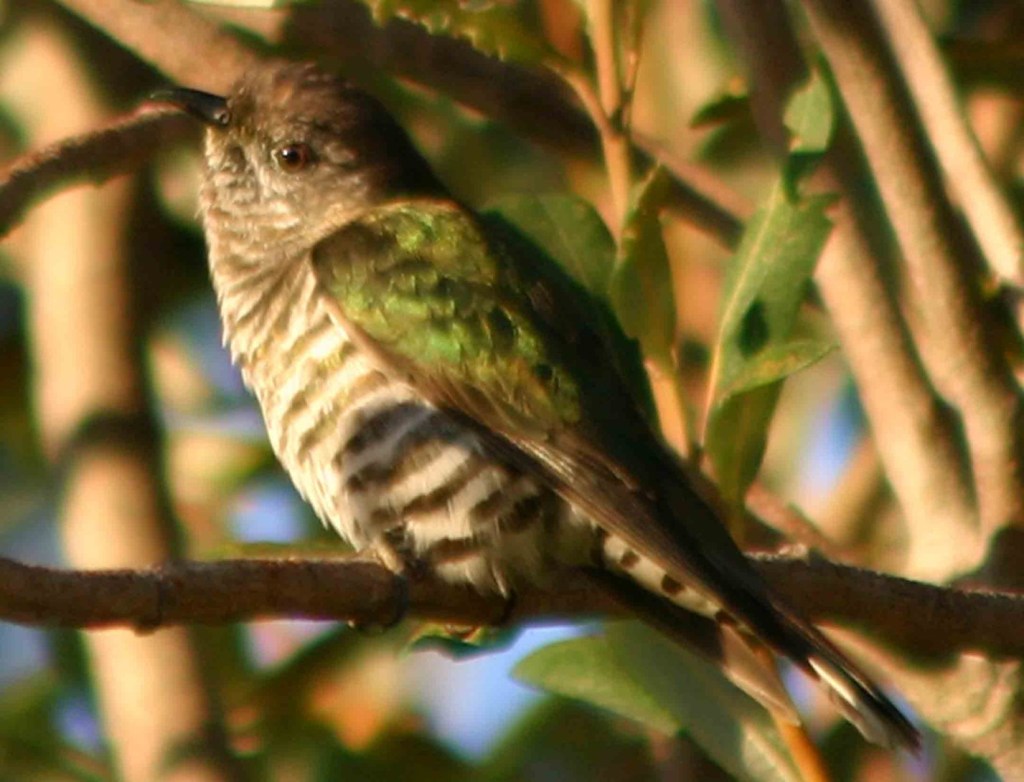
I found a magpie’s nest, high in a Flooded Gum, both parents busying back and forth so that I know it shelters chicks. Another brood to swell the numbers of this most common of suburban birds. And I heard a cuckoo – a Shining Bronze Cuckoo (see aboved photo) – quite tentative in its whistling call but audible to human ears.
I have been trying out the Merlin app from Cornell University; it’s quite marvellous in its ability to pick up bird calls that are at the very edge of human hearing – or beyond. Very useful if you are doing surveys, which I am.
There are so many apps, now, and other digital programs to aid us in the identity of birds as well as making lists, conducting surveys, data collation and interpretation. I accept them gratefully but sigh a bit for the old days when we used only our own eyes and ears and kept lists in little note books.
This is a busy time for photographing plants and I found myself rushing from one tree or shrub or vine to another, capturing the flowers. It’s always a bit miraculous how a perfectly nondescript scrubby bit of vegetation comes so quickly and vividly to life, sometimes with astonishing profusion, only to slink back into nonentity when blooming time is over. This time is often very short with bush plants, reminding us just how much work – and time – has gone into gradually breeding garden plants to flower larger and longer.
This week my first thrill was the sight of a fine specimen of Zieria collina absolutely covered with its tiny white blossoms. This shrub is one of our rare endemics, belonging only to our mountain, so those who interest themselves in local botany are very proud of it! Usually it goes unnoticed, a straggly shrub with tiny dull green leaves, and even in spring it barely attract attention because the specimens growing along the edge of the rainforest are so lacking in oomph. But this plant is out in the open, in sunlight, and has perhaps been trimmed a bit because the bush has a nice, rounded shape and the flowers are thick on the branchlets.
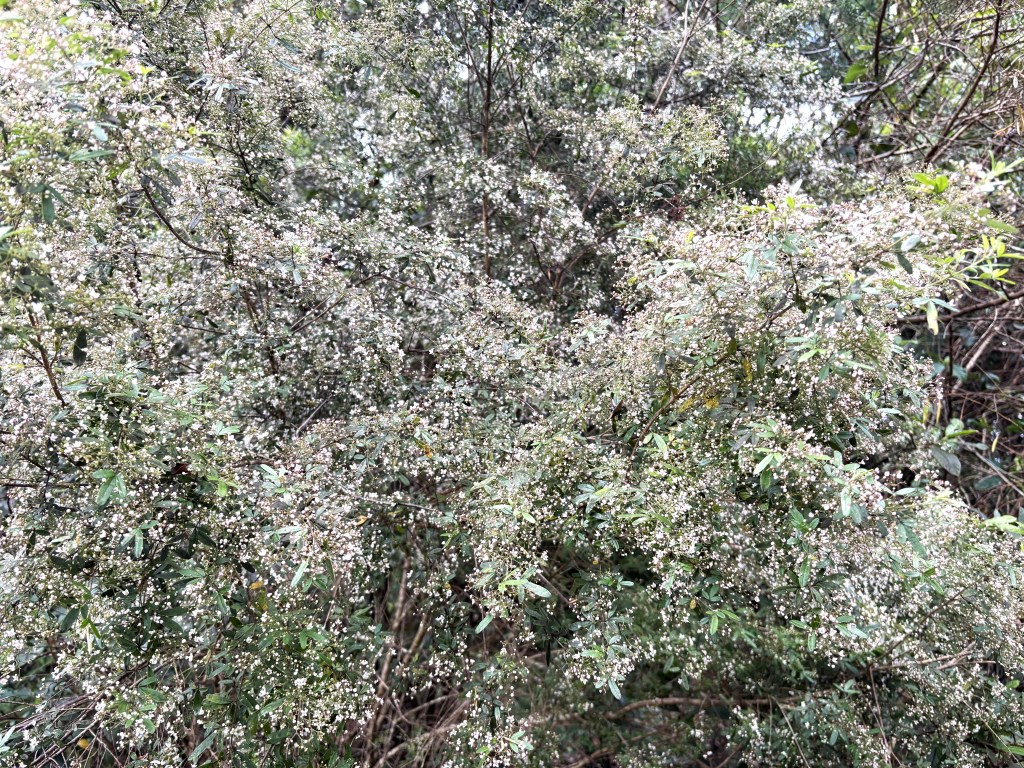
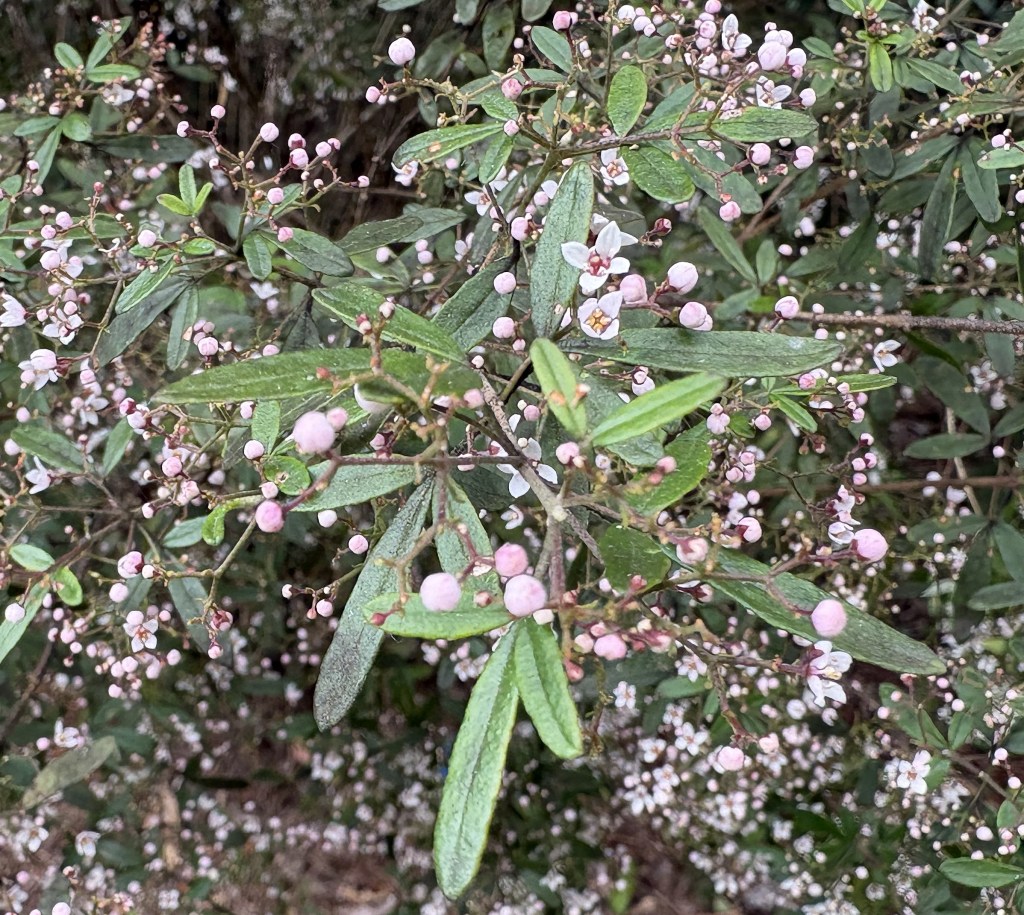
The local Landcare group has done a fine job in preserving and encouraging our Zieria and this will prevent it going extinct in the face of increasing development.
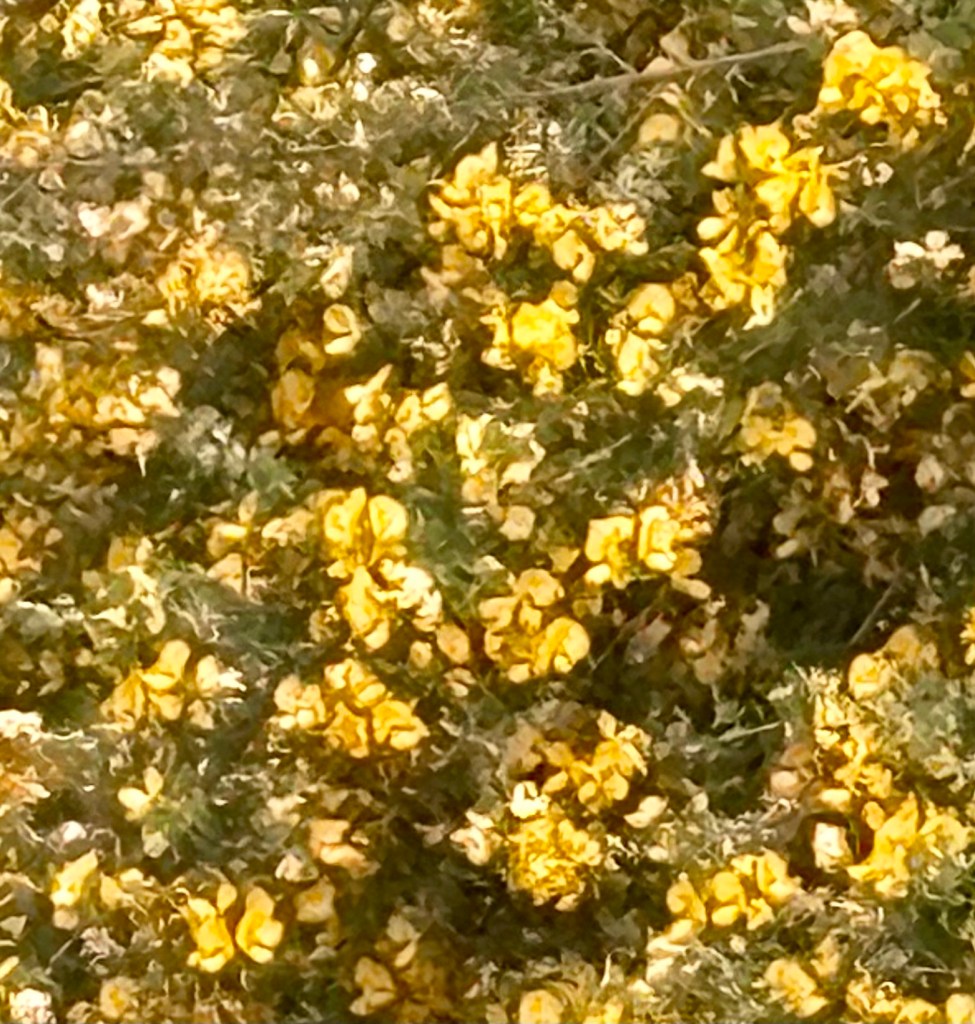
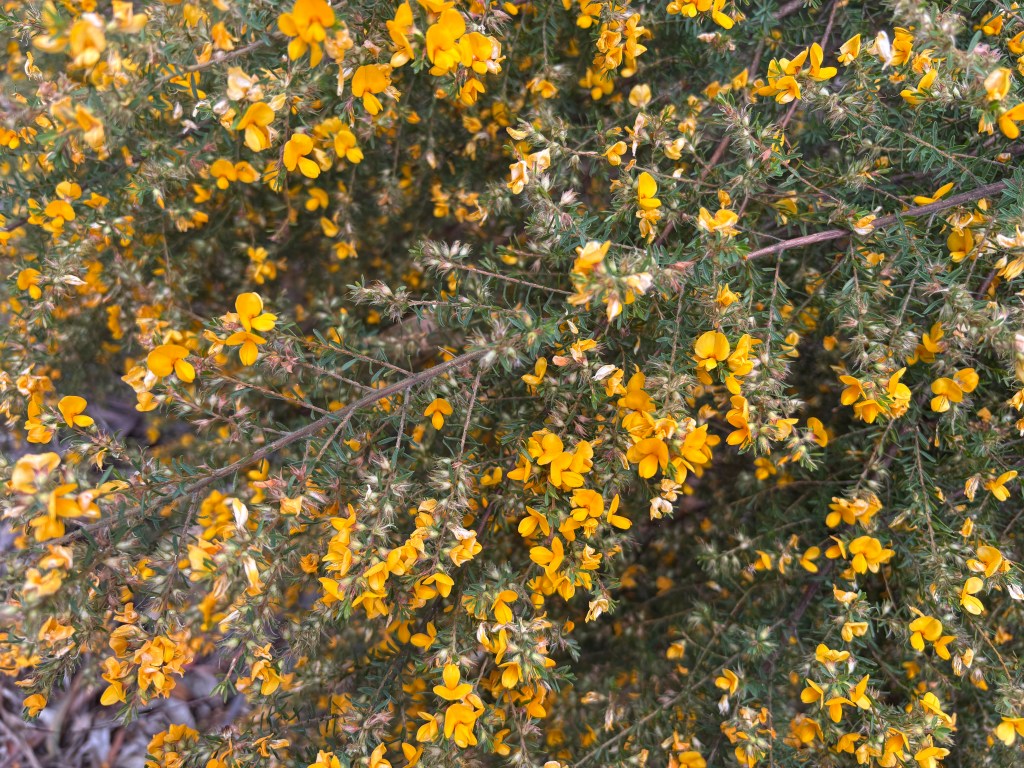
Another plant which grows shyly in the light shadows of towering eucalypts along the rainforest-wet sclerophyll margin is Daviesia ulicifolia, one of the pea flowers that can turn the bush to gold in season. I found several growing along the track; my eye was immediately drawn by the colour which was also attracting bees and other insects.
Also along that track were several young specimens of Pittosporum undulatum, sometimes called Sweet Pittosporum or Native Daphne. This is the most aggressive of the Australian pittosporums and has colonised many areas beyond its original habitat. It’s native to here and one of the more attractive shrubs in the rainforest because of its bright green leaves, even brighter orange berries and large clusters of creamy, fragrant flowers.
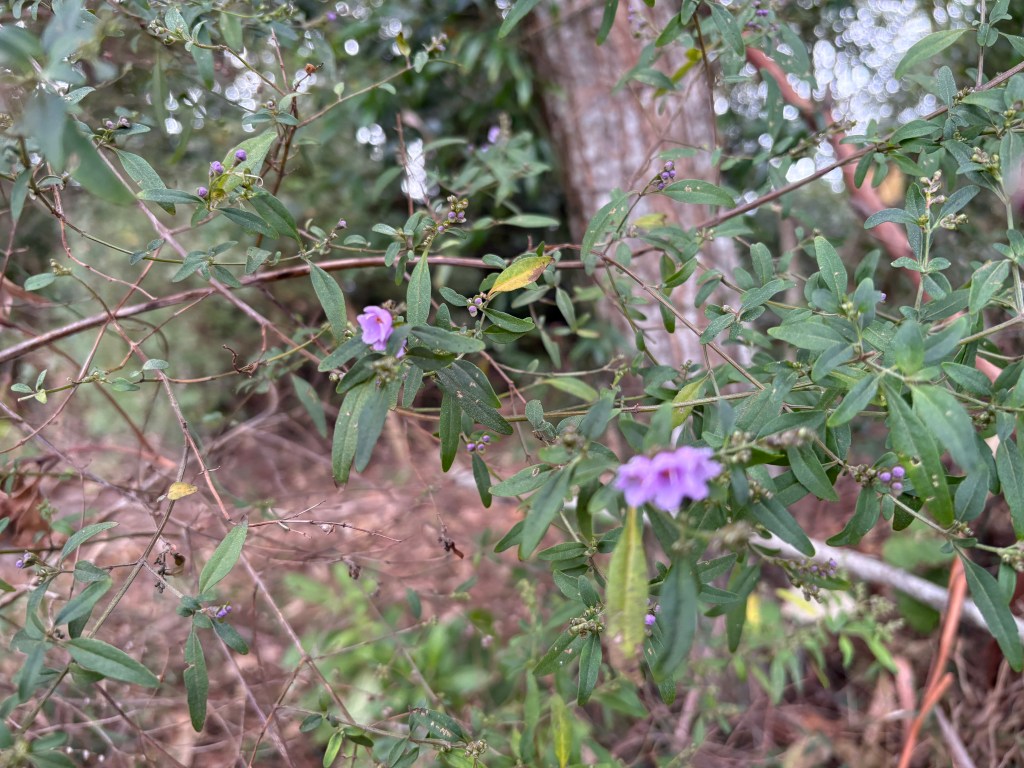
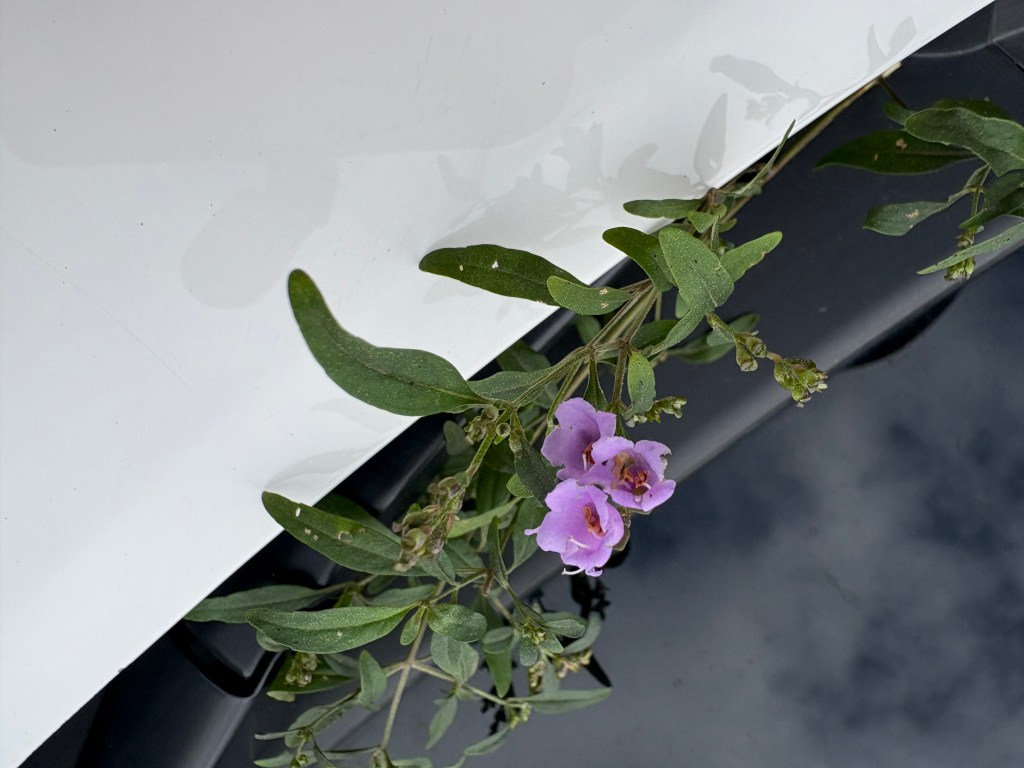
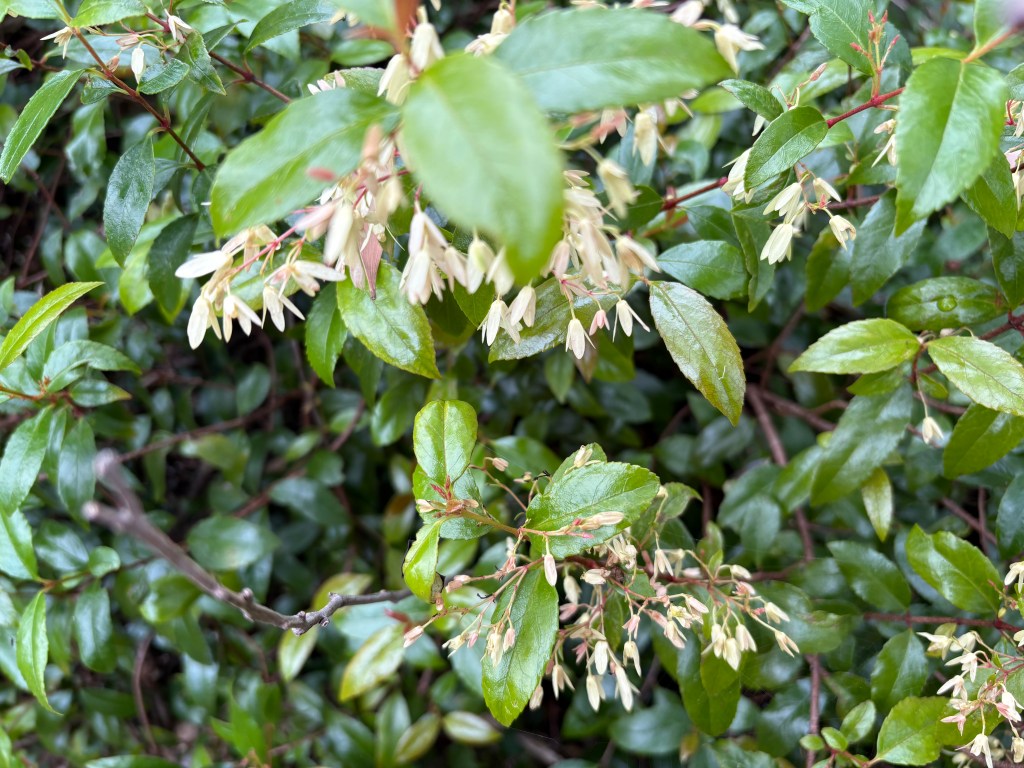
Other plants in flower this week are the native mint bush Prostanthera ovalifolia (below) which I picked and crushed in my pocket for its fragrance, and my climber for the week, Gum Vine or Aphanopetalum resinosum (below right) which was draping itself elegantly along a barbed wire fence. I don’t know why it’s not used more in cultivation because it grows easily and is a pretty thing.
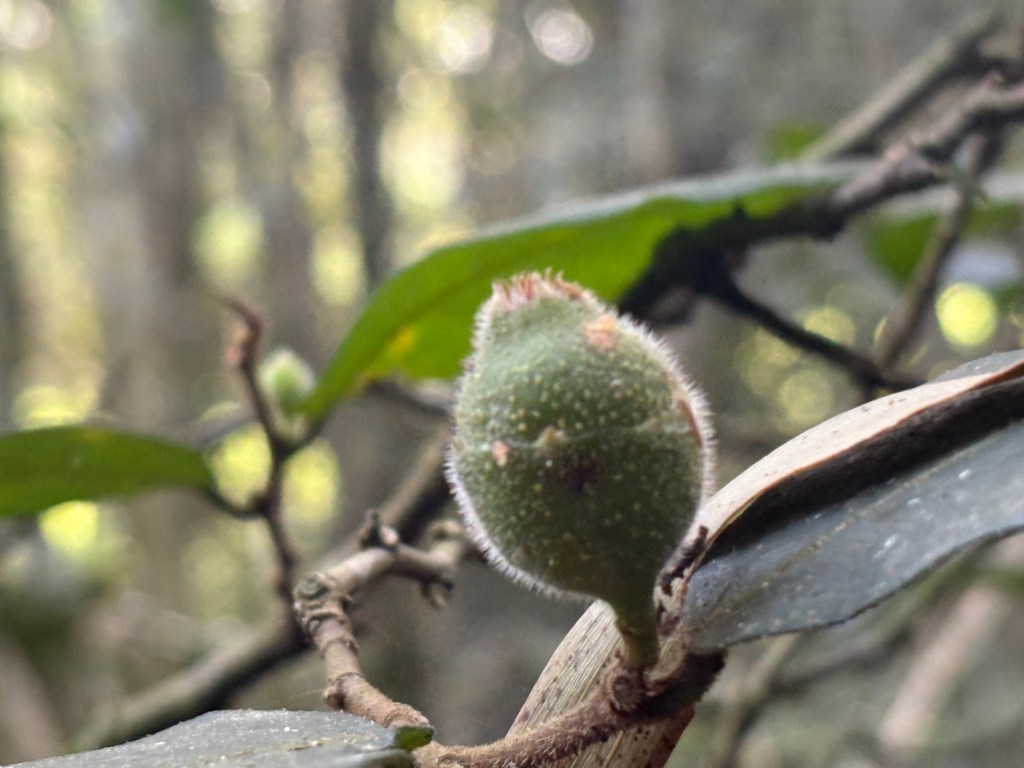
The only fruiting plant I could find this week was the nativer fig Ficus coronata, growing along the creek and holding up, as if for display, a couple of fine figs for my delight.
Late August 2026
Vines
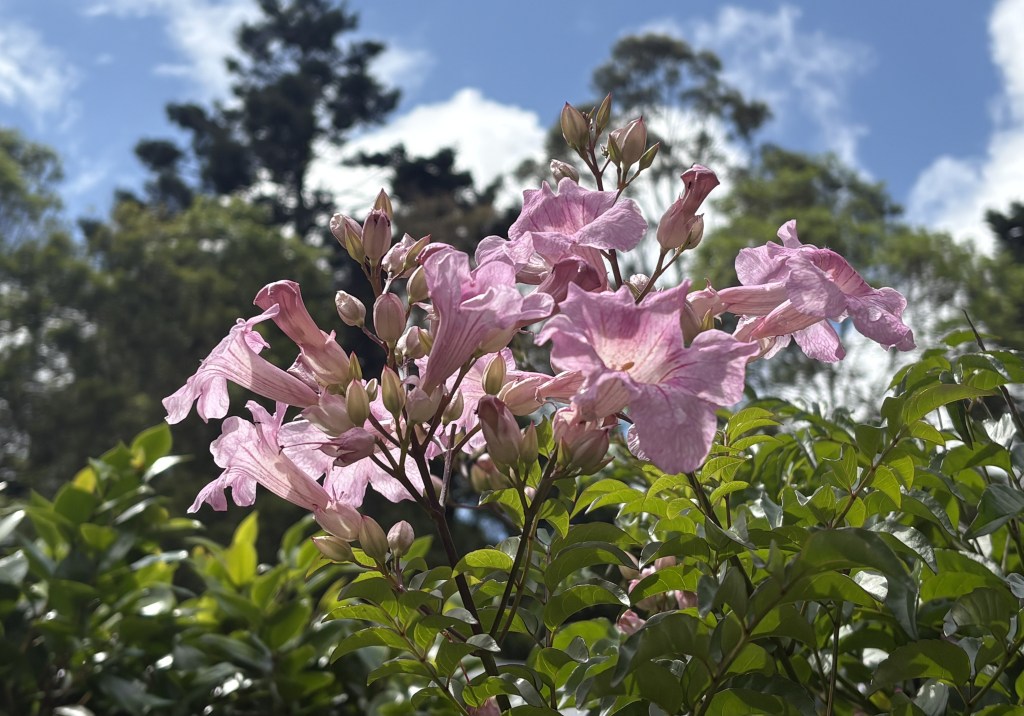
This specimen of Pandorea jasminoides is the rainforest vine best-known to gardeners because it has been bred in captivity to be available in many colours and not just the original mauve with purple centre. It’s a very vigorous climber of the liana type, developing long loops of thick stems as it matures.
It’s very easy to overlook vines when you are walking through a rainforest and yet they are one of the vital elements for stitching the canvas of vegetation together.
Even those that have spectacular flowers, such as the pandoreas and calleryas, are only noticeable when the blossoms fall on the ground because, like most plants, they head for the light and so can only be seen in the canopy.
I am fascinated by vines. As a plant group they are such poster plants for evolutionary strategy because they have come up with so many different ways to support themselves.
I suppose you could say they are lazy, almost parasitic, because unlike trees and shrubs and even herbs, which have to put a lot of energy into standing in one place and developing strong stems in order to do so, vines use those same plants to carry them where they want to go.
Some do it through twining around stronger plants, others use hooks or thorns, still others use suckers and then there are those – the laziest of all – who just sprawl over other vegetation.
The most spectacular climbing plants are found in the hot, wet forests of the tropics and their variety declines according to the distance of a rainforest from the equator. When I was hiking the mighty Tongas forest of western coastal Alaska last year, I noticed the absence of the loops of thick-stemmed climbers common to tropical forests and which are still found, though in less abundance, in the subtropical rainforest where I live.
My project for the rest of this year is to study some of the small, weak vines that we tend not to notice on our forest rambles. Probably the commonest climber on this subtropical mountain is Parsonsia straminea (Common Silkpod or Monkey Rope Vine) which uses adventitious roots along the stem to cling to the supporting plant and sending our long, thin, leaf-bearing tendrils to extend its reach to further-off branches. This is a very aggressive climber that, with age, develops thick, corky, very tough stems. If it should take root in your garden, usually from a seed dropped by a bird, it will take over fences, force its way into gaps and is also happy to encircle a drainpipe. It’s happy to take over gutters, too, and rain heads.
In the forest it can cover large areas of tree canopy. The leaves are large at maturity and opposite along the stem; the shape varies from elliptic to linear and the long pods contain lots of silky-haired seeds, hence one of its common names.
There are many different kinds of Parsonsia which have adapted themselves to different types of forest, altitude and climate. I was delighted to find a rare one this week – or at least one not previously found on this mountain because usually it is restricted to a small area of northern New South Wales. A mystery, which I am endeavouring to solve!
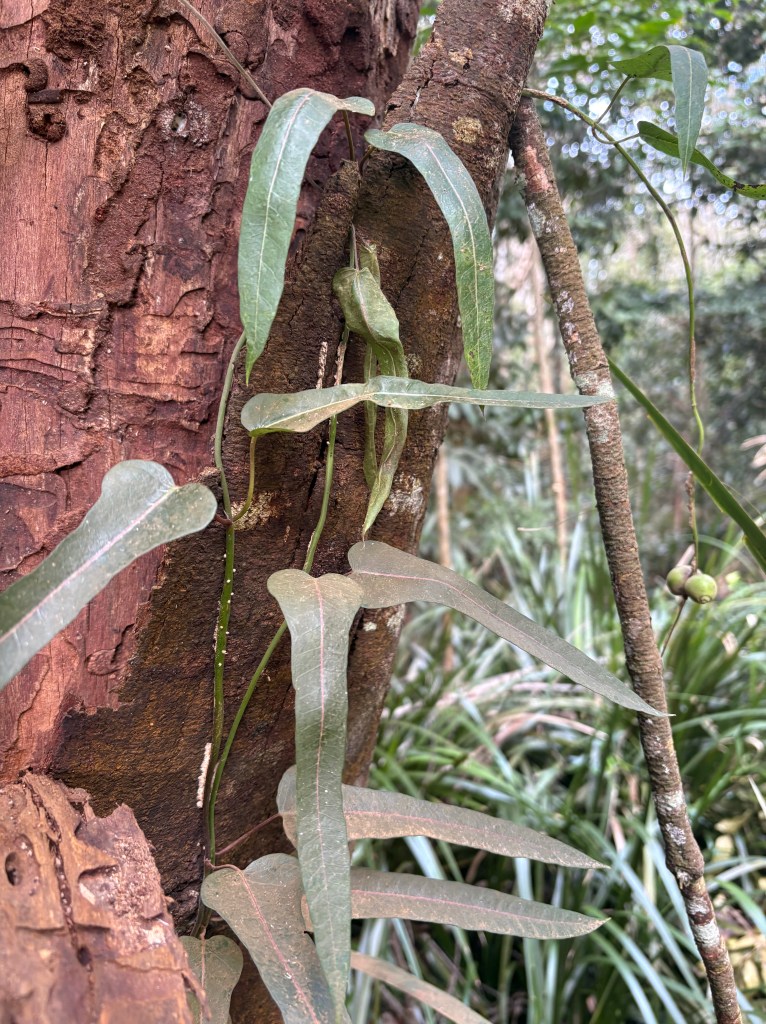
The long leaves with their distinctive basal lobes of Parsonsia dorrigoensis, found this week growing a long way north of its usual habitat. A mystery. The leaves are covered with fine sawdust from the decaying tree upon which the vine is fastening its thousands of tiny adventitious roots, enabling it to grow from its roots in the ground upwards as far as its support tree (or shrub) will allow. The vine itself, if you look closely at left, is supporting the larvae of some sort of insect.
That’s one of the things I love about rainforests, they are always full of mystery!
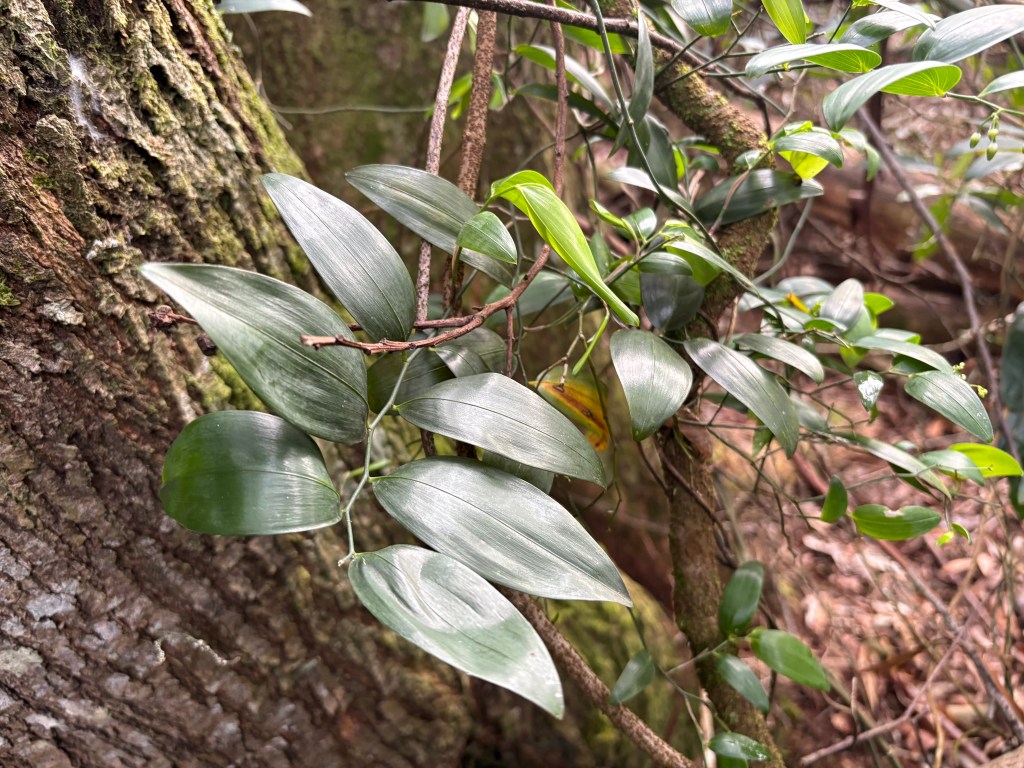
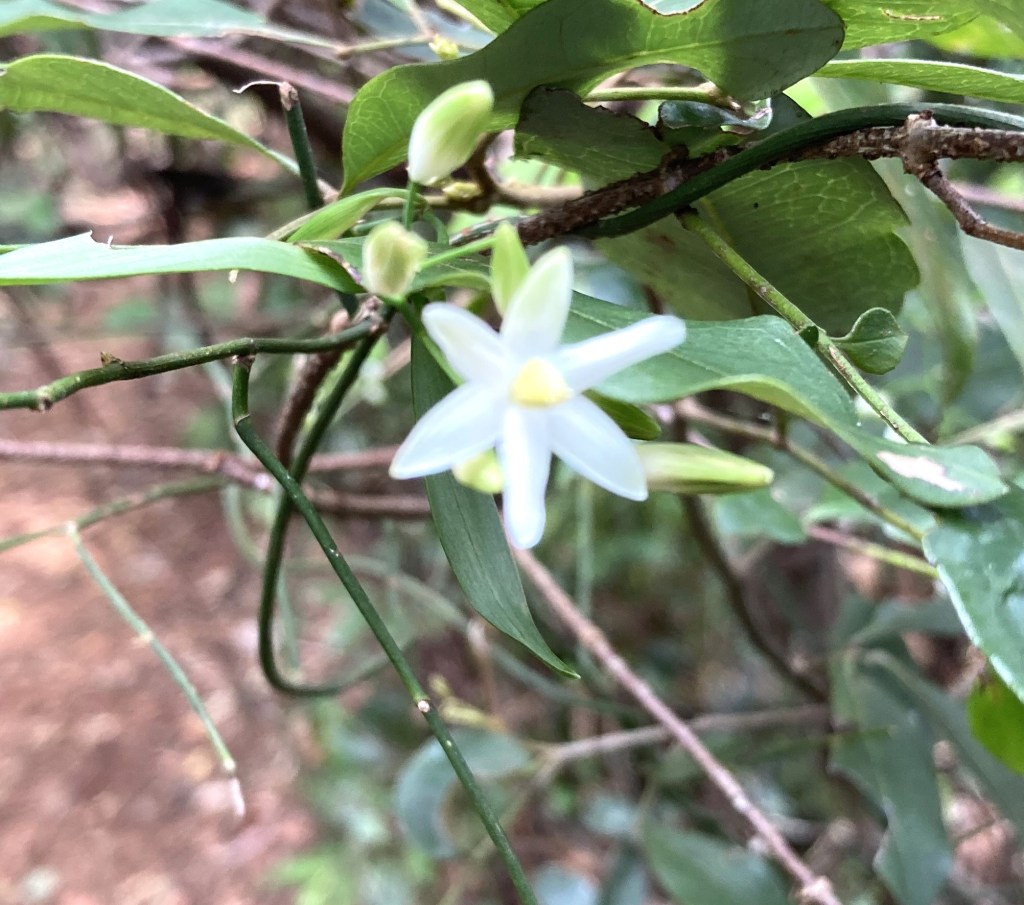
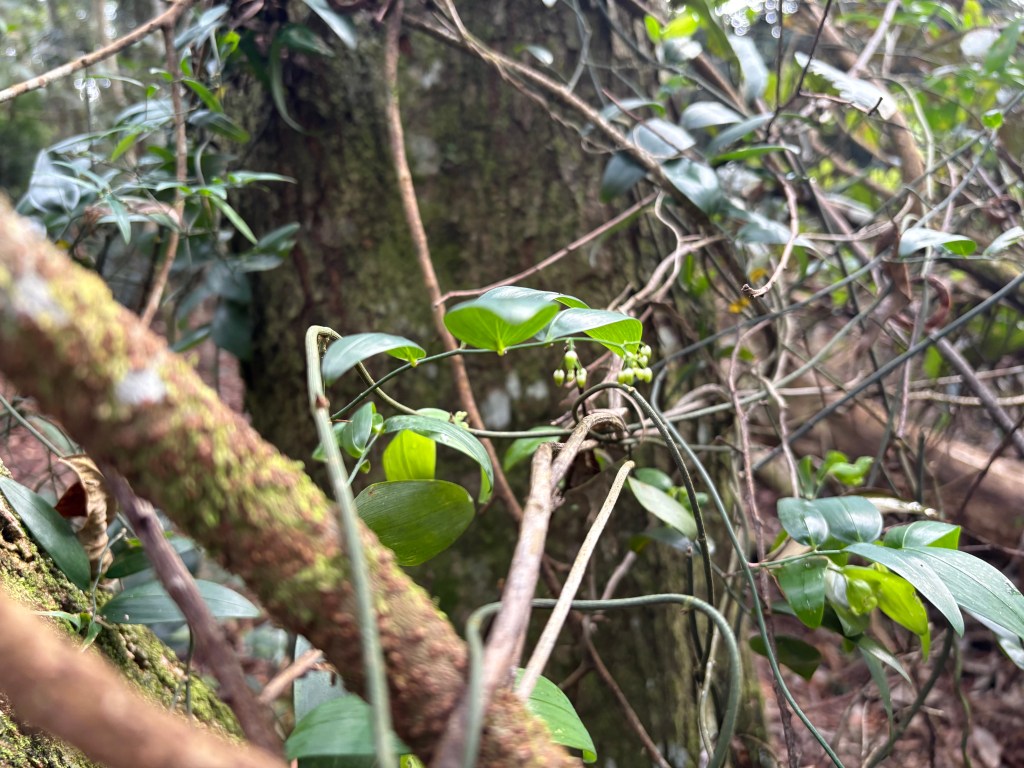
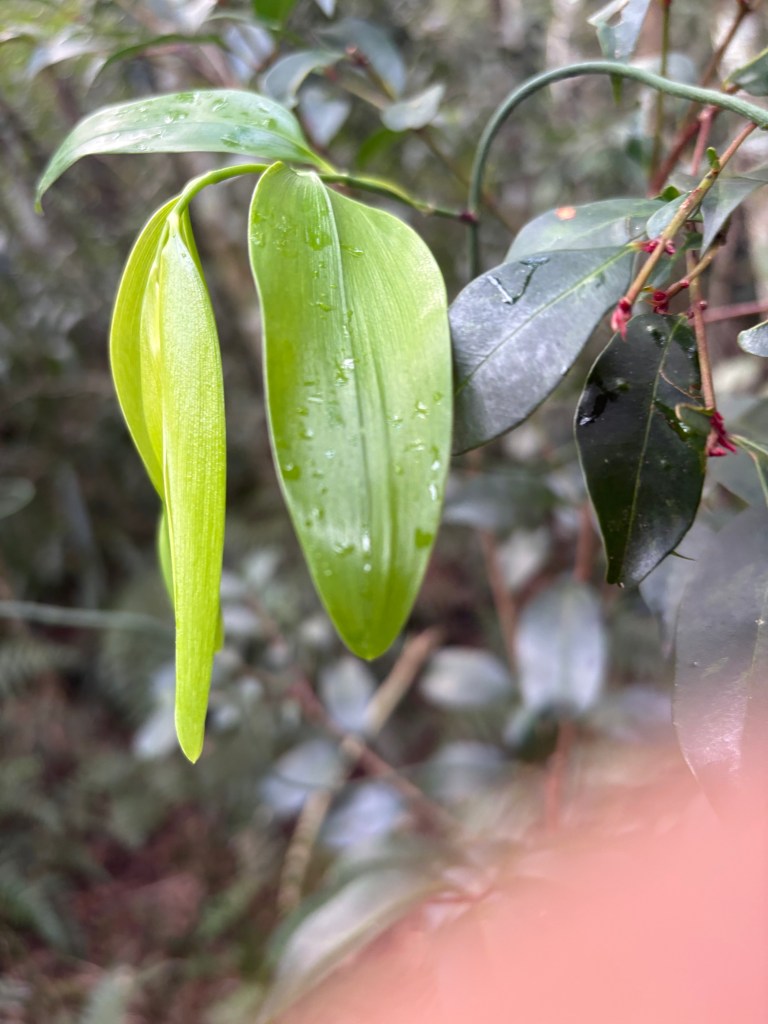
Spring has arrived early this year and with it new growth on most rainforest plants, including the climbers. Thus it was easy to spot one of our commoner but not particularly noticeable vines, Geitonoplesium cymosum, sometimes called by the much simpler common name of Scrambling Lily. This is very much a plant of rainforest margins because it also grows in molst eucalypt forests. It’s very easy to mistake for the Wombat Berry (Eustrephus latifolius) because they have similar leaves with many longitudinal veins, except that the mid vein of Scrambling Lily is pronounced, the five-petalled dainty flowers are white and the fruit turns from green to black when ripe.
The role of climbing plants in any forest must be mostly beneficial or they wouldn’t be there at all, and in such a profuse variety. Their fruits feed birds and some animals, the flowers provide nectar for insects and, in a few cases, birds, their foliage can help protect stems from damage and canopy leaves from wind and salt spray. Though in the case of the big, heavy vines, the canopy beneath them can suffer from being overweighted, leading to the felling of the entire tree during strong gales.
For the most part, climbing plants and those that support them appear to live in harmony and they make the rainforest a more complex, interesting place. I’ll be introducing you to more of them during the next few weeks.
Below: Scrambling Lily (Geitonoplesium cymosum). If you look hard at picture bottom left you can see the tiny green fruits hanging down; they’ll turn black in the next week or so.
Birds are very active this week as testosterone swells with the spring. I was delighted to put up a Brown Goshawk which was lurking quietly on a low branch, waiting for prey – possibly a fat pigeon although they’ll take currawongs and even kookaburras as well as rodents and small marsupials. My bird had taken up prime position in an area of light forest and open meadow with rainforest along one margin – smorgasbord for a goshawk. At first I thought it was a Grey Goshawk because a pair of Greys have long claimed this territory but then, when it settle in a tree not far away, I saw that the colouring was too dark.
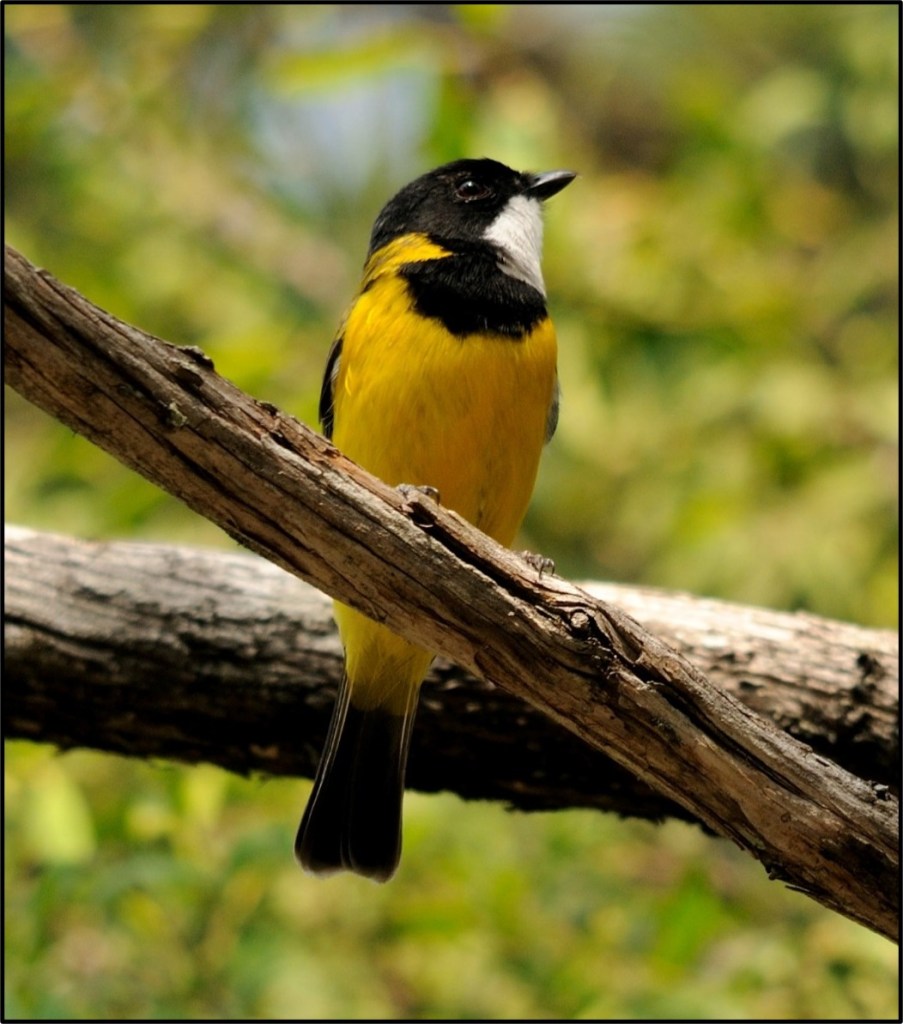
Large-billed Scrubwrens were particularly active in the bush along the creek, which is only a couple of pools at this time of year, but my favourite bird of the morning was a male Golden Whistler (below) – I have a saying, well known to my mountain birdwatching companions, that “any morning you see a male Golden Whistler you know it’s going to be a great day!”. Never fails!
………………………………………………………………………………………………………………………….
Early August 2026
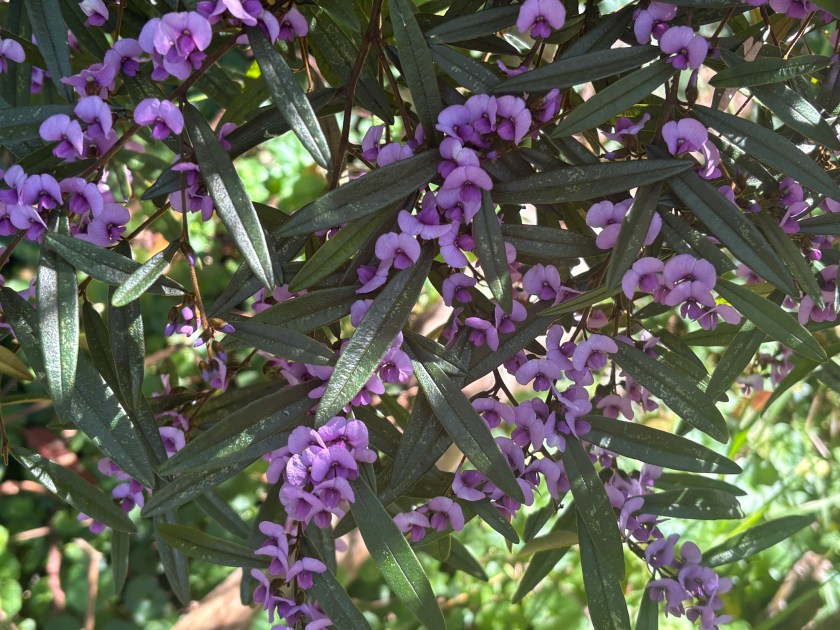
Hardenbergia violaceae: see article below.
Yes indeed, spring IS in the air though it’s a month too early. And yet there is that slight tingle you get when you feel that things are changing, that life is bursting forth in many small, almost imperceptible ways. Birds are more active, plants are sprouting buds, grass is growing again, the air feels fizzy.
It helps that we have had a bit of rain, with more promised. And that the the temperatures, though cool, are not as cold as usual at this time of year.
I walked in my favourite place, the Landcare site and adjacent cliff-edge forest at the end of Hartley Road. A road that, at its eastern end, goes nowhere except the edge of the escarpment. Below is some of the best unspoiled, unlogged subtropical rainforest to be found anywhere in Queensland and you can sit on a rock at the edge and examine the canopy for birds and plants. Here you have a rare opportunity to study trees and climbing plants from the top down, noting the flowers that are rarely seen except as spent blossoms at ground level. Birds, too, such as fruit doves can be better seen from this vantage point as they nest in the canopy and find fruits there.
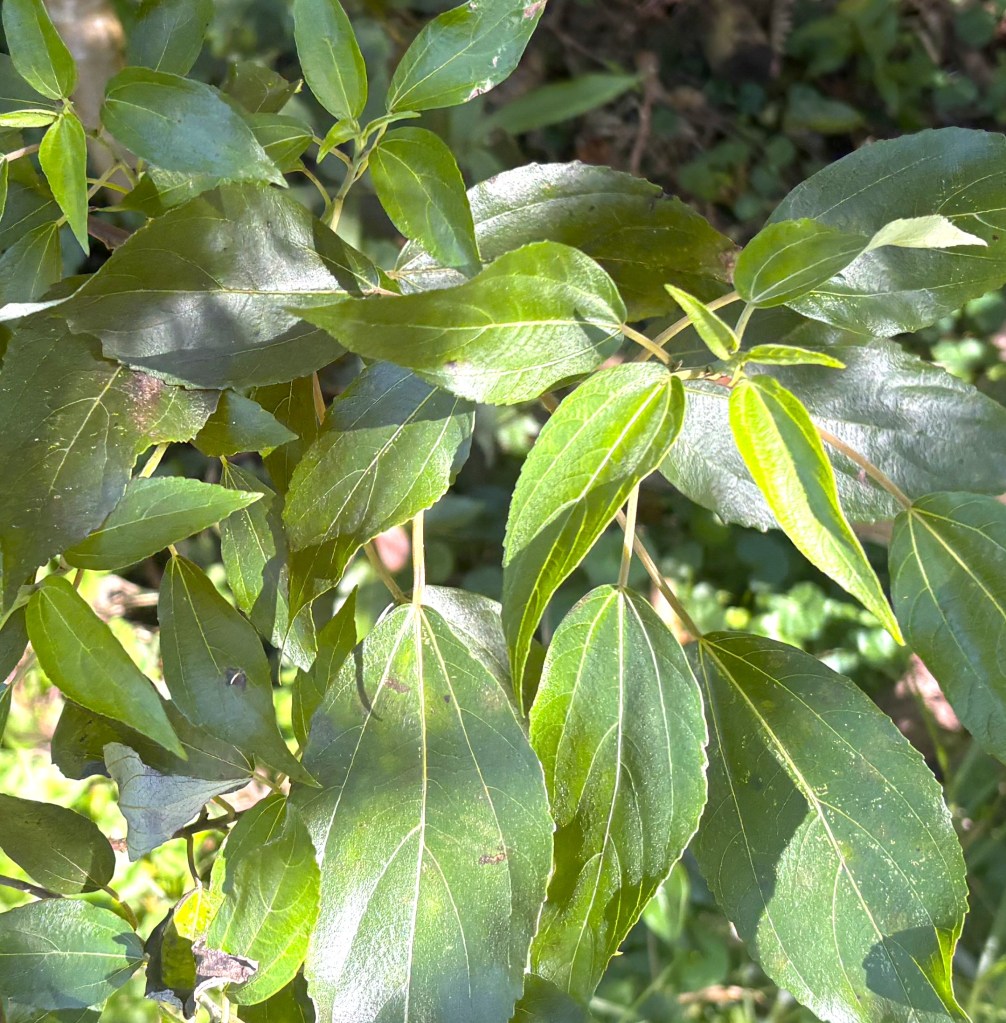
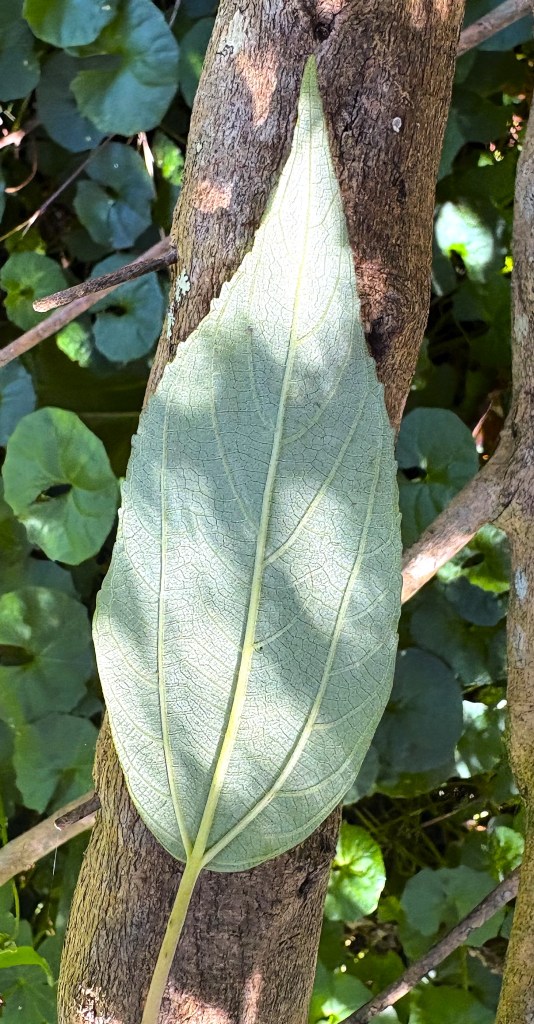
The leaves of the Native Mulberry (Pipturus argenteus), showing details of the silvery-green underleaf which gives this plant its species name. Tiny white flowers are inconspicuous but the small, white round fruits are edible. Unfortunately I couldn’t find any on this plant so shall try again next week!
The most colourful floral show at the beginning of my walk was the Hovea (Hovea acutiflora) which has blooming for a couple of months now and seems to be putting forth a burst of blossom before retiring into obscurity for the next nine months or so. It’s like the garment of an emperor of old, thrown carelessly over a bush!This is a plant of rainforest margins and the adjacent eucalypt forest; a typically pea-flowered legume that brings the bush alive during cooler season. From a distance it attracts the eye, close up there is glory in the massed flowers in their shades of purple and mauve. These are a favourite with the tiny native bees and also with other pollinator insects.
I’m surprised to see the small, round, edible fruits of Orange Thorn (Pittosporum multiflorum) still on the bush and pick a few to take home and add to my larder. They have a piquancy that makes a lot of dishes more interesting and are very good in marmalade, pickles, chutneys and other relishes. You have to try and avoid the thorns which are not easily visible unless you look close – though stick your hand in the bush and you’ll know they’re there!
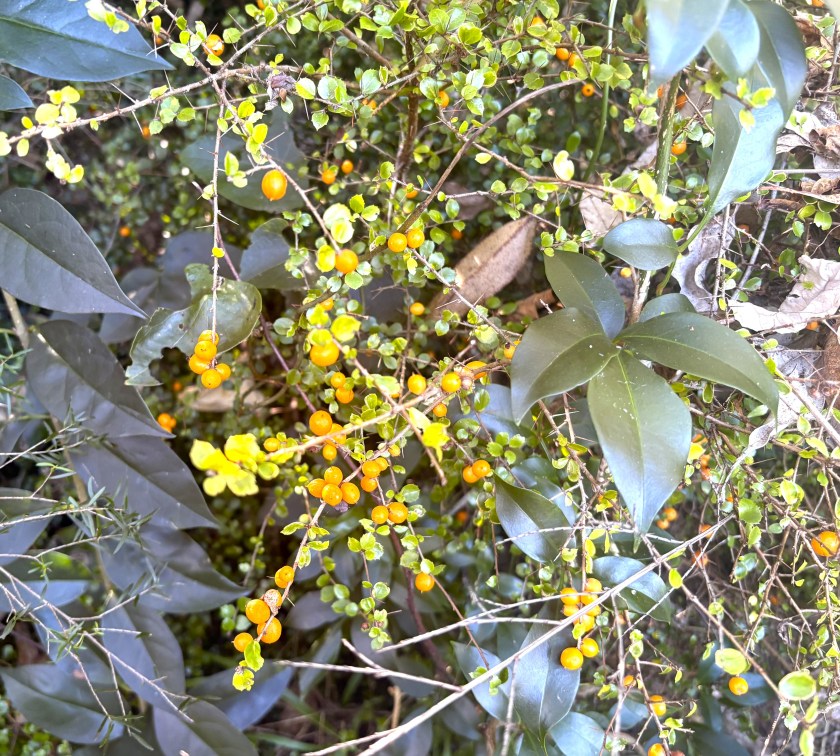
Orange Thorn (Pittosporum multiflorum) – fruit colour can range from orange to yellow.
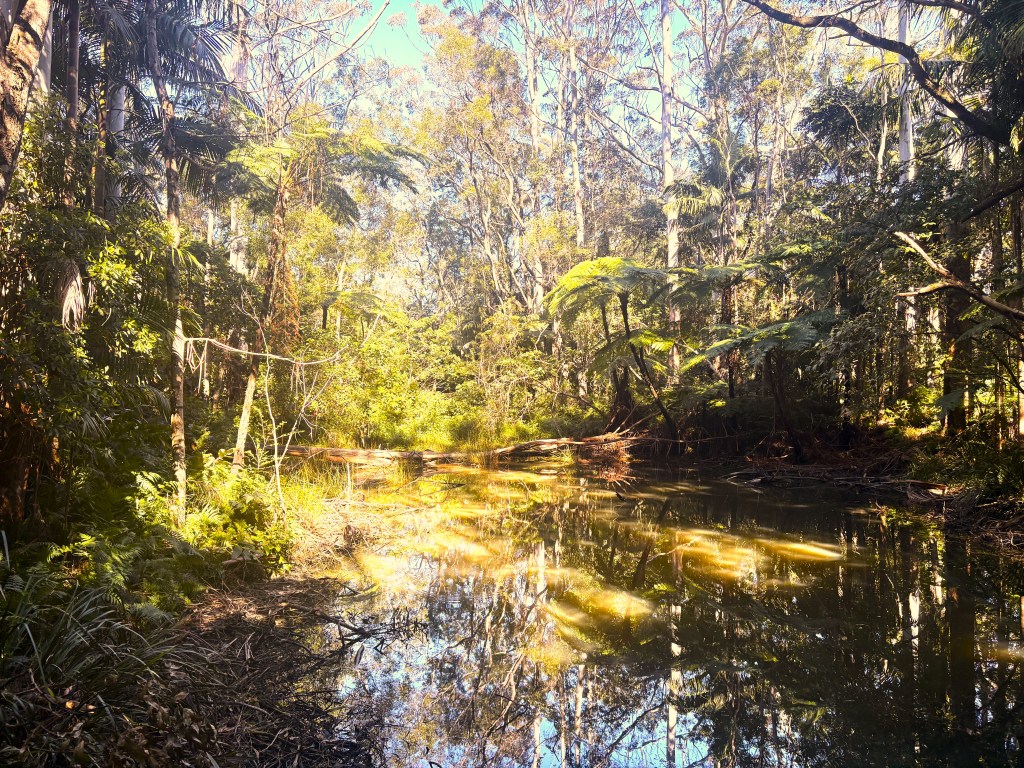
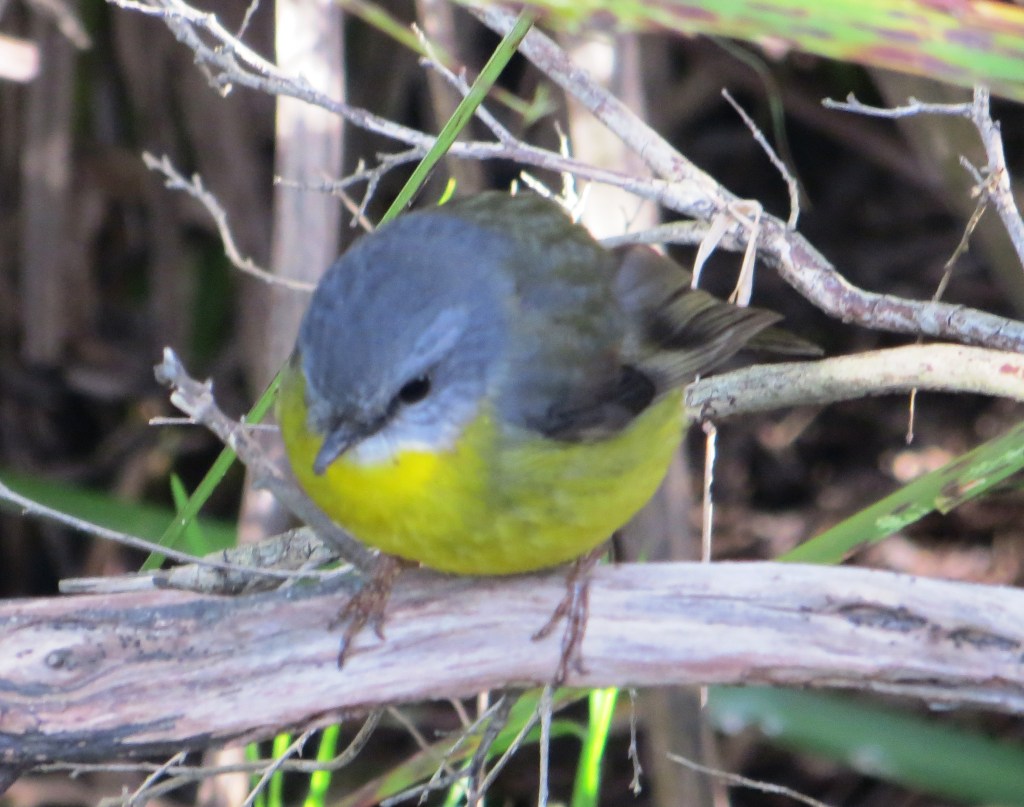
It’s a beautiful day, crisp and cloudless. I visit my favourite little forest pool to see what’s doing there…not much! I check the surrounding shrubs for a Rose Robin, one of our winter visitors, which someone had seen nearby but, alas, it didn’t show. Instead, a Yellow Robin dropped to the ground in pursuit of an insect; this cheeky little birds sit quietly in ambush and don’t miss much.
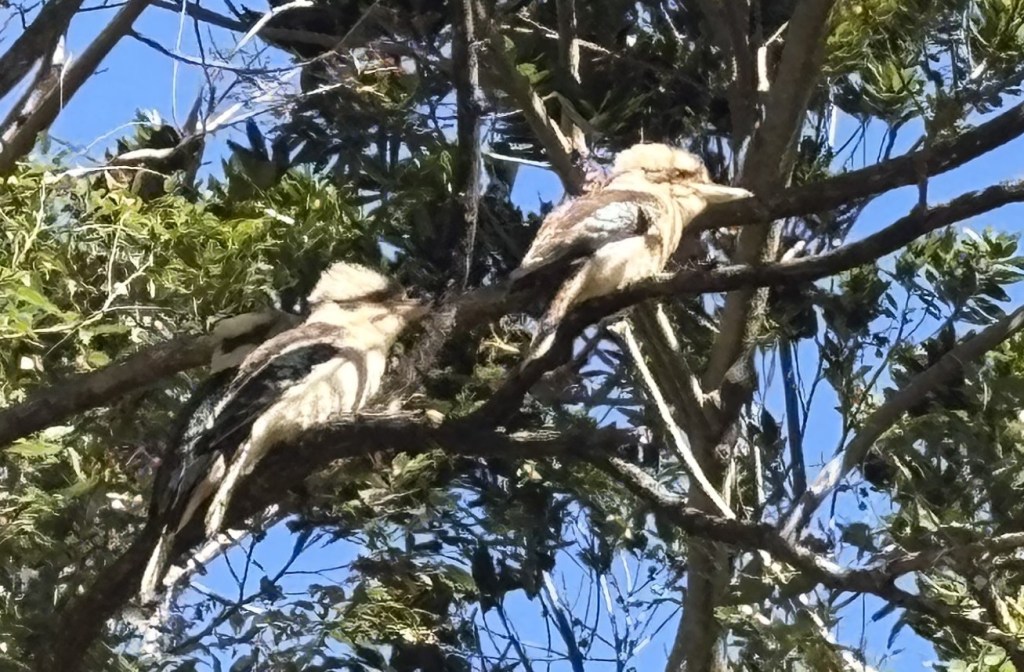
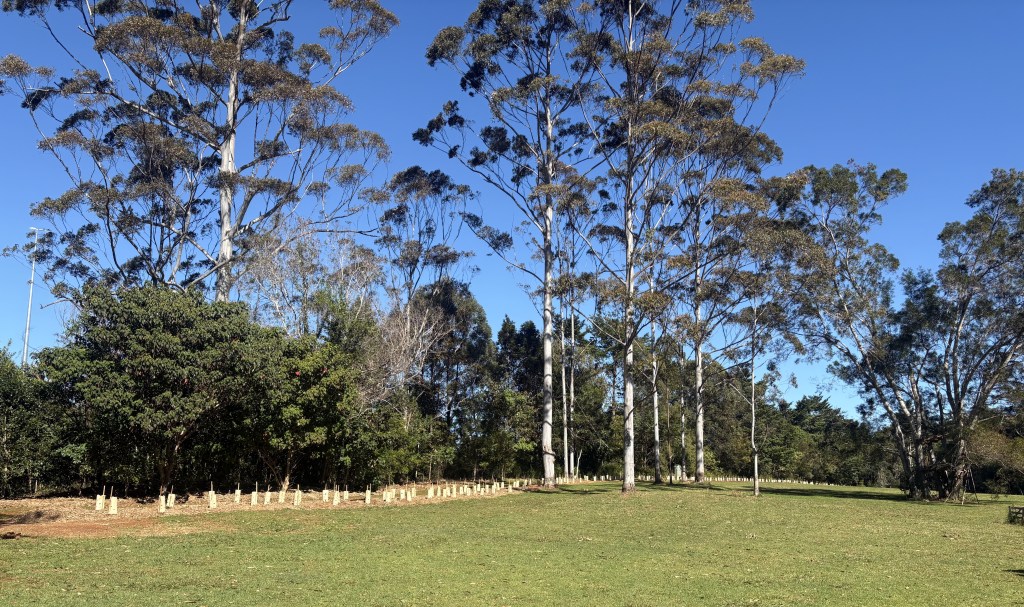
Out in the open meadow belonging to the local Boy Scout troupe three kookaburras chase each other from tree to tree, laughing all the while. Close to this line of fine Flooded Gums (Eucalyptus grandis) the local Landcare group has planted a long line of endemic species which, when grown will form a walking corridor with the eucalypt hedgerow between this meadow and the sports ground beyond. I think this was the outcome of this year’s National Tree Day which Landcare organised and supervised – a fine addition to the mountain’s revegetation program.
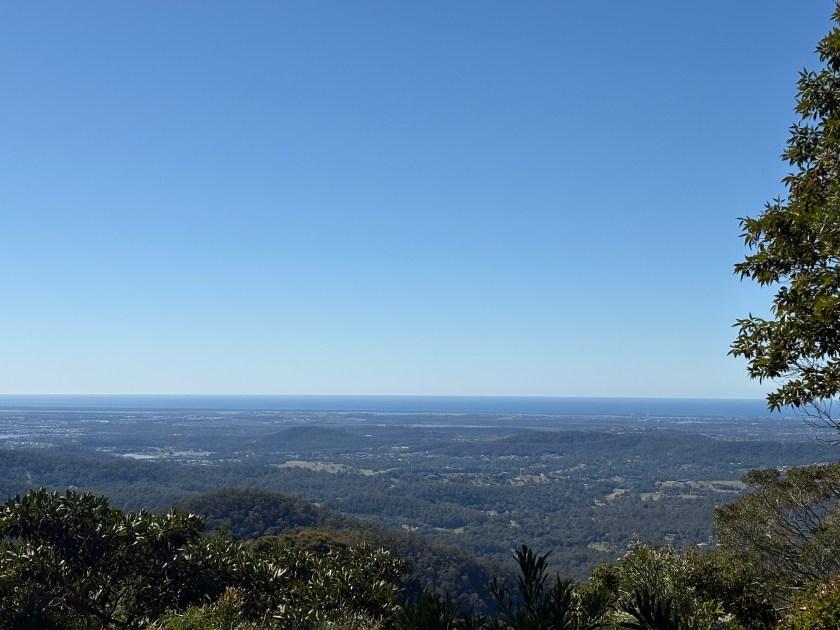
At the end of the cliff path I stopped to look over the valleys below to the sea. In the tree beside me a young Golden Whistler, one of this winter’s brook and still in its drab juvenile feathers, tried out his song with a few uncertain notes and then a loud, confident whistle. I knew how he felt – a beautiful sunny morning in the bush is well worth celebrating.
A hint of Autumn – March 23 – 30
It’s autumn in the Australian rainforest but there’s only a hint of it in the slightly lower temperatures at night. The days are still warm, butterflies are still fluttering, some trees are in flower and the rains of early March have given the vegetation a lush, sleek look.
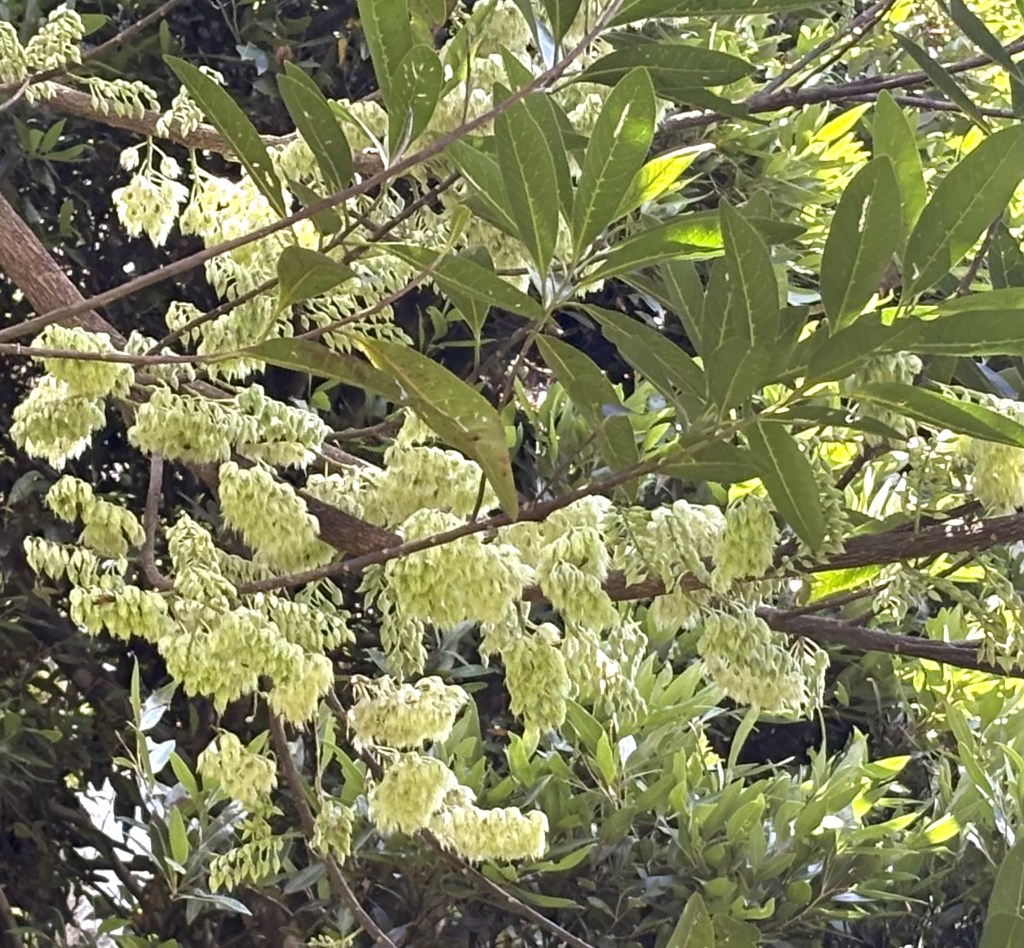
The most flamboyantly flowering tree right now is Elaeocarpus grandis, or Blue Quandong, its creamy, fringed blossoms carpeting the forest floor in places. This is a huge tree with branches that extend several metres at maturity so it scatters its flowers over a wide area, promising lots of rich blue fruits to come.
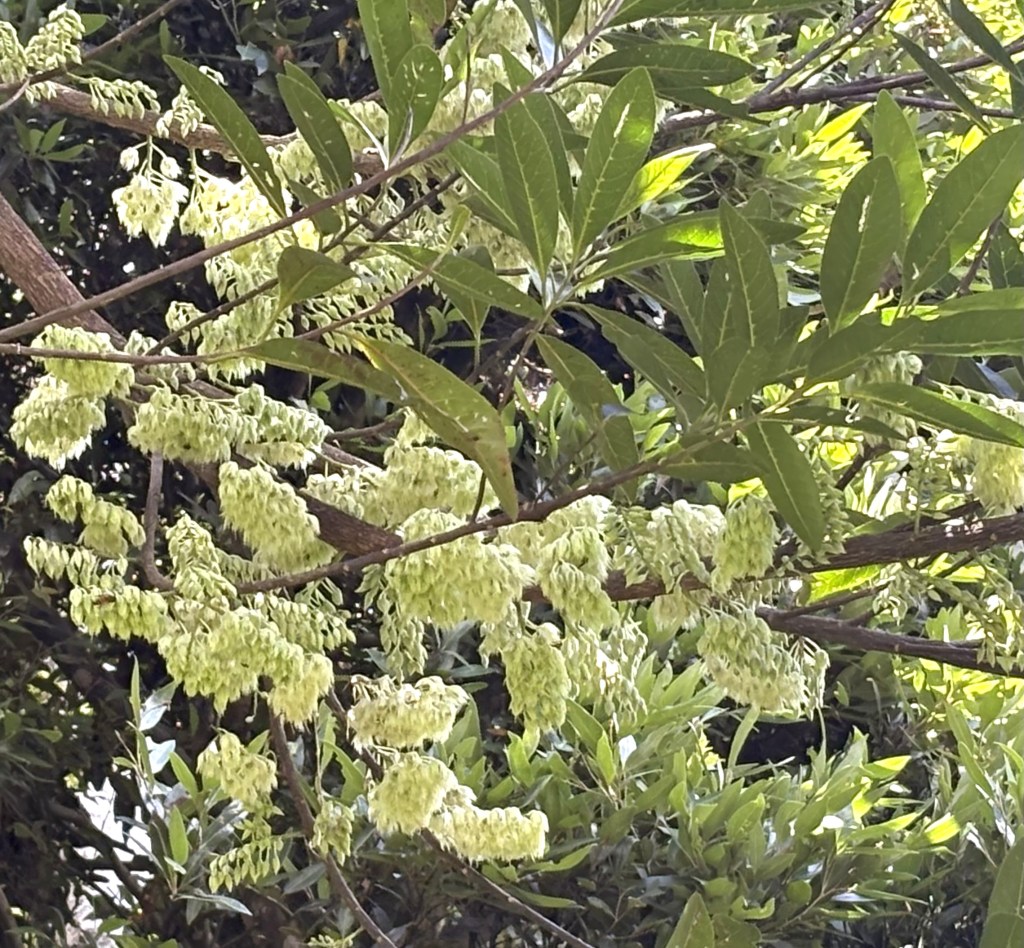
Eleocarpus grandis flowers – when they fall the cover the rainforest floor for metres
At the edge of the rainforest I found Leptospermum petersonii (a species of Tea Tree) in splendid flower – though not a plant of the deep forest it does grow around the open edges and its dainty five-petalled white flowers are a welcome sight at a time of year when most other local plants have finished putting on a show and are packing up for winter.
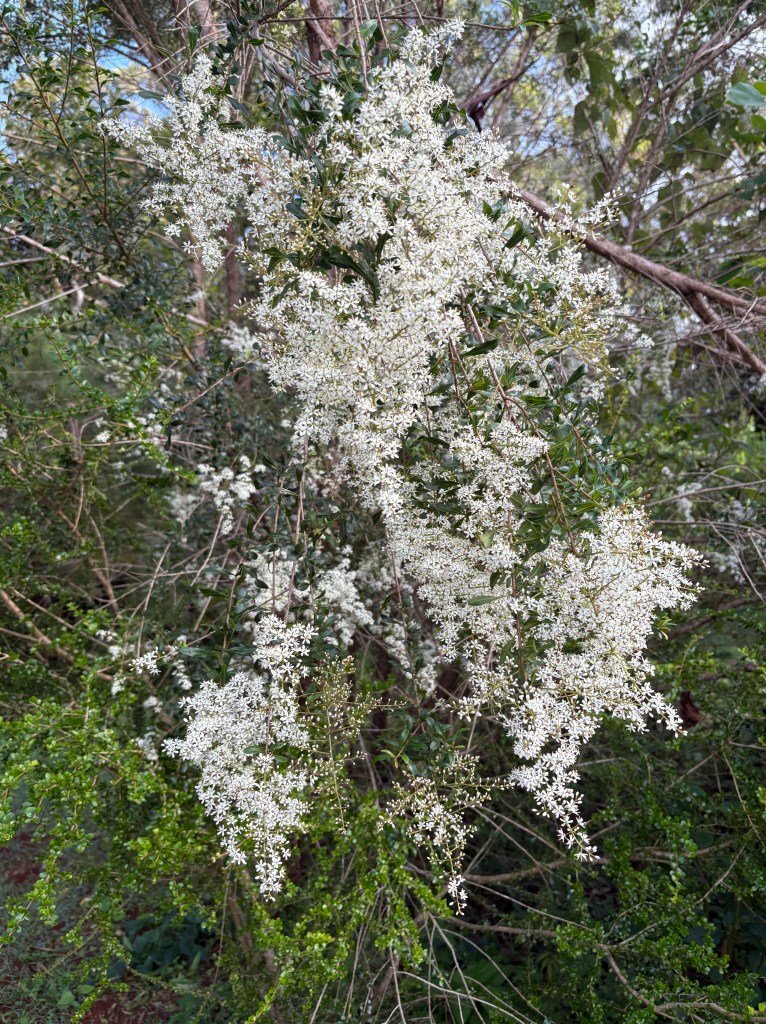
Leptospermum petersonii
When flowers are not plentiful, berries are there to brighten up the greenery. Cordylines are still dangling their stems of shiny red fruit and my eye was also drawn to the clusters of glowing purple berries of Callicarpa pedunculata. This rather straggly shrub with its modest flowers only comes into its moment of glory at this time of year. As with the tea tree, it grows at the rainforest edge.
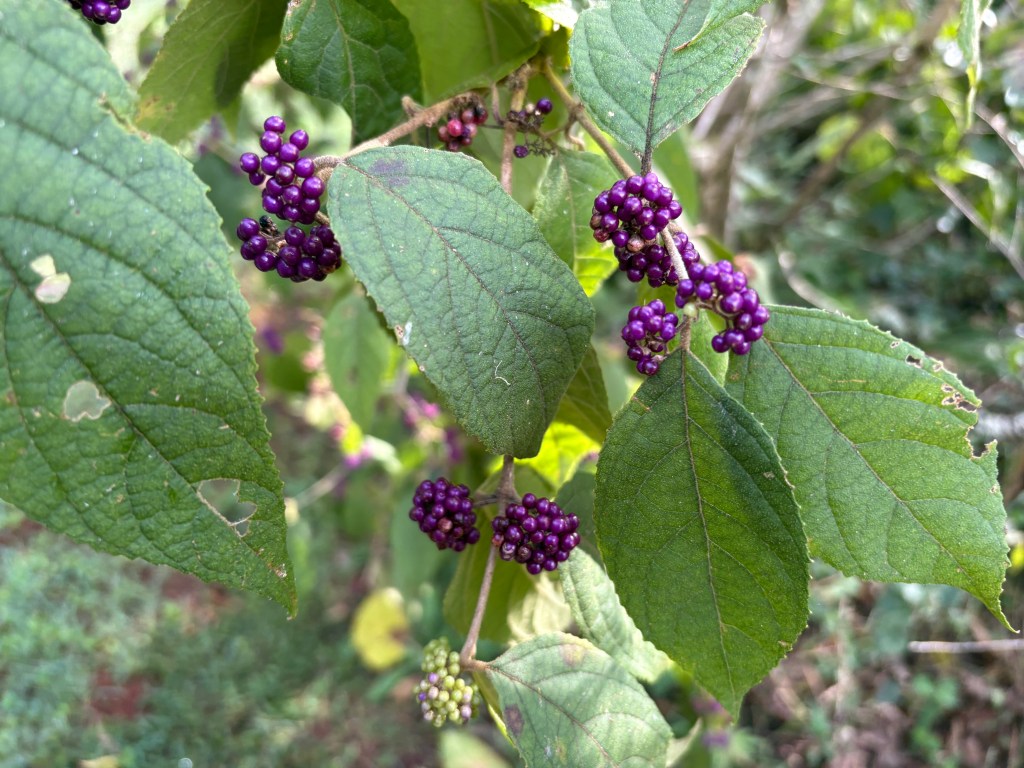
Berries of Callycarpa pedunculata
The most common bird this morning and certainly the most active, as usual, was the Lewin’s Honeyeater. Though the birds I saw were not chasing each other around all the time the way they do in spring, they were still both vocal and busy among the branches. A family of Brown Thornbills sang sweetly to each other with plenty of melodic variation but none of the chattering or the characteristic trill of the males that you hear in spring and summer. I like to assume that by now this year’s young have found their voices and enjoy using them and this year’s dads no longer feel they have to assert themselves!
Logrunners, too, are quiet at this time of year though in a couple of months they’ll be noisily disputing territories. When silent they are hard to see, scuffling in the deep leaf litter, their black and rich brown plumage blending into the surroundings. But my sharp-eyed companion spotted the bright orange breast of a female and we watched her for a while, apparently alone, which is rare for these apparently uxorious birds. Soon she will be thinking of nest-building and good luck if you can find one of these well-concealed structures of twigs and moss – I’ll be looking for them in winter and if I find one I’ll photograph it and put it up here for you to see.
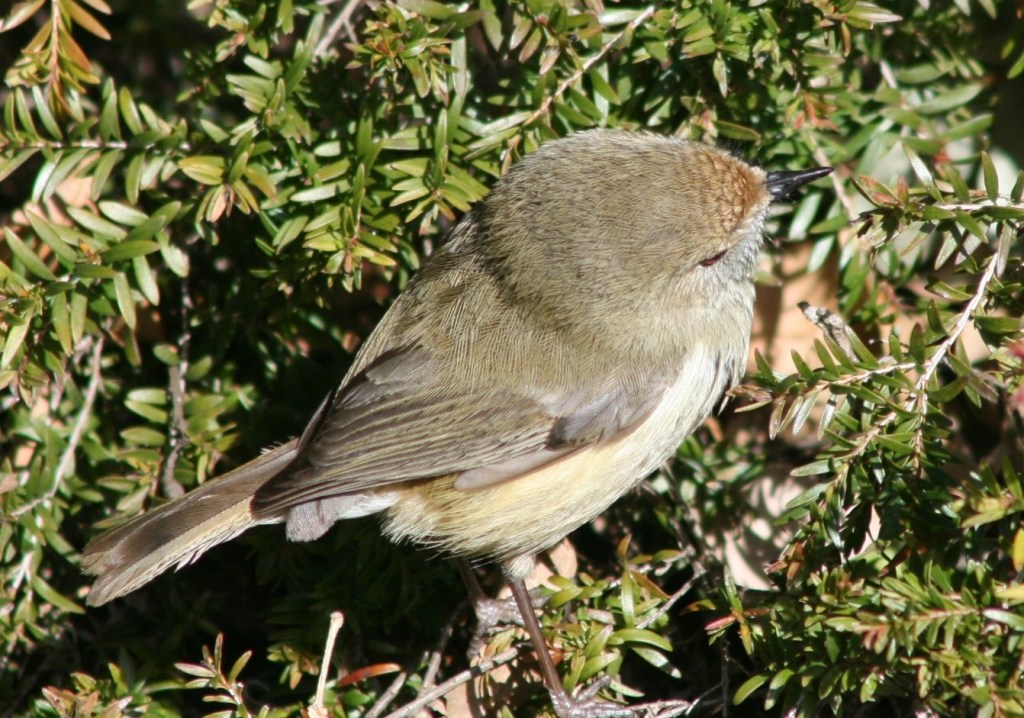
Brown Thornbill
Here’s a good tip!
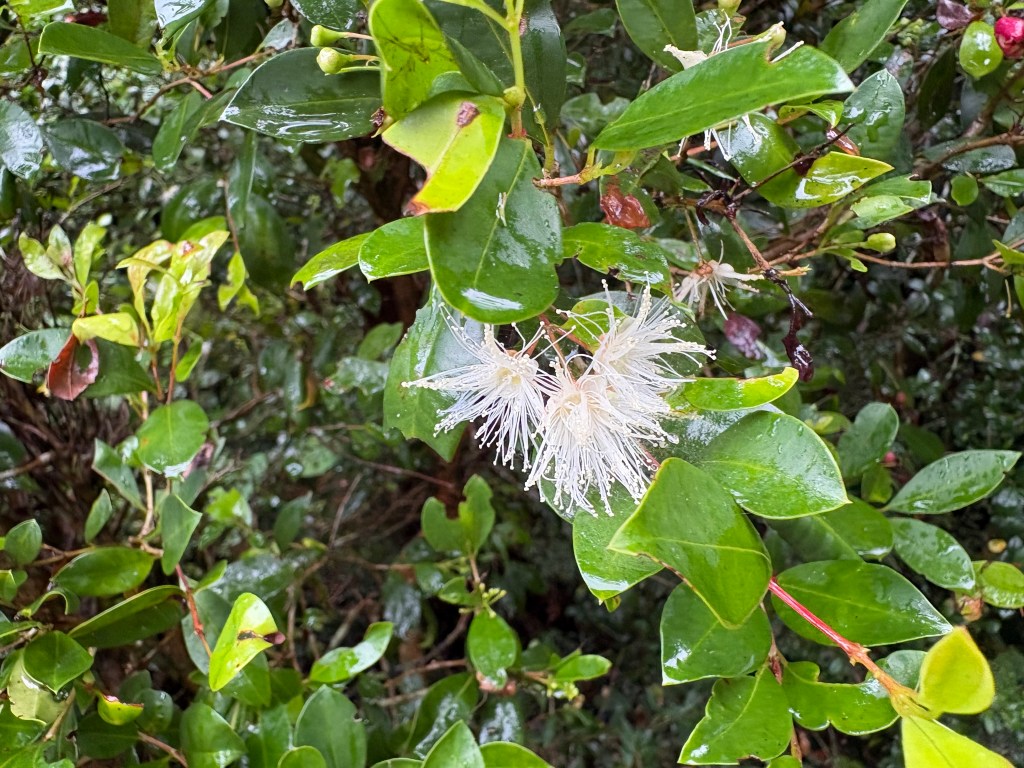
Syzygium australe has a modest but still sharp-pointed drip tip. Weight of rain will cause the leaves to point downwards, shedding the water load.
One of the great marvels of evolution is its development of forms and shapes to suit every kind of need – animal and vegetable.
This is visible everywhere you look in nature and the rainforest is no exception. For example, on the margin you will find plans with thorns or stinging hairs to keep outsiders at bay – I’ll write on this another day. Buttresses have evolved on some trees to meet certain needs, the ability to grow flowers on bark is another.
And when I went for my usual walk yesterday I paid particular attention to another wonder – the way so many leaves have a downward tilt and pointed, often long and slender points at the end.
These pointed leaves are called drip tips and their shape allows moisture to channel rainfall downwards to where it is most needed – the ground. Of course all leaves shed water but drip tips are more purposeful than flatter, broader leaves with blunt apices that tend to scatter rain rather than direct it. Drip tipped leaves are formed at an angle from the mid-vein to the outer edge, so that the central main vein forms a runnel. Side veins are usually straight and parallel, numerous and close, such as those of the lilly pillies (Syzgiums)and have an intra-marginal vein, running down roughly parallel to the outer edges of the leaf blade.
Paradoxically, though constant moisture is an important factor in the rainforest ecosystem, the thick canopy of broad leafed trees and height from the ground means that a lot of rain dissipates and evaporates before it can get to the roots of trees, buried under a thick layer of leaf litter. Thus the drip-tip species of trees and shrubs do better than others in temporarily capturing the moisture and then channeling it in a steady, controlled way.
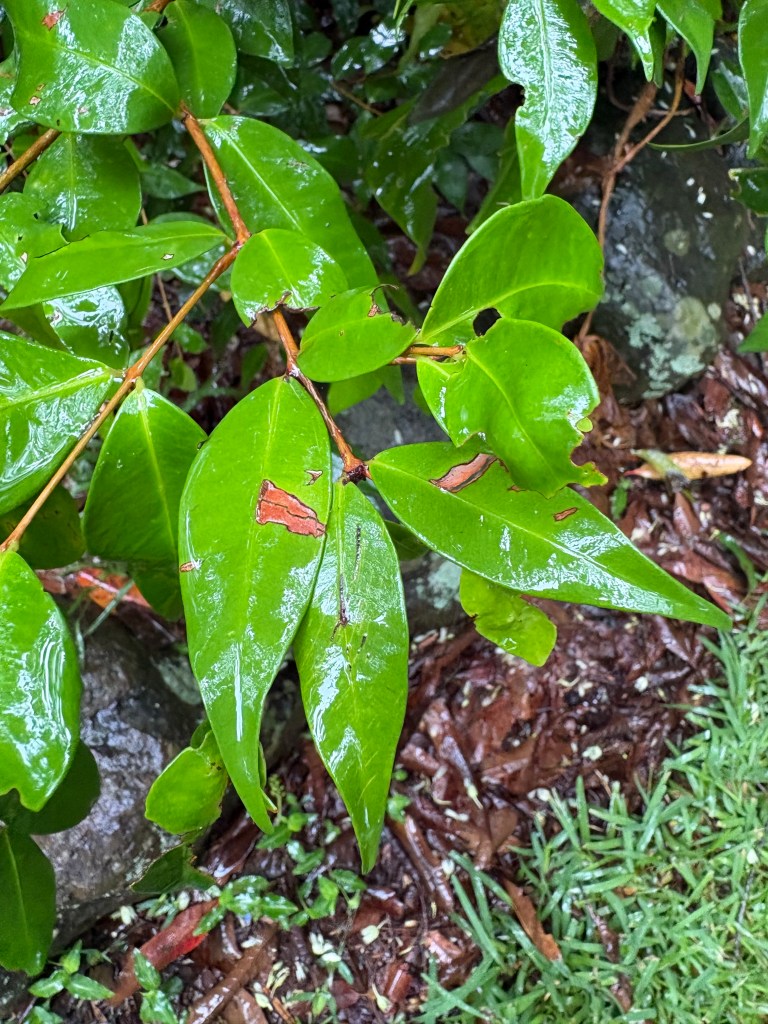
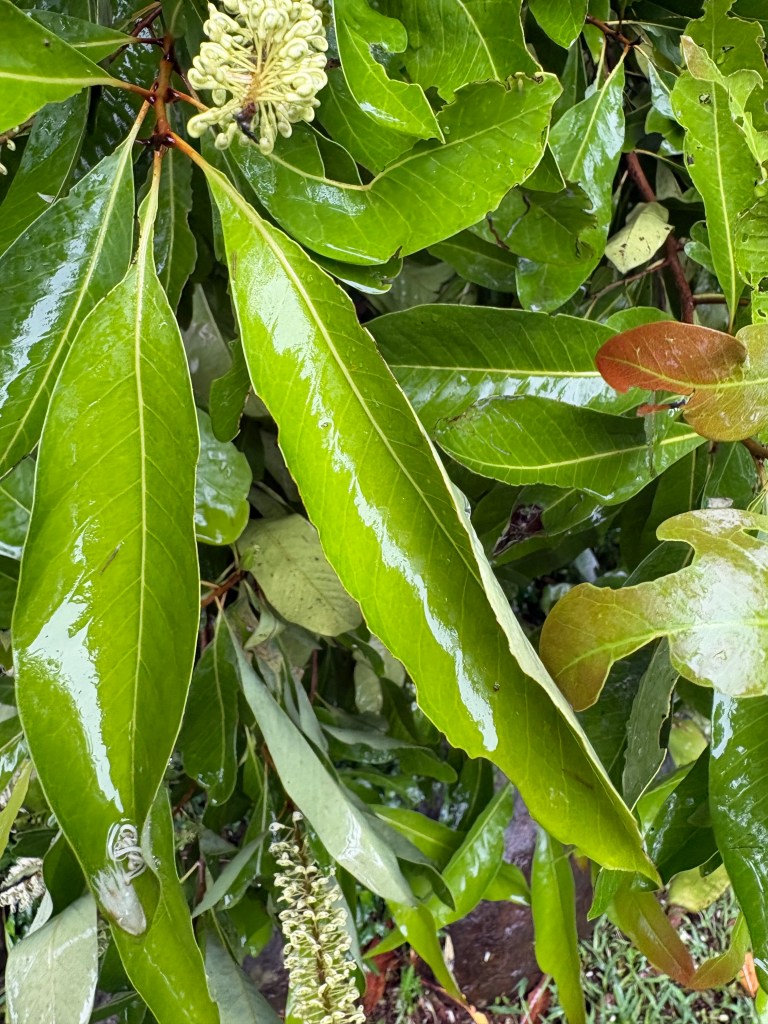
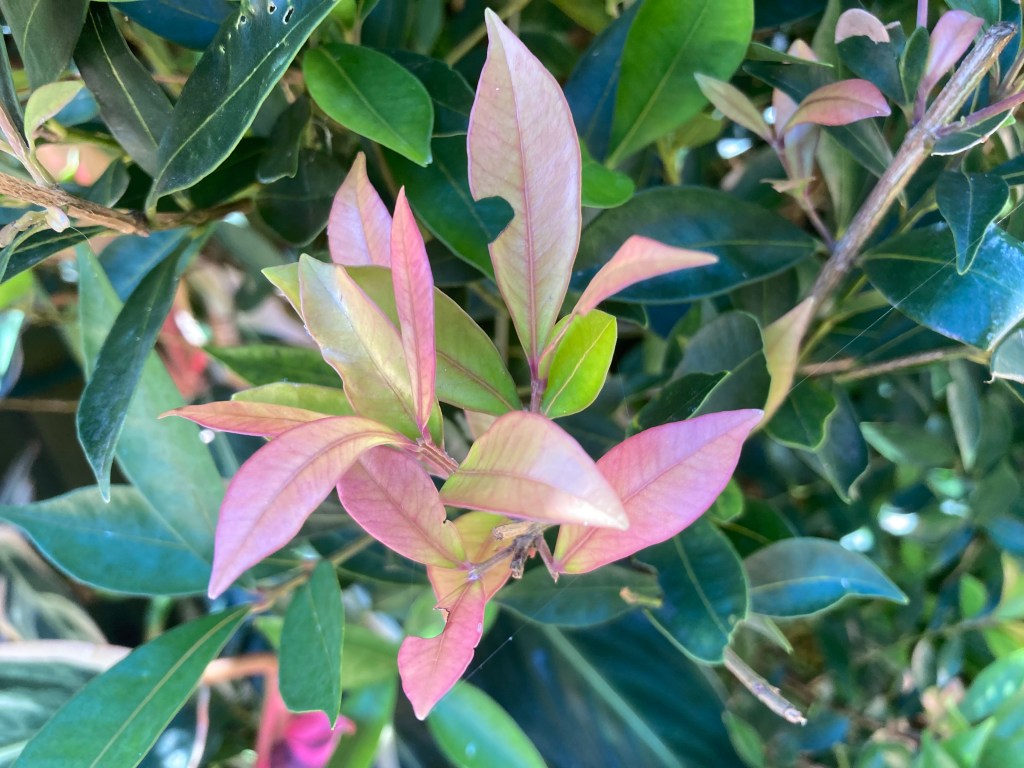
Left: The long, pointed tips of Syzygium leuhmanni, Right: The medium-length tips of Syzygium smithii and, in the middle, a very different tree, the long leaves of the lovely Golden Penda (Xanthostemon chrysanthus) with down-sloping pointed leaves that channel rain very effectively.
Mist – tiny droplets of water that swirls through the forest – is a vital moisturizer even when there is no actual precipitation. Drip tip leaves capture the mist on their shiny laminae (leaf blades) and, as with rainfall, send it groundwards. In fact the function of drip tips in misty conditions may be even more important than in downpours where rain can actually penetrate the canopy and reach the ground without specialized assistance. This “drip tip”theory of evolutionary adaption to circumstancircumstance was, at least, the prevailing one when I first began studying rainforest ecology forty years ago. I believe it is still valid.
And drip tips have other functions, too. By channeling the falling rain, in an environment where rainfall is as constant – or at least regular during the wet season – moisture which could otherwise cause delicate leaf tissue to develop mould is swiftly disposed of. Moreover, there is some belief that this swift disposal also assists photosynthesis in an ecosystem where every shaft of sunlight is precious.
I’m of a frivolous mind, so my friends tell me, and so I like drip tips because I think they are elegant! Especially when the leaves of so many species with this characteristics are flaunting their spring pink and copper and bronze.
And even when a shower or storm of rain has passed, these pointy leave extend the magic by keeping up a steady drip…drip…drip. Sit silently and you will hear it. It’s the drip of life!
Rain!
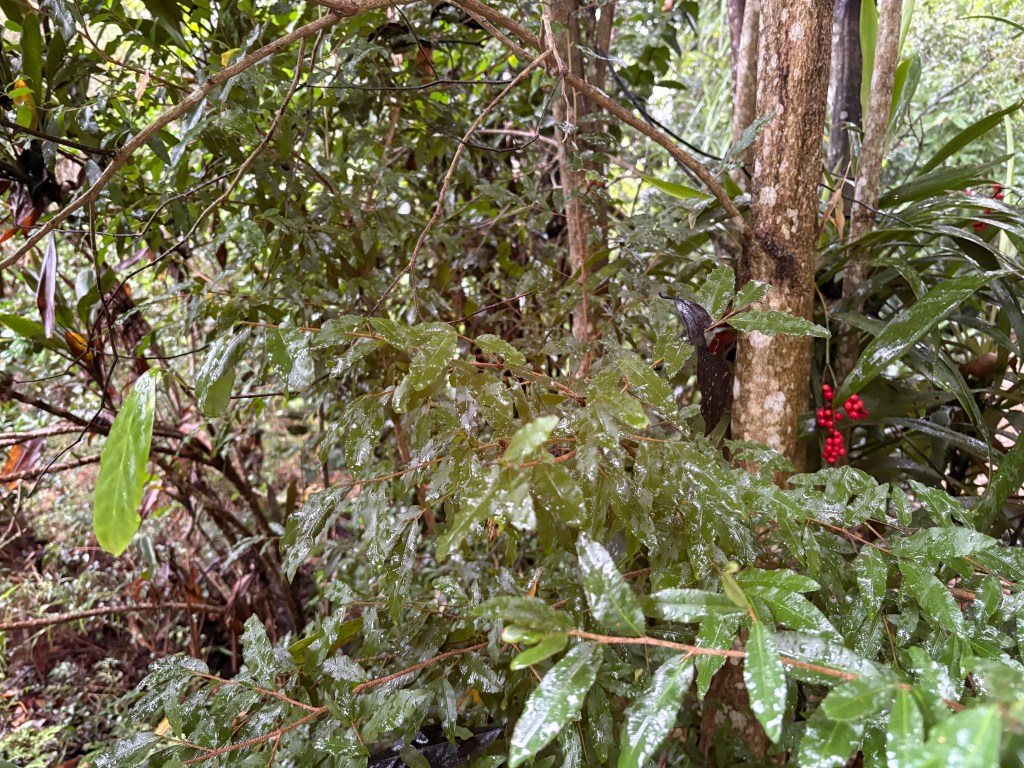
Rain at last! A month has gone by with very little rainfall and at this time of year – high summer in the southern subtropics – a lot of it is needed to offset the heat that sucks moisture from all living things.
When I went into the forest this morning the main sound was of raindrops softly striking the leaves and a rhythmic drip…drip…drip. Such a welcome sound and above the birds were applauding it.
Beneath my feet the litter was dark with moisture and there was that rich scent of decaying vegetation, suddenly accelerate by two days of constant moisture.
This is what nurtures the rainforest. Rain, and the mist that often accompanies it.
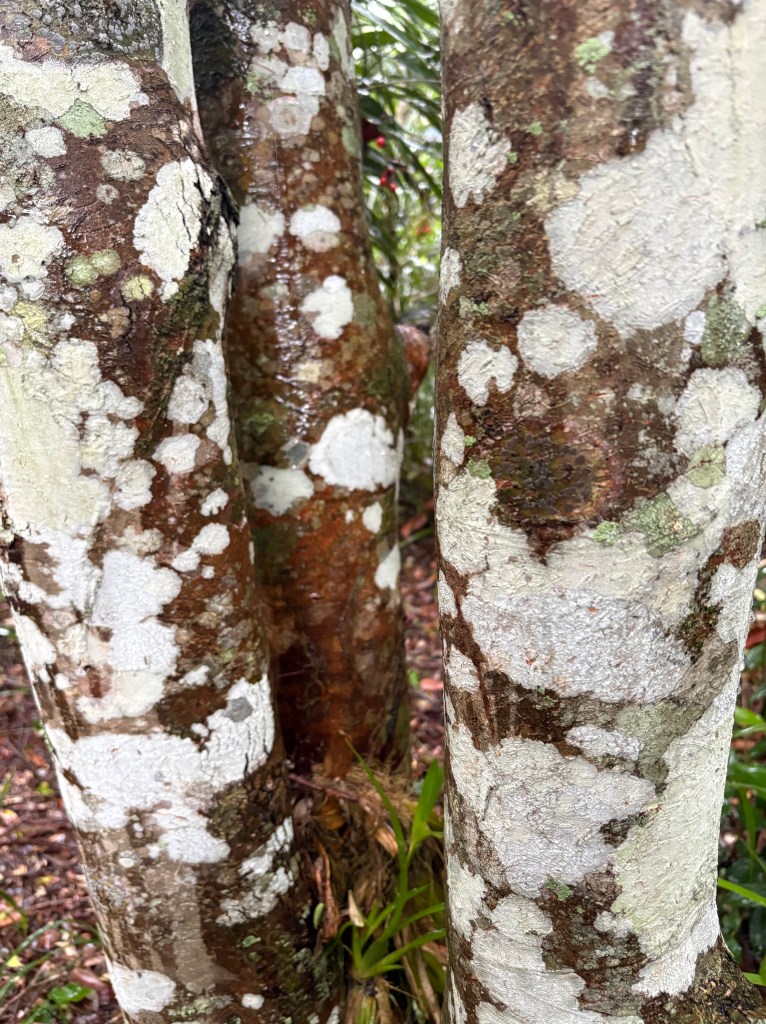
Bark comes to shining life when it rains, the steady trickle downwards nurturing tiny ferns and mosses and orchids that thrive in the low light at the bottom of the tree trunks.
The creek was singing with joy as the turgid trickle of last week turned into a stream worth the name. Frogs frolicked in the pools and last night their varied voices rose to a crescendo of … lust! “Here I am!” croaked the males. “Ready for action! Come, girls, and let me embrace you in an ecstasy of amplexus! Release those eggs!” (Amplexus, if you don’t know, is the process by which male frogs clutch their females from behind, aligning their bodies and fertilising the eggs which the females lay in response to being hugged). It’s fun to be a frog, in the rainy season.
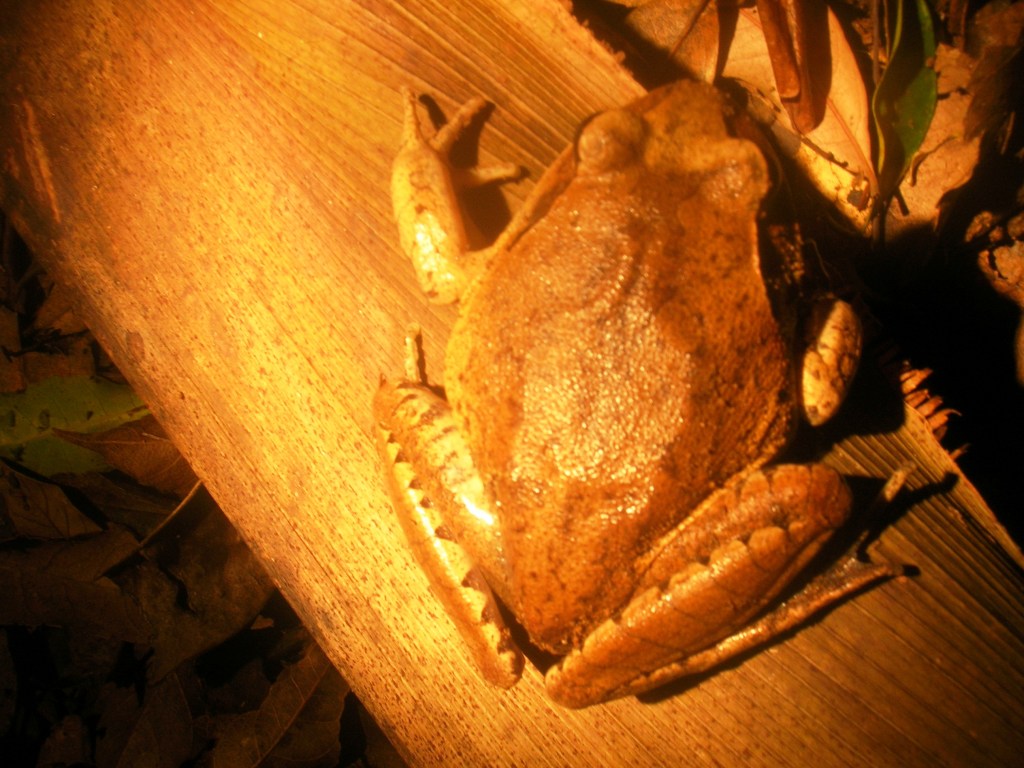
A Great Barred Frog (Mixophyes fasciulatus) – the males are very active and noisy when it rains, their repeated wAa wAa wAa calls carrying a good distance.
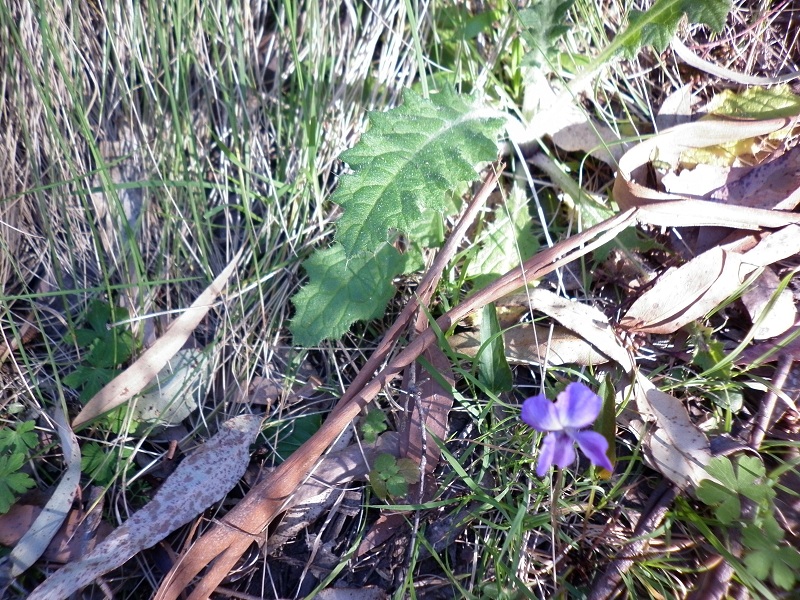
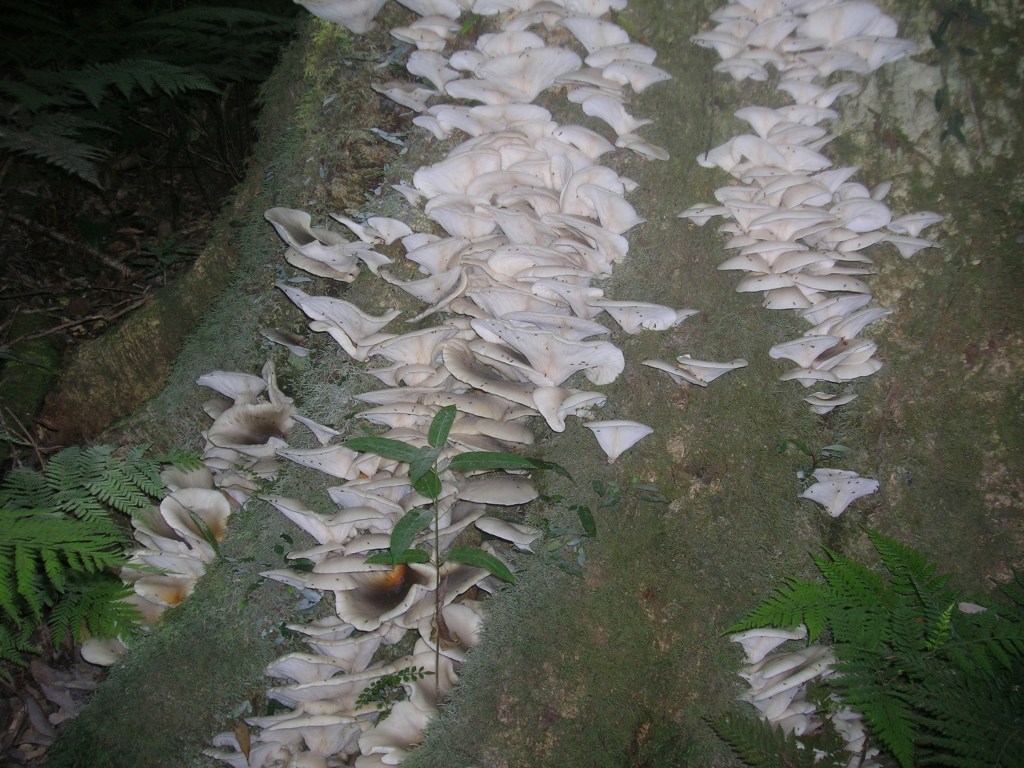
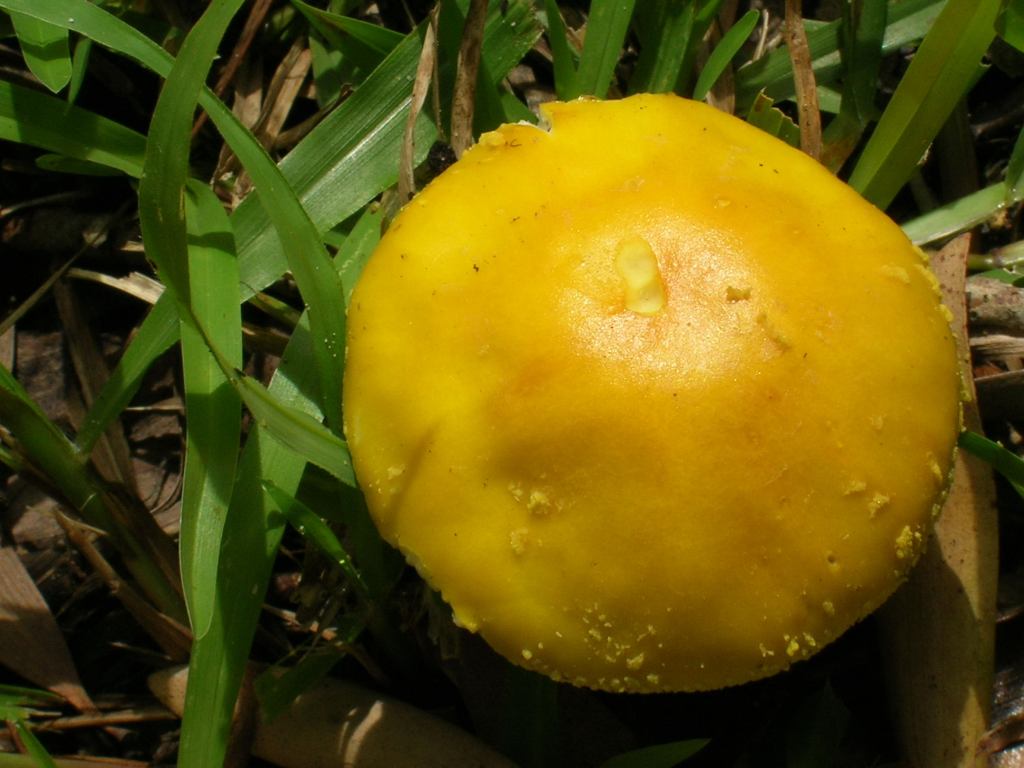
My own heart was singing as I walked, thrilling to the way everything – trees, shrubs, herbaceous things – seemed to be waking up from a dreary drought dream. Leaves were greener and shinier, bark shone as if polished, mosses swelled and brightened as they soaked up the rain. Best of all, the forest fungi which only a few days ago looked dry and shriveled were now fairly aglow with energy. I looked hard for the tiny Greenhood orchids that come with rain and found a couple and then noticed a mass of tiny fungi like fairy umbrellas on a nearby log. Close to the path, half-hidden beneath ferns, was a small yellow fungus, bright as a button.
When you go into the rainforest it’s important not only to look up to the canopy and around you at head height, it’s important to look at the ground, too. Train your eyes to search in the leaf litter at the base of trees, in the buttress niches and beneath the ground cover. Wonders abide there!
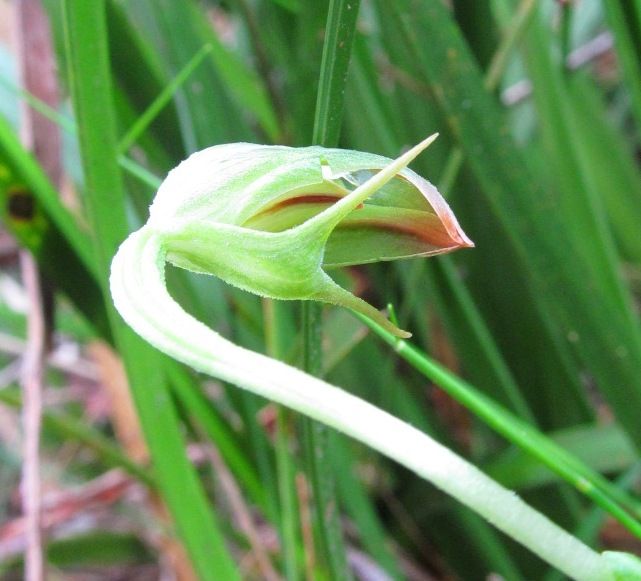
Below: Top left – Greenhood Orchid (Pterosylus nutans), usually found in spring but flowering today, for reasons best known to itself! Top right – pretty little orchid which I have not yet managed to identify. Bottom are two different types of fungi brought to glowing life by the rain.
*************************************************************
Like Anna, the character in my book Lyrebird Mountain, I have a deep connection with the rainforest.
For many years it was my main focus of study and the hours that I spent among the buttressed trees and palm gullies and creeks running clear between banks of fern and moss-softened rocks were among the happ0iest of my life. And it is still my happy place.
Each day there is something new and exciting to see. The hidden nest of a shy bird, a glorious butterfly feeding on a host plant and laying its larvae beneath a new leaf, some ephemeral flower that is here today and gone today, the colours of fungi after rain.
So in this new series I will record the small but significant happenings of my local rainforest from week to week as I wander there, binoculars and hand lens around my neck, stick in hand, camera in my pocket. I invite you cordially to
wander there with me…
*************************************************************
February 2 – 9
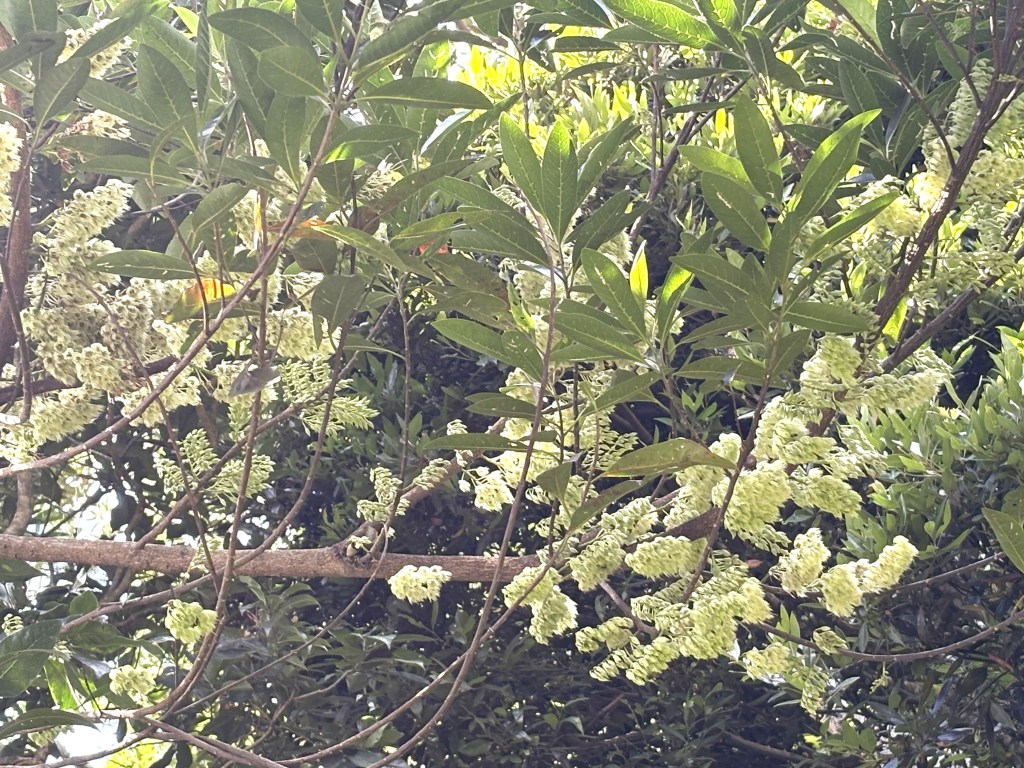
The screech of Rainbow Lorikeets alerted me and I looked up, knowing from the excitement of their calls that they were on to something good. As I did so, pale ivory blossoms fell softly on to my face and I then saw that the ground around me was covered in a soft carpet of flowers. The mighty Blue Quandong (Elaeocarpus grandis) that stands at the entry to that part of the national park was responding to the unusually dry early summer by putting on a show.
This tree is one of the largest in the rainforest, tall and wide spreading, with pale grey bark, buttresses and thick, heavy limbs that can stretch for several metres, especially when the tree is growing in the open, as this impressive specimen is.
Definitely not a tree for the small home garden! It’s kissing cousin Elaeocarpus reticulatus is much more suitable for domestic use.
Lorikeets of all kinds love the clusters of dainty flowers, like little lampshades or ballerina skirts, because they are full of nectar. And after the flowers come the large blue fruits which attract every kind of colourful fruit-eating pigeon, bats, rat kangaroos, Lumholtz’s Tree Kangaroo and ground-dwellers such as the Cassowary. The fruit was eaten by indigeous people and is edible rather than palatable though with enough sugar added it can be made into jam, or chutney. I tried this once and it was horrible!
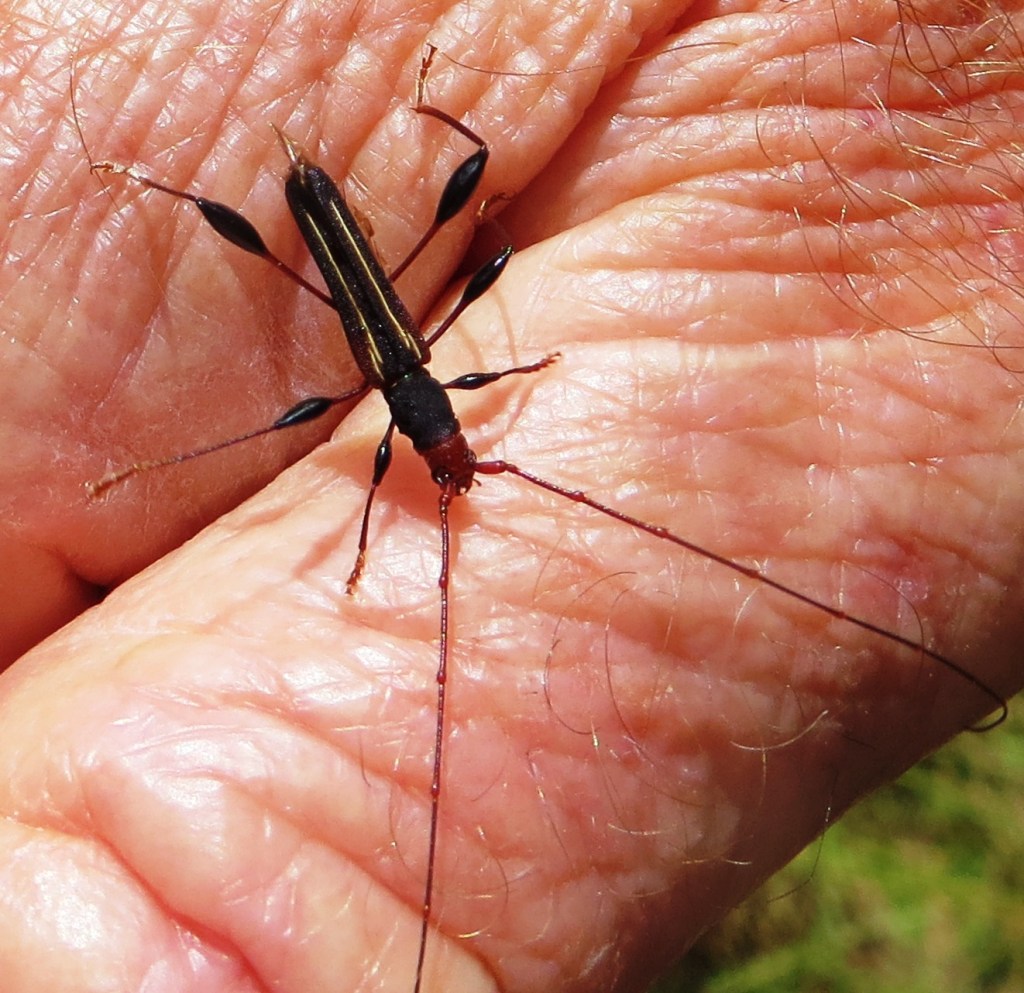
And while I was sitting watching the blossoms fall through shafts of sunlight on this beautiful day I saw on a nearby leaf an elegant little longicorn beetle – there are many of these in the word but this is one of our locals. Just look at those antennae!
If you can find a vantage point above the tree canopy, and there are many places on this mountain where you can do this, you’ll see that there are many Blue Quandongs in flower right now. This is due to unseasonable dryness – a survival mechanism. Lovely to see – but oh, we do need rain!
January 27 – February 2
As I rambled through the forest towards a waterfall this week I observed how little colour there was in the rainforest at this time of year – apart from green! Of course there is every shade of green imaginable along with the red soil and the browns-greys-olives of the tree trunks – but not many blues or reds or purples or whites.
On the forest floor the little Tripladenias (Tripladenia cunninghamii) continue to put on a brave show and I love them for their delicacy of form and colour.
They remind me of another exquisite rainforest groundcover, the glowing white-flowers of Gardenia scabrella, Australia’s only true gardenia. Alas, it doesn’t grow in our local rainforest but comes from North Queensland, where it is often used in public landscaping.
I thought I’d include it here because the picture below (BOTTOM) was taken by my dear friend and sometime collaborator Ralph Bailey with whom I once wrote two books on gardening with Australian rainforest plants. He is growing the little gardenia successfully in his own Brisbane garden, as indeed I have done in the past. And walking through Ralph’s garden IS like walking through a rainforest because he has created a mini-sanctuary of rainforest trees, shrubs and other plants.
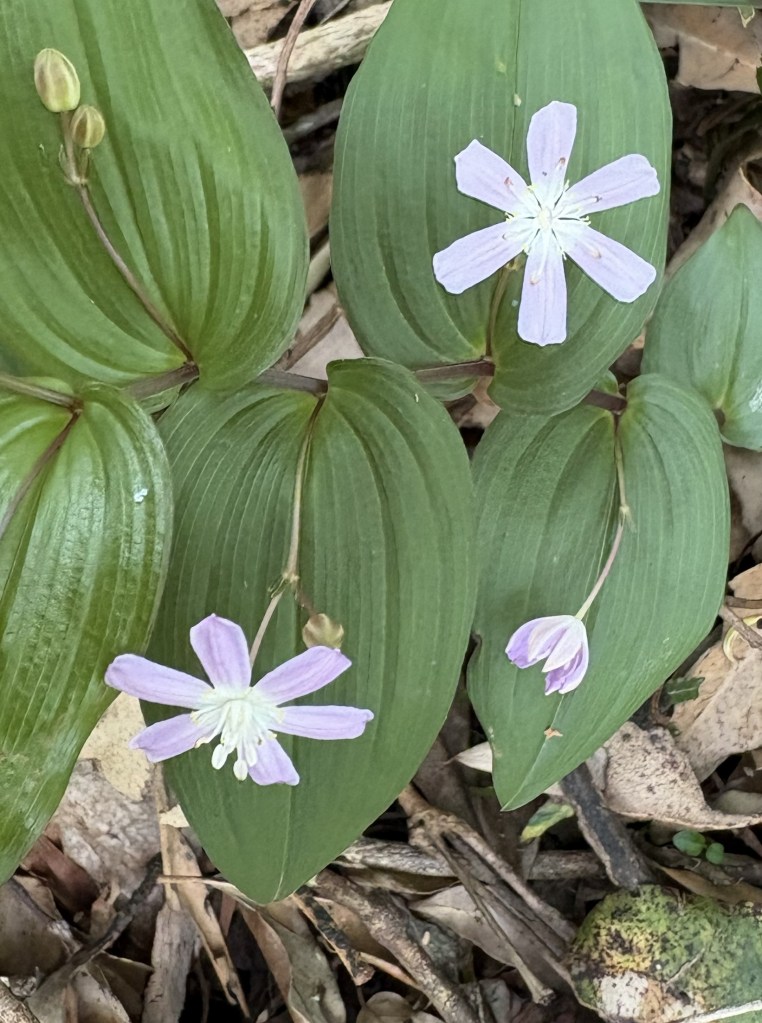
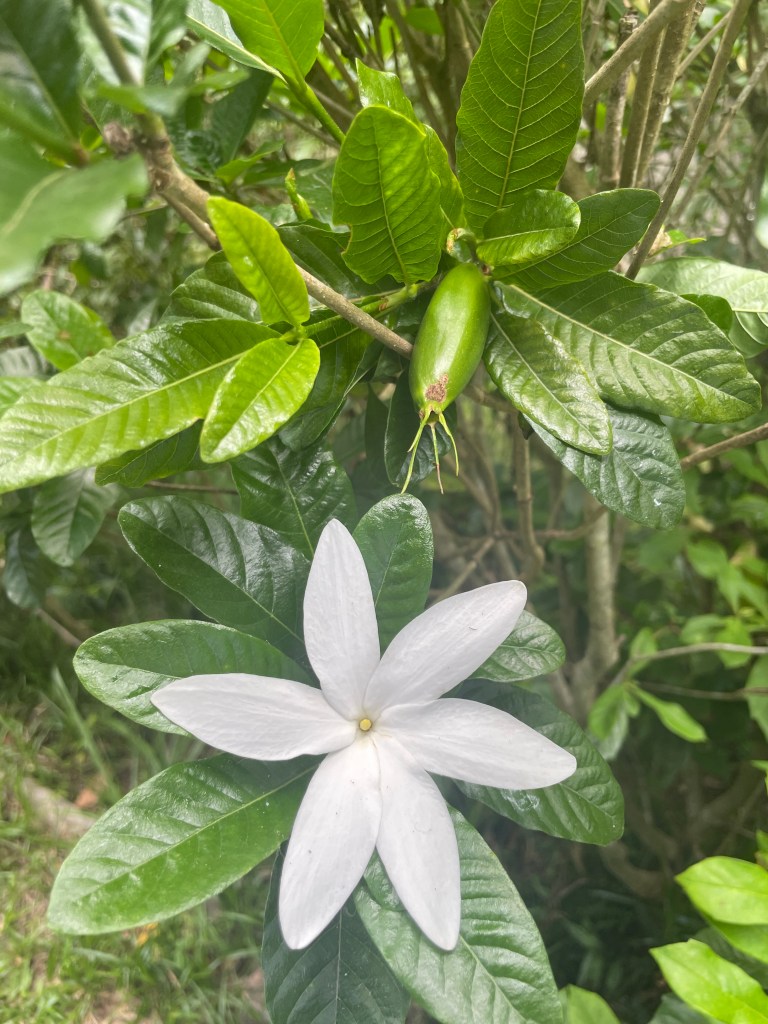
Gardenia scabrella above, photo by Ralph Bailey
Ralph is also a talented artist as well as one of Brisbane’s better-known architects, with a passion for our rainforest plants which he has used extensively in private and public landscaping projects. Below is his delightful sketch of a lyrebird which I suspect I shall be using quite often on this website.
I do so because this morning I had that rare, magical moment when a young Albert’s Lyrebird suddenly emerged from a tangle of Lawyer Vine on the path ahead of me and ran along for a few metres, occasionally stopping to look back over its shoulder at me.
I don’t see this marvellous birds as often as I used to do, partly because I am not in the rainforest so often nowadays and partly because I suspect their numbers are declining due to increasing urban development around the slopes of the mountain. And the greater number of noisy visitors to our national park.
These are such shy birds, though they do habituate themselves to human society where gardens back on to the forest. And their colours are so cryptic that they are well disguised. I’ve found that if I dress in lyrebird hues of russet and grey they will tolerate me, provided I stay silent and still.
My little friend of the morning stopped to scratch around the base of a tree with his (or her, it’s hard to tell with young ‘uns) long and powerful feet, then ducked its head down to peck at the uncovered grubs. Reminding me that everything in the rainforest is a constant battleground – even the beautiful, graceful lyrebird is a predator and other creatures die so that it might live. Only the few truly fructivorous bird species are innocent of killing and even most of them will take insects when fruit is scarce or they have young to feed.
It’s the inexorability of nature and, as I used to tell my rainforest interpretation students, nature is all about the three Fs – feeding, fornicating and fighting!
And all that seemed quite alright to me as I sat on a mossy log, daydreaming, listening to bird calls, watching a Monarch butterfly drift into a glade full of sunlight.
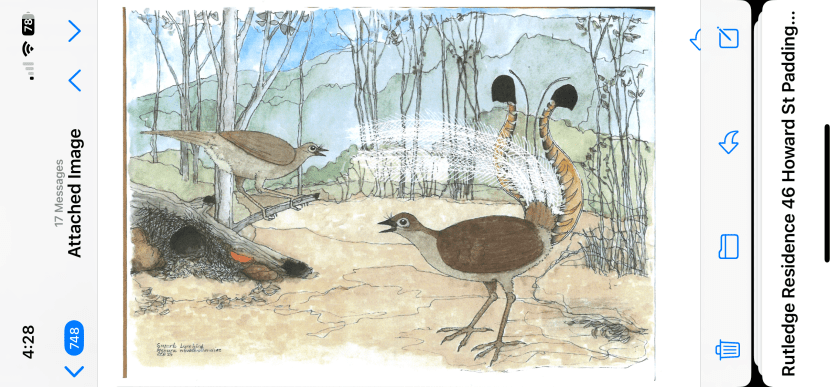
A pair of Albert’s Lyrebirds, by Ralphy Bailey

