
Here’s a good tip!
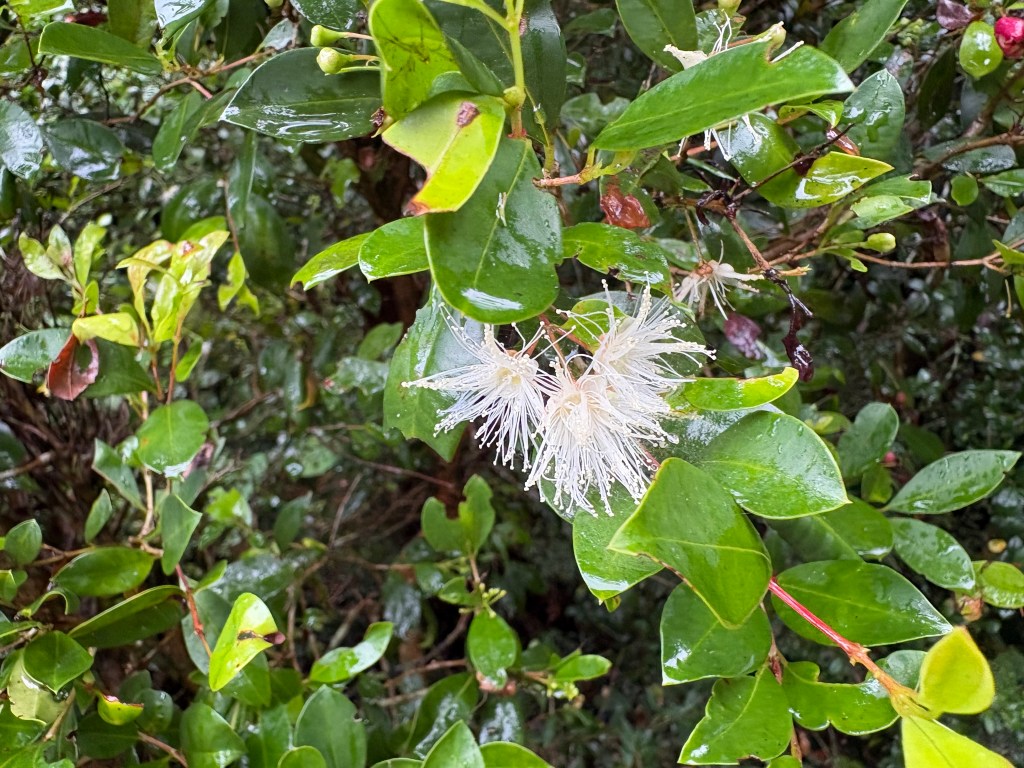
Syzygium australe has a modest but still sharp-pointed drip tip. Weight of rain will cause the leaves to point downwards, shedding the water load.
One of the great marvels of evolution is its development of forms and shapes to suit every kind of need – animal and vegetable.
This is visible everywhere you look in nature and the rainforest is no exception. For example, on the margin you will find plans with thorns or stinging hairs to keep outsiders at bay – I’ll write on this another day. Buttresses have evolved on some trees to meet certain needs, the ability to grow flowers on bark is another.
And when I went for my usual walk yesterday I paid particular attention to another wonder – the way so many leaves have a downward tilt and pointed, often long and slender points at the end.
These pointed leaves are called drip tips and their shape allows moisture to channel rainfall downwards to where it is most needed – the ground. Of course all leaves shed water but drip tips are more purposeful than flatter, broader leaves with blunt apices that tend to scatter rain rather than direct it. Drip tipped leaves are formed at an angle from the mid-vein to the outer edge, so that the central main vein forms a runnel. Side veins are usually straight and parallel, numerous and close, such as those of the lilly pillies (Syzgiums)and have an intra-marginal vein, running down roughly parallel to the outer edges of the leaf blade.
Paradoxically, though constant moisture is an important factor in the rainforest ecosystem, the thick canopy of broad leafed trees and height from the ground means that a lot of rain dissipates and evaporates before it can get to the roots of trees, buried under a thick layer of leaf litter. Thus the drip-tip species of trees and shrubs do better than others in temporarily capturing the moisture and then channeling it in a steady, controlled way.
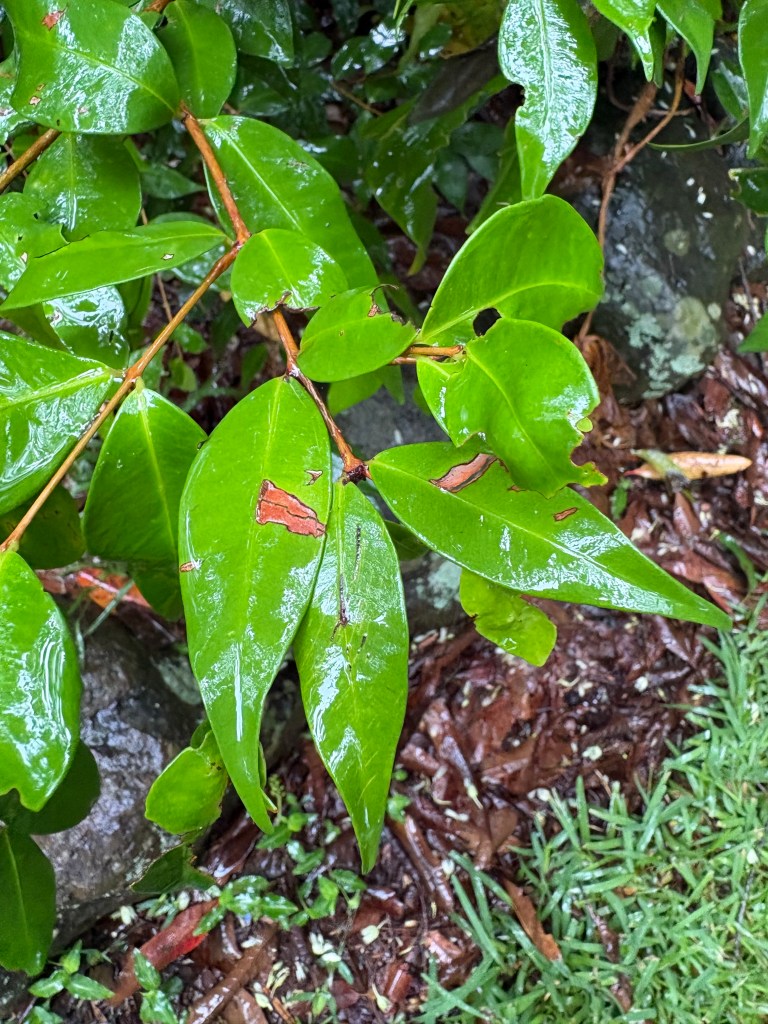
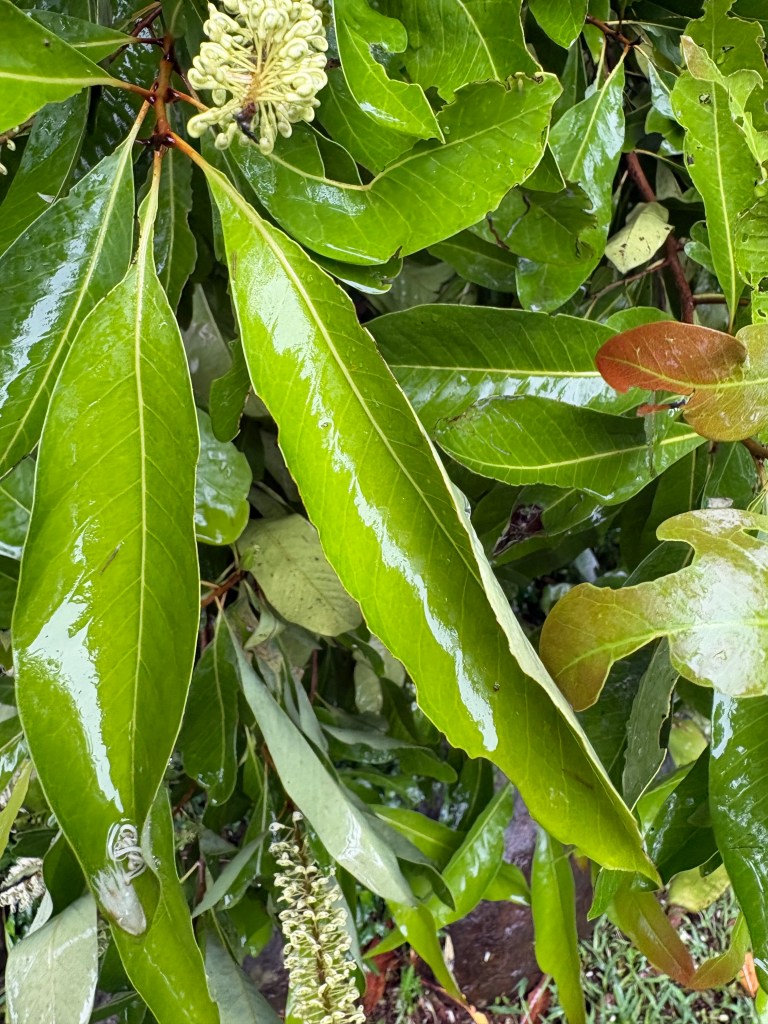
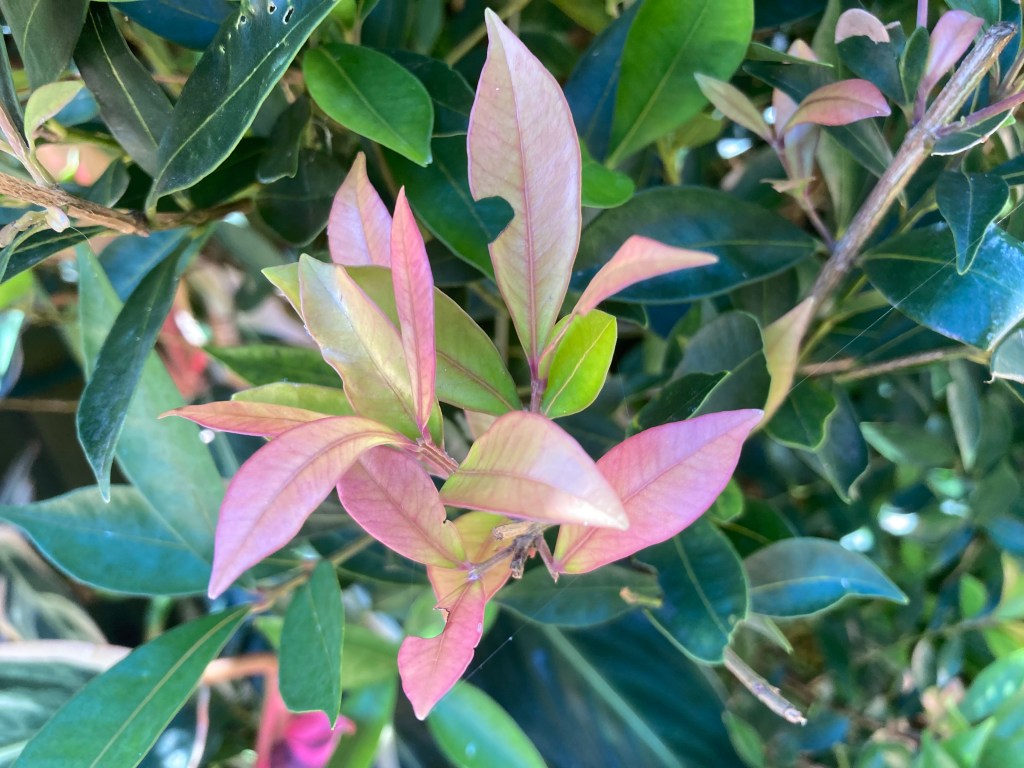
Left: The long, pointed tips of Syzygium leuhmanni, Right: The medium-length tips of Syzygium smithii and, in the middle, a very different tree, the long leaves of the lovely Golden Penda (Xanthostemon chrysanthus) with down-sloping pointed leaves that channel rain very effectively.
Mist – tiny droplets of water that swirls through the forest – is a vital moisturizer even when there is no actual precipitation. Drip tip leaves capture the mist on their shiny laminae (leaf blades) and, as with rainfall, send it groundwards. In fact the function of drip tips in misty conditions may be even more important than in downpours where rain can actually penetrate the canopy and reach the ground without specialized assistance. This “drip tip”theory of evolutionary adaption to circumstancircumstance was, at least, the prevailing one when I first began studying rainforest ecology forty years ago. I believe it is still valid.
And drip tips have other functions, too. By channeling the falling rain, in an environment where rainfall is as constant – or at least regular during the wet season – moisture which could otherwise cause delicate leaf tissue to develop mould is swiftly disposed of. Moreover, there is some belief that this swift disposal also assists photosynthesis in an ecosystem where every shaft of sunlight is precious.
I’m of a frivolous mind, so my friends tell me, and so I like drip tips because I think they are elegant! Especially when the leaves of so many species with this characteristics are flaunting their spring pink and copper and bronze.
And even when a shower or storm of rain has passed, these pointy leave extend the magic by keeping up a steady drip…drip…drip. Sit silently and you will hear it. It’s the drip of life!
Rain!
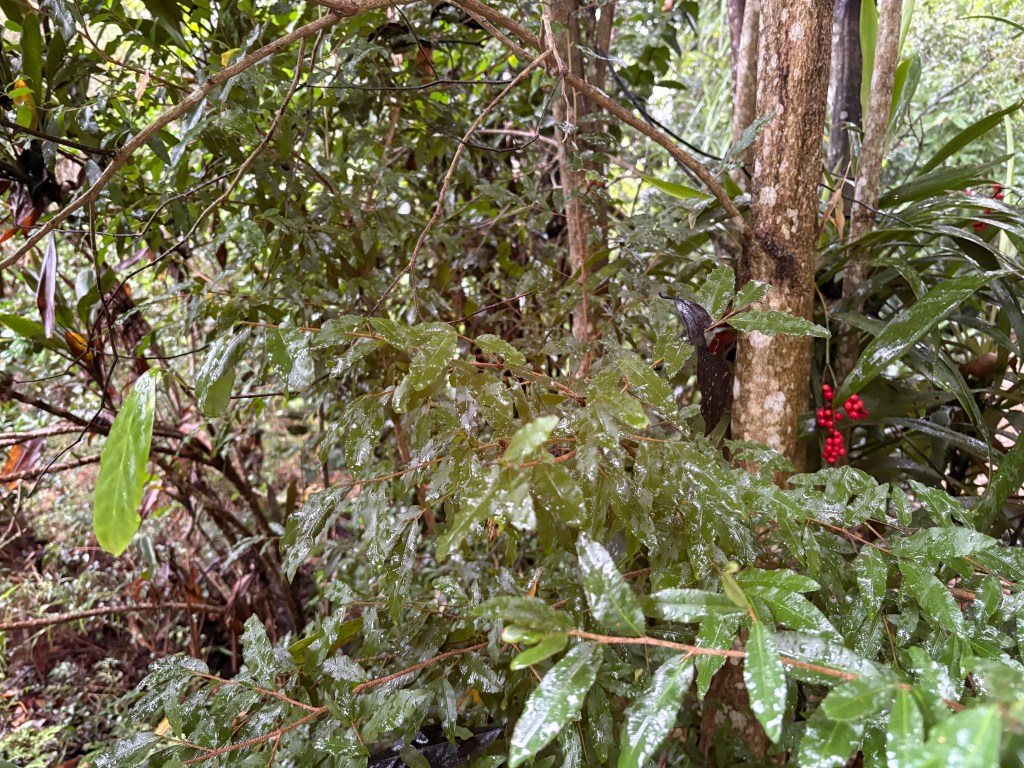
Rain at last! A month has gone by with very little rainfall and at this time of year – high summer in the southern subtropics – a lot of it is needed to offset the heat that sucks moisture from all living things.
When I went into the forest this morning the main sound was of raindrops softly striking the leaves and a rhythmic drip…drip…drip. Such a welcome sound and above the birds were applauding it.
Beneath my feet the litter was dark with moisture and there was that rich scent of decaying vegetation, suddenly accelerate by two days of constant moisture.
This is what nurtures the rainforest. Rain, and the mist that often accompanies it.
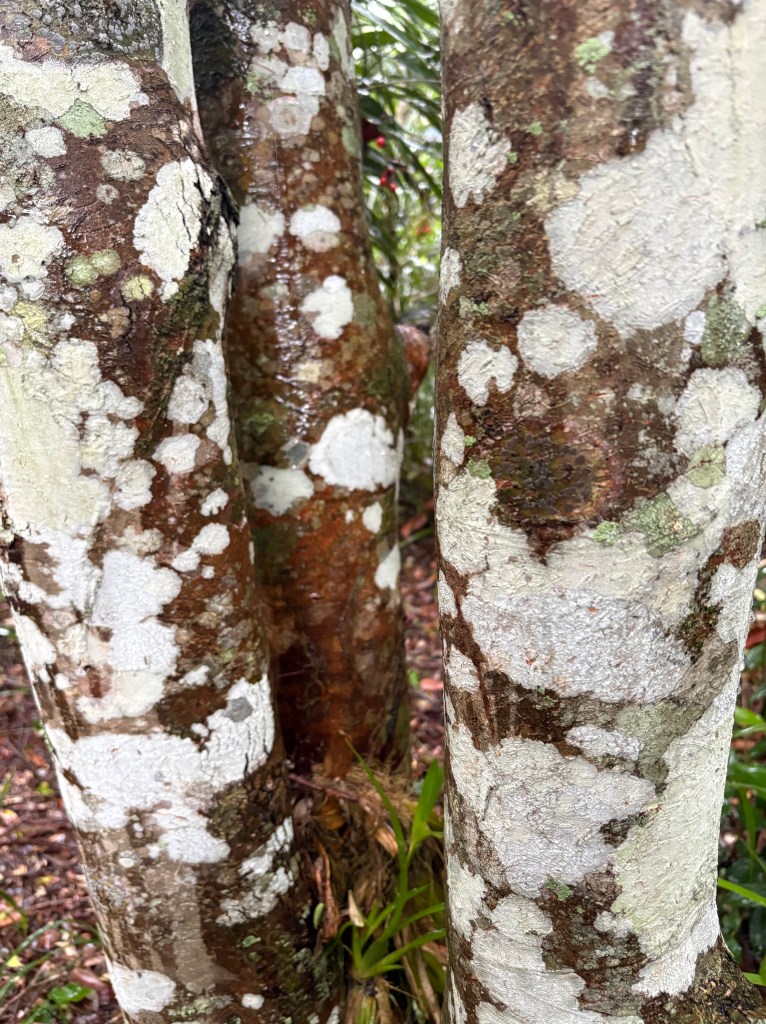
Bark comes to shining life when it rains, the steady trickle downwards nurturing tiny ferns and mosses and orchids that thrive in the low light at the bottom of the tree trunks.
The creek was singing with joy as the turgid trickle of last week turned into a stream worth the name. Frogs frolicked in the pools and last night their varied voices rose to a crescendo of … lust! “Here I am!” croaked the males. “Ready for action! Come, girls, and let me embrace you in an ecstasy of amplexus! Release those eggs!” (Amplexus, if you don’t know, is the process by which male frogs clutch their females from behind, aligning their bodies and fertilising the eggs which the females lay in response to being hugged). It’s fun to be a frog, in the rainy season.
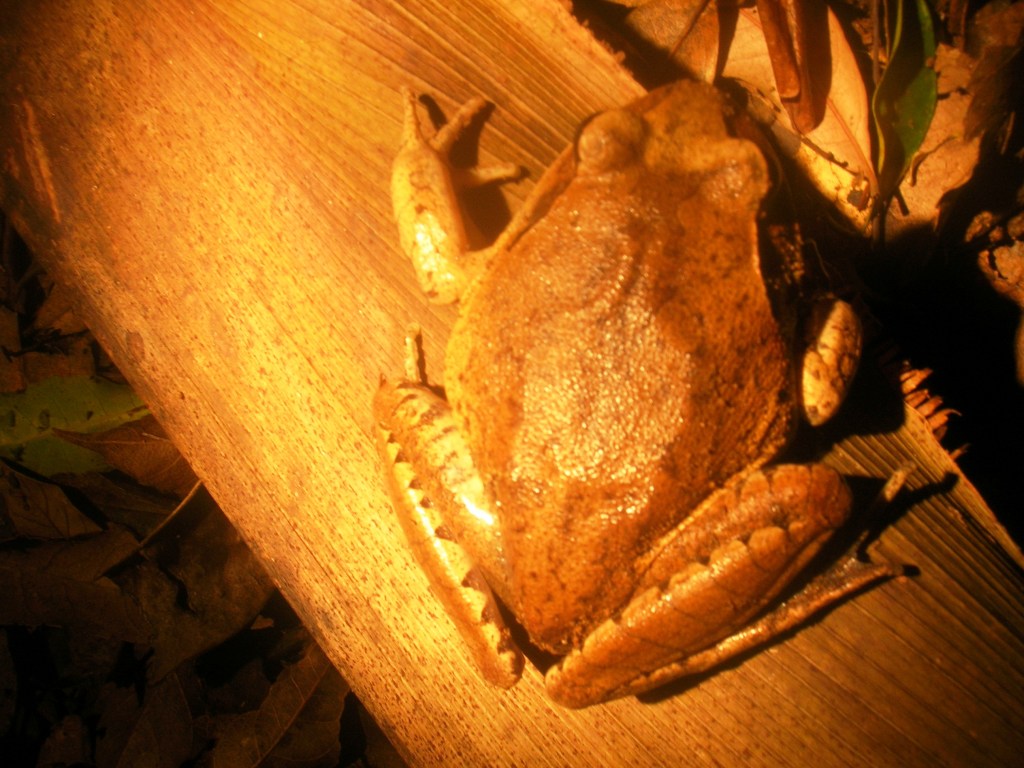
A Great Barred Frog (Mixophyes fasciulatus) – the males are very active and noisy when it rains, their repeated wAa wAa wAa calls carrying a good distance.
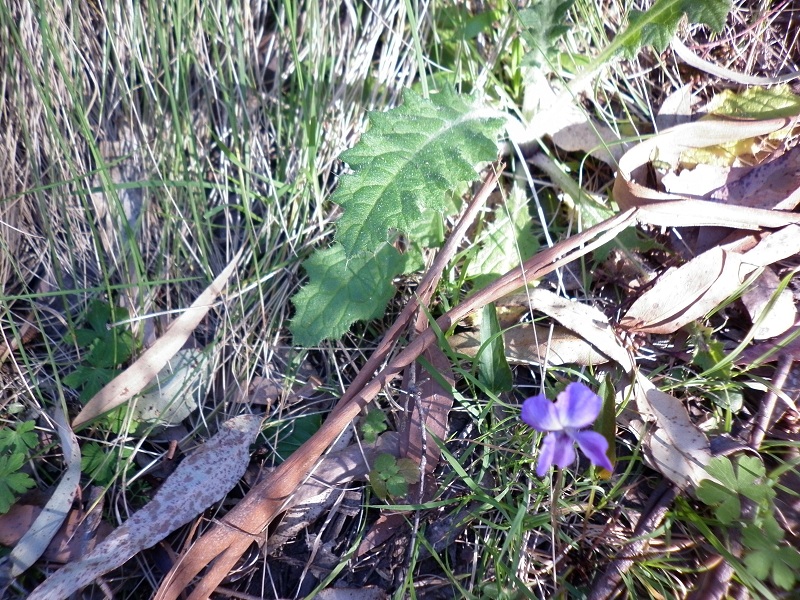
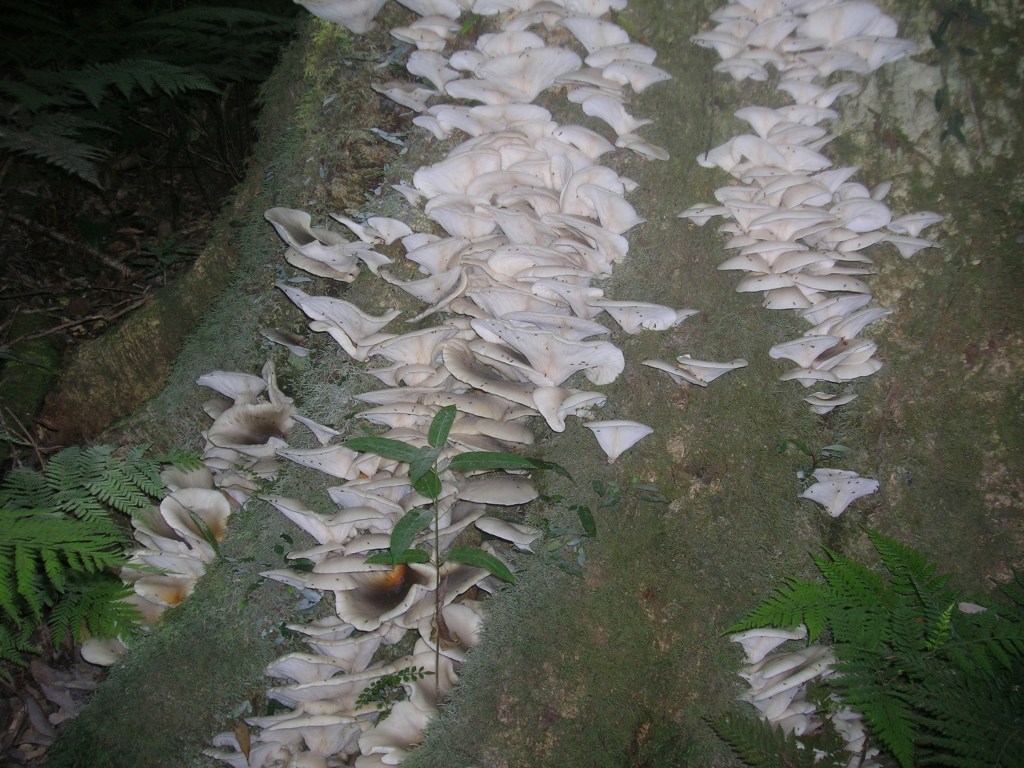
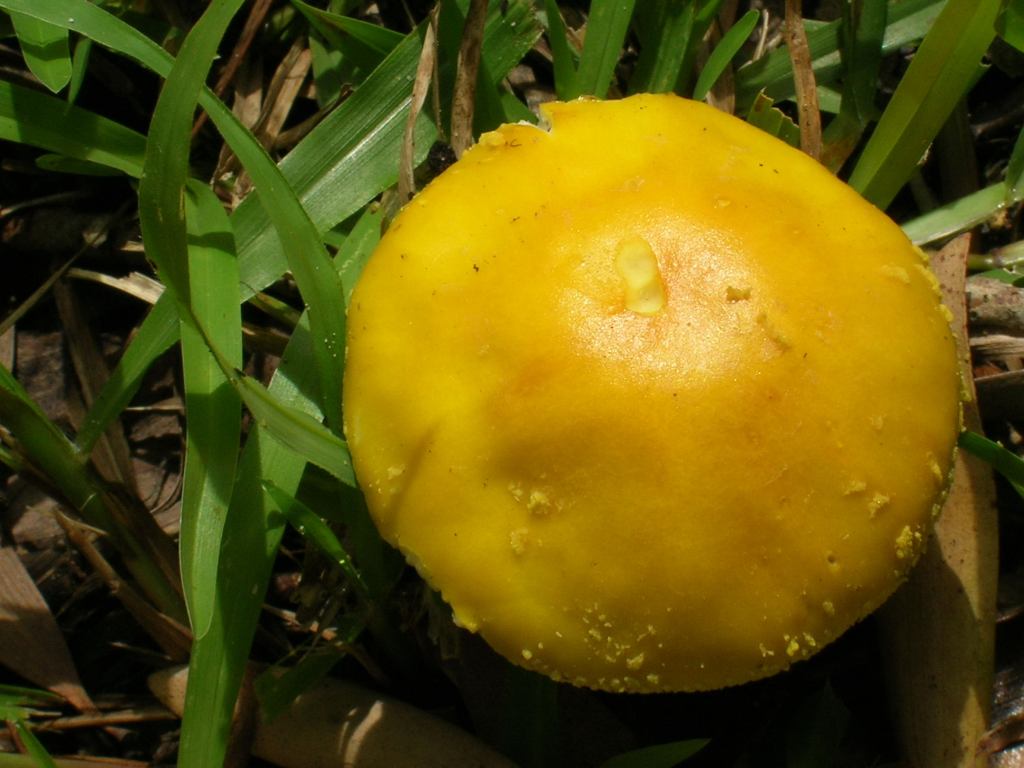
My own heart was singing as I walked, thrilling to the way everything – trees, shrubs, herbaceous things – seemed to be waking up from a dreary drought dream. Leaves were greener and shinier, bark shone as if polished, mosses swelled and brightened as they soaked up the rain. Best of all, the forest fungi which only a few days ago looked dry and shriveled were now fairly aglow with energy. I looked hard for the tiny Greenhood orchids that come with rain and found a couple and then noticed a mass of tiny fungi like fairy umbrellas on a nearby log. Close to the path, half-hidden beneath ferns, was a small yellow fungus, bright as a button.
When you go into the rainforest it’s important not only to look up to the canopy and around you at head height, it’s important to look at the ground, too. Train your eyes to search in the leaf litter at the base of trees, in the buttress niches and beneath the ground cover. Wonders abide there!
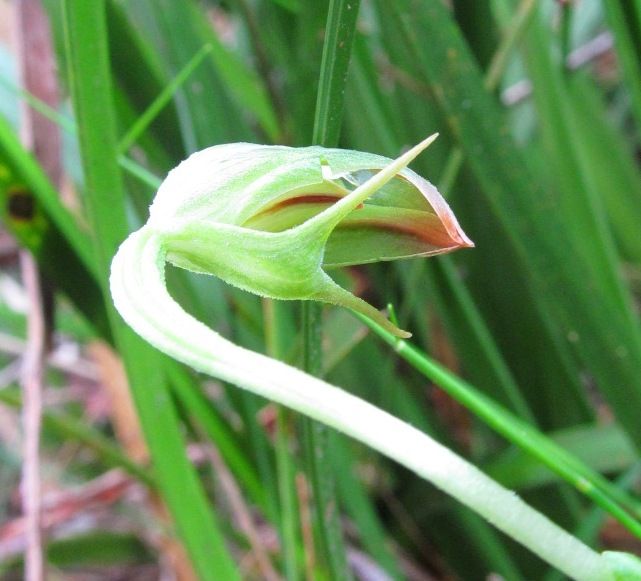
Below: Top left – Greenhood Orchid (Pterosylus nutans), usually found in spring but flowering today, for reasons best known to itself! Top right – pretty little orchid which I have not yet managed to identify. Bottom are two different types of fungi brought to glowing life by the rain.
*************************************************************
Like Anna, the character in my book Lyrebird Mountain, I have a deep connection with the rainforest.
For many years it was my main focus of study and the hours that I spent among the buttressed trees and palm gullies and creeks running clear between banks of fern and moss-softened rocks were among the happ0iest of my life. And it is still my happy place.
Each day there is something new and exciting to see. The hidden nest of a shy bird, a glorious butterfly feeding on a host plant and laying its larvae beneath a new leaf, some ephemeral flower that is here today and gone today, the colours of fungi after rain.
So in this new series I will record the small but significant happenings of my local rainforest from week to week as I wander there, binoculars and hand lens around my neck, stick in hand, camera in my pocket. I invite you cordially to
wander there with me…
*************************************************************
February 2 – 9
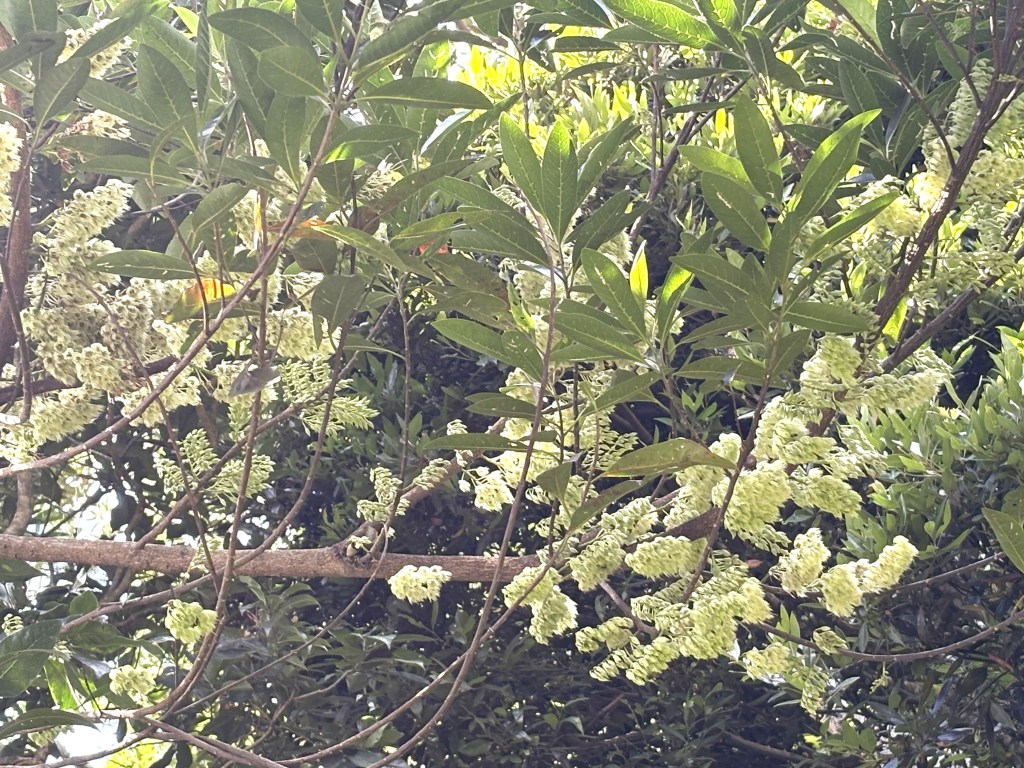
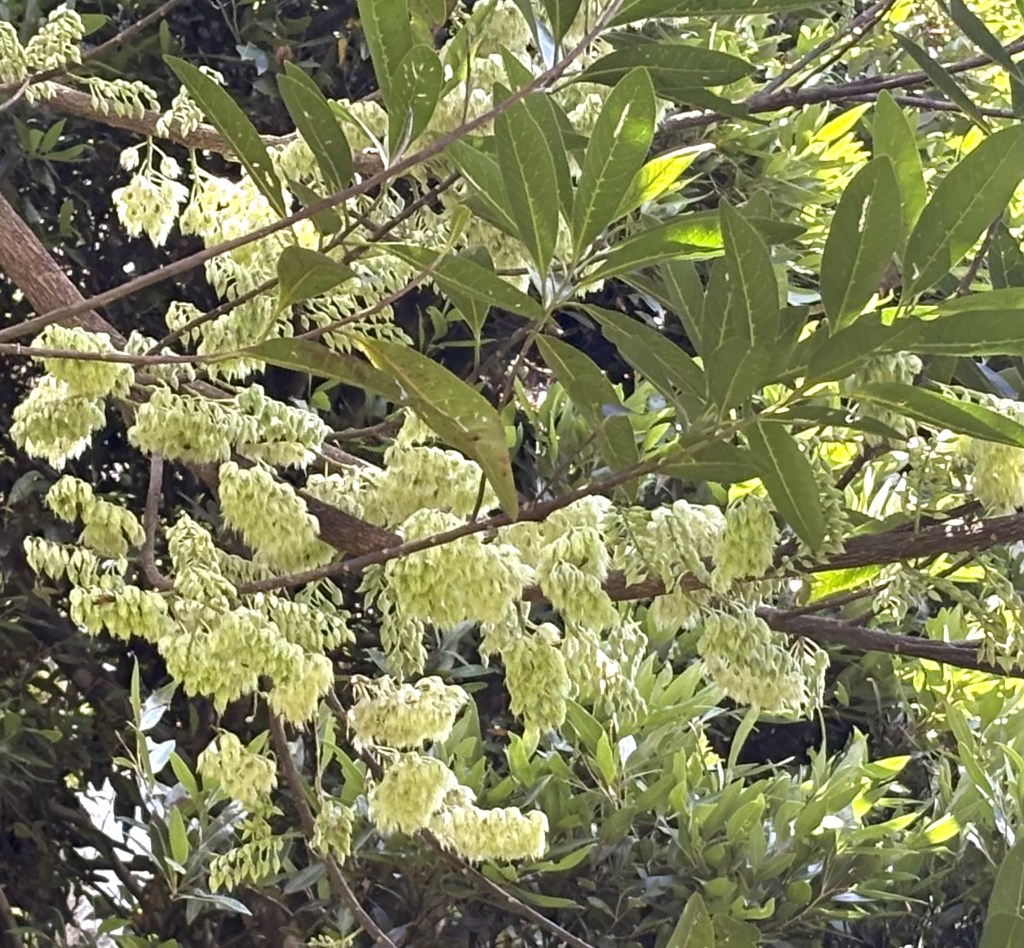
The screech of Rainbow Lorikeets alerted me and I looked up, knowing from the excitement of their calls that they were on to something good. As I did so, pale ivory blossoms fell softly on to my face and I then saw that the ground around me was covered in a soft carpet of flowers. The mighty Blue Quandong (Elaeocarpus grandis) that stands at the entry to that part of the national park was responding to the unusually dry early summer by putting on a show.
This tree is one of the largest in the rainforest, tall and wide spreading, with pale grey bark, buttresses and thick, heavy limbs that can stretch for several metres, especially when the tree is growing in the open, as this impressive specimen is.
Definitely not a tree for the small home garden! It’s kissing cousin Elaeocarpus reticulatus is much more suitable for domestic use.
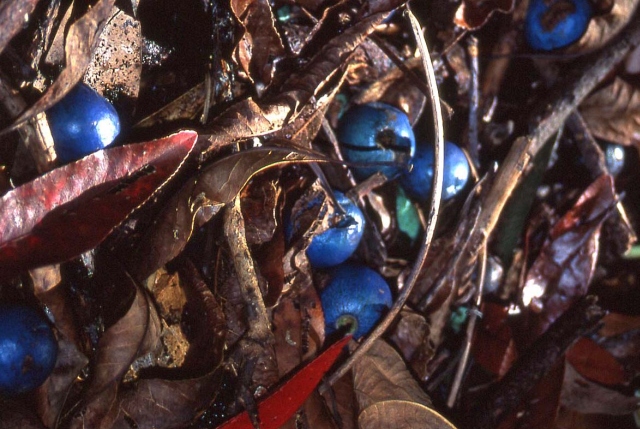
Lorikeets of all kinds love the clusters of dainty flowers, like little lampshades or ballerina skirts, because they are full of nectar. And after the flowers come the large blue fruits which attract every kind of colourful fruit-eating pigeon, bats, rat kangaroos, Lumholtz’s Tree Kangaroo and ground-dwellers such as the Cassowary. The fruit was eaten by indigeous people and is edible rather than palatable though with enough sugar added it can be made into jam, or chutney. I tried this once and it was horrible!
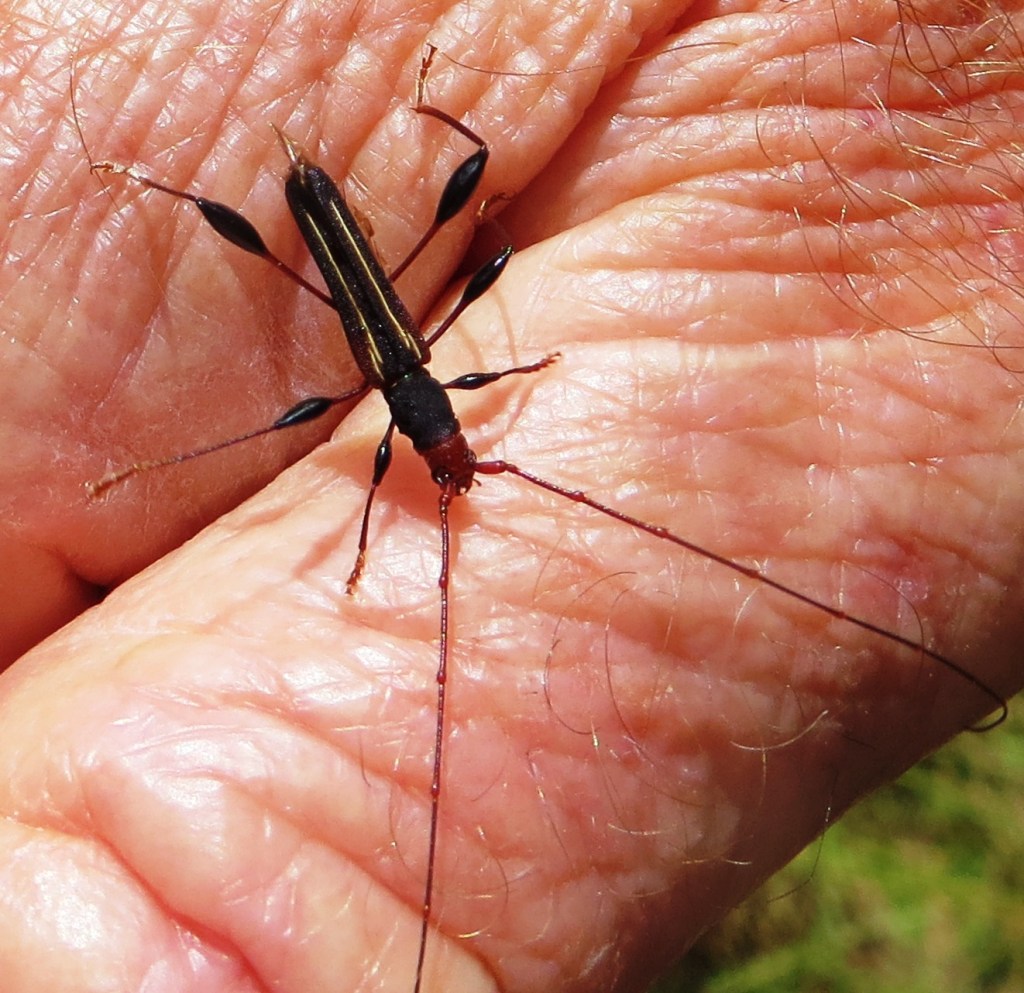
And while I was sitting watching the blossoms fall through shafts of sunlight on this beautiful day I saw on a nearby leaf an elegant little longicorn beetle – there are many of these in the word but this is one of our locals. Just look at those antennae!
If you can find a vantage point above the tree canopy, and there are many places on this mountain where you can do this, you’ll see that there are many Blue Quandongs in flower right now. This is due to unseasonable dryness – a survival mechanism. Lovely to see – but oh, we do need rain!
January 27 – February 2
As I rambled through the forest towards a waterfall this week I observed how little colour there was in the rainforest at this time of year – apart from green! Of course there is every shade of green imaginable along with the red soil and the browns-greys-olives of the tree trunks – but not many blues or reds or purples or whites.
On the forest floor the little Tripladenias (Tripladenia cunninghamii) continue to put on a brave show and I love them for their delicacy of form and colour.
They remind me of another exquisite rainforest groundcover, the glowing white-flowers of Gardenia scabrella, Australia’s only true gardenia. Alas, it doesn’t grow in our local rainforest but comes from North Queensland, where it is often used in public landscaping.
I thought I’d include it here because the picture below (BOTTOM) was taken by my dear friend and sometime collaborator Ralph Bailey with whom I once wrote two books on gardening with Australian rainforest plants. He is growing the little gardenia successfully in his own Brisbane garden, as indeed I have done in the past. And walking through Ralph’s garden IS like walking through a rainforest because he has created a mini-sanctuary of rainforest trees, shrubs and other plants.
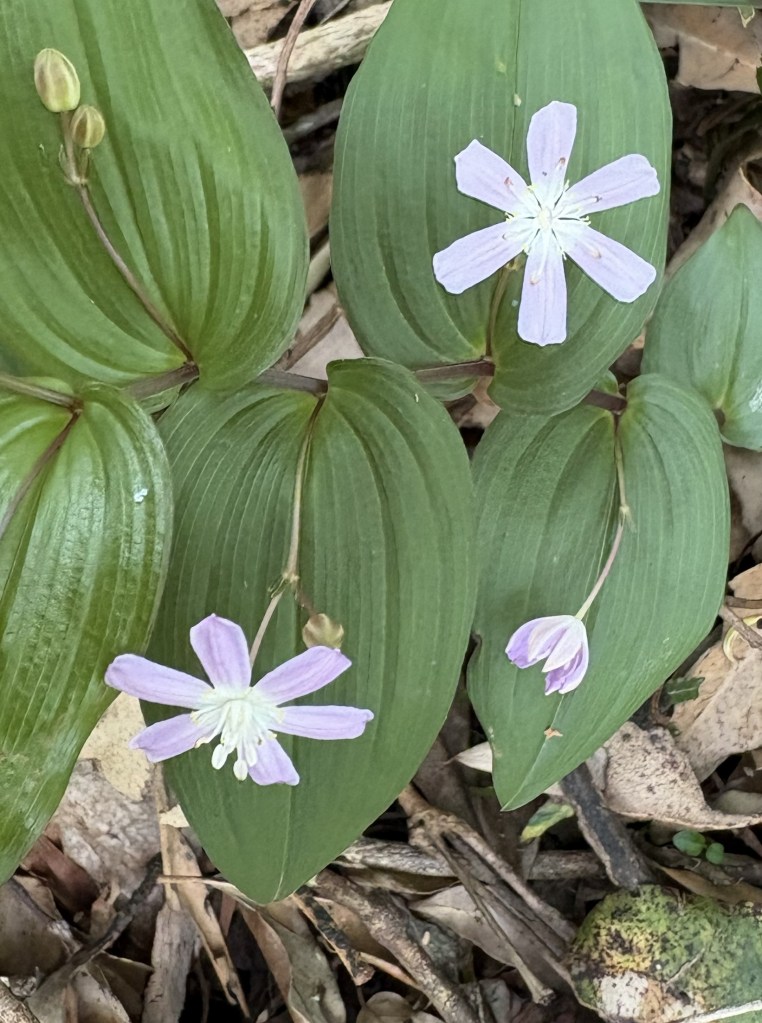
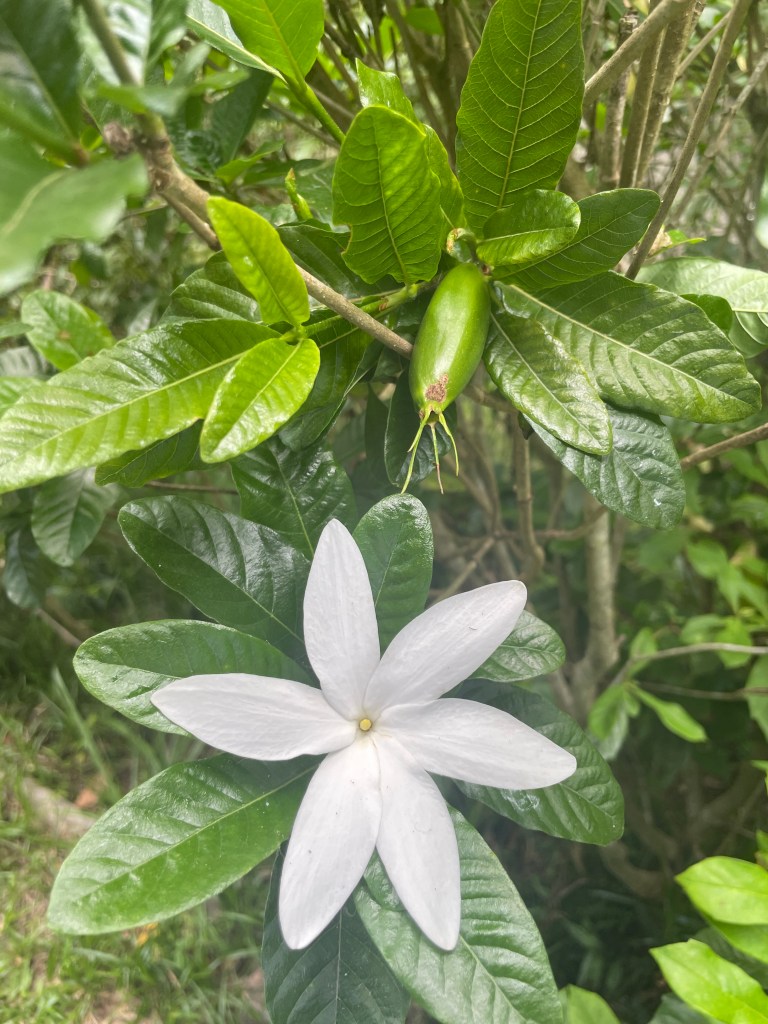
Gardenia scabrella above, photo by Ralph Bailey
Ralph is also a talented artist as well as one of Brisbane’s better-known architects, with a passion for our rainforest plants which he has used extensively in private and public landscaping projects. Below is his delightful sketch of a lyrebird which I suspect I shall be using quite often on this website.
I do so because this morning I had that rare, magical moment when a young Albert’s Lyrebird suddenly emerged from a tangle of Lawyer Vine on the path ahead of me and ran along for a few metres, occasionally stopping to look back over its shoulder at me.
I don’t see this marvellous birds as often as I used to do, partly because I am not in the rainforest so often nowadays and partly because I suspect their numbers are declining due to increasing urban development around the slopes of the mountain. And the greater number of noisy visitors to our national park.
These are such shy birds, though they do habituate themselves to human society where gardens back on to the forest. And their colours are so cryptic that they are well disguised. I’ve found that if I dress in lyrebird hues of russet and grey they will tolerate me, provided I stay silent and still.
My little friend of the morning stopped to scratch around the base of a tree with his (or her, it’s hard to tell with young ‘uns) long and powerful feet, then ducked its head down to peck at the uncovered grubs. Reminding me that everything in the rainforest is a constant battleground – even the beautiful, graceful lyrebird is a predator and other creatures die so that it might live. Only the few truly fructivorous bird species are innocent of killing and even most of them will take insects when fruit is scarce or they have young to feed.
It’s the inexorability of nature and, as I used to tell my rainforest interpretation students, nature is all about the three Fs – feeding, fornicating and fighting!
And all that seemed quite alright to me as I sat on a mossy log, daydreaming, listening to bird calls, watching a Monarch butterfly drift into a glade full of sunlight.
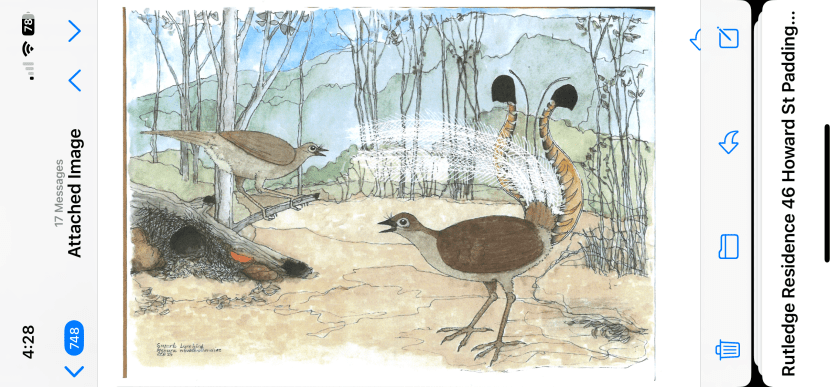
A pair of Albert’s Lyrebirds, by Ralphy Bailey
 Lyrebird Mountain